

A stockbroker’s duty to you shifts with the moment, the account type, and the paperwork you signed. Regulation Best Interest requires brokers to act in your best interest when they make a recommendation, but that is not the same as the full fiduciary duty investment advisers carry under the Investment Advisers Act of 1940. Courts and some states, Massachusetts among them, can push a broker into fiduciary territory when discretion, contract language, or advisory conduct crosses a line. Which standard governs your account depends on facts you can actually check.
TL;DR:
- Reg BI requires brokers to act in your best interest only at the time of recommendation and does not impose ongoing account monitoring.
- A broker can be deemed a fiduciary if they have discretionary authority, use contractual language promising ongoing advice, or are subject to state fiduciary rules like Massachusetts’.
- Many breaches involve excessive trading, undisclosed conflicts, or unsuitable high-commission products, which can lead to damages or regulatory penalties.
- Confirm your account type, registration, and capacity in writing before trading and keep all disclosures to help prove compliance in disputes.
- Contract language and state regulations can create fiduciary duties outside of federal securities law, especially in high-value or non-securities transactions.
Table of Contents
- What Is Broker Fiduciary Duty Under Reg BI?
- How Does the Advisers Act Differ From Reg BI?
- Can a Broker Become a Fiduciary Without Being an Adviser?
- What Duties Show Up in Everyday Broker Interactions?
- How Do You Know Which Standard Applies to You?
- What Can You Do if a Broker Breaches Fiduciary Duty?
- How Do Brokerage Contracts Define Fiduciary Scope in Practice?
- How Did Broker Fiduciary Duty Get This Complicated?
- Fiduciary Duty vs. Suitability: What’s the Real Difference?
- What Do Real Fiduciary Breach Cases Look Like?
- Does Fiduciary Duty Work the Same Way Across Broker Types?
- An Editorial Take on Why the Law Feels Murkier Than It Should
- Sources
What Is Broker Fiduciary Duty Under Reg BI?
Reg BI does not turn every broker into a fiduciary. It requires broker-dealers to act in the best interest of a retail customer at the moment they make a recommendation, and the rule is satisfied only when a firm meets all four of its component obligations, according to the Legal Information Institute’s summary of Regulation Best Interest.
Those four components work together, not independently:
- Disclosure Obligation: the firm must tell you, in writing, the material facts about the recommendation, including fees and conflicts of interest.
- Care Obligation: the broker needs a reasonable basis to believe the recommendation could serve at least some retail investors’ interests, weighed against your specific investment profile, a standard the SEC’s Reg BI adopting release spells out in detail.
- Conflict of Interest Obligation: firms must establish written policies to identify and either eliminate or disclose and mitigate conflicts.
- Compliance Obligation: the firm must maintain policies reasonably designed to achieve compliance with the whole rule.
Here’s the catch most investors miss. Reg BI applies only at the time a recommendation is made and does not impose a continuing duty to watch your account going forward, which is exactly where the Investment Advisers Act draws a different line.
How Does the Advisers Act Differ From Reg BI?
Investment advisers registered under the Investment Advisers Act of 1940 are fiduciaries, full stop, for the entirety of the advisory relationship. That status carries two distinct obligations: a duty of care, meaning the adviser must investigate and recommend suitable, well-researched strategies, and a duty of loyalty, meaning the adviser cannot let its own interests, or the firm’s, come before yours.
The practical gap between the two regimes shows up in three places:
- Duration: an adviser’s fiduciary duty runs continuously through the relationship; a broker’s Reg BI obligation is tied to the recommendation itself.
- Monitoring: advisers typically have an ongoing duty to monitor your account and holdings, a duty Reg BI does not impose on brokers by default.
- Dual registration: many professionals are registered as both a broker and an adviser, and the standard that applies can change depending on which “hat” they’re wearing for a given account or conversation.
That last point matters more than most disclosure forms let on. The SEC’s staff guidance notes that when a professional acts both as broker and adviser, firms should disclose the capacity in which they are acting, because different standards may apply at different times, per the SEC staff bulletin on standards of conduct.
Can a Broker Become a Fiduciary Without Being an Adviser?
Yes, and this is where the law gets genuinely interesting instead of just procedural. A broker who is not registered as an investment adviser can still be held to a fiduciary standard by a court, an arbitration panel, or a state regulator, depending on how the relationship actually functioned.
Three triggers tend to convert an ordinary broker relationship into a fiduciary one:
- Discretionary authority. If you gave your broker trading discretion or power of attorney over your account, arbitrators frequently treat that discretion as creating fiduciary obligations, regardless of the account’s formal label.
- Contractual language. A written representation agreement or advisory mandate that promises ongoing guidance, monitoring, or “acting on your behalf” can create fiduciary duties by contract, even without a formal adviser registration.
- State-imposed standards. Some states go further than federal rules. Massachusetts’ regulation, 950 CMR 12.207, imposes a fiduciary duty on broker-dealers and their agents for certain advisory activities, requiring both a duty of care and a duty of loyalty, effective since March 6, 2020, according to the Massachusetts rule text published by the Legal Information Institute.
Scholarly analysis backs up how unsettled this area still is. A Villanova Law Review examination of broker and adviser fiduciary obligations found that courts lean heavily on the scope of the agency relationship and the presence of discretionary authority, and that the prevalence of arbitration (rather than published court opinions) means precedent stays inconsistent from one jurisdiction to the next.
Pro Tip: If your account agreement uses words like “advise,” “manage,” or “monitor” anywhere in the text, that language alone can be enough for an arbitrator to find fiduciary duties existed, even if your account is technically a brokerage account.
What Duties Show Up in Everyday Broker Interactions?
Legal duty elements sound abstract until you map them onto an actual phone call with your broker. Here’s what each one looks like in practice:
- Duty of care means reasonable investigation before a recommendation, including looking at whether a series of trades, not just one transaction, actually serves your goals.
- Duty of loyalty means the broker cannot favor a house product or a higher commission over what genuinely fits your account, and simply disclosing the conflict does not automatically satisfy this duty.
- Conflict-of-interest management under Reg BI requires firms to have written procedures that identify conflicts tied to compensation, proprietary products, or sales incentives, then either eliminate them or disclose and mitigate them.
- Best execution applies when a broker handles your trade order, requiring the firm to seek the most favorable terms reasonably available, a distinct obligation from the recommendation itself.
Reg BI’s Care Obligation requires broker-dealers to have a reasonable basis to believe a recommendation could be in the best interest of at least some retail investors, considering the investor’s profile, a distinction the SEC’s adopting release draws directly.
How Do You Know Which Standard Applies to You?
You can determine this yourself, and you should do it before you sign anything or move meaningful money. Work through these steps in order:
- Check the registration. Search FINRA BrokerCheck or the SEC’s Investment Adviser Public Disclosure database to see whether your professional is registered as a broker, an adviser, or both.
- Read Form CRS. Every registered broker-dealer and adviser must give you a Client Relationship Summary describing the services offered and the standard of conduct that applies.
- Look at the account type. Discretionary managed accounts point toward adviser treatment; self-directed brokerage accounts point toward Reg BI.
- Review signed agreements for capacity language. Look specifically for words describing ongoing monitoring, discretion, or advisory services, since those phrases can trigger fiduciary treatment even in a brokerage account.
- Ask in writing. Request written confirmation of the capacity your broker is acting in for a given recommendation, along with fee structure and any conflicts tied to the product being recommended.
Watch for red flags that suggest a broker is leaning on the weaker standard while acting like a fiduciary in conversation: vague or shifting fee language, reluctance to put conflicts in writing, unusually frequent trading in your account, or compensation tied to sales contests for specific products.
Pro Tip: Save every written disclosure your broker sends you, even the boilerplate ones. If a dispute ever goes to arbitration, the written record of what you were told, and when, often matters more than what you remember being said on a call.
What Can You Do if a Broker Breaches Fiduciary Duty?
Enforcement runs through several channels, and which one you use depends on the nature of the breach and where you live. The SEC enforces Reg BI and oversees Investment Advisers Act compliance at the federal level. FINRA runs the arbitration forum that handles most broker-customer disputes, since brokerage account agreements typically require arbitration rather than court litigation. State regulators add another layer, particularly in states like Massachusetts that have their own fiduciary rule.
Remedies vary by forum but typically include:
- Compensatory damages awarded through FINRA arbitration for losses tied to the breach.
- Rescission of a transaction in some state regulatory actions.
- SEC enforcement outcomes, which can include fines, disgorgement, or industry bars for the firm or individual.
If you suspect a breach of duty, promptly document interactions, collect disclosures, and consider filing a complaint with FINRA or your state regulator while the complaint period is still open. Consulting a securities attorney early, rather than after a small claim balloons into a larger dispute, tends to preserve more options.
How Do Brokerage Contracts Define Fiduciary Scope in Practice?
Securities law is not the only place fiduciary-style protection gets built. In high-value private brokerage, yacht sales included, the written mandate often does more work than any statute, because much of the transaction sits outside securities regulation entirely. Practitioner guidance in this space points to a handful of clauses that actually determine what a broker owes you, according to The Owners Club’s brokerage handbook.
Before you sign, verify:
- Scope of authority — does the agreement limit the broker to marketing and introductions, or grant broader representation?
- Exclusivity terms — is this an open listing or a closed, exclusive mandate, since that shapes incentive alignment?
- Commission disclosure — is the fee structure, and who pays it, spelled out plainly?
- Escrow and wire safeguards — does the agreement specify verified escrow instructions before any funds move?
Yachts-bysteve’s own guidance on yacht brokerage compliance steps and the breakdown of common brokerage agreement types walk through exactly which clauses to request in writing before a deposit ever leaves your account.
How Did Broker Fiduciary Duty Get This Complicated?
Broker fiduciary law did not arrive fully formed. For decades, brokers operated primarily under a suitability standard, meaning they only had to reasonably believe a recommendation fit a customer’s profile, a much lower bar than fiduciary duty. Meanwhile, investment advisers were fiduciaries from the moment the Investment Advisers Act of 1940 took effect, creating two parallel tracks for professionals who often looked identical to the average client.
Court decisions through the 1990s and 2000s slowly chipped at the wall between the two categories, usually in cases involving discretionary accounts or brokers who marketed themselves as ongoing advisers while operating under suitability rules. Arbitrators, not appellate courts, decided most of these disputes, which is part of why precedent never fully consolidated, a pattern the Villanova Law Review’s analysis documents in detail.
The SEC’s adoption of Reg BI in 2019 was the biggest federal move in this history, replacing suitability with a stricter best-interest standard for recommendations but still short of full fiduciary status. States did not wait for federal consensus. Massachusetts moved first with 950 CMR 12.207, effective in 2020, imposing fiduciary duties on broker-dealers for specific advisory conduct regardless of federal classification. That state-by-state variation remains the biggest wildcard in the entire framework today.
Fiduciary Duty vs. Suitability: What’s the Real Difference?
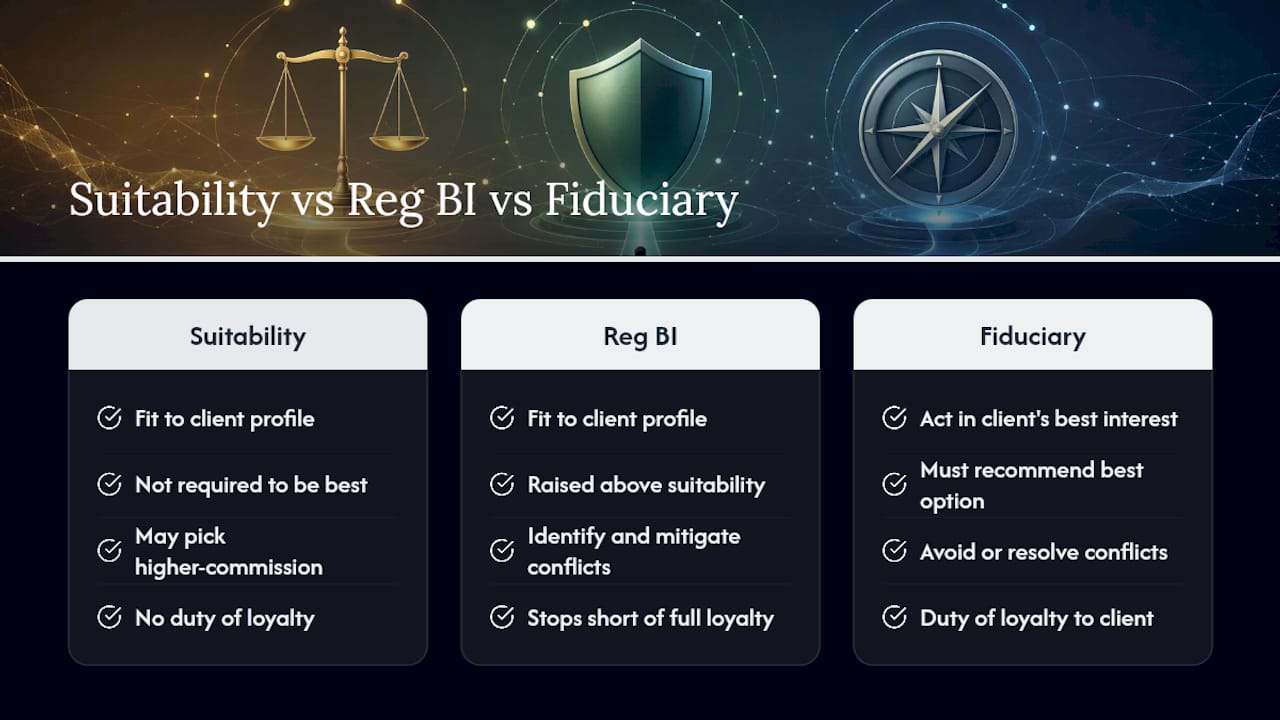
Suitability asks whether a recommendation reasonably fits your profile. Fiduciary duty asks whether the recommendation is actually in your best interest, with your interests placed ahead of the broker’s or firm’s. The gap between those two questions is where most investor complaints originate.
Under a pure suitability standard, a broker could recommend a higher-commission product over a nearly identical lower-cost alternative, as long as both were suitable for your profile. That is legal under suitability, but it would likely fail a fiduciary duty of loyalty test, since the fiduciary standard requires the broker to set aside the more lucrative option in favor of your interest.
Reg BI sits between these two poles. It raised the bar above plain suitability by adding the four component obligations, particularly the requirement to identify and mitigate conflicts rather than simply disclose and proceed. But Reg BI still does not require a broker to recommend the objectively best available option, only one they reasonably believe serves your interest among the alternatives they considered. A true fiduciary, under the Advisers Act or a state rule like Massachusetts’, carries the heavier obligation of loyalty that suitability and Reg BI both stop short of requiring.
What Do Real Fiduciary Breach Cases Look Like?
Breach cases tend to cluster around a few recognizable patterns, and recognizing them helps you spot trouble before it compounds. Excessive trading, sometimes called churning, is one of the most common: a broker generates commissions through frequent, unnecessary transactions in a discretionary account, a pattern that arbitrators have repeatedly found breaches fiduciary duty when discretion was present.
Unsuitable concentration is another recurring pattern, where a broker places a disproportionate share of a client’s account into a single proprietary product or a high-commission alternative investment, particularly when the client’s stated risk tolerance did not support that concentration. Undisclosed conflicts round out the list. A broker recommending a product tied to an undisclosed revenue-sharing arrangement, or pushing house products during a sales contest without telling the client, sits squarely in breach territory under both Reg BI’s Conflict of Interest Obligation and any applicable fiduciary standard.
Consequences scale with the forum. FINRA arbitration awards compensatory damages tied to actual losses. State regulatory action, as in Massachusetts, can trigger rescission or licensing consequences for the individual broker. SEC enforcement, reserved for larger or systemic violations, can bring fines, disgorgement of ill-gotten gains, and industry bars that end a broker’s career entirely.
Does Fiduciary Duty Work the Same Way Across Broker Types?
No, and conflating them is a common mistake. Securities brokers operate inside the federal and state framework described throughout this piece, layered with Reg BI, the Advisers Act where applicable, FINRA rules, and state overlays like Massachusetts’ 950 CMR 12.207.
Real estate brokers operate under an entirely separate body of state agency law. Many states impose fiduciary duties on real estate agents representing a buyer or seller by default, often through licensing statutes rather than anything resembling Reg BI. The duties look similar in name, care, loyalty, disclosure, but the enforcement mechanism runs through state real estate commissions, not the SEC or FINRA.
Brokers in specialty markets, yacht and aircraft sales among them, typically fall outside securities regulation altogether. Their duties are shaped almost entirely by contract language in the representation agreement, since no federal Reg BI equivalent governs a vessel sale. This is exactly why the written mandate carries so much weight in those transactions. Without a statute filling the gap, the contract is the fiduciary framework, and vague language in that document leaves a buyer or seller with far less recourse than a securities investor would have under Reg BI or the Advisers Act.
An Editorial Take on Why the Law Feels Murkier Than It Should
The frustrating truth about broker fiduciary duty is that the law gives you real tools, but almost nobody hands you the instructions. Reg BI, the Advisers Act, and state rules like Massachusetts’ all exist, all carry teeth, and all get buried under compliance jargon that discourages the average investor from ever checking which one actually applies to their account.
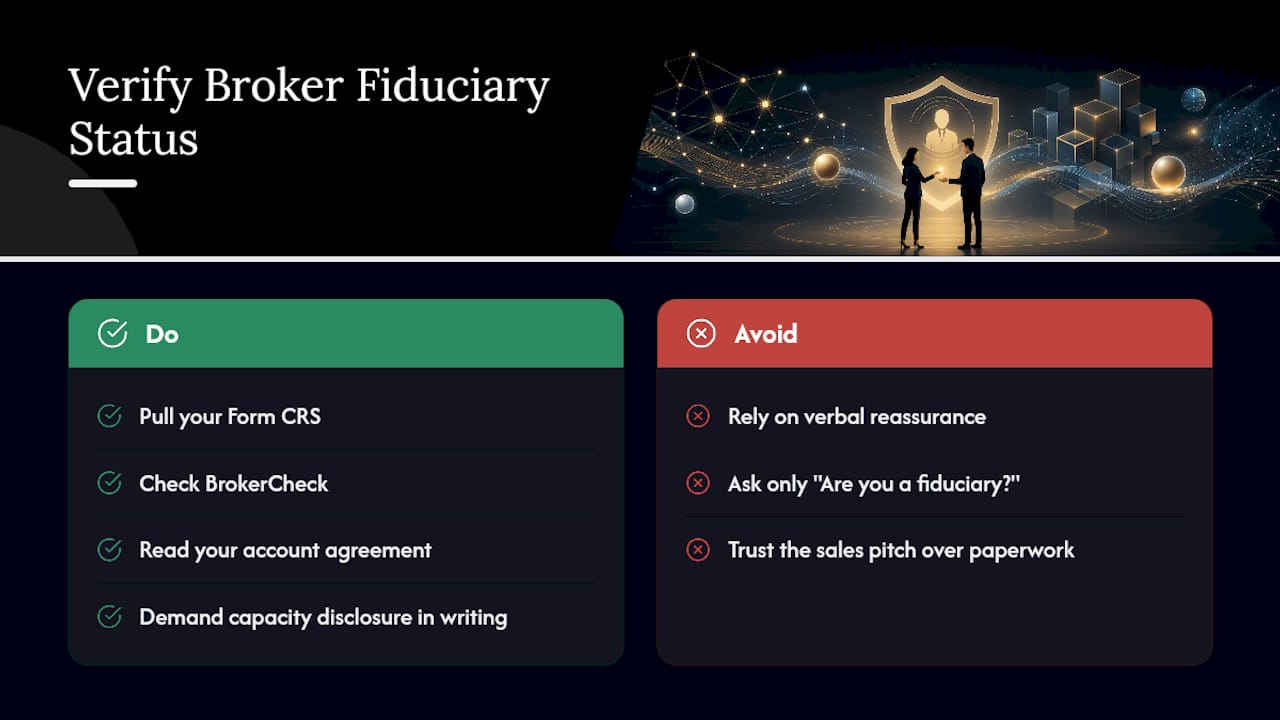
Conventional advice tells people to “just ask if your broker is a fiduciary,” which is close to useless, because the honest answer is often “it depends on the account and the moment.” The better move is documentary, not conversational. Pull your Form CRS, check BrokerCheck, and read your account agreement for the specific words that create obligations, discretion, monitoring, advisory language, rather than trusting a verbal reassurance.
The specialty brokerage world gets this right in one respect the securities industry often gets wrong: it puts everything in the contract because it has no choice. Securities investors would do well to borrow that instinct. Read the mandate. Demand the capacity disclosure in writing. Treat the paperwork, not the pitch, as the real source of protection.
— Jason
If you are navigating a high-value purchase where the brokerage agreement itself defines your protections, working with a broker who puts those terms in writing upfront matters as much as any regulatory framework. Yachts-bysteve structures its representation agreements around exactly this kind of clarity, scope of authority, commission disclosure, and escrow safeguards spelled out before any funds move, and our guide on how to choose a yacht broker walks through what to look for before you sign anything. For a broader look at how brokerage responsibilities work in vessel transactions generally, this overview of the broker’s role is a useful companion read.
This article is general information, not a substitute for advice from a qualified lawyer. Consult a qualified legal professional about your own circumstances before acting on anything here.
Sources
- Regulation Best Interest (Reg BI) — Legal Information Institute (LII)
- Regulation Best Interest: The Broker-Dealer Standard of Conduct (SEC adopting release 34-86031)
- Fiduciary Obligations of Broker-Dealers and Investment Advisers — Villanova Law Review
Recommended
Featured Listings

2028 Columbus Yachts
$22,900,008
137
Ancona

2012 Benetti PATIENCE
$10,975,000
132
Fort Lauderdale Florida

2028 Kingship Kingship
$20,350,000
125

2024 Silver Yachts
$25,400,000
117

2009 Hargrave BRANDI WINE
$2,500,000
114
Fort Lauderdale Florida

2028 Extra Yachts
$20,350,000
100
Ancona

2028 Alpha
$12,100,000
100
Ft Lauderdale Florida

2028 Extra Yachts Extra 96
$9,495,000
96
Ancona

2021 Sanlorenzo GATSBY
$6,795,000
96
Fort Lauderdale Florida

2028 Kingship
$11,990,000
90

2028 Alpha
$9,894,500
90
Fano

2023 Azimut COMPASS
$7,950,000
88
Miami Beach Florida

1999 Northern Marine OFF LINE
$2,495,000
84
Ft Lauderdale Florida

2013 Pershing DOROTHY ANN
$1,375,000
82
Fort Lauderdale Florida

1997 Ferretti Yachts
$825,000
80
La Paz

2008 Princess Yachts OCARALIA
$1,095,000
75
Charleston South Carolina

2014 Sunseeker
$1,400,000
68
New York New York

2024 Fairline
$2,750,000
68
Ft. Lauderdale Florida

2019 Vanquish Yachts IMPULSIVE
$1,799,000
58
Miami Beach Florida

2021 Ferretti Yachts HAVEN
$1,595,000
57
Fort Lauderdale Florida

2025 Formula BREAKTHROUGH III
$1,895,000
53
Miami Beach Florida

2023 Fairline
$900,000
45
Fort Lauderdale Florida

2012 Zeelander Mississippi Queen
$575,000
44
West Palm Beach Florida
2028 Columbus Yachts 137'
$22,900,008
2012 Benetti 132'
$10,975,000
2028 Kingship 125'
$20,350,000
2024 Silver Yachts 117'
$25,400,000
2009 Hargrave 114'
$2,500,000
2028 Extra Yachts 100'
$20,350,000
2028 Alpha 100'
$12,100,000
2028 Extra Yachts 96'
$9,495,000
2021 Sanlorenzo 96'
$6,795,000
2028 Kingship 90'
$11,990,000
2028 Alpha 90'
$9,894,500
2023 Azimut 88'
$7,950,000
1999 Northern Marine 84'
$2,495,000
2013 Pershing 82'
$1,375,000
1997 Ferretti Yachts 80'
$825,000
2008 Princess Yachts 75'
$1,095,000
2014 Sunseeker 68'
$1,400,000
2024 Fairline 68'
$2,750,000
2019 Vanquish Yachts 58'
$1,799,000
2021 Ferretti Yachts 57'
$1,595,000
2025 Formula 53'
$1,895,000
2023 Fairline 45'
$900,000
2012 Zeelander 44'
$575,000