

A corporation can buy a yacht, and the purchase can carry genuine tax advantages, but only when the vessel serves a legitimate business purpose that survives scrutiny. That means clearing a business-use threshold above 50%, timing the purchase around “placed in service” rules, and keeping contemporaneous documentation from day one. Skip any of those three, and the deduction you counted on can turn into a recapture bill with penalties attached.
TL;DR:
- Yachts used for business purposes must exceed 50% operational use and have thorough, contemporaneous documentation to qualify for tax deductions.
- Financing options include cash purchases, specialty marine loans, or staged payments on new builds, each affecting liquidity and depreciation timing differently.
- The choice of ownership structure impacts liability and basis but does not guarantee business use; operational substance verified through bookings and documented activities is crucial.
- When claiming immediate depreciation, the vessel’s placed-in-service date and the associated payment schedule must align with the desired tax year, requiring meticulous planning.
- Chartering must demonstrate genuine profit motives with market-rate bookings and proper records, especially when involving related parties or corporate retreats for deductions.
Table of Contents
- What Every Executive Should Do Before Signing
- How Do You Finance a Corporate Yacht Purchase?
- Individual, LLC, or Trust: Which Ownership Structure Fits?
- What Are the Section 179 and Bonus Depreciation Rules for Yachts?
- Can You Charter a Corporate Yacht and Still Deduct It?
- What USCG and Registration Rules Affect a Corporate Yacht?
- What Does It Cost to Own and Operate a Corporate Yacht Each Year?
- The Ten-Step Path From Modeling to Closing
- A Broker’s View on Corporate Yacht Deals
- How Yachts by Steve Helps You Structure the Purchase
- Sources
- FAQ
What Every Executive Should Do Before Signing
Before your signature goes on a purchase agreement, a handful of decisions need to happen in the right order. Get these sequenced correctly and the rest of the process moves fast. Get them backward, and you’ll be unwinding paperwork after the fact.
- Model the deduction three ways: Section 179, 100% bonus depreciation, and straight-line, so your CFO sees the real first-year cash impact versus the multi-year picture.
- Pick the ownership entity, whether that’s the operating corporation, a dedicated LLC, or a trust, and confirm how it affects your tax basis before you’re at the closing table.
- Build an operational plan that can actually produce more than 50% qualified business use, backed by a booking calendar or charter schedule you can defend later.
- Confirm your intended passenger counts against U.S. Coast Guard limits and line up event insurance before you plan the first executive retreat aboard.
None of these steps require months of lead time individually. Sequenced correctly, they usually run in parallel with the search for the right vessel, which is exactly how an experienced broker keeps a corporate deal on schedule.
How Do You Finance a Corporate Yacht Purchase?
Corporate buyers finance yachts three main ways: outright cash purchase, conventional or specialty marine lending, or staged progress financing for a new build. Each route has a different effect on liquidity, and each interacts differently with your depreciation timing.
Paying cash is the simplest path and it eliminates interest cost, but it also ties up capital that might otherwise generate a return elsewhere in the business. For a company sitting on strong reserves, that tradeoff might be fine. For most corporate buyers, financing at least a portion of the purchase preserves working capital while still capturing the tax benefits tied to ownership, not to how the purchase was funded.
Specialty yacht lenders and private-banking teams do not underwrite the way a commercial bank underwrites an office building. They expect a marine survey, an independent hull appraisal, and often a written operational plan showing how the vessel will be used. J.P. Morgan Private Bank’s superyacht lending desk, for instance, coordinates acquisition loans, progress financing, and eventual refinancing with the buyer’s own legal and tax advisers rather than treating the loan as a standalone transaction. That coordination matters because lenders increasingly want to see conservative revenue projections before they commit capital to a vessel destined for charter or corporate use.
New-build purchases add another layer. Shipyards typically require staged progress payments tied to construction milestones rather than a single closing payment. Corporate acquisitions disclosed in SEC filings show this pattern clearly: an initial letter of intent with an advance payment credited against the final price, followed by additional payments as due diligence and construction milestones are met. The trouble is that a progress schedule stretching across two tax years can complicate exactly when the vessel is “placed in service” for depreciation purposes.
- Decide cash versus financing based on your company’s cost of capital, not just sticker price.
- If financing, get a term sheet from a specialty marine or private-banking lender before you make an offer.
- For new builds, negotiate a progress-payment schedule that lines up with your desired tax year for the deduction.
- Loop in tax counsel on the closing date itself. Moving a closing by even two weeks can shift which tax year captures the write-off.
Pro Tip: Ask your lender for the progress-payment schedule in writing before you sign the letter of intent. A schedule that lands the final milestone in December instead of January can be the difference between claiming bonus depreciation this year or next.
Individual, LLC, or Trust: Which Ownership Structure Fits?
The right ownership structure for a corporate yacht depends on how the vessel will be used, who bears liability exposure, and how the business plans to finance it. There’s no universal answer, but there is a clearly wrong one: titling the yacht in an LLC and assuming that alone creates business use.
It doesn’t. The IRS looks past the entity on the title and asks whether the vessel is actually operated for a business purpose. A single-member LLC that owns a yacht used exclusively for the owner’s weekend recreation gets treated the same as personal ownership, regardless of what the paperwork says. Operational substance, meaning actual bookings, actual business meetings, actual documented use, is what separates a legitimate business asset from an expensive hobby with a corporate wrapper.
That said, the entity choice still matters enormously for liability and basis:
- Direct corporate ownership keeps the asset on the company’s balance sheet and ties depreciation directly to corporate taxable income, but it also exposes the parent entity to liability from onboard incidents.
- A dedicated LLC isolates liability from the parent business and is the most common structure brokers see for corporate buyers, provided the operating agreement spells out business use explicitly.
- Pass-through entities such as partnerships or S corporations raise basis questions. Outside basis limitations can cap how much depreciation an individual owner can actually deduct, even when the entity’s inside basis in the yacht is much higher.
- Trust ownership shows up occasionally for succession planning but rarely aligns cleanly with active business-use tests, since trusts are harder to document as running an operating trade or business.
Whatever structure you choose, the paper trail needs to match the intent. That means a properly drafted operating agreement, any charter contracts the entity signs, and, if a corporation is the buyer, board minutes authorizing the purchase for a stated business reason. Our guide on optimizing yacht ownership structures for tax purposes walks through basis mechanics in more depth than we can cover here.
What Are the Section 179 and Bonus Depreciation Rules for Yachts?
A yacht can qualify for Section 179 expensing and 100% bonus depreciation, but only within specific dollar limits and only when it passes the listed-property business-use test. Get the numbers and the test right, and the first-year write-off can be substantial. Get them wrong, and you’re looking at recapture.
The numbers that matter: The Section 179 deduction limit for qualifying business property is approximately $2,560,000 in 2026, with a phase-out that begins once total equipment purchases for the year exceed $4,090,000. Critically, the deduction cannot exceed taxable income from active business operations. Excess amounts carry forward, but they don’t disappear into a refund check.
Bonus depreciation works alongside Section 179 rather than instead of it. Bonus depreciation was restored to 100% for qualifying property acquired after January 19, 2025, which means a corporate buyer can potentially write off the full purchase price in the year the vessel enters service, subject to the same business-use conditions. That restoration makes first-year deductions materially larger than they were during the previous phasedown period, which sounds like unambiguous good news until you consider the flip side: bigger first-year deductions mean bigger recapture exposure if business use drops in later years.
Here’s where the listed-property rules bite. A yacht is treated as listed property under the tax code, which triggers a strict test:
- Business use must exceed 50% of total use, measured and documented, not estimated after the fact.
- If business use falls below that threshold in a later year, the IRS can recapture the accelerated depreciation you already claimed, turning a tax win into a retroactive tax liability.
- Audit defenses hold up best when the underlying records, meaning logs, invoices, and booking confirmations, were created at the time of use rather than reconstructed months later for a return.
One more variable corporate buyers routinely underweight: state sales and use tax. Rates and caps vary enormously by state, and some states cap the tax owed on a vessel purchase outright while others apply the full rate with no ceiling. That variance can swing your total upfront cost by six figures depending on where the yacht is registered, which makes it worth a call to state tax counsel before you pick a home port.
Can You Charter a Corporate Yacht and Still Deduct It?
Yes, but the IRS wants to see evidence of a genuine profit motive, not a paper-thin charter arrangement built to justify a deduction. Real chartering means market-rate bookings, income reported across multiple tax years, and records that were created as the trips happened.
Related-party charters draw extra scrutiny. If your own executives or affiliated companies are the ones chartering the yacht, the IRS expects to see the same market rate a stranger would pay, along with proof that payment actually changed hands. A charter agreement that exists only on paper, with no invoice and no deposit, won’t hold up.
Corporate retreats present a cleaner path to deductibility under IRC §274(e)(5), which preserves deductions for business meetings of employees, stockholders, or directors even though entertainment expenses are generally disallowed. Industry charter advisers recommend building the documentation before the trip, not after.
- Draft a written agenda showing the business purpose of the trip in advance.
- Keep formal meeting minutes documenting decisions made aboard.
- Maintain an attendee list separating business participants from personal guests.
- File a business-purpose memo describing why the yacht, specifically, was the appropriate venue.
Pro Tip: Photograph the whiteboard from your onboard strategy session. It sounds trivial, but a dated photo of an actual working meeting is more persuasive to an auditor than a memo written from memory three months later.
What USCG and Registration Rules Affect a Corporate Yacht?
The single biggest operational constraint for corporate use is the USCG limit of 12 paying passengers on a crewed charter vessel. Companies planning larger events, a board retreat with two dozen attendees, for example, commonly solve this with tandem-charter arrangements across two vessels rather than trying to certify a single yacht for a higher capacity.
- Groups of 13 to 24 typically split across two crewed yachts operating together.
- Groups of 30 or more usually require a Subchapter K commercial passenger vessel or a fully licensed charter operation, a different regulatory category entirely.
- Registration and flag choice affect whether the vessel can legally carry paying passengers for hire, and switching flags after purchase can be costly.
- Insurance for corporate events needs separate riders for liability limits appropriate to a business gathering, plus hull coverage that accounts for crewed operations rather than private recreational use.
Crew qualifications and confidentiality matter more for corporate use than most first-time buyers expect. A crew accustomed to family charters may not be prepared for the discretion an executive retreat or a sensitive board discussion requires, so it’s worth discussing confidentiality provisions directly with the captain before the first event. Safe Boating America’s overview of Coast Guard requirements is a useful primer to hand to whoever on your team is managing compliance.
What Does It Cost to Own and Operate a Corporate Yacht Each Year?
Annual operating costs for a crewed yacht typically run in a wide range as a percentage of the purchase price, and the variance comes almost entirely from crew size, vessel age, and how aggressively the vessel is chartered out.
- Crew salaries, training, and benefits, which scale sharply with vessel size and the number of specialized roles aboard.
- Maintenance and dockage, including seasonal haul-outs and slip fees that vary by home port.
- Insurance, both hull coverage and liability riders for corporate events.
- Fuel costs, which swing significantly based on cruising range and engine type.
- Periodic refit cycles that create large, lumpy expenses every few years rather than a steady monthly bill.
Charter income should be modeled conservatively. Weather cancellations, off-season gaps, and maintenance downtime routinely eat into projected revenue, and lenders underwriting a charter-intended yacht want to see that contingency built into the plan, not bolted on afterward. Our breakdown of the economics of yacht ownership walks through the cost categories in more detail.
The Ten-Step Path From Modeling to Closing
Turning all of the above into an actual purchase comes down to sequencing. Here’s the order that keeps a corporate transaction moving without a last-minute scramble.
- Run tax modeling comparing Section 179, 100% bonus depreciation, and straight-line depreciation against projected taxable income.
- Select the ownership entity and confirm outside basis with your tax adviser before shopping for vessels.
- Get pre-commitment from a lender if financing any portion of the purchase.
- Align your target closing date with the placed-in-service timing that captures the deduction you modeled.
- Draft a written operational plan proving more than 50% business use, whether through a booking pipeline or a charter strategy.
- Build contemporaneous record templates now, meaning logs, agendas, and invoice formats, so you’re not inventing them under audit pressure later.
- Commission a full marine survey and sea trial before making an offer.
- Review our yacht inspection checklist alongside the survey findings.
- Finalize the purchase agreement and any charter contracts with counsel who understands vessel transactions specifically.
- Close, document the placed-in-service date formally, and start the operational plan on day one, rather than easing into it.
Pro Tip: Treat step six as non-negotiable. The single most common reason a corporate yacht deduction gets challenged isn’t bad math, it’s missing records created after the fact instead of during actual use.
A Broker’s View on Corporate Yacht Deals
The corporate purchases that go smoothly are the ones where tax and structure conversations happen before the vessel search, not after. I’ve watched a deal nearly unravel because the buyer’s entity choice was settled after the survey was already scheduled, forcing a scramble to rebuild financing around a structure nobody had stress-tested. The lesson holds every time: sequencing beats speed. Talk to your tax counsel first, then let a broker who has run this process before help you avoid the same mistake.
— Jason
How Yachts by Steve Helps You Structure the Purchase
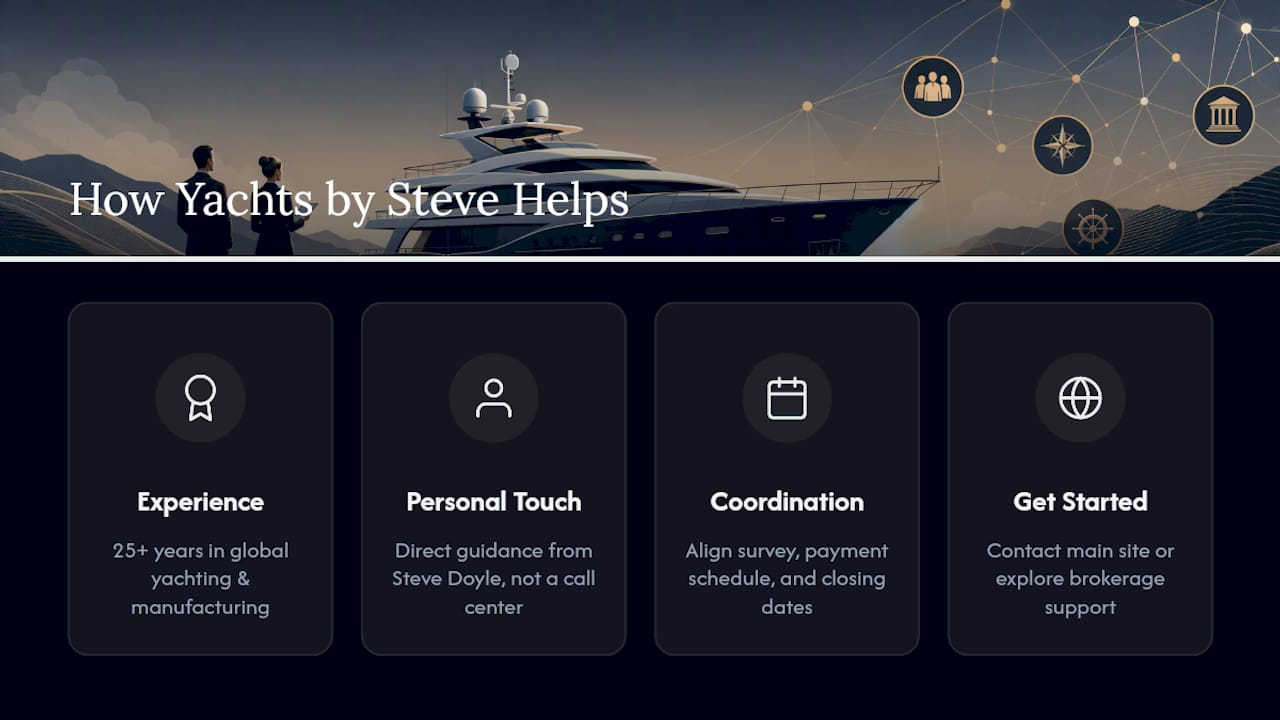
Yachts-bysteve is the alternative to going it alone on a transaction where the paperwork matters as much as the vessel itself. Our Premier Yacht Broker Services bring more than 25 years of experience in global yachting and manufacturing to sourcing, negotiation, and due diligence, with Steve Doyle providing direct, personal guidance rather than handing you off to a call center. We help corporate buyers coordinate survey timing, progress-payment schedules, and closing dates with the operational and tax planning covered above, because a missed deadline on any of those fronts can cost more than the broker’s involvement ever would. If you’re evaluating a corporate purchase right now, start with a conversation on our main site or explore how yacht brokerage support works before you make an offer.
Sources
Hand your advisers the primary sources, not summaries. Start with IRS Publication 946 on depreciation and listed property, 46 U.S.C. §2101 for passenger-vessel definitions, and IRS Publication 463 for the entertainment-expense exceptions under §274(e)(5). For a plain-language walkthrough of the deduction mechanics, LegalClarity’s breakdown is a solid practical companion.
This article is general information, not a substitute for advice from a qualified financial advisor. Consult a qualified financial professional about your own circumstances before acting on anything here.
- 46 U.S.C. §2101 (Definitions related to passenger vessels)
- How to Claim a Yacht Tax Break: Deductions Explained — LegalClarity
FAQ
Is Buying a Yacht a Tax Write-Off?
A yacht can generate real tax deductions through Section 179 or bonus depreciation, but only when it’s used predominantly for a legitimate business purpose and backed by contemporaneous documentation. Personal or mostly-personal use doesn’t qualify, and misrepresenting business use can trigger recapture of deductions already claimed.
What Kind of Yacht Can I Buy for $1,000,000?
At that price point, corporate buyers typically look at a well-equipped motoryacht or catamaran in a size range suited to executive retreats, client entertainment, or occasional chartering, either brokered pre-owned or select new-build options depending on the market. The right fit depends heavily on intended use, whether that’s executive retreats, client entertainment, or occasional chartering, so working with a broker to match specifications to your operational plan matters more than chasing size alone.
What Is the 12-Person Yacht Rule?
Under U.S. Code, a crewed charter yacht is limited to 12 paying passengers before it needs a different regulatory classification. Corporate groups larger than that commonly use tandem-charter arrangements across two vessels rather than certifying a single yacht for higher capacity.
Why Do Companies Buy Yachts for Business Use?
Companies buy yachts to host client entertainment, run executive retreats, and in some cases generate charter income, all of which can qualify for meaningful tax treatment when structured correctly. Beyond the tax angle, a yacht also gives leadership a controlled, private environment for high-stakes meetings that a hotel conference room simply can’t replicate.
Recommended
Featured Listings

2028 Columbus Yachts
$22,900,008
137
Ancona

2012 Benetti PATIENCE
$10,975,000
132
Fort Lauderdale Florida

2028 Kingship Kingship
$20,350,000
125

2024 Silver Yachts
$25,400,000
117

2009 Hargrave BRANDI WINE
$2,500,000
114
Fort Lauderdale Florida

2028 Extra Yachts
$20,350,000
100
Ancona

2028 Alpha
$12,100,000
100
Ft Lauderdale Florida

2028 Extra Yachts Extra 96
$9,495,000
96
Ancona

2021 Sanlorenzo GATSBY
$6,795,000
96
Fort Lauderdale Florida

2028 Kingship
$11,990,000
90

2028 Alpha
$9,894,500
90
Fano

2023 Azimut COMPASS
$7,950,000
88
Miami Beach Florida

1999 Northern Marine OFF LINE
$2,495,000
84
Ft Lauderdale Florida

2013 Pershing DOROTHY ANN
$1,375,000
82
Fort Lauderdale Florida

1997 Ferretti Yachts
$825,000
80
La Paz

2008 Princess Yachts OCARALIA
$1,095,000
75
Charleston South Carolina

2014 Sunseeker
$1,400,000
68
New York New York

2024 Fairline
$2,750,000
68
Ft. Lauderdale Florida

2019 Vanquish Yachts IMPULSIVE
$1,799,000
58
Miami Beach Florida

2021 Ferretti Yachts HAVEN
$1,595,000
57
Fort Lauderdale Florida

2025 Formula BREAKTHROUGH III
$1,895,000
53
Miami Beach Florida

2023 Fairline
$900,000
45
Fort Lauderdale Florida

2012 Zeelander Mississippi Queen
$575,000
44
West Palm Beach Florida
2028 Columbus Yachts 137'
$22,900,008
2012 Benetti 132'
$10,975,000
2028 Kingship 125'
$20,350,000
2024 Silver Yachts 117'
$25,400,000
2009 Hargrave 114'
$2,500,000
2028 Extra Yachts 100'
$20,350,000
2028 Alpha 100'
$12,100,000
2028 Extra Yachts 96'
$9,495,000
2021 Sanlorenzo 96'
$6,795,000
2028 Kingship 90'
$11,990,000
2028 Alpha 90'
$9,894,500
2023 Azimut 88'
$7,950,000
1999 Northern Marine 84'
$2,495,000
2013 Pershing 82'
$1,375,000
1997 Ferretti Yachts 80'
$825,000
2008 Princess Yachts 75'
$1,095,000
2014 Sunseeker 68'
$1,400,000
2024 Fairline 68'
$2,750,000
2019 Vanquish Yachts 58'
$1,799,000
2021 Ferretti Yachts 57'
$1,595,000
2025 Formula 53'
$1,895,000
2023 Fairline 45'
$900,000
2012 Zeelander 44'
$575,000