

Overview — Seven custom yacht design tips that reliably lift livability, resale, and owner satisfaction: coordinate your naval architect before any aesthetic decisions are made; prioritize natural light and restrained detailing over decorative excess; specify bespoke ergonomics measured to your body; choose marine-grade materials matched to your cruising latitude; integrate structural systems as architectural features rather than obstacles; map your daily routines into the layout brief; and build a realistic timeline with contingency before signing any contract.
- Coordinate naval architect and designer from day one — systems constraints shape every interior decision
- Prioritize light and texture over decorative layering; refinement reads as luxury at sea
- Specify bespoke ergonomics — seat depth, back angle, mattress construction, berth orientation
- Select marine-grade materials by performance first, then by beauty
- Integrate exhaust trunking, HVAC ducts, and structural members as design features
- Map your routines — where you spend mornings, how you host, crew interaction zones
- Set a realistic budget and timeline with contingency built in before production begins
Pro Tip: Lock a formal collaboration slot between your designer and naval architect into the contract before any schematic work begins. That single step prevents the most expensive revisions.
Table of Contents
- What custom yacht design tips actually produce a refined interior?
- How do you get bespoke furniture that actually fits you?
- Why engineering constraints must be addressed before aesthetics
- Which materials look luxurious and actually survive at sea?
- What does the design process look like from brief to delivery?
- How do you translate your lifestyle into a layout that works?
- How do you choose a yacht designer who delivers on both art and engineering?
- Common mistakes owners make and how to avoid them
- How lighting shapes the feel of every space onboard
- Key Takeaways
- What early coordination actually saves you
- Yachts-bysteve: your partner for design-driven yacht transactions
- Useful sources and further reading
What custom yacht design tips actually produce a refined interior?
The principles that consistently produce refined superyacht interiors are light, material logic, and restraint. Not more finishes, more fixtures, or more statement pieces. As Opalinski Design House notes, excess rarely reads as luxury at sea; it is the clear horizontal planes, considered texture, and quality of light that create a sense of lifted luxury aboard.
Daylight is the most powerful spatial tool on a yacht. Wide-beam windows, pale overhead surfaces, and carefully placed mirrors compound to make a 40-meter interior feel genuinely expansive. Where natural light is limited, concealed cove lighting that washes headliners from the edges visually amplifies ceiling height more effectively than any structural change.
When reviewing 3D renders and VR walkthroughs, ask your designer to show the space at three times of day: morning, midday, and evening with artificial light active. Proportion and light read very differently across those conditions, and catching a problem in a render costs nothing compared to catching it after joinery is installed.
How do you get bespoke furniture that actually fits you?
Ergonomics must be specified to the owner’s body, not to a generic standard. Off-the-shelf seating dimensions are built for statistical averages; a bespoke interior built around your actual proportions feels categorically different the moment you sit down.
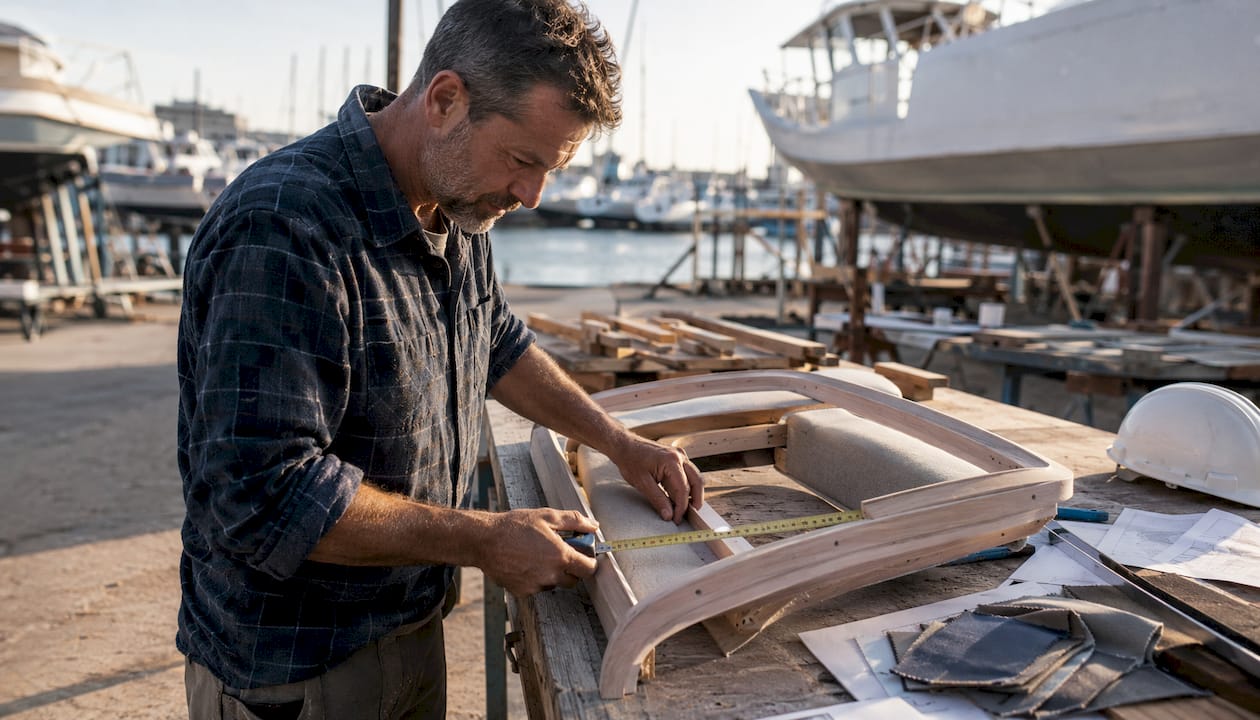
During the brief, capture seat depth, preferred back angle, cushion firmness, mattress construction, and berth orientation. On a sailing yacht, berths oriented fore-and-aft are far more comfortable at heel than athwartships positions. Motor yacht owners often prioritize mattress depth and climate control over orientation. These are not minor preferences; they determine whether the owner suite feels like a sanctuary or a hotel room that happens to float.
For owner suite design details, the brief should also capture dressing room flow, bathroom fixture heights, and reading light placement.
Pro Tip: Insist on full-scale mockups or a sit-test session on comparable furniture before production. A single afternoon in a mockup suite prevents months of post-delivery regret.
Why engineering constraints must be addressed before aesthetics
Engineering constraints shape every interior decision, and coordinating with the naval architect from day one using specialized business-management software for the nautical industry is the single most protective move an owner can make. Exhaust trunking, HVAC ducts, structural frames, HVAC zones, fire-rated partitions, and cable runs all claim volume before the designer touches a surface.
The integration of functional infrastructure is what separates a refined interior from a compromised one. Cladding a vertical exhaust trunk as an architectural pillar, or using a central ceiling dome to conceal a duct cluster, transforms an obstacle into a feature. That approach also maximizes usable interior volume rather than surrendering it to awkward soffits.
Questions to ask your naval architect before schematic design begins:
- Where are the fixed structural members, and what clearances are non-negotiable?
- What are the HVAC zone boundaries, and where do supply and return ducts run?
- What fire-rated partition requirements apply to this vessel class?
- Where does exhaust trunking pass through accommodation spaces?
- What is the weight budget per deck, and where is the center of gravity most sensitive?
- Which cable runs are fixed, and which can be rerouted at reasonable cost?
Pro Tip: Request a weight ledger and center-of-gravity analysis when major joinery or stone is specified. Hundreds or thousands of kilograms in the wrong location materially affect trim and fuel burn.
Which materials look luxurious and actually survive at sea?
Pick materials by marine performance first, then by beauty. That order matters because a finish that degrades in 18 months of tropical cruising is not a luxury choice regardless of its initial appearance.
| Material | UV Resistance | Moisture Performance | Maintenance Level |
|---|---|---|---|
| Teak decking | High (natural oils) | Excellent | Medium (annual oiling) |
| Solution-dyed acrylic upholstery | Excellent | Excellent | Low |
| marine-grade stainless steel hardware | High | Excellent | Low |
| Varnished hardwood joinery | Low–Medium | Medium | High |
| Engineered stone countertops | Excellent | High | Low |
| Closed-cell foam cushion cores | N/A | Excellent | Low |
Tropical UV exposure accelerates degradation in fabrics, varnished timbers, and synthetics. Solution-dyed acrylics and correct metal grades extend service life considerably in those latitudes. On serious sailing yachts, avoid solid stone countertops: weight high and aft affects stability and pointing, and heavy materials common on motor superyachts are often inappropriate on performance sailing hulls. Closed-cell foam and marine-grade fabrics are non-negotiable for cushions in humid environments.
Pro Tip: Order material samples and live with them onboard for a week before committing. Artificial showroom lighting hides color shifts and texture changes that become obvious under direct sun on the water.
What does the design process look like from brief to delivery?
The project runs in predictable stages: brief, schematic design, detailed design, full-scale mockups, production, installation, and sea trials. Knowing what each stage delivers helps owners and brokers set expectations and manage approvals without delays.
| Stage | Typical Duration | Key Deliverables |
|---|---|---|
| Owner brief | 2–4 weeks | Lifestyle questionnaire, moodboards, spatial priorities |
| Schematic design | 4 weeks | Concept renders, layout options, material palette |
| Detailed design | 8 weeks | 3D renders, engineering packages, material samples |
| Full-scale mockups | 4–6 weeks | Furniture sit-tests, joinery approval, lighting tests |
| Production | 12 weeks | Fabrication, quality control, systems integration |
| Installation and sea trials | 4 weeks | Fit-out, commissioning, punch list |
Require these deliverables in every contract: approved 3D renders, full-scale mockups, signed material samples, and systems integration sign-off before production begins.
Budget factors that drive the largest cost variance:
- Custom joinery and material grade (the single largest variable)
- Systems integration scope, particularly on refits
- Refit vs. new-build: consolidating systems upgrades into one project saves money versus staggered work
- Cruising-region requirements (tropical vs. polar specifications differ significantly)
How do you translate your lifestyle into a layout that works?
Personalization comes from mapping real routines before the designer draws a single line. Where you spend your mornings, whether you prefer formal or casual dining, how much privacy you want from crew, and how many guests you typically host — these answers drive layout decisions more reliably than any style reference.
A simple lifestyle mapping exercise: for each primary activity (morning coffee, working, hosting dinner, water sports, sleeping), note the time of day, preferred location on the vessel, and the features that activity requires. That matrix becomes the brief.
Usage profile shifts priorities dramatically. Owners who entertain formally need a dining saloon that seats eight comfortably and a galley with direct service access. Families with children prioritize play areas, shallow-water toy storage, and convertible cabin configurations. Long-range cruisers need deep storage, efficient HVAC, and low-VOC finishes that hold up over months at sea. Charter-intended yachts require additional escape routes, more crew amenities, and flexible guest cabin configurations to meet regulatory requirements. For personalization ideas matched to your usage profile, the range of options is broader than most owners initially expect.
Integrated storage — under-berth compartments, concealed stair tread storage, multi-use toy lockers — keeps horizontal surfaces clear and preserves the sense of spaciousness that defines a well-designed interior.
How do you choose a yacht designer who delivers on both art and engineering?
Choose a designer who demonstrates naval coordination, materials knowledge, and genuine client-fit rather than style alone. A portfolio of beautiful renders means little if the designer has never successfully navigated a complex refit with a shipyard.
Questions to ask in every designer interview:
- Can you share references from shipyards you have worked with on similar-size vessels?
- How do you coordinate with the naval architect during schematic and detailed design?
- What is your mockup process, and who signs off on each stage?
- How do you handle engineering changes that affect the design mid-project?
- What warranty or quality-control provisions do you include in your contracts?
Red flags: no shipyard references, vague deliverable descriptions, unwillingness to share engineering drawings with the owner’s technical team, and contracts that lack defined approval points.
Require these items in every design contract: a full scope of deliverables, named references, defined approval points, mockup sign-off requirements, and a responsibility matrix that clearly assigns accountability between the designer, the yard, and the naval architect.
Common mistakes owners make and how to avoid them
Most costly mistakes in custom yacht design come from late coordination and aesthetic-first decisions that ignore systems or durability. The pattern is consistent: an owner falls in love with a material or layout concept, commits to it before engineering review, and then faces expensive revisions when the naval architect identifies a conflict.
Specific mistakes and how to prevent them:
- Delaying the naval architect: Schedule the first coordination meeting before any schematic work begins, not after.
- Choosing heavy materials on performance yachts: Specify engineered stone alternatives or composite surfaces on sailing hulls; save marble for motor yachts where weight distribution is less critical.
- Skipping full-scale mockups: A mockup session costs a fraction of a post-delivery refit. Require it contractually.
- Underestimating maintenance in tropical cruising: Budget for annual varnish work, UV-protective fabric replacement, and hardware inspection from the outset.
Pro Tip: Hidden weight is the most underestimated risk in bespoke interiors. Request a weight ledger and center-of-gravity analysis whenever significant joinery or stone is specified.
How lighting shapes the feel of every space onboard
Lighting design on a superyacht is less about fixtures and more about how light behaves across surfaces, water reflections, and the changing quality of natural daylight throughout the day. The goal is a scheme that enhances perceived space without competing with the view outside.
Warm dimmable LED presets, standardized at 2700K or lower, preserve the quality of natural daylight and prevent the harsh, clinical feel that higher color temperatures produce at sea. Invisible light sources — concealed cove strips, under-cabinet washes, recessed floor lighting — compound to change perceived space in ways that no single fixture can achieve alone. Scene presets for morning, afternoon, and evening allow the interior to shift mood without manual adjustment, which matters when you are hosting and want the atmosphere to evolve naturally.
For smart lighting and AV integration, the control architecture should be specified alongside the lighting design, not retrofitted afterward. A system where lighting, climate, and AV respond to a single interface is both more elegant and more reliable than layered afterthought installations.
Key Takeaways
Successful custom yacht design requires coordinating engineering and aesthetics from the first meeting, not after the renders are approved.
| Point | Details |
|---|---|
| Hire the naval architect first | Coordinate structural and systems constraints before any schematic design begins. |
| Demand render and mockup validation | Require 3D renders at three lighting conditions and full-scale mockups before production sign-off. |
| Specify marine-grade materials | Match material choice to cruising latitude; solution-dyed acrylics and closed-cell foam outperform domestic alternatives. |
| Map routines into the brief | Document daily habits, hosting patterns, and privacy needs before engaging a designer. |
| Yachts-bysteve brokerage support | Yachts-bysteve coordinates design-driven purchases and refits, offering market insight and contract guidance throughout the process. |
What early coordination actually saves you
There is a moment in almost every complex refit when someone walks into a nearly finished saloon and says, quietly, “the sofa is six inches too deep.” Not because the designer made an error, but because the exhaust trunk shifted the usable beam by six inches and nobody updated the furniture spec. The fix is not catastrophic, but it costs time, money, and the particular frustration of a problem that was entirely preventable.
The owners who avoid that moment are the ones who treated the naval architect as a creative collaborator from the start, not a technical reviewer brought in at the end. They asked the hard questions early: where does the trunking run, what is the weight budget, which partitions are fixed? And they built those answers into the brief before a single moodboard was produced.
That kind of early coordination is also where an experienced broker earns their value. Knowing which shipyards communicate well with independent designers, which contracts need stronger approval-point language, and which material specifications tend to create cost surprises later — that institutional knowledge protects the owner in ways that are hard to quantify until something goes wrong.
Yachts-bysteve: your partner for design-driven yacht transactions
When a purchase or refit involves significant custom design work, the brokerage relationship becomes as important as the design relationship. Yachts-bysteve brings market transparency, shipyard familiarity, and contract experience to every transaction, helping owners avoid the specification traps and timeline surprises that inflate project costs.
The practical value is concrete: vendor negotiation grounded in real market data, contract language that protects the owner at each approval stage, and coordination between the design team, naval architect, and yard that keeps the project moving. For owners considering a design-driven purchase, understanding how to choose a yacht broker is the natural first step. For those already in a transaction, yacht brokerage services from Yachts-bysteve are available to support the full process from brief through delivery.
Useful sources and further reading
- American Marine: Superyacht Interior Design — 5 Ultimate Tips — practical guidance on integrating structural systems and storage optimization
- Opalinski Design House: Luxury Yacht Interior Guide for Bespoke Design Success — ergonomics, material logic, and the case for full-scale mockups
- House of Nuances: Yacht Interior Design — Materials, Space, and Renovation Costs — lighting techniques, UV-grade materials, and cost drivers
- Patrick Knowles Designs: The Art of Designing a Superyacht Interior That Feels Like Home — designer perspective on owner-personalized interiors
- Yachts-bysteve — brokerage support, market insights, and design-driven purchase guidance
- For technical specifications and fire-safety compliance, consult your naval architect directly and reference IMO fire-safety code guidance applicable to your vessel’s flag state and gross tonnage
Save this list for your procurement package and share it with your design team at the first coordination meeting.
Recommended
Featured Listings

2028 Columbus Yachts
$22,900,008
137
Ancona

2012 Benetti PATIENCE
$10,975,000
132
Fort Lauderdale Florida

2028 Kingship Kingship
$20,350,000
125

2024 Silver Yachts
$25,400,000
117

2009 Hargrave BRANDI WINE
$2,500,000
114
Fort Lauderdale Florida

2028 Extra Yachts
$20,350,000
100
Ancona

2028 Alpha
$12,100,000
100
Ft Lauderdale Florida

2028 Extra Yachts Extra 96
$9,495,000
96
Ancona

2021 Sanlorenzo GATSBY
$6,795,000
96
Fort Lauderdale Florida

2028 Kingship
$11,990,000
90

2028 Alpha
$9,894,500
90
Fano

2023 Azimut COMPASS
$7,950,000
88
Miami Beach Florida

1999 Northern Marine OFF LINE
$2,495,000
84
Ft Lauderdale Florida

2013 Pershing DOROTHY ANN
$1,375,000
82
Fort Lauderdale Florida

1997 Ferretti Yachts
$825,000
80
La Paz

2008 Princess Yachts OCARALIA
$1,095,000
75
Charleston South Carolina

2014 Sunseeker
$1,400,000
68
New York New York

2024 Fairline
$2,750,000
68
Ft. Lauderdale Florida

2019 Vanquish Yachts IMPULSIVE
$1,799,000
58
Miami Beach Florida

2021 Ferretti Yachts HAVEN
$1,595,000
57
Fort Lauderdale Florida

2025 Formula BREAKTHROUGH III
$1,895,000
53
Miami Beach Florida

2023 Fairline
$900,000
45
Fort Lauderdale Florida

2012 Zeelander Mississippi Queen
$575,000
44
West Palm Beach Florida
2028 Columbus Yachts 137'
$22,900,008
2012 Benetti 132'
$10,975,000
2028 Kingship 125'
$20,350,000
2024 Silver Yachts 117'
$25,400,000
2009 Hargrave 114'
$2,500,000
2028 Extra Yachts 100'
$20,350,000
2028 Alpha 100'
$12,100,000
2028 Extra Yachts 96'
$9,495,000
2021 Sanlorenzo 96'
$6,795,000
2028 Kingship 90'
$11,990,000
2028 Alpha 90'
$9,894,500
2023 Azimut 88'
$7,950,000
1999 Northern Marine 84'
$2,495,000
2013 Pershing 82'
$1,375,000
1997 Ferretti Yachts 80'
$825,000
2008 Princess Yachts 75'
$1,095,000
2014 Sunseeker 68'
$1,400,000
2024 Fairline 68'
$2,750,000
2019 Vanquish Yachts 58'
$1,799,000
2021 Ferretti Yachts 57'
$1,595,000
2025 Formula 53'
$1,895,000
2023 Fairline 45'
$900,000
2012 Zeelander 44'
$575,000