

Overview: The essential broker-led onboarding plan for a new luxury-yacht owner is a structured, 90-day roadmap that delivers five things at handover: a personalized ownership-cost estimate, a marina placement path, a crew plan, a legal and registration checklist, and a first-season budget. Owners who receive all five within the first week are far less likely to face the operational friction — surprise costs, staffing gaps, missed berths — that turns an idyllic purchase into a stressful one. Yachts-bysteve builds this package into every transaction.
The core components a broker must deliver at handover:
- Signed documentation list and title confirmation
- Ownership-cost estimate (run through a calculator, sized to the hull)
- Marina introduction or waitlist placement in the owner’s home port
- Crew plan: roles needed, hiring timeline, and recruiter referrals
- Legal and registration checklist with a maritime attorney referral
- First-90-days schedule with named responsible parties
The first action is straightforward: run an ownership-cost estimate before the ink dries, then schedule a broker handover call to walk through every line item together.
Table of Contents
- How do you educate new yacht owners in the first 90 days?
- What does yacht ownership actually cost by size?
- What crew does your yacht need, and what will it cost?
- U.S. registration, title, and legal steps you cannot skip
- Should you hire a yacht management company or run it yourself?
- What can you do right now to protect resale value?
- Key Takeaways
- The part of onboarding most brokers get wrong
- Yachts-bysteve: your onboarding partner from day one
- Selected sources and references
How do you educate new yacht owners in the first 90 days?
A structured, broker-delivered checklist removes the guesswork that derails most first seasons. Post-sale support matters precisely because the period between closing and first departure is when owners are most vulnerable to costly missteps.
- Days 8–30: Conduct crew interviews if the yacht requires professional staff, set up provisioning accounts, and arrange satellite/connectivity systems. A yacht connectivity plan is no longer optional on a vessel above 80 feet.
Deliverables the broker produces by day 90: a signed documentation package, a vetted contact directory (insurance, legal, crew, yard), an itemized first-season budget, and a written timeline with owner and broker responsibilities clearly separated. The Yachts-bysteve seller onboarding guide models this process in detail.
What does yacht ownership actually cost by size?
Annual ownership costs rise non-linearly with length because crew complements and regulatory requirements jump at specific thresholds. A practical rule of thumb: expect to spend 10%–25% of the vessel’s purchase price annually on operating and maintenance costs, depending on size, usage, and cruising profile.
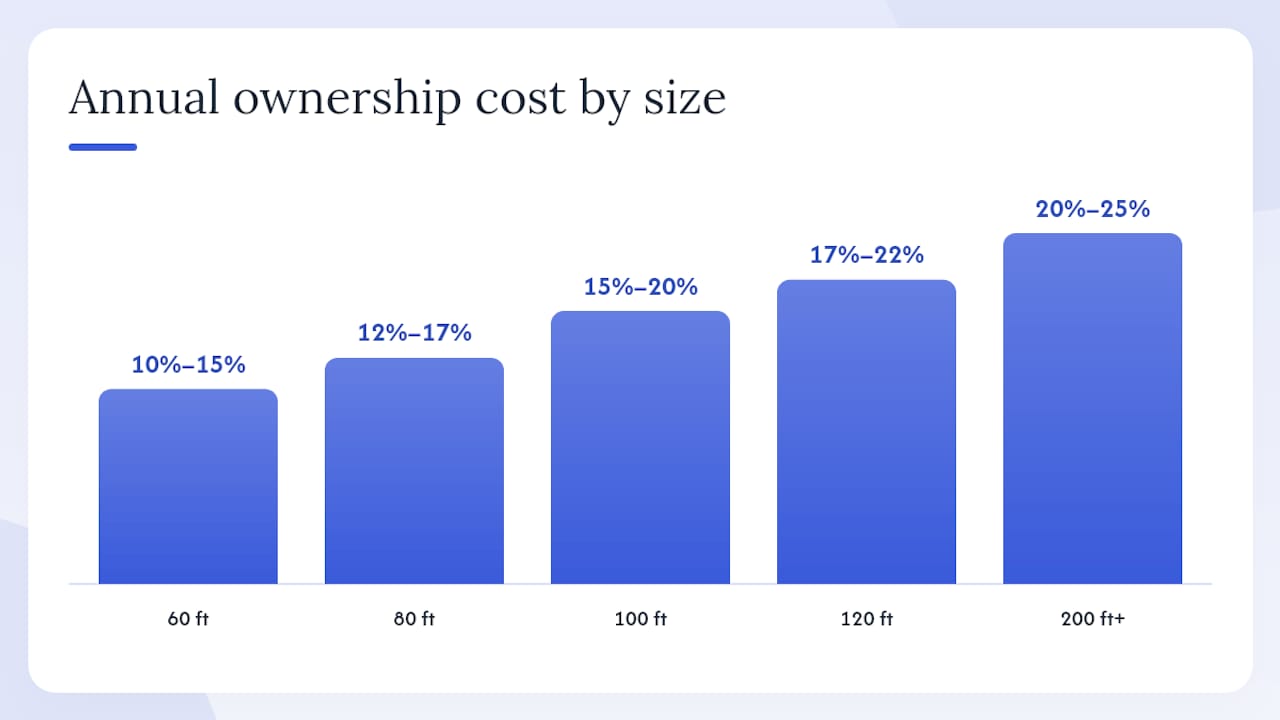
The table below uses 200 engine hours per year, a mixed U.S./Caribbean/Mediterranean cruising profile, and comprehensive insurance as its baseline assumptions.
| Yacht Size | Est. Annual Ownership Cost (% of Value) | Crew | Maintenance | Insurance | Dockage | Fuel | Total Range (Annual) |
|---|---|---|---|---|---|---|---|
| 60 ft | 10%–15% | Moderate crew costs | Maintenance expenses | Insurance fees | Dockage charges | Fuel expenses | Estimated total annual costs |
| 80 ft | 12%–17% | Increased crew costs | Maintenance expenses | Insurance fees | Dockage charges | Fuel expenses | Estimated total annual costs |
| 100 ft | 15%–20% | Higher crew costs | Maintenance expenses | Insurance fees | Dockage charges | Fuel expenses | Estimated total annual costs |
| 120 ft | 17%–22% | Larger crew complement costs | Maintenance expenses | Insurance fees | Dockage charges | Fuel expenses | Estimated total annual costs |
| 200 ft+ | 20%–25% | Significant crew costs | Maintenance expenses | Insurance fees | Dockage charges | Fuel expenses | Estimated total annual costs |
Three threshold effects shape these numbers. At roughly 80 feet, a professional chef becomes standard, and the crew cost line jumps accordingly. At 100–120 feet, a dedicated chief engineer is often required for safe operation and class surveys. Above 200 feet, ISM Code compliance and mandatory professional management become functionally unavoidable, which changes both the budgeting and vendor-selection conversation entirely.
Pro Tip: Use an ownership-cost calculator with your specific hull value, usage hours, and cruising area before finalizing a purchase. Generic percentages are a starting point; a hull-specific estimate is what actually informs a realistic budget.
What crew does your yacht need, and what will it cost?
The boat may be the stage, but the crew are the stars — and getting the complement right from day one sets the tone for every season that follows.
| Yacht Size | Typical Crew | Key Roles | Annual Crew Cost (Est.) |
|---|---|---|---|
| 60 ft | Small crew | Captain and deckhand roles | Estimated crew costs |
| 80 ft | Moderate crew size | Including chef and steward | Estimated crew costs |
| 100 ft | Larger crew | Including chief engineer, chef, stew, deckhand | Estimated crew costs |
| 120 ft | Full department heads plus additional crew | Comprehensive staffing | Estimated crew costs |
| —+ | Full professional complement with department structure | Extensive crew | Estimated crew costs |
Crew costs include base salary, benefits, travel, and provisioning allowances. Recruit before handover when possible — a good captain is rarely available on two weeks’ notice. Probationary periods of 30–90 days are standard, and U.S. captains operating commercially must hold a valid USCG license. For yachts with international itineraries, visa and work-permit timelines add weeks to the hiring process.
Pro Tip: When hiring through a crew recruiter, always request three verifiable references and ask specifically about the candidate’s experience with your vessel type and systems. A red flag: any recruiter who discourages direct reference calls.
U.S. registration, title, and legal steps you cannot skip
New owners face a fork in the road immediately: Coast Guard documentation versus state registration. For vessels over five net tons used in U.S. waters, federal documentation through the National Vessel Documentation Center is typically the stronger choice — it facilitates financing, simplifies international travel, and provides a cleaner title record.
Key steps every new owner must complete:
- Confirm lien releases and a clean title search before funds transfer — the broker should verify this, but the owner’s maritime attorney should confirm it independently
- Understand state sales and use tax obligations, which vary significantly; Florida, California, and New York each have different rules, and a maritime tax advisor is worth the fee
- Record any preferred mortgage with the NVDC if the vessel is financed
- Obtain a yacht bill of sale that meets NVDC requirements and retain it permanently
- Engage yacht legal services for flag-state decisions if the owner plans international cruising
This section provides general information, not legal or tax advice. Confirm current rules with a qualified maritime attorney or tax advisor for your specific vessel and state.
Should you hire a yacht management company or run it yourself?
Professional yacht management becomes less optional as length increases. The decision framework turns on five variables: yacht size, cruising profile, owner availability, regulatory requirements, and systems complexity.
| Management Model | Best For | Cost Premium | Compliance Coverage |
|---|---|---|---|
| Owner-managed | Smaller yachts with simple systems | Lower cost | Owner responsible |
| Boutique manager | Medium-sized yachts with moderate complexity | Moderate cost | Partial compliance management |
| Full-service ISM manager | Larger yachts with complex systems | Higher cost | Comprehensive regulatory compliance |
Brokers who partner with management firms extend their value well beyond the sale and give owners a single point of accountability. For yachts above 200 feet, ISM Code compliance is functionally mandatory, and the management firm selection becomes as consequential as the original purchase.
Pro Tip: Ask any management firm for their SLA on response times, their crew-vetting process, and a sample monthly report. A firm that cannot produce a sample report has not standardized its service delivery.
What can you do right now to protect resale value?
Resale value is built in the first season, not the last. The owners who command the strongest offers are those whose vessels arrive at market with complete service records, photographic condition logs, and a continuous professional management history.
- Start a digital service log from day one — engine hours, service dates, parts replaced, and yard invoices
- Photograph the vessel at handover and after every significant service or refit
- Prioritize electronics upgrades, fresh paint, and engine servicing over cosmetic interior changes when allocating refit budgets
- Keep the vessel under continuous professional management if you plan to sell within five years; spotty care history is the single most common reason buyers discount an asking price
- Work with your broker on market timing — listing with a broker consistently produces stronger outcomes than private sales
Key Takeaways
A broker-led onboarding plan, delivered within the first 90 days, is the single most effective way to reduce first-season ownership risk for a new luxury-yacht buyer.
| Point | Details |
|---|---|
| Run the cost estimate first | Annual costs range from roughly 10%–25% of vessel value, with actual estimates by size band: 10%–15% for 60ft yachts, scaling to 20%–25% for 200ft+; a hull-specific calculator output is more reliable than any generic figure. |
| Three crew thresholds matter | At 80ft a chef becomes standard; at 100–120ft a chief engineer is typically required; above 200ft, ISM management is functionally mandatory. |
| Marina placement is time-sensitive | Prime berths in key U.S. markets fill fast — broker introductions bypass public waitlists that can run months long. |
| Resale value starts at handover | Complete service logs, continuous professional management, and timely refits are the highest-ROI actions a new owner can take. |
| Yachts-bysteve delivers the full package | The brokerage provides a broker-led onboarding plan, ownership-cost estimates, and vetted specialist introductions from day one. |
The part of onboarding most brokers get wrong
The conventional wisdom is that a broker’s job ends at closing. Hand over the keys, collect the commission, move on. What that misses is that the first 90 days of ownership are when the relationship either deepens into something lasting or dissolves into a transaction the owner quietly regrets.
The owners who feel genuinely supported are not the ones who received the thickest binder at closing. They are the ones whose broker picked up the phone when the marina waitlist stalled, who had a maritime attorney’s number before they needed it, and who walked into their first season with a budget that actually matched reality. That kind of onboarding is not a nice gesture. It is the difference between a client who refers three friends and one who never calls again.
The cost tables and checklists in this guide matter. But the real work is relational — knowing which yard to call, which insurance underwriter understands agreed-value policies for a 100-foot motor yacht, and which crew recruiter will not waste an owner’s time. That knowledge is not in any calculator. It lives in the broker’s network, built over years of completed transactions.
Yachts-bysteve: your onboarding partner from day one
Yachts-bysteve offers something most brokerages do not: a structured post-sale onboarding package that stays with you through the entire first year. From the ownership-cost estimate at closing to the 12-month budget reconciliation, every step is broker-coordinated and backed by a vetted network of maritime attorneys, crew recruiters, insurance specialists, and management firms.
The ownership-cost calculator on the Yachts-bysteve site generates a hull-specific annual budget in minutes. Pair that with a broker-led onboarding review and you have a first-season plan grounded in real numbers, not industry averages. For owners ready to take the next step, the how to choose a yacht broker guide explains exactly what to look for in a brokerage relationship. Contact Yachts-bysteve to schedule your personalized onboarding consultation.
Selected sources and references
- Yacht Cost by Size: Annual Expenses for 40ft–300ft Yachts (2026)
- Beyond the Sale: How Yacht Brokers Continue Supporting Boaters Long After Closing Day | The Log
- The Broker’s Guide to Post-Sale Client Support | Yacht Management South Florida
- Why Post-Sale Support Matters in a Successful Yacht Purchase | WriterLiz
- Yachts by Steve
All cost figures use 200 engine hours per year, a mixed U.S./Caribbean/Mediterranean cruising profile, and comprehensive insurance as baseline assumptions. Individual vessel costs will vary. Run a personalized estimate through the Yachts-bysteve ownership-cost calculator for hull-specific projections.
Recommended
Featured Listings

2028 Columbus Yachts
$22,900,008
137
Ancona

2012 Benetti PATIENCE
$10,975,000
132
Fort Lauderdale Florida

2028 Kingship Kingship
$20,350,000
125

2024 Silver Yachts
$25,400,000
117

2009 Hargrave BRANDI WINE
$2,500,000
114
Fort Lauderdale Florida

2028 Extra Yachts
$20,350,000
100
Ancona

2028 Alpha
$12,100,000
100
Ft Lauderdale Florida

2028 Extra Yachts Extra 96
$9,495,000
96
Ancona

2021 Sanlorenzo GATSBY
$6,795,000
96
Fort Lauderdale Florida

2028 Kingship
$11,990,000
90

2028 Alpha
$9,894,500
90
Fano

2023 Azimut COMPASS
$7,950,000
88
Miami Beach Florida

1999 Northern Marine OFF LINE
$2,495,000
84
Ft Lauderdale Florida

2013 Pershing DOROTHY ANN
$1,375,000
82
Fort Lauderdale Florida

1997 Ferretti Yachts
$825,000
80
La Paz

2008 Princess Yachts OCARALIA
$1,095,000
75
Charleston South Carolina

2014 Sunseeker
$1,400,000
68
New York New York

2024 Fairline
$2,750,000
68
Ft. Lauderdale Florida

2019 Vanquish Yachts IMPULSIVE
$1,799,000
58
Miami Beach Florida

2021 Ferretti Yachts HAVEN
$1,595,000
57
Fort Lauderdale Florida

2025 Formula BREAKTHROUGH III
$1,895,000
53
Miami Beach Florida

2023 Fairline
$900,000
45
Fort Lauderdale Florida

2012 Zeelander Mississippi Queen
$575,000
44
West Palm Beach Florida
2028 Columbus Yachts 137'
$22,900,008
2012 Benetti 132'
$10,975,000
2028 Kingship 125'
$20,350,000
2024 Silver Yachts 117'
$25,400,000
2009 Hargrave 114'
$2,500,000
2028 Extra Yachts 100'
$20,350,000
2028 Alpha 100'
$12,100,000
2028 Extra Yachts 96'
$9,495,000
2021 Sanlorenzo 96'
$6,795,000
2028 Kingship 90'
$11,990,000
2028 Alpha 90'
$9,894,500
2023 Azimut 88'
$7,950,000
1999 Northern Marine 84'
$2,495,000
2013 Pershing 82'
$1,375,000
1997 Ferretti Yachts 80'
$825,000
2008 Princess Yachts 75'
$1,095,000
2014 Sunseeker 68'
$1,400,000
2024 Fairline 68'
$2,750,000
2019 Vanquish Yachts 58'
$1,799,000
2021 Ferretti Yachts 57'
$1,595,000
2025 Formula 53'
$1,895,000
2023 Fairline 45'
$900,000
2012 Zeelander 44'
$575,000