

Handling yacht paperwork is the process of gathering, submitting, and organizing all legal, ownership, and compliance documents required to buy, register, and maintain a yacht. Most owners underestimate how many moving parts are involved. You are dealing with bill of sale documents, deletion certificates, tonnage surveys, insurance certificates, MMSI radio licenses, and flag state filings, all of which must align perfectly before a registry accepts your application. Get one detail wrong and the whole process stalls. This guide walks you through every stage, from pre-registration preparation to long-term compliance, so your ownership experience stays as calm as the water you sail on.
How to handle yacht paperwork: what documents do you need first?
Every successful registration starts with a complete document package. Missing even one item triggers rejection across most flag states, so assembling your paperwork before you approach a registry is the only sensible approach.
The core documents fall into three categories: proof of ownership, vessel identity, and owner identity.
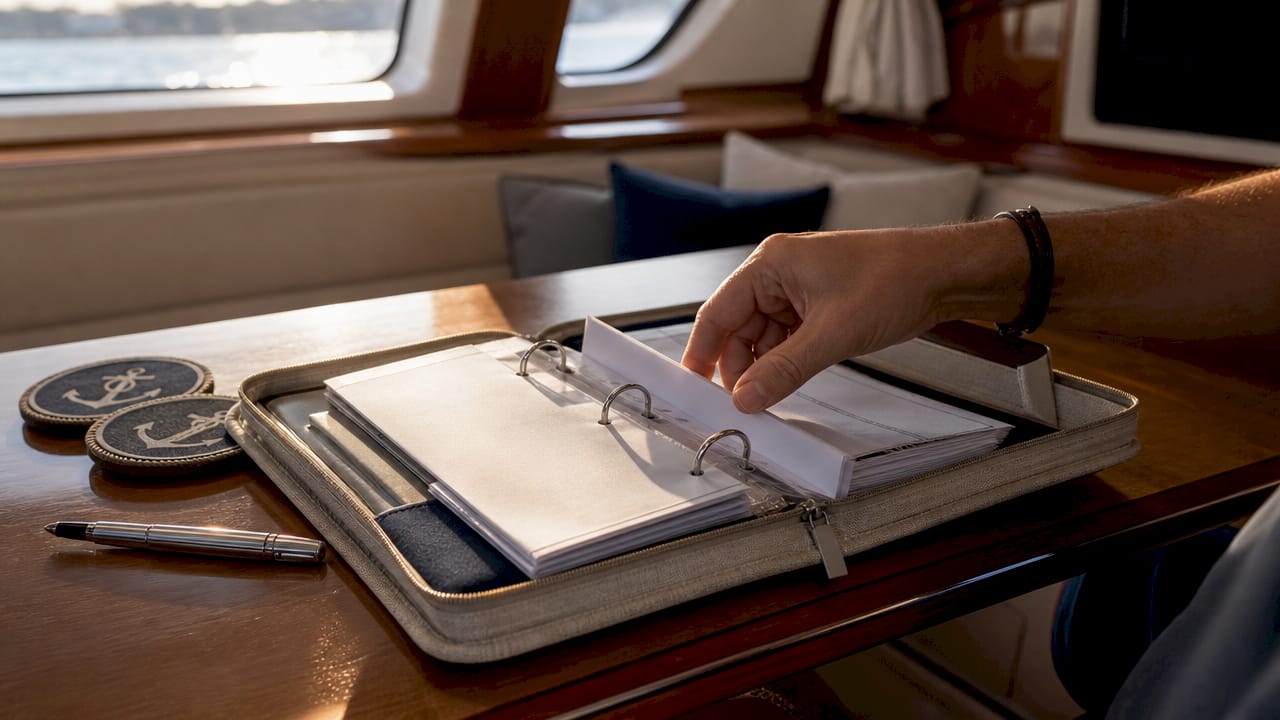
Proof of ownership covers the bill of sale or builder’s certificate. For a new build, the builder’s certificate serves as the original title. For a secondhand vessel, notarized proof of ownership is mandatory, and the bill of sale must match your passport name exactly. Even minor name mismatches between the bill of sale and your passport can trigger application rejection at most registries. That single detail catches more first-time owners off guard than any other.
Vessel identity documents include the deletion certificate if the yacht was previously registered elsewhere, plus tonnage and measurement certificates. The deletion certificate formally removes the vessel from its prior registry. Without it, two countries could technically claim jurisdiction over the same boat, which no registry will allow.
Owner identity requires a valid passport for individual owners. Corporate owners must supply full incorporation papers, including articles of association and a certificate of good standing. Incomplete corporate paperwork is one of the most frequent causes of registration delays worldwide.
| Document | Type | Purpose |
|---|---|---|
| Bill of sale or builder’s certificate | Ownership | Proves legal title to the vessel |
| Deletion certificate | Vessel identity | Removes prior registration |
| Tonnage and measurement certificate | Vessel identity | Confirms vessel dimensions for registry |
| Safety and survey certificate | Compliance | Meets flag state seaworthiness standards |
| Passport or incorporation papers | Owner identity | Confirms who legally owns the vessel |
| MMSI radio license | Compliance | Required for VHF radio and AIS operation |
| Insurance certificate | Compliance | Proof of valid hull and liability coverage |
Some registries also require an apostille on notarized documents, particularly when the owner’s nationality differs from the flag state. Confirm this requirement early, as apostille processing adds days to your timeline.
Pro Tip: Request certified copies of every document the moment you sign the purchase agreement. Waiting until you are ready to file creates a bottleneck that delays everything downstream.
How do you navigate the yacht registration process effectively?
Registration is not a single form. It is a sequence of decisions and submissions that must happen in the right order.
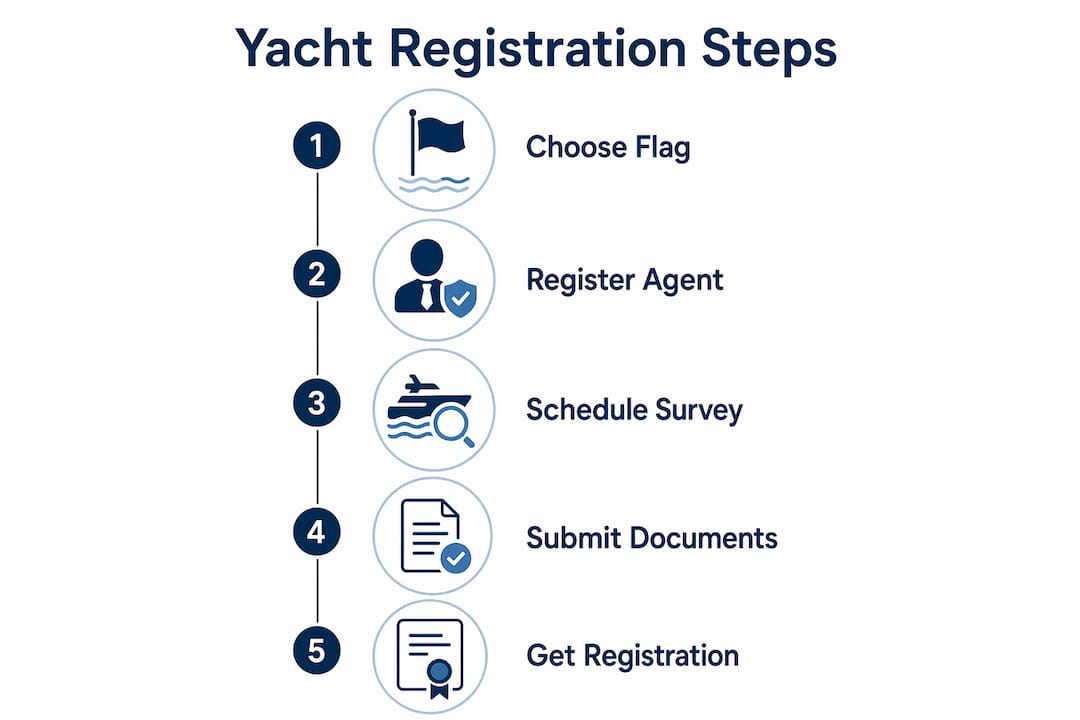
Step 1: Choose your flag state
Your flag state determines your legal obligations, annual fees, and processing speed. The U.S. Coast Guard Certificate of Documentation takes 4–8 weeks to process. Registries like San Marino process applications in as little as 2–7 days, while Malta and Poland typically take 2–4 weeks. Speed matters if you have a charter season approaching or a delivery window to meet.
Step 2: Appoint a registered agent
Most registries require an approved local agent to submit on your behalf. An experienced registered agent coordinates paperwork submissions and fast-tracks approvals, significantly lowering the risk of rejection. Think of the agent as the liaison between your document package and the bureaucracy. Trying to manage this yourself from abroad rarely ends well.
Step 3: Time your surveys and insurance carefully
Owners consistently underestimate how long surveys and insurance take to arrange. Preparation time commonly adds 1–2 weeks beyond the registry’s own processing window. Book your survey and contact your insurance broker the same week you sign the purchase agreement, not after.
Step 4: Submit a complete application
Submit all required documents together. Partial submissions invite delays and sometimes require you to restart the process entirely. Many modern registries bundle MMSI licensing, AIS setup, and insurance coordination into integrated service packages. Using these bundles reduces the number of vendors you coordinate with and speeds up the final approval.
Step 5: Receive provisional registration and complete final paperwork
Most registries issue a provisional certificate within days of accepting a complete application. This document allows the vessel to operate legally while the permanent certificate is processed. Use this window to finalize any outstanding items, such as the original deletion certificate if it was still in transit.
Pro Tip: Coordinate your survey appointment, insurance binder, and agent submission on the same week. Staggering these steps is the single biggest cause of self-inflicted delays.
You can also read the full yacht registration process guide on Yachts-bysteve for a deeper look at flag state comparisons and agent selection.
How to organize and maintain yacht paperwork after purchase
Buying the yacht and registering it is only the beginning. The real discipline is keeping your documentation current for the life of the vessel.
The gold standard for ongoing compliance is a digital compliance binder. This is a structured folder system, either cloud-based or on a dedicated device, that holds every active certificate, its expiration date, and a renewal checklist. Automated reminders set at 90, 30, and 7 days before each expiration are industry best practice. That three-tier reminder system means you never arrive at a port inspection with a lapsed safety certificate.
The documents that require active renewal tracking include:
- Vessel registration certificate (annual or biennial depending on flag state)
- Safety and survey certificates (typically annual)
- Insurance policy (annual renewal, with updated certificate of currency)
- MMSI radio license (varies by registry, often five years)
- Corporate ownership documents (annual good standing certificates for company-owned vessels)
Physical copies still matter. Keep a waterproof binder aboard with originals or certified copies of all active certificates. Port authorities and customs officers want to see paper, not a phone screen. Store digital backups in a cloud service like Google Drive or Dropbox so a lost binder never means a compliance crisis.
For corporate-owned yachts, add a separate folder for the ownership structure documents. These include the certificate of incorporation, shareholder register, and any power of attorney granted to the captain or manager. The documentation guide for company-owned yachts on Yachts-bysteve covers this in detail.
Pro Tip: Set calendar reminders at 90, 30, and 7 days before every document expiration. The 90-day alert gives you time to shop for better insurance rates. The 7-day alert is your safety net.
What are common paperwork pitfalls and how do you avoid delays?
The most expensive paperwork mistakes are also the most preventable. They share one common cause: leaving things too late.
| Common pitfall | Why it happens | How to avoid it |
|---|---|---|
| Name mismatch on bill of sale | Owner uses a nickname or middle name inconsistently | Verify all names match passport exactly before signing |
| Missing deletion certificate | Previous registry is slow to issue | Request deletion certificate the day you sign the purchase agreement |
| Incomplete corporate documents | Owner assumes basic incorporation papers are sufficient | Confirm full document list with your agent before submission |
| Lapsed insurance certificate | Renewal overlooked during busy season | Set automated reminders at 90, 30, and 7 days before expiration |
| Survey delays | Survey booked too late in the process | Schedule survey the same week as purchase agreement signing |
Name mismatches deserve special attention. Even minor discrepancies between the bill of sale and passport trigger rejection at most flag states. If your legal name includes a middle name that appears on your passport but not on the bill of sale, the registry will flag it. Consistency across every document is not optional.
Deletion certificates create their own timeline risk. The previous registry controls when they issue the document, and some are slower than others. Requesting it immediately after purchase, rather than waiting until you are ready to file, removes this variable from your critical path.
Working with an experienced registered agent addresses most of these risks at once. A good agent knows which flag states have stricter formatting requirements, which documents need apostilles, and how to follow up with registries when processing stalls. The cost of a qualified agent is modest compared to the cost of a delayed delivery or a missed charter season.
For a full breakdown of what to prepare when buying or selling, the essential yacht documentation guide on Yachts-bysteve is worth reading before you sign anything.
Key takeaways
Handling yacht paperwork correctly from day one prevents costly delays, legal complications, and compliance lapses that can ground your vessel at the worst possible moment.
| Point | Details |
|---|---|
| Assemble documents early | Gather bill of sale, deletion certificate, and surveys before approaching any registry. |
| Choose your flag state wisely | Processing times range from 2 days to 8 weeks depending on the registry you select. |
| Appoint a registered agent | A qualified agent reduces rejection risk and coordinates submissions on your behalf. |
| Build a digital compliance binder | Track every expiration date with automated reminders set at 90, 30, and 7 days out. |
| Verify name consistency | Every document must match your passport exactly to avoid automatic rejection. |
What I have learned from years of watching owners get this wrong
The paperwork side of yacht ownership is where the most avoidable stress lives. I have watched buyers close on beautiful vessels and then spend weeks in limbo because they requested the deletion certificate two weeks too late, or because the bill of sale used a shortened version of the owner’s name. These are not complex problems. They are timing and attention problems.
The owners who handle this well share one habit: they treat document preparation as part of the purchase negotiation, not as an afterthought. The moment heads of agreement are signed, they are already contacting the previous registry for the deletion certificate and booking the survey. By the time the purchase agreement is finalized, their document package is nearly complete.
I also believe the digital compliance binder is underused, especially among first-time owners who assume a physical folder is sufficient. The physical folder is fine for the boat. The digital system is what keeps you from missing a renewal while you are three weeks offshore. These are not competing approaches. You need both.
One more thing worth saying plainly: the flag state decision is not just about speed. It affects your tax exposure, your crewing requirements, and your inspection obligations for years. Choosing San Marino because it processes in 2–7 days makes sense for some owners. For others, the U.S. Coast Guard documentation carries weight with American marinas and lenders that a foreign flag cannot replicate. Talk to your agent about the full picture before you decide, not just the processing timeline.
— Jason
Working with Yachts-bysteve to simplify your ownership transition
The documentation process is one area where having the right partner makes a genuine difference. At Yachts-bysteve, we work alongside buyers throughout the purchase and registration process, coordinating with registries, agents, and surveyors so nothing falls through the gaps. Whether you are buying your first yacht or adding to an existing fleet, our team understands the full scope of yacht ownership paperwork and what it takes to get a vessel properly documented and ready to sail. If you want expert guidance from contract to certificate, choosing the right yacht broker is the most important first step you can take.
FAQ
What documents are required to register a yacht?
The core documents are a notarized bill of sale or builder’s certificate, a deletion certificate from any prior registry, tonnage and measurement certificates, a safety survey, owner identification, an MMSI radio license, and a valid insurance certificate.
How long does yacht registration take?
Processing times vary by flag state. The U.S. Coast Guard takes 4–8 weeks, while registries like San Marino process applications in 2–7 days. Malta and Poland typically fall in the 2–4 week range.
What is a deletion certificate and why does it matter?
A deletion certificate is an official document from a vessel’s previous registry confirming it has been removed from that register. Without it, most flag states will not accept a new registration application.
How do you keep yacht paperwork current after registration?
Set up a digital compliance binder with automated reminders at 90, 30, and 7 days before each document’s expiration date. Track registration renewals, insurance policies, safety certificates, and MMSI licenses separately.
Can a company own a yacht, and does that change the paperwork?
Yes, corporate ownership is common for tax and liability reasons. It adds a layer of documentation, including articles of incorporation, a certificate of good standing, and any relevant power of attorney. Incomplete corporate paperwork is one of the leading causes of registration delays.
Recommended
Featured Listings
2019 Bilgin MOONRAKER
$21,404,500
156
West Palm Beach Florida

2028 Columbus Yachts
$22,900,008
137
Ancona
2012 Benetti PATIENCE
$10,975,000
132
Fort Lauderdale Florida
2024 Silver Yachts
$25,400,000
117
2009 Hargrave BRANDI WINE
$2,995,000
114
Fort Lauderdale Florida

2028 Extra Yachts
$21,404,500
100
Ancona

2028 Extra Yachts Extra 96
$9,495,000
96
Ancona
2021 Sanlorenzo GATSBY
$6,795,000
96
Miami Beach Florida

1999 Northern Marine OFF LINE
$2,495,000
84
Ft Lauderdale Florida
2013 Pershing DOROTHY ANN
$1,750,000
82
Miami Beach Florida

1997 Ferretti Yachts
$850,000
80
La Paz
2008 Princess Yachts OCARALIA
$1,095,000
75
Charleston South Carolina
2014 Sunseeker
$1,400,000
68
New York New York

2024 Fairline
$2,750,000
68
Ft. Lauderdale Florida

2024 Sunreef Catallaxi
$3,700,000
60
Newport Rhode Island
2019 Vanquish Yachts IMPULSIVE
$1,799,000
58
Miami Beach Florida
2025 Formula BREAKTHROUGH III
$1,895,000
53
Miami Beach Florida

2023 Fairline
$900,000
45
Fort Lauderdale Florida
2012 Zeelander Mississippi Queen
$575,000
44
West Palm Beach Florida
2019 Bilgin 156'
$21,404,500
2028 Columbus Yachts 137'
$22,900,008
2012 Benetti 132'
$10,975,000
2024 Silver Yachts 117'
$25,400,000
2009 Hargrave 114'
$2,995,000
2028 Extra Yachts 100'
$21,404,500
2028 Extra Yachts 96'
$9,495,000
2021 Sanlorenzo 96'
$6,795,000
1999 Northern Marine 84'
$2,495,000
2013 Pershing 82'
$1,750,000
1997 Ferretti Yachts 80'
$850,000
2008 Princess Yachts 75'
$1,095,000
2014 Sunseeker 68'
$1,400,000
2024 Fairline 68'
$2,750,000
2024 Sunreef 60'
$3,700,000
2019 Vanquish Yachts 58'
$1,799,000
2025 Formula 53'
$1,895,000
2023 Fairline 45'
$900,000
2012 Zeelander 44'
$575,000