

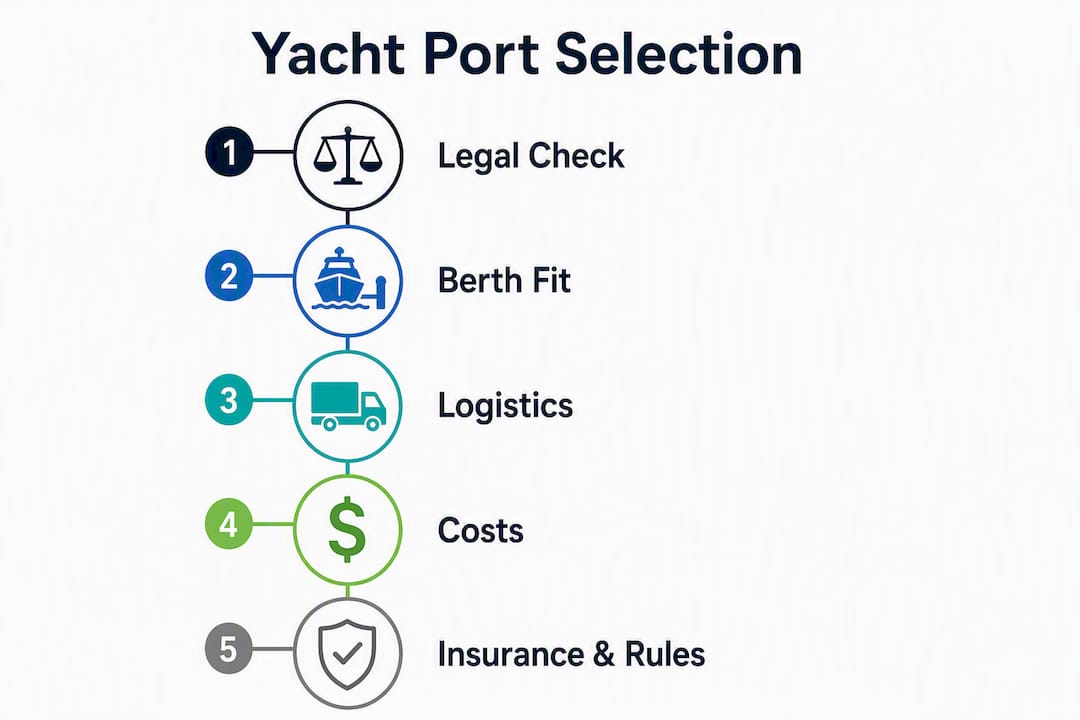
Overview — the right yacht home port comes down to four things: legal eligibility, berth fit and availability, operational logistics, and total recurring cost. Get those four in order and you can build a shortlist of two or three candidate ports before you ever set foot on a dock.
Before you read further, here is a practical starting point:
- Legal check: Confirm whether your vessel is USCG-documented or state-registered, because that determines what your hailing port designation actually means and what paperwork you need to change it.
- Berth-fit check: Pull your yacht’s length, beam, draft, and shore-power requirements and compare them against each candidate marina’s published slip dimensions and low-tide depths.
- Logistics check: Map the drive or flight time from your primary residence to each candidate port, and note whether the marina offers haul-out, fuel, and year-round access.
With those three checks done, you can rank your candidates before the first site visit. The sections below walk through each factor in depth, with a decision matrix and step-by-step change process at the end.
Table of Contents
- How to select a yacht home port: the legal framework first
- What berth costs and local taxes actually look like
- Does your marina actually fit your yacht?
- How your home port affects insurance and regulatory standing
- Step-by-step: how to change your official home port
- A decision matrix you can use on site
- When a broker or maritime lawyer is worth the fee
- Key Takeaways
- The trade-offs most owners only learn the hard way
- Yachts-bysteve can handle the port selection process for you
- Useful sources for next steps
How to select a yacht home port: the legal framework first
The single most clarifying question you can ask is whether your vessel is USCG-documented or state-registered, because the answer shapes everything about how your home port is designated and displayed.
USCG-documented vessels carry a Certificate of Documentation issued by the U.S. Coast Guard National Vessel Documentation Center. The hailing port on a documented vessel is a formal element of registry. It must appear on the stern and must match the paperwork on file with the USCG. It is not a mailing address or a sentimental choice. It is a legal identifier, and a mismatch between the stern marking and the documentation record is a compliance problem.
State-registered vessels follow each state’s boating authority rules, typically administered through the DMV or a dedicated marine division. The “home port” concept is less formal here — it is more a matter of where the vessel is principally kept for tax and registration purposes than a stern-marking requirement.
Most yachts over five net tons used in coastwise trade or charter are eligible for, and often required to carry, USCG documentation. Pleasure vessels under that threshold may choose state registration instead.
Documents to confirm before you designate a hailing port:
- Current Certificate of Documentation (USCG) or state registration certificate
- Bill of sale or proof of ownership in the name of the registering entity
- Prior registration or documentation records (to confirm no outstanding liens or flags)
- Proof of address if the state requires a nexus between owner residence and registration state
- Any existing mortgage or preferred ship’s mortgage that may require lienholder consent before a port change
Pro Tip: Never list a hailing port in a city where you have no legal or operational connection. Insurers and the USCG both look at whether the declared port reflects actual mooring patterns. A mismatch can complicate a claim or trigger a documentation audit.
What berth costs and local taxes actually look like
The single biggest recurring cost driver is berth availability and how marinas price their slips, which is primarily by vessel length and beam. Prime locations near major cruising corridors such as Miami and Palm Beach command significant premiums, while secondary marinas in the same region can offer meaningful savings for owners willing to add a short transit leg to their cruising.
| Cost Category | Key Variable | Practical Notes |
|---|---|---|
| Annual slip rental | Length overall, beam | Rates rise sharply at 50 ft and 100 ft thresholds |
| Long-term lease or berth purchase | Location, lease years remaining | Leasehold transfers often take 6–10 weeks from deposit to completion |
| State registration fees | Vessel value or length (varies by state) | Florida, California, and Texas each use different fee schedules |
| Utilities (shore power, water) | Power draw, liveaboard status | High-amperage powerboats pay materially more than comparable sailboats |
| Local sales/use tax on berth | State and county | Some states exempt long-term leases; others tax monthly |
| Marina service charges | Services used | Haul-out, pump-out, and fuel markups vary widely |
The lease-versus-purchase math deserves a moment. Buying a berth outright removes annual rental exposure and can appreciate in high-demand locations, but it ties up capital and involves title searches and legal steps similar to a land transaction. Leasehold berth purchases require buyers to verify remaining lease years and any subletting restrictions before paying a deposit. For owners who plan to upgrade their vessel within five years, a long-term lease often makes more sense than a purchase.
Understanding how location influences yacht buying costs is worth doing before you commit to any port, because state-level sales tax, use tax, and property tax rules on marina leases vary enough to shift the annual cost picture by thousands of dollars.
- High-demand resort marinas can require over a year’s advance notice for peak-season berths, which affects both cost and planning timelines.
- Some states charge use tax on vessels kept in-state beyond a threshold number of days, regardless of where the vessel is registered.
- Liveaboard fees, if applicable, are typically charged on top of the base slip rate.
Does your marina actually fit your yacht?
Size and protection come first. A marina without a solid breakwater or natural bay shelter will put constant strain on your lines and fenders, and poorly protected marinas increase wear and raise damage risk in ways that show up in both maintenance budgets and insurance premiums. After protection, the technical fit of the slip itself determines whether the port is operationally viable at all.
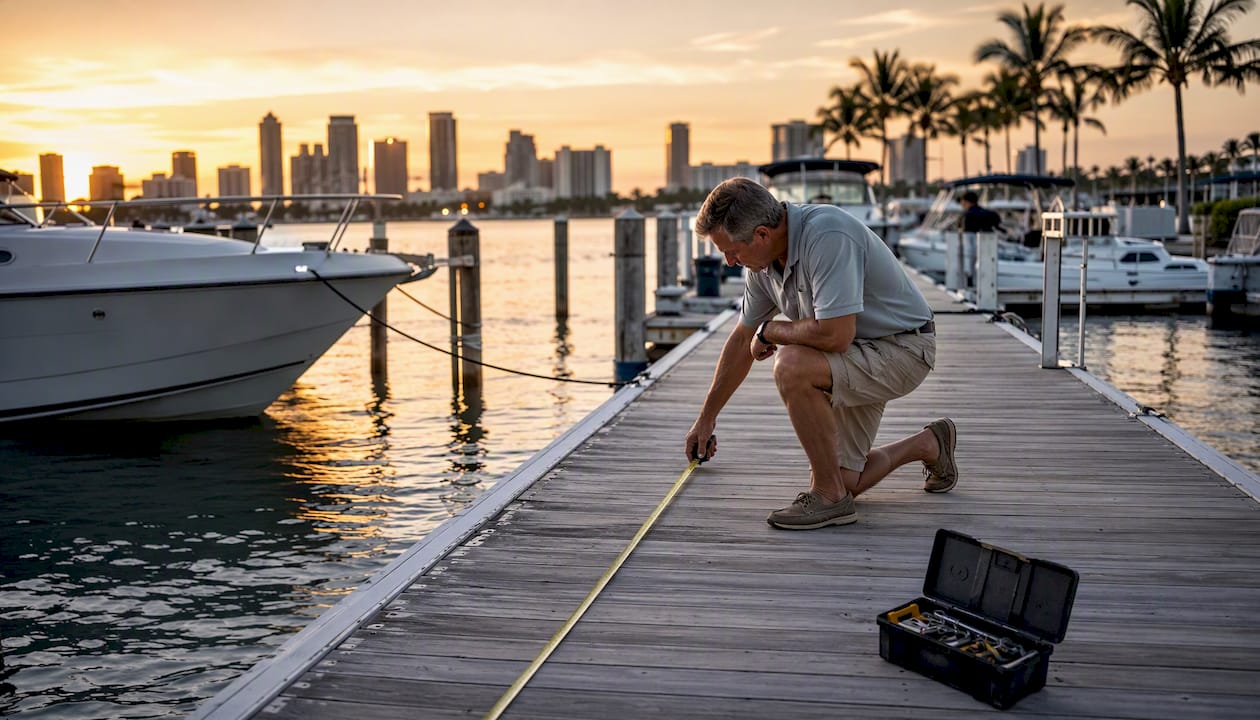
Technical compatibility failures are the most common reason owners are forced to relocate: a catamaran whose beam exceeds the slip width, a deep-keel monohull that grounds at low tide, or a powerboat whose shore-power draw exceeds the marina’s amperage capacity. Confirm every dimension before signing anything.
On-site checklist for marina fit:
- Slip length vs. LOA (add at least 10% buffer)
- Slip width vs. beam (catamarans need particular attention here)
- Charted depth at low tide vs. vessel draft
- Turning basin diameter for your vessel’s turning radius
- Shore-power capacity (30A, 50A, or 100A three-phase)
- Fuel dock access and fuel types available
- Pump-out station availability and frequency
- Haul-out and travel lift capacity for your vessel’s weight
- Onsite boatyard or proximity to a certified yard
Beyond the slip itself, operational logistics shape how much you actually use the yacht. Airport transfer times and local transport costs matter more than most owners admit. Local taxi and ferry pricing models can multiply transport costs for crewed yachts, particularly in island or resort locations where per-person fares replace per-trip pricing. Factor in provisioning options, seasonal congestion during regattas or holidays, and whether the marina restricts access during peak events.
Pro Tip: When evaluating berth size, think three to five years ahead. Buying a slightly oversized berth to accommodate a probable upgrade is almost always cheaper and less disruptive than relocating after a new purchase.
How your home port affects insurance and regulatory standing
Insurers do not treat all marinas equally. The underwriting assessment of your home port considers marina protection, local crime rates, storm exposure, and whether the facility is a recognized port of entry. A marina with no breakwater in a hurricane-prone region will attract higher premiums or coverage exclusions that a well-protected facility in the same state would not.
Common insurer checks tied to home port:
- Marina security (gated access, CCTV, night security)
- Storm and hurricane risk (is the marina in a designated storm hole?)
- Proximity to a customs port of entry (relevant for international cruising coverage)
- Local no-anchoring zones or restricted areas that affect where the vessel can legally shelter
- Seasonal restrictions that may void coverage if the vessel is in-region during named-storm season
Whether a marina is an official port of entry matters operationally for owners who cruise internationally. Some marinas have in-house customs agents or permanent customs offices, which reduces clearance time and complexity on return. Insurers sometimes factor this in when assessing the vessel’s typical operating pattern.
The regulatory side is equally concrete. Local no-anchoring zones, seasonal speed restrictions, and state-specific boating rules all apply based on where the vessel is principally kept. Confirm these with the marina harbormaster and your state’s boating authority before finalizing any port choice.

Step-by-step: how to change your official home port
The fastest practical route to changing a documented vessel’s hailing port is to secure the new berth agreement first, then submit the USCG documentation change, then update the stern marking. The whole process typically runs four to twelve weeks depending on whether you are changing a lease or completing a berth purchase.
- Confirm eligibility and new berth availability. Verify the new marina can accommodate your vessel’s dimensions and that a slip is available on the timeline you need.
- Execute a berth lease or purchase agreement. For leasehold purchases, allow for title verification and legal review. Leasehold transfers typically take 6–10 weeks from deposit to completion.
- Submit the USCG documentation change. For documented vessels, file a change of hailing port with the USCG National Vessel Documentation Center using the current Certificate of Documentation and the required fee. Processing times vary; allow several weeks.
- Update the stern marking. Once the new Certificate of Documentation is issued, update the hailing port marking on the stern to match exactly.
- Notify your insurer. Provide the new marina address, updated mooring location, and any change in storm-season plans. Failure to notify can void coverage.
- Notify any lienholders. If the vessel carries a preferred ship’s mortgage, the lienholder may require written notice or consent before a port change.
- Update state registration if applicable. For state-registered vessels, file the change with the relevant state boating authority and update any in-state tax filings.
Paperwork checklist to bring to the marina or broker:
- Current Certificate of Documentation or state registration
- Executed berth lease or purchase agreement
- Government-issued ID and proof of ownership entity
- Lienholder consent letter (if applicable)
- Insurance declaration page showing current home port
Pro Tip: Submit the USCG documentation change before you repaint the stern. If the application is rejected or delayed, you avoid the cost of repainting twice.
A decision matrix you can use on site
Weight the four core axes by your own priorities and score each candidate port from 1 to 5. An owner who charters frequently will weight customs port-of-entry status and provisioning access higher; an owner who cruises locally and values low cost will weight total recurring cost and proximity to home.
| Evaluation Axis | What to Score | Weight (example) |
|---|---|---|
| Legal / registration fit | USCG or state eligibility, documentation ease | High |
| Berth fit | LOA, beam, draft, shore power match | High |
| Protection and safety | Breakwater, storm hole, security | Medium-High |
| On-site services | Haul-out, fuel, maintenance, pump-out | Medium |
| Total recurring cost | Slip rent, utilities, taxes, transport | High |
| Operational logistics | Drive/flight time, provisioning, customs entry | Medium |
Printable on-site checklist:
- Slip length and beam confirmed against vessel specs
- Low-tide depth confirmed against vessel draft
- Shore-power amperage confirmed
- Haul-out capacity confirmed
- Fuel dock access confirmed
- Customs port-of-entry status confirmed
- Drive or flight time to owner’s primary residence noted
- Provisioning options within 30 minutes noted
- Lease length and renewal terms reviewed
- Storm-season policy reviewed with harbormaster
Example weighting in practice: An owner based in Fort Lauderdale with a 65-foot motoryacht and plans to cruise the Bahamas regularly would weight customs port-of-entry status and fuel dock access at the top, accept a modest premium for a protected slip in a marina with an onsite boatyard, and treat total cost as secondary to operational convenience. An owner with a 45-foot sailboat kept primarily for weekend sailing would likely invert that weighting entirely.
- List your top three candidate ports by name.
- Score each against the matrix above.
- Visit the top two in person before signing anything.
When a broker or maritime lawyer is worth the fee
Hire a broker or maritime lawyer when you face complex lease terms, cross-jurisdiction tax implications, a large berth purchase, or any documentation edge case. The fee is almost always smaller than the cost of a mistake.
What a yacht broker handles:
- Negotiating berth lease terms and securing competitive rates
- Verifying berth title or remaining leasehold years before deposit
- Sourcing alternative berthing when your first choice has a waiting list
- Coordinating local logistics, marina introductions, and harbormaster relationships
- Reviewing marina contracts for unusual clauses (subletting restrictions, exit penalties)
When to escalate to a maritime lawyer:
- Leasehold title disputes or unclear ownership history
- Tax residency questions tied to vessel use and home port designation
- Existing liens or preferred ship’s mortgages that complicate a port change
- Complex USCG documentation disputes or name/hailing port correction filings
- Cross-state or international registration questions
| Situation | Broker sufficient? | Maritime lawyer needed? |
|---|---|---|
| Standard annual slip rental | Yes | No |
| Long-term leasehold purchase | Yes, for negotiation | Yes, for title review |
| USCG hailing port change only | Yes | No |
| Lien or mortgage complication | No | Yes |
| Cross-state tax residency question | No | Yes |
| Berth title dispute | No | Yes |
Pro Tip: Ask any broker you consider working with whether they have existing relationships at the marinas on your shortlist. A broker who can call the harbormaster directly will often secure a berth that never appears on the public waiting list.
Yachts-bysteve supports owners through port selection and paperwork coordination as part of its brokerage service. If you are at the stage of matching a vessel purchase to a home port, working with an experienced yacht broker from the start keeps both decisions aligned.
Key Takeaways
Selecting the right yacht home port requires aligning legal eligibility, berth fit, operational logistics, and total recurring cost before committing to any marina agreement.
| Point | Details |
|---|---|
| Legal designation matters | USCG-documented vessels must display the hailing port on the stern; it must match documentation on file. |
| Berth fit is non-negotiable | Confirm slip length, beam, low-tide draft, and shore-power amperage before signing a lease. |
| Cost drivers vary by location | Prime marinas near major cruising corridors command premiums; secondary marinas in the same region can offer real savings. |
| Changing a port takes weeks | Leasehold transfers and USCG documentation changes typically run 6–10 weeks; notify insurer and lienholders promptly. |
| Yachts-bysteve coordinates the process | Yachts-bysteve supports owners with port selection, berth negotiation, and paperwork coordination as part of its brokerage service. |
The trade-offs most owners only learn the hard way
The conventional wisdom on choosing a home port tends to focus on scenery and prestige. Pick the glamorous marina, the argument goes, and the rest will follow. What that advice consistently underestimates is the operational friction that accumulates when a port is beautiful but poorly matched to how you actually use the yacht.
The most instructive cases are the ones where an owner chose a marina based on its reputation, signed a multi-year lease, and then discovered that the low-tide depth was marginal for their keel, the shore-power supply was inadequate for their generator load, or the nearest boatyard capable of handling their vessel was two hours away. None of those details appear in a marina brochure. They only surface during a thorough site visit or a conversation with an owner who already berths there.
Seasonality is the other factor that gets systematically underestimated. Waiting lists at high-demand resort marinas can stretch beyond a year for peak-season berths. Owners who plan to use their yacht most during summer or holiday periods need to account for that lead time when they are choosing a base, not after they have already committed to a vessel purchase.
The negotiation side has its own rhythm. Marinas respond to owners who come prepared: a confirmed vessel spec sheet, a clear lease-length preference, and references from a previous marina. Harbormaster relationships matter more than most owners expect. A broker with existing contacts at your target marina can often unlock a berth that never reaches the public waiting list, simply because the relationship exists.
One more thing worth saying plainly: the home port decision and the vessel purchase decision are not independent. The cruising grounds you want to reach, the maintenance infrastructure you need, and the tax environment you want to operate in all point toward the same small cluster of candidate ports. Make both decisions together, not sequentially.
Yachts-bysteve can handle the port selection process for you
Port selection is one of those decisions that looks straightforward until you are three marinas deep into site visits, comparing lease terms written in different formats, and trying to reconcile berth dimensions against your vessel’s spec sheet. Yachts-bysteve offers brokerage support that covers the full process, from building your initial shortlist to coordinating paperwork submissions and insurer notifications.
Specific deliverables include:
- Shortlist creation based on your vessel specs, cruising plans, and budget
- Marina negotiation and harbormaster introductions
- Lease and berth purchase contract review coordination
- USCG and state registration paperwork guidance
- Insurer and lienholder notification support
The goal is to arrive at a signed berth agreement and a correctly documented vessel without the back-and-forth that typically adds weeks to the process. To get started, connect with the Yachts-bysteve brokerage team and describe your vessel, your preferred cruising region, and your timeline.
Useful sources for next steps
The resources below are the most authoritative starting points for U.S. owners completing documentation, registration, and marina research.
- Yachting World: How to find the right berth for your yacht — practical marina evaluation guidance covering facilities, protection, and lease considerations.
- Coldwell Banker BVI: Choosing a home base for yachting — useful for owners considering Caribbean or international home bases, with practical notes on customs ports of entry and transport logistics.
For owners who want a structured approach to the full decision, the Yachts-bysteve brokerage team can walk you through each step, from legal eligibility to signed berth agreement.
Recommended
Featured Listings

2028 Columbus Yachts
$22,900,008
137
Ancona

2012 Benetti PATIENCE
$10,975,000
132
Fort Lauderdale Florida

2028 Kingship Kingship
$20,350,000
125

2024 Silver Yachts
$25,400,000
117

2009 Hargrave BRANDI WINE
$2,500,000
114
Fort Lauderdale Florida

2028 Extra Yachts
$20,350,000
100
Ancona

2028 Alpha
$12,100,000
100
Ft Lauderdale Florida

2028 Extra Yachts Extra 96
$9,495,000
96
Ancona

2021 Sanlorenzo GATSBY
$6,795,000
96
Fort Lauderdale Florida

2028 Kingship
$11,990,000
90

2028 Alpha
$9,894,500
90
Fano

2023 Azimut COMPASS
$7,950,000
88
Miami Beach Florida

1999 Northern Marine OFF LINE
$2,495,000
84
Ft Lauderdale Florida

2013 Pershing DOROTHY ANN
$1,375,000
82
Fort Lauderdale Florida

1997 Ferretti Yachts
$825,000
80
La Paz

2008 Princess Yachts OCARALIA
$1,095,000
75
Charleston South Carolina

2014 Sunseeker
$1,400,000
68
New York New York

2024 Fairline
$2,750,000
68
Ft. Lauderdale Florida

2019 Vanquish Yachts IMPULSIVE
$1,799,000
58
Miami Beach Florida

2021 Ferretti Yachts HAVEN
$1,595,000
57
Fort Lauderdale Florida

2025 Formula BREAKTHROUGH III
$1,895,000
53
Miami Beach Florida

2023 Fairline
$900,000
45
Fort Lauderdale Florida

2012 Zeelander Mississippi Queen
$575,000
44
West Palm Beach Florida
2028 Columbus Yachts 137'
$22,900,008
2012 Benetti 132'
$10,975,000
2028 Kingship 125'
$20,350,000
2024 Silver Yachts 117'
$25,400,000
2009 Hargrave 114'
$2,500,000
2028 Extra Yachts 100'
$20,350,000
2028 Alpha 100'
$12,100,000
2028 Extra Yachts 96'
$9,495,000
2021 Sanlorenzo 96'
$6,795,000
2028 Kingship 90'
$11,990,000
2028 Alpha 90'
$9,894,500
2023 Azimut 88'
$7,950,000
1999 Northern Marine 84'
$2,495,000
2013 Pershing 82'
$1,375,000
1997 Ferretti Yachts 80'
$825,000
2008 Princess Yachts 75'
$1,095,000
2014 Sunseeker 68'
$1,400,000
2024 Fairline 68'
$2,750,000
2019 Vanquish Yachts 58'
$1,799,000
2021 Ferretti Yachts 57'
$1,595,000
2025 Formula 53'
$1,895,000
2023 Fairline 45'
$900,000
2012 Zeelander 44'
$575,000