

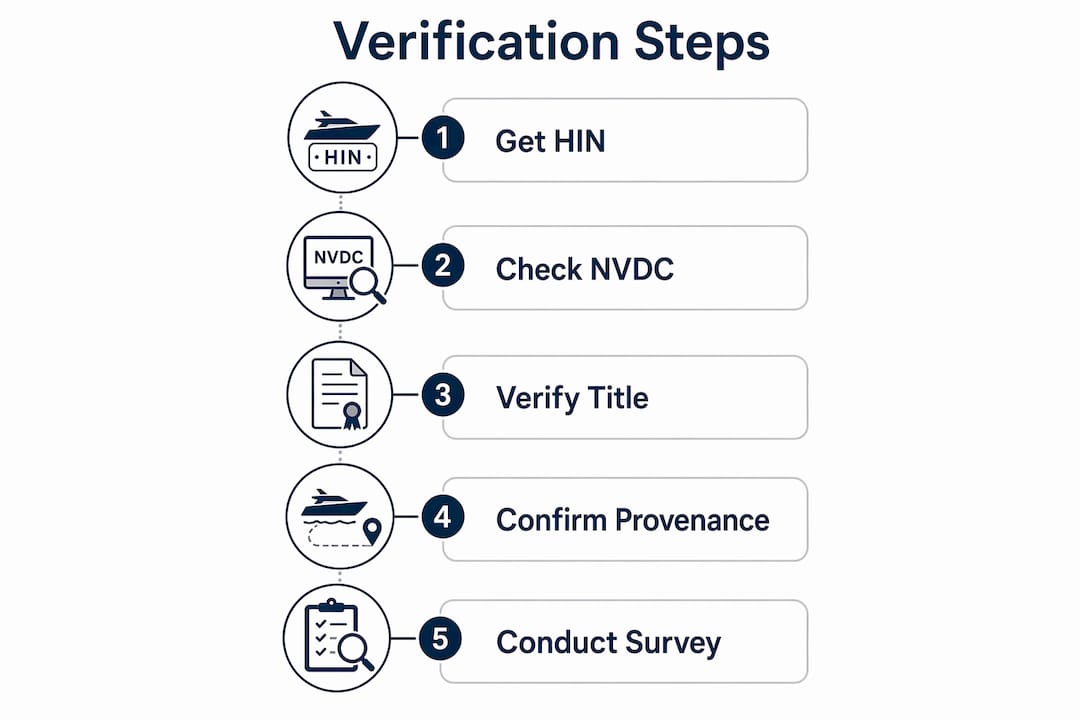
Overview: Verify a yacht’s authenticity by confirming registration and title with the USCG National Vessel Documentation Center (NVDC) or your state agency, decoding and cross-checking the hull identification number (HIN) against engine and equipment serials, obtaining builder certificates and a complete chain of bills of sale, and commissioning an accredited pre-purchase survey through SAMS or NAMSGlobal. Do all four before you sign anything or wire a single dollar.
Here is the order that matters most:
- Run an NVDC or state registration lookup to confirm documented status and check for recorded liens.
- Locate the primary HIN on the starboard transom and the duplicate HIN in an interior location; confirm they match and decode the 12-character format.
- Request the full chain of bills of sale, the builder’s certificate, and a current certificate of registry or registry transcript (Abstract of Title).
- Hire an accredited marine surveyor holding SAMS AMS/CMS or NAMSGlobal credentials before escrow opens. A broker’s “verified” badge is a starting point, not a substitute.
Table of Contents
- Your at-a-glance verification checklist
- How to verify U.S. documentation: NVDC vs. state registration
- How to check hull, engine, and equipment identifiers
- How to confirm clear title and run a lien search
- Confirming provenance: builder archives, certificates, and chain of ownership
- Commissioning an independent pre-purchase survey
- How to validate online listings and spot fraud
- What verification typically costs and how long it takes
- What to do when checks uncover problems
- How to choose a surveyor or broker you can trust
- Key Takeaways
- The verification steps most buyers skip
- Yachts-bysteve handles verification so you can focus on the purchase
- Authoritative sources to consult for yacht verification
Your at-a-glance verification checklist
Carry this list to every viewing, broker meeting, or surveyor briefing. Buyers who arrive with an organized request list close faster and surface title problems before survey day, according to yacht due diligence guidance.
Documents to request:
- Current certificate of registry (for USCG-documented vessels) or state title certificate
- Builder’s certificate or yard archive confirmation
- Complete chain of bills of sale from original owner to present seller
- Abstract of Title (NVDC transcript) showing all recorded encumbrances
- Maintenance logs, service invoices, and any prior survey reports
Identifiers to confirm:
- Primary HIN (starboard transom) and duplicate HIN (interior, hidden location)
- Engine serial numbers matched against service records
- Major electronics and equipment serials cross-checked with onboard logs
Who to contact:
- USCG NVDC for documented vessels (Abstract of Title, official number lookup)
- State DMV or boating agency for state-titled recreational vessels
- SAMS or NAMSGlobal directory for an accredited pre-purchase surveyor
Stop immediately if you see:
- A missing or illegible HIN on the transom
- A seller who cannot produce any bill of sale
- Inconsistent pricing for the same vessel across multiple listing sites
- Evasive answers about documentation or refusal to allow an independent survey
How to verify U.S. documentation: NVDC vs. state registration
The United States has two parallel registration systems, and knowing which one applies to your vessel shapes every document request you make.
Federal documentation (USCG NVDC) applies to vessels five net tons or more used in coastwise trade, fishing, or recreation on navigable waters. The NVDC record contains the vessel’s documented name, official number, flag endorsement, current certificate status, and any recorded mortgages or encumbrances. An Abstract of Title is the most useful extract: it usually has a cost and returns within a few business days. Always request the official abstract rather than accepting a broker-supplied screenshot. Screenshots are unverified and carry no legal weight.
State registration covers most recreational vessels under five net tons and those not enrolled in federal documentation. Each state maintains its own title and registration database. Florida’s records sit with the DHSMV; California uses the DMV; other states route through their fish and wildlife or parks agencies. State title searches are generally faster and cheaper than NVDC abstracts, but they only cover vessels titled in that state. If the vessel has moved between states, you may need to trace prior titles across multiple jurisdictions.
| Feature | USCG NVDC (Federal) | State Registration |
|---|---|---|
| Applies to | Documented vessels (≥5 net tons or voluntary enrollment) | Most recreational vessels not federally documented |
| Key document | Abstract of Title / Certificate of Registry | State title certificate |
| Shows liens/mortgages | Yes, recorded federal maritime liens | Varies by state; not always comprehensive |
| Typical cost | ~$75 for Abstract of Title | Varies by state; often free to low-cost lookup |
| Turnaround | 2–3 business days | Same day to 2–3 days |
| How to access | NVDC online portal or written request | State DMV, boating agency, or online portal |
Fields to confirm in any registry extract:
- Documented name and official number (must match the vessel’s displayed name and paperwork)
- Flag endorsement (fishery, coastwise, recreation)
- Documented owner’s name and address
- Recorded liens, mortgages, or encumbrances
- Certificate expiry date
For a deeper look at what these records contain, the yacht documentation guide at Yachts-bysteve walks through each field in plain language.
How to check hull, engine, and equipment identifiers
The HIN is the closest thing a yacht has to a fingerprint. Understanding how to read it, and where to find both copies, is one of the most reliable ways to authenticate a vessel.
Where to find the HINs:
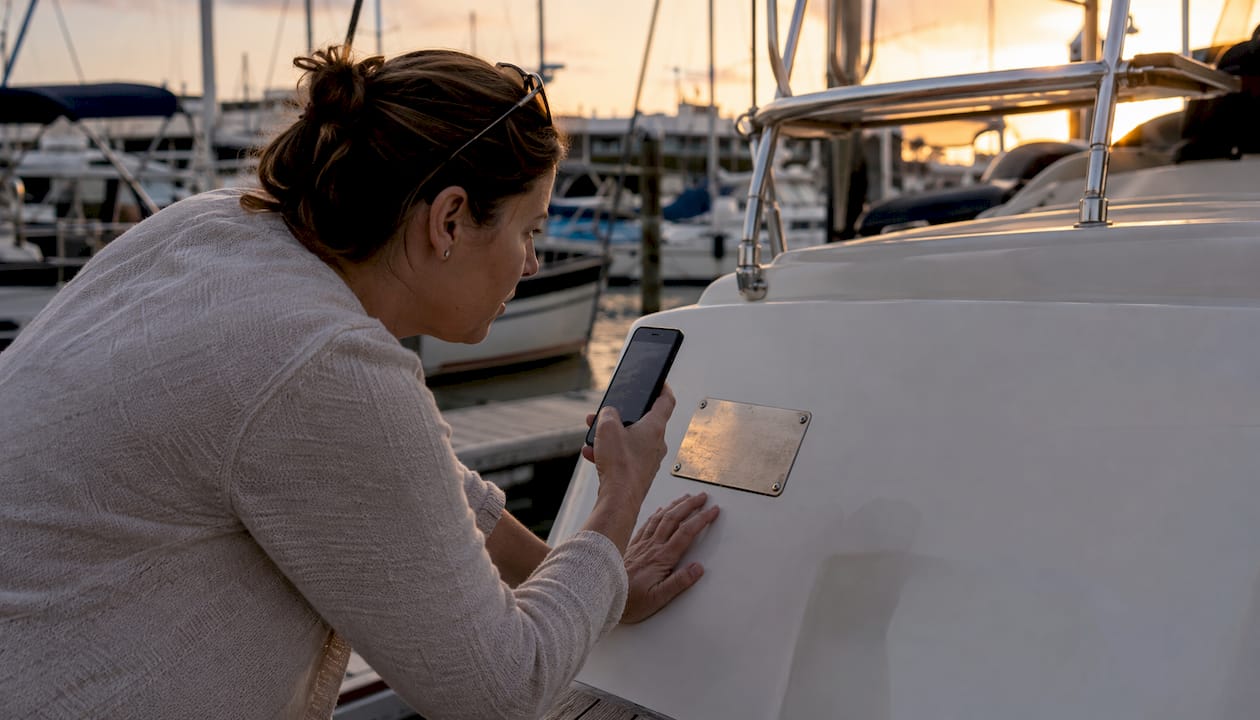
- Primary HIN: permanently affixed to the starboard side of the transom, at or near the top.
- Duplicate HIN: in a second interior location, typically under a fitting or in an unexposed area. Regulatory guidance requires two identical HINs permanently affixed to every vessel built after November 1, 1972.
How to decode the 12-character HIN:
The HIN format identifies the manufacturer, serial number, and month/year of certification, comparable in function to a car’s VIN. According to HIN decoding guidance, the first three characters are the Manufacturer Identification Code (MIC), characters four through eight are the serial number (note: the letters I, O, and Q are excluded from these positions), and the final four characters encode the month and year of certification and model year. You can verify the MIC against the Coast Guard’s published manufacturer code list to confirm the builder matches the listing.
Decoding the HIN also surfaces recalls, registration history, and ownership tracing data, making it a practical first step before you ever board the vessel. Learn more about reading hull identification numbers and what each segment tells you.
Engine and equipment serials:
Match engine serial numbers against the manufacturer’s build records and any service invoices in the maintenance log. For major electronics, cross-reference serial numbers with onboard equipment logs. Discrepancies between what is installed and what the service records describe are a quiet but serious red flag.
Red flags to watch for:
- Primary and duplicate HINs do not match
- HIN plate appears re-bonded, scratched around, or repainted
- Duplicate HIN is missing entirely
- Manufacturer code does not correspond to the listed builder
- Engine serials absent from or inconsistent with service records
Pro Tip: Ask the surveyor to locate and photograph the duplicate HIN before the formal survey begins. Discrepancies between the visible and hidden HIN are a classic fraud signal that experienced surveyors know to check first.
How to confirm clear title and run a lien search
Title clarity is where many buyers get hurt. A vessel can look perfect on the water and still carry a maritime lien that transfers with the sale.
- Understand the difference between documents. A certificate of registry confirms current documented status. A registry transcript or Abstract of Title lists every recorded encumbrance, mortgage, and transfer. You want the latter, not just the former.
- Request the Abstract of Title from the NVDC. For federally documented vessels, this is the authoritative lien record. The abstract costs approximately $75 and returns within 2–3 business days. Always secure a certified transcript rather than relying on broker-supplied copies.
- Run a state title search for state-registered vessels. Contact the relevant state DMV or boating agency. Some states offer online lookups; others require a written request. If the vessel has been titled in multiple states, trace each jurisdiction.
- Engage a maritime attorney for complex transactions. A buyer’s lawyer can issue a certified title opinion, evaluate gaps in the chain of title, and confirm that any recorded liens have been formally released before closing.
- Use escrow for every transaction. Hold funds with a licensed escrow agent or attorney until a clean title and written lien-release documentation are delivered. This applies to private sales as much as brokered ones.
Pro Tip: Never wire funds directly to a private seller based on verbal assurances of clean title. Even a straightforward-looking transaction can carry an undisclosed maritime mortgage. Escrow is the one structural protection that keeps your money safe while title is being confirmed.
For practical guidance on the bill of sale and transfer documentation that accompany a title transfer, the yacht bill of sale guide at Yachts-bysteve covers what to include and what to insist on.
Confirming provenance: builder archives, certificates, and chain of ownership
Provenance is the story of where a vessel came from and who owned it along the way. A complete provenance record is decisive for luxury yacht transactions, where the difference between an original build and a heavily modified or misrepresented vessel can be significant.
Builder’s certificate and yard records:
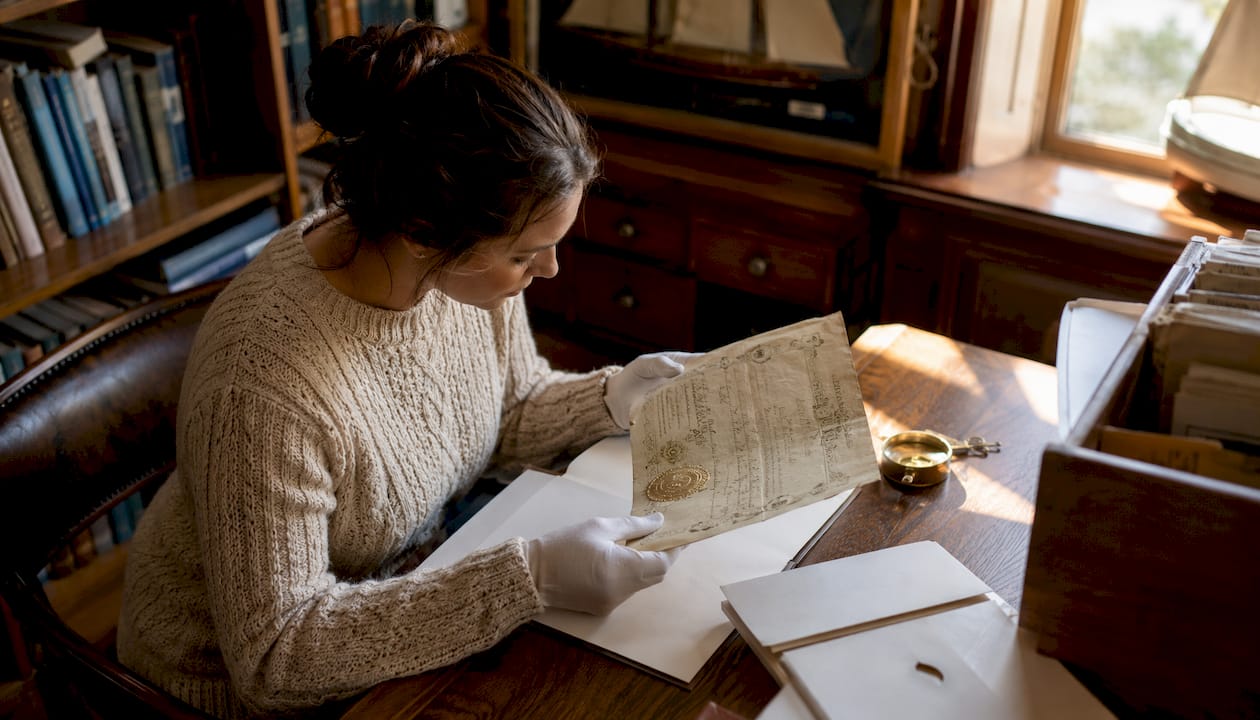
An original builder’s certificate, issued by the shipyard at delivery, confirms the vessel’s original specifications, build number, and delivery date. For well-known builders, yard archives can often confirm build details even decades later. A builder letter or stamped yard confirmation is the gold standard for provenance.
Chain of bills of sale:
A complete documentation pack includes a continuous chain of bills of sale from the original owner to the present seller. Gaps in this chain are transactional risks. A missing link does not necessarily mean fraud, but it does mean you cannot confirm unbroken legal title. A maritime attorney can advise on how to document or bridge missing transfers through affidavits or registry extracts showing prior recorded owners.
Certificates of Authenticity and spec matching:
Some builders, particularly in the classic and heritage yacht segment, issue Certificates of Authenticity that confirm original configuration. Cross-check the listing’s stated specifications against the original build data using the HIN or shipyard build number. Discrepancies in LOA, beam, engine type, or year of build are worth investigating before you proceed.
Acceptable forms of provenance proof:
- Original builder’s certificate or a stamped letter from the yard
- Registry extract showing all prior recorded transfers
- Continuous chain of bills of sale with dated signatures
- OEM equipment serial verifications matched to build records
- Prior survey reports referencing original specifications
Maintaining thorough yacht service records alongside provenance documents gives buyers the clearest possible picture of a vessel’s history.
Commissioning an independent pre-purchase survey
A pre-purchase survey by an accredited marine surveyor is the buyer’s primary independent check. No listing badge, broker assurance, or seller-supplied report replaces it.
Credentials to require:
Look for surveyors holding the SAMS Accredited Marine Surveyor (AMS) or Certified Marine Surveyor (CMS) designation, or NAMSGlobal accreditation through the National Association of Marine Surveyors. These credentials require demonstrated experience, ongoing education, and adherence to professional standards.
- Confirm accreditation. Verify the surveyor’s current standing directly through the SAMS or NAMSGlobal member directory before booking.
- Confirm vessel-type experience. A surveyor with deep experience in sailing yachts may not be the best choice for a large motoryacht with complex engineering systems. Ask specifically about recent surveys of comparable vessels.
- Review a sample report. A thorough survey report includes a condition summary, itemized deficiencies with estimated remediation costs, photographs, and recommended follow-ups. Ask to see one before you hire.
- Understand the scope. A full pre-purchase survey covers hull and structure (including ultrasonic thickness testing where relevant), engines and propulsion, electrical systems, fuel systems, safety equipment, electronics, and a sea trial. Anything less is a partial inspection.
What a survey report supports:
- Insurance underwriting (most insurers require a recent survey for vessels over a certain age or value)
- Escrow decisions and price negotiations
- Identification of deferred maintenance that affects value
Pro Tip: Provide any prior survey reports to the new surveyor before inspection day. They accelerate the process and reveal whether recurring deficiencies have been addressed or simply carried forward.
The yacht surveys guide at Yachts-bysteve explains surveyor credentials and what buyers should expect from the report in detail.
How to validate online listings and spot fraud
Most listing platforms accept broker-submitted data with minimal independent verification. A “verified” badge typically confirms only that the vessel exists and is represented by a broker, not that it has clean title or accurate specifications. Treat it as a starting point.
A listing verification badge tells you a broker submitted the data. It does not tell you the title is clean, the specs are accurate, or the vessel is free of encumbrances. Independent checks are the only way to confirm those things.
Red flags on listings:
- Multiple inconsistent prices for the same vessel across different sites
- No HIN listed, or a seller who refuses to provide it
- Duplicated photos appearing across unrelated listings under different vessel names
- Open listings with no named central agent or authority to sell
- Vague or evasive broker responses to direct documentation questions
Verification steps you can run yourself:
- Ask for the HIN and run your own NVDC or state lookup before viewing
- Request a copy of the central agency agreement or authority to sell
- Reverse-image search suspicious listing photos using Google Images or TinEye
- Confirm the broker’s credentials and membership in recognized industry associations
- Cross-check manufacturer specifications using the HIN against the builder’s published data
Pro Tip: If a listing shows the same vessel at two different prices on two different platforms, request the HIN from both listings and compare. Identical HINs confirm it is the same vessel; different HINs suggest at least one listing is fabricated or misattributed.
Understanding the difference between open and central agency listings helps you assess how much weight to give any single listing’s claims.
What verification typically costs and how long it takes
Budget and timeline vary by vessel size, season, and complexity. Here is a realistic picture for U.S.-based buyers.
| Verification step | Typical timeline | Typical cost (USD) |
|---|---|---|
| Initial listing checks and HIN lookup | Same day | Free |
| NVDC Abstract of Title | 2–3 business days | ~$75 |
| State title/registration search | Same day to 2–3 days | Free or small fee |
| Accredited pre-purchase survey | 1–2 weeks to schedule; 1-day inspection | — |
| Accredited pre-purchase survey | 1–3 weeks to schedule; 1–2 day inspection | — |
| Accredited pre-purchase survey | 2–4 weeks to schedule; multi-day inspection | — |
| Legal/title opinion from maritime attorney | 1–2 weeks | — |
A few factors push timelines and costs higher: peak season (spring and early summer) when surveyors are heavily booked, geographic travel required for the surveyor, and commercial or classed yachts that require additional technical review. International vessels with foreign VAT status or dual-flag documentation add another layer of complexity that typically requires specialist legal advice.
What to do when checks uncover problems
Finding a problem during verification is not necessarily a reason to walk away. It is a reason to pause, assess, and act deliberately.
- Stop all funds immediately. If a title gap, lien, or identifier mismatch surfaces, halt any deposit or wire transfer. Route all payments through a licensed escrow agent or attorney until the issue is resolved.
- Engage a maritime attorney. A lawyer experienced in vessel transactions can evaluate the severity of a title gap, advise on lien resolution, and determine whether the seller can cure the defect before closing.
- Use the surveyor’s report in negotiations. Documented deficiencies and estimated remediation costs are legitimate grounds for a price reduction. A well-structured purchase agreement should allow the buyer to renegotiate or withdraw based on survey findings.
- Involve law enforcement for suspected theft or HIN tampering. If the primary and duplicate HINs do not match, or if the vessel appears in a stolen-vessel database, contact the U.S. Coast Guard or local marine law enforcement. Preserve all evidence: photographs of the HIN discrepancy, copies of all communications with the seller, and any documentation provided.
- Know when to walk away. A seller who cannot produce a continuous chain of bills of sale, refuses to allow an independent survey, or cannot explain a lien on the Abstract of Title is presenting unacceptable risk. No vessel is worth a transaction that cannot be documented cleanly.
How to choose a surveyor or broker you can trust
The professionals you hire shape the quality of every check you run. Choosing poorly here undermines everything else.
Questions to ask a surveyor:
- What is your current accreditation status with SAMS or NAMSGlobal?
- How many surveys of this vessel type and size have you completed in the past two years?
- Can you provide a sample report and two professional references?
- What are your insurance and liability limits?
- Will your findings be delivered in a written, signed report?
Questions to ask a broker:
- Can you provide a copy of the central agency agreement or authority to sell?
- What professional associations are you a member of?
- Which escrow arrangements do you use, and who holds the funds?
- What documentation has the seller provided, and can I review it before making an offer?
Red flags for both roles:
- Evasiveness about credentials or refusal to name their accrediting body
- Unwillingness to put findings or agreements in writing
- Refusal to share references or sample reports
- Pressure to skip the formal survey or move to escrow before documentation is complete
The decision rule is straightforward: prefer accredited surveyors and brokers with documented processes, written agreements, and transparent references, even when they cost more than the alternative. In a luxury transaction, the cost of professional oversight is negligible compared to the cost of a bad purchase.
Key Takeaways
Verifying yacht authenticity requires four non-negotiable steps: an NVDC or state registration lookup, a decoded and cross-checked HIN, a complete provenance chain, and an accredited pre-purchase survey before escrow closes.
| Point | Details |
|---|---|
| Start with HIN and NVDC | Get the HIN first, run an NVDC or state lookup, and request the Abstract of Title before any deposit. |
| Never skip an accredited survey | Hire a SAMS or NAMSGlobal surveyor; listing badges do not confirm physical condition or clean title. |
| Require a complete provenance chain | Builder’s certificate, continuous bills of sale, and a clean Abstract of Title are non-negotiable for documented vessels. |
| Use escrow for every transaction | Hold funds with a licensed escrow agent until clean title and lien-release documentation are confirmed. |
| Yachts-bysteve assembles the documentation | Yachts-bysteve handles documentation pack assembly, NVDC lookups, and accredited surveyor referrals for buyer clients. |
The verification steps most buyers skip
There is a pattern worth naming honestly. Most buyers who get hurt in a yacht transaction did not skip the survey entirely. They skipped it on a vessel that “looked fine” or came from a seller who seemed credible. The survey is not a formality for uncertain purchases. It is the structural check that confirms what no document can: the actual physical and mechanical condition of the vessel on the day you are buying it.
The other step that gets skipped more than it should is the duplicate HIN check. Buyers look at the transom, see a clean plate, and move on. Experienced surveyors know that the interior HIN is where fraud surfaces. A thief who re-tags a stolen vessel almost never finds the hidden duplicate. That mismatch, when it exists, is one of the clearest signals in the entire verification process.
The documentation chain matters too, but for a different reason. A gap in the bills of sale does not always mean the vessel is stolen. Sometimes it means a private sale was handled informally, or an estate transfer was never properly recorded. What it always means is that you cannot prove unbroken legal title without additional work. A maritime attorney can often resolve these gaps, but only if you identify them before closing, not after.
The buyers who navigate these transactions with confidence are the ones who treat verification as a process, not a checklist to rush through. Every step builds on the last. The HIN tells you who built the vessel. The NVDC abstract tells you who owns it and what is owed on it. The survey tells you what condition it is actually in. The provenance chain tells you the story of how it got here. Together, they give you the full picture.
Yachts-bysteve handles verification so you can focus on the purchase
For buyers who want professional guidance through every step of this process, Yachts-bysteve offers a structured approach to luxury yacht brokerage that includes documentation pack assembly, NVDC and state registration lookups, and referrals to SAMS and NAMSGlobal-accredited surveyors. Rather than coordinating each check independently, buyer clients work with a single point of contact who manages the documentation request, flags title issues early, and connects you with the right legal and survey professionals before escrow opens.
The process is straightforward: share the vessel details, and Yachts-bysteve assembles the documentation request, runs the initial registry checks, and coordinates the survey schedule. Most buyers find that having an experienced broker manage this sequence saves time and surfaces problems that would otherwise reach closing. To get started, choose a yacht broker who handles verification as standard practice, not as an add-on.
Authoritative sources to consult for yacht verification
These are the primary records and directories buyers should go to directly.
- USCG National Vessel Documentation Center (NVDC): The authoritative source for Abstract of Title requests, official number lookups, and documented vessel status. Access through the NVDC online portal or submit a written request. Provides recorded mortgages, encumbrances, and certificate history for federally documented vessels.
- State DMV and boating agencies: For state-titled recreational vessels, contact the relevant state agency (e.g., Florida DHSMV, California DMV, or your state’s fish and wildlife or parks department). State records confirm title, registration status, and in some states, recorded liens.
- Society of Accredited Marine Surveyors (SAMS): Maintains a searchable directory of accredited surveyors holding AMS and CMS designations. Use it to verify a surveyor’s current standing before hiring.
- NAMSGlobal (National Association of Marine Surveyors): A parallel accrediting body with its own member directory. Both SAMS and NAMSGlobal directories are publicly accessible online.
- Builder and shipyard archives: Contact the original builder directly for yard records, build numbers, and Certificates of Authenticity. Many established builders maintain archives and can confirm original specifications by HIN or build number.
- BoatUS: Offers buyer guidance on title and lien checks, and provides some title support resources for recreational vessel buyers navigating state registration systems.
For documents you can access online, the NVDC portal and most state DMV sites allow basic lookups by vessel name or official number. Formal abstracts and certified title opinions require paid requests or attorney engagement, but the initial lookup costs nothing and takes minutes.
Recommended
Featured Listings

2028 Columbus Yachts
$22,900,008
137
Ancona

2012 Benetti PATIENCE
$10,975,000
132
Fort Lauderdale Florida

2028 Kingship Kingship
$20,350,000
125

2024 Silver Yachts
$25,400,000
117

2009 Hargrave BRANDI WINE
$2,500,000
114
Fort Lauderdale Florida

2028 Extra Yachts
$20,350,000
100
Ancona

2028 Alpha
$12,100,000
100
Ft Lauderdale Florida

2028 Extra Yachts Extra 96
$9,495,000
96
Ancona

2021 Sanlorenzo GATSBY
$6,795,000
96
Fort Lauderdale Florida

2028 Kingship
$11,990,000
90

2028 Alpha
$9,894,500
90
Fano

2023 Azimut COMPASS
$7,950,000
88
Miami Beach Florida

1999 Northern Marine OFF LINE
$2,495,000
84
Ft Lauderdale Florida

2013 Pershing DOROTHY ANN
$1,375,000
82
Fort Lauderdale Florida

1997 Ferretti Yachts
$825,000
80
La Paz

2008 Princess Yachts OCARALIA
$1,095,000
75
Charleston South Carolina

2014 Sunseeker
$1,400,000
68
New York New York

2024 Fairline
$2,750,000
68
Ft. Lauderdale Florida

2019 Vanquish Yachts IMPULSIVE
$1,799,000
58
Miami Beach Florida

2021 Ferretti Yachts HAVEN
$1,595,000
57
Fort Lauderdale Florida

2025 Formula BREAKTHROUGH III
$1,895,000
53
Miami Beach Florida

2023 Fairline
$900,000
45
Fort Lauderdale Florida

2012 Zeelander Mississippi Queen
$575,000
44
West Palm Beach Florida
2028 Columbus Yachts 137'
$22,900,008
2012 Benetti 132'
$10,975,000
2028 Kingship 125'
$20,350,000
2024 Silver Yachts 117'
$25,400,000
2009 Hargrave 114'
$2,500,000
2028 Extra Yachts 100'
$20,350,000
2028 Alpha 100'
$12,100,000
2028 Extra Yachts 96'
$9,495,000
2021 Sanlorenzo 96'
$6,795,000
2028 Kingship 90'
$11,990,000
2028 Alpha 90'
$9,894,500
2023 Azimut 88'
$7,950,000
1999 Northern Marine 84'
$2,495,000
2013 Pershing 82'
$1,375,000
1997 Ferretti Yachts 80'
$825,000
2008 Princess Yachts 75'
$1,095,000
2014 Sunseeker 68'
$1,400,000
2024 Fairline 68'
$2,750,000
2019 Vanquish Yachts 58'
$1,799,000
2021 Ferretti Yachts 57'
$1,595,000
2025 Formula 53'
$1,895,000
2023 Fairline 45'
$900,000
2012 Zeelander 44'
$575,000