

Overview: A U.S. superyacht owner needs, at minimum, a bespoke Hull & Machinery policy on an agreed-value basis, Protection & Indemnity (P&I) or third-party liability cover, crew and employers’ liability protection, and specialist endorsements for pollution, wreck removal, and war and strikes. Three actions to take right now: (1) contact a specialist marine broker and secure a pre-purchase offer of insurance before you sign anything, (2) arrange a condition and valuation survey, and (3) compile your management, crew certification, and charter documentation. Premium ranges typically run within a broad range of the vessel’s insured value, though the actual figure depends on vessel size, cruising area, intended use, and claims history. This insurance guide for superyachts walks you through every layer of that coverage, from the core policies to the specialty endorsements most owners overlook until it is too late.
Key Takeaways
Securing adequate superyacht insurance requires agreed-value H&M cover, P&I Club access, specialist endorsements, and a pre-purchase offer arranged through a specialist marine broker before closing.
| Point | Details |
|---|---|
| Secure cover before closing | Obtain a pre-purchase offer of insurance through a specialist broker before signing the purchase contract. |
| Agreed value is non-negotiable | Insist on agreed-value H&M cover; ACV policies pay depreciated value and can leave a significant gap on large vessels. |
| Budget 1%–5% of vessel value | Annual premiums typically fall in this range, shaped by cruising area, use, crew experience, and claims history. |
| P&I Club access matters | P&I Clubs provide liability pooling, crisis support, foreign correspondents, and the certificates ports require. |
| Document everything, always | Maintenance logs, crew records, and survey reports are the primary defense against claim denials under policy warranties. |
| Yachts-bysteve coordinates the process | Yachts-bysteve helps buyers connect with specialist brokers, schedule surveys, and organize underwriting documentation. |
Table of Contents
- What does a superyacht insurance policy actually cover?
- How are superyacht premiums calculated, and what should you budget?
- What do underwriters require, and how long does placement take?
- How do you choose the right marine broker or insurer?
- What happens during a claim, and how do you prevent losses?
- Common pitfalls new superyacht buyers face at purchase stage
- How should you approach renewal and ongoing policy review?
- What are the U.S. tax implications of owning and insuring a superyacht?
- Why early broker involvement changes everything
- Yachts-bysteve coordinates the purchase process so nothing falls through the cracks
- Sources
What does a superyacht insurance policy actually cover?
The short answer: far more than a standard boat policy, and the difference in wording matters enormously. Comprehensive superyacht programs commonly include hull and machinery on an “all risks” and “agreed value” basis, plus broad cover for tenders, contents, owner personal effects, and loss of charter hire when applicable. Here is what each layer does:
- Hull & Machinery (H&M): Covers physical loss or damage to the vessel, engines, and fittings. Agreed value means the insured sum is fixed at policy inception — no depreciation argument at claim time, which is the standard you want on a vessel worth millions.
- Protection & Indemnity (P&I) / Third-Party Liability: Covers third-party bodily injury, property damage, and collision liability. Large yachts often split coverage, placing P&I with a P&I Club rather than a commercial insurer, gaining access to pooled liability capacity and crisis support.
- Crew and Employers’ Liability: Covers crew injury, illness, and repatriation costs. MLC 2006 compliance requires documented crew welfare provisions; U.S.-flagged or U.S.-operating vessels must meet USCG crew standards as well.
- Pollution and Oil Liability (OPA 90): The U.S. Oil Pollution Act of 1990 imposes strict liability for oil discharges in U.S. waters. Owners must carry evidence of financial responsibility; P&I cover typically addresses this, but the certificate must be in order before entering U.S. ports.
- Wreck Removal: The Nairobi International Convention on the Removal of Wrecks, and many U.S. port authorities independently, require proof that a vessel owner can fund wreck removal. Port states commonly require third-party, pollution, and wreck-removal certificates for larger yachts, particularly those above 300 GT and 1,000 GT thresholds.
- War and Strikes: A separate endorsement or standalone policy covering loss from war, piracy, terrorism, and civil unrest. Standard H&M policies exclude these perils by default.
- Fine Art and Valuables: High-value artwork, jewelry, and collectibles aboard require scheduled coverage; standard H&M policies cap contents at modest sublimits that rarely reflect what is actually on board.
- Subsea and Tender Cover: Tenders, jet skis, and subsea equipment are often excluded from the main H&M policy unless specifically scheduled.
- Kidnap and Ransom (K&R): Relevant for yachts operating in higher-risk regions; a standalone K&R policy covers negotiation costs, ransom payments, and crisis management.
- Project and Builders’ Risk / Refit Cover: New builds and major refits require dedicated project risk cover. During yard periods, insurers typically require prior notification and proof of the yard’s contractor insurance; otherwise cover may be limited or attract additional premium.
- Charter and Charterers’ Liability: If you charter the vessel commercially, you need a charter endorsement and charterers’ liability cover. Operating as a charter yacht without notifying your insurer can void the policy entirely.
Pro Tip: Agreed value versus actual cash value (ACV) is not a minor clause. An ACV policy pays depreciated market value at the time of loss. On a $20M superyacht, that gap can run into millions. Always insist on agreed value, and confirm it is written explicitly into the policy schedule.
P&I Clubs do more than pool liability capacity. They provide foreign correspondents, crisis support, and the ability to issue certificates that can secure the release of a detained vessel overseas — practical advantages that a standard commercial liability policy rarely replicates.
How are superyacht premiums calculated, and what should you budget?
Premiums are bespoke. There is no rate card, and any broker who quotes you a firm number before reviewing your vessel details, cruising plans, and crew records is working from guesswork. Underwriters are selective, particularly for first-time large-yacht owners without professional management in place.
Primary premium drivers
- Vessel value: Higher insured values attract more scrutiny and, above roughly $10M, draw the attention of the London specialist market.
- Cruising area and geographical limits: U.S. East Coast hurricane exposure, Caribbean seasonality, and international itineraries each carry different risk weightings.
- Intended use: Private cruising carries a lower rate than commercial charter, which introduces third-party passenger liability and revenue-loss exposure.
- Crew experience and management: A professional captain with documented large-yacht experience and a recognized management company behind the vessel materially improves terms.
- Survey condition: A recent, clean condition survey is the single most effective document for securing favorable terms.
- Loss history: Prior claims, especially frequency claims, push premiums up and can limit market access.
- Security features and safety equipment: EPIRB, fire suppression systems, and AIS tracking are all positive underwriting signals.
- Deductibles: A higher deductible reduces premium but increases your out-of-pocket exposure per incident.
- Hurricane sublimits and named-storm wording: In the Gulf of Mexico and Atlantic seaboard, named-storm deductibles can be structured as a percentage of insured value rather than a fixed dollar amount — a meaningful difference on a large vessel.
Two anonymized cost illustrations
Example A: A $12M motor yacht, privately operated, cruising U.S. East Coast and Bahamas, professional captain, recent survey, no prior claims. A $50,000 deductible on H&M is typical at this level.
Example B: A $45M sailing superyacht, international itineraries including Mediterranean and Caribbean, occasional commercial charter, professional management company, two prior minor claims.
Deductible structuring deserves its own moment of attention. A fixed-dollar deductible of $100,000 on a $45M vessel is relatively modest. Read that clause carefully before binding.
What do underwriters require, and how long does placement take?
Securing a pre-purchase offer of insurance before finalizing a purchase is both common practice and genuinely advisable. Underwriters can decline risks outright, and discovering that on the day of closing is a problem no buyer wants.
Step-by-step placement timeline
- Initial enquiry (Day 1–3): Contact a specialist marine broker. Provide vessel name, flag, size, value, intended use, and cruising area. The broker assesses market appetite and identifies suitable underwriters.
- Proposal/PIQ and initial indication (Day 3–10): Complete a Proposal for Insurance Questionnaire (PIQ). The broker approaches Lloyd’s syndicates or specialist markets and returns indicative terms — not yet binding, but sufficient for purchase contract purposes.
- Survey and valuation (Day 10–30): Commission a condition and valuation survey from a recognized marine surveyor. This is the underwriter’s primary risk assessment tool.
- Underwriting review and endorsements (Day 30–45): Underwriters review the survey, crew CVs, management credentials, and itinerary. They may request additional information or apply endorsements (e.g., itinerary restrictions, hot-works exclusions).
- Binding and certificate issuance (Day 45–60): Once terms are agreed and premium confirmed, the policy binds. Certificates of insurance, P&I entry confirmation, and OPA 90 financial responsibility evidence are issued.
Pre-binding document checklist
- Builder or owner valuation and recent appraisal
- Condition and valuation survey (within 12–24 months, depending on vessel age)
- Captain’s CV, certificates of competency, and sea service record
- Management company credentials and safety management system documentation
- Planned cruising itinerary and flag state registration
- Refit scope and yard insurance certificate (if applicable)
- Fire suppression and safety equipment certificates
- Scheduled items list for art, tenders, and valuables
- Prior claims history and current/expiring insurance certificates
Pro Tip: An “offer to insure” or bridging policy can satisfy purchase contract requirements and marina or flag state demands before the full policy binds. Arrange this through your broker as soon as the PIQ is submitted — it closes the coverage gap between contract signing and policy inception, and it costs far less than the alternative of closing without cover in place.
How do you choose the right marine broker or insurer?
Use a specialist marine broker with proven superyacht placement experience. Price alone is a poor selection criterion — the difference between a policy that pays and one that does not often live in a single clause buried in the wording, and a generalist broker may never notice it.
Questions to ask every broker you interview
- How many superyachts of similar value and size have you placed in the past 12 months?
- Do you have direct access to Lloyd’s syndicates and specialist marine markets?
- How do you handle agreed-value confirmation and scheduled items?
- Which P&I Clubs do you work with, and can you arrange FD&D (Freight, Demurrage and Defence) legal support?
- What is your claims handling process, and who is my point of contact after hours?
- Can you provide a sample policy wording before I commit?
- What is your typical turnaround from PIQ submission to binding?
- Can you provide references from owners of comparable vessels?
Red flags that should give you pause
- No superyacht-specific references or case studies
- Inability or reluctance to provide sample policy wording
- Offering a consumer-grade marine policy for a vessel above $5M
- No access to P&I Club placement
- Vague answers on certificate issuance timelines
- Pressure to bind quickly without a completed survey
A useful internal resource for understanding what the selection process involves: how to choose a yacht broker covers the evaluation criteria that apply equally to insurance brokers and transaction brokers.
Must-have criteria: Lloyd’s or specialist market access, superyacht references, agreed-value capability, P&I Club access, clear claims contact.
Nice-to-have criteria: In-house claims team, FD&D legal line, loss-prevention advisory service, multi-asset bundling capability.
What happens during a claim, and how do you prevent losses?
Notify your broker and P&I Club immediately after any incident. Preserve evidence, follow crew emergency procedures, and document everything from the first moment. Quick, documented action is the difference between a smooth recovery and a disputed claim.
Claims checklist: immediate steps
- Secure the vessel and crew safety first; activate emergency procedures.
- Notify your broker and P&I Club within the timeframe specified in your policy (often 24–48 hours).
- Photograph and video all damage before any repairs begin.
- Gather witness statements and crew log entries from the incident period.
- Secure port authority certificates and any required security deposits.
- Do not admit liability to third parties; refer all claims to your P&I Club.
- Coordinate with the appointed surveyor and, where needed, legal support through your FD&D line.
Emergency contacts every owner should carry aboard
- Broker’s 24-hour claims line
- P&I Club correspondent for the relevant port or region
- FD&D legal support line
- Salvage company contact (pre-agreed where possible)
- Local agent contact for the cruising area
Insurers may deny claims if owners breach warranties such as maintaining seaworthiness, following manufacturer maintenance schedules, or keeping proper logs. Documentation is the primary defense — not just in a crisis, but as a daily discipline.
Pro Tip: Maintain a dedicated maintenance log that records every service, repair, and safety inspection with dates, technician names, and parts used. Underwriters and surveyors treat a clean, consistent log as evidence of a well-managed vessel. A gap in the record, even an innocent one, can complicate a claim.
Loss prevention measures that materially reduce claim frequency include: storm and hurricane plans filed with your marina, pre-approved yards for any refit work, updated fire suppression system certifications, and regular crew drills documented in the ship’s log.
Common pitfalls new superyacht buyers face at purchase stage
The purchase stage is where most insurance problems are created, not the cruising season. Here are the mistakes that recur most often, and the immediate corrective action for each.
- Failing to secure a pre-purchase offer: Buyers sign purchase contracts assuming insurance will follow. Action: contact a specialist broker before signing and obtain an offer to insure tied to a survey schedule.
- Inadequate or outdated survey: A survey more than 12–24 months old may be rejected by underwriters, delaying binding. Action: commission a fresh condition and valuation survey as part of the purchase due diligence.
- Undisclosed refit or charter plans: Owners who change operational use without notifying insurers risk voiding coverage entirely. Action: notify your broker before any change in use and obtain a written endorsement.
- Unqualified captain or crew: Underwriters may decline or exclude cover if the captain’s certificates do not match the vessel’s tonnage or trading area. Action: verify captain and crew qualifications against the policy’s crew warranty before binding. For a detailed look at crew roles and certification requirements, the luxury yacht crew roles guide is worth reviewing.
- Failure to update itinerary: Sailing outside the agreed geographical limits without prior notification can void cover for any incident in that area. Action: notify your broker of any itinerary change and confirm coverage in writing.
- Improper scheduling of high-value items: Art, jewelry, and tenders left unscheduled are either excluded or covered at nominal sublimits. Action: provide a full items schedule with valuations at policy inception.
- Weak yard contractor insurance: Owners should confirm that contractors and shipyards carry appropriate liability insurance and that policy wording does not limit recovery to the value of the works rather than the yacht’s full insured value. Action: request the yard’s liability certificate before any work begins.
- Treating insurance as a post-sale formality: Insurance placement is part of the purchase timeline, not an afterthought. Start the process the moment a vessel is under serious consideration.
How should you approach renewal and ongoing policy review?
Renewal is not a rubber-stamp exercise. A superyacht’s risk profile shifts every year — new cruising areas, a refit, a change in management, a crew turnover, or a market shift in underwriting appetite can all affect both your premium and your coverage adequacy.
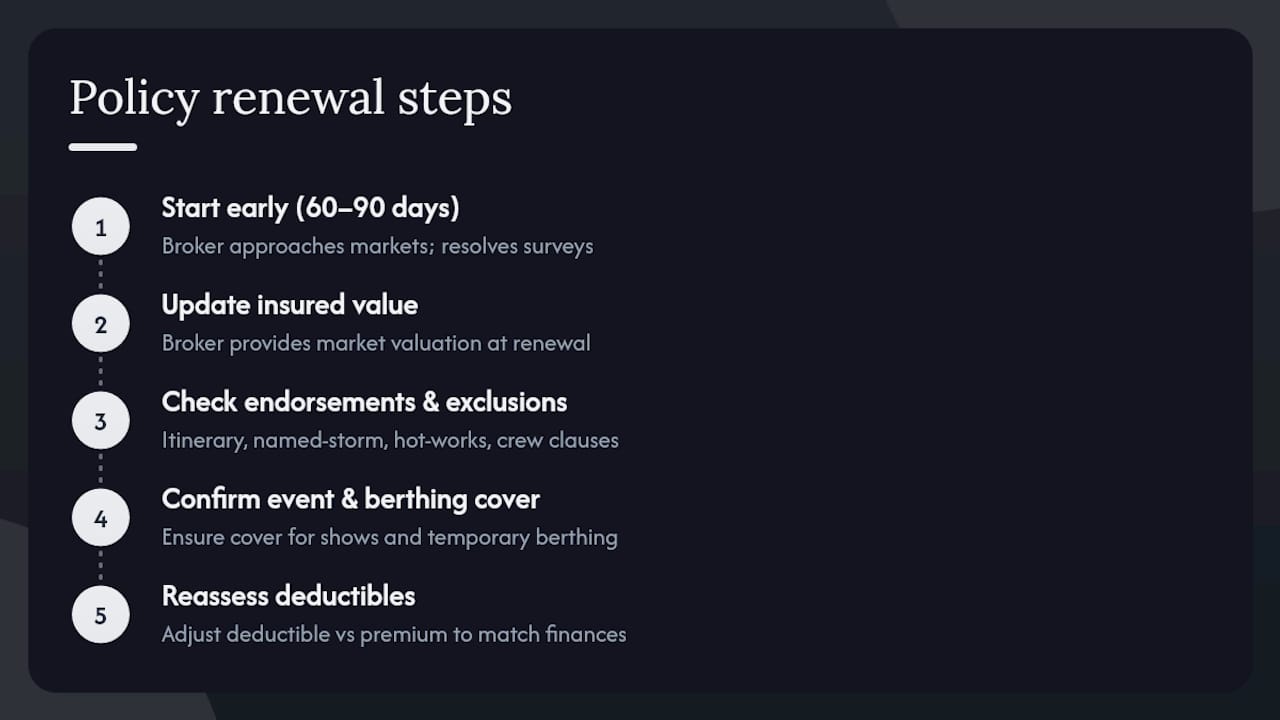
Start the renewal process at least 60–90 days before expiry. That window gives your broker time to approach multiple markets, negotiate terms, and resolve any survey requirements before the policy lapses. A last-minute renewal almost always produces worse terms.
At each renewal, review the insured value against current market valuations. Superyacht values have moved significantly in recent years; an agreed value set three years ago may now be materially below replacement cost, leaving you exposed in a total loss. Your broker should provide a market valuation update as part of the renewal process.
Review every endorsement and exclusion, not just the premium. Itinerary restrictions, named-storm wording, hot-works exclusions, and crew warranty clauses can all shift between policy years without a headline change in premium. The luxury yacht insurance essentials guide covers the key clauses to scrutinize at renewal in detail.
If you attended major yachting events during the year, such as the Monaco Yacht Show, note that temporary operations and logistics during those events carry their own risk considerations. Partners like TranspOnyx’s Monaco Yacht Show transfers handle the shoreside logistics, but confirm your policy covers the vessel during show attendance and any temporary berthing arrangements.
Finally, use renewal as the moment to reassess your deductible structure. If your financial position has changed, a higher deductible in exchange for a lower premium may now make sense — or the reverse.
What are the U.S. tax implications of owning and insuring a superyacht?
U.S. tax treatment of superyacht ownership is genuinely complex, and the rules turn on how the vessel is used, how it is titled, and where it is registered. This is general information; confirm your specific position with a qualified maritime tax attorney or CPA.
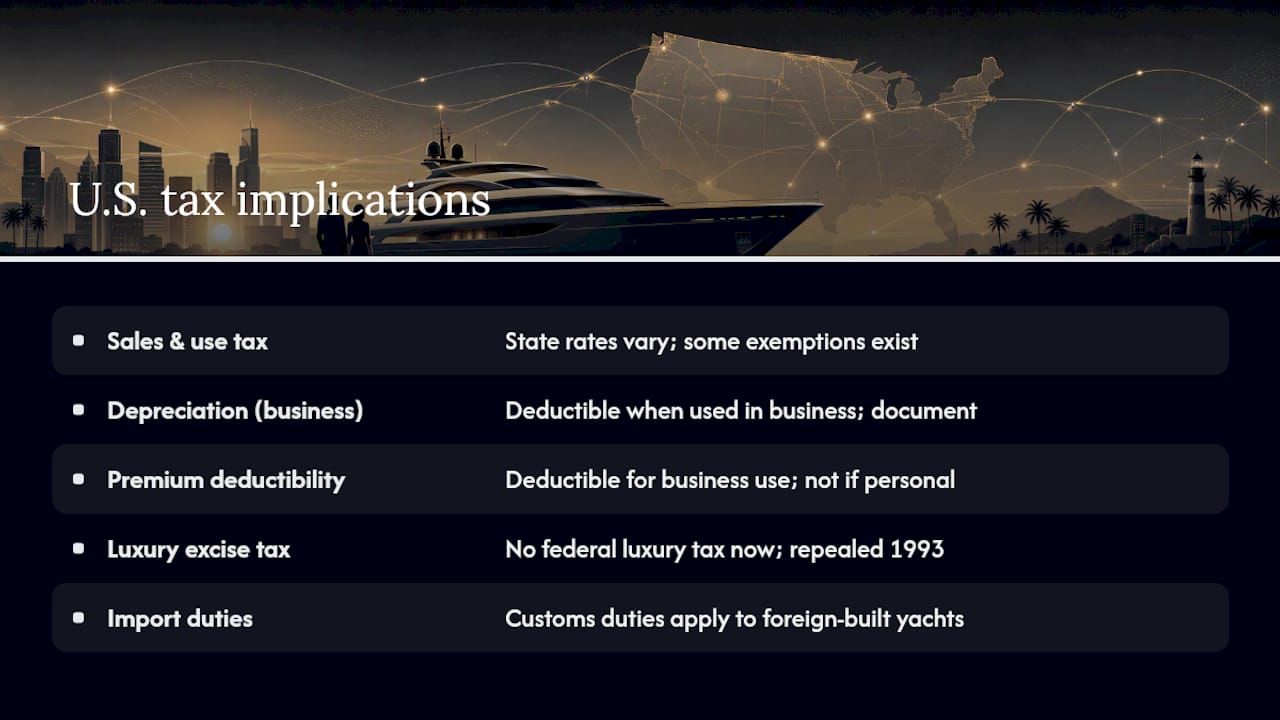
Sales and use tax: Most U.S. states impose sales or use tax on yacht purchases. Rates and exemptions vary significantly by state. Florida, for example, caps its sales tax on vessels, while California applies its standard rate with fewer carve-outs. Some buyers structure purchases through out-of-state LLCs or take delivery offshore to manage this exposure, but state tax authorities have become increasingly sophisticated at challenging these arrangements.
Depreciation and business use: If the vessel is used in a legitimate charter or business operation, owners may be able to depreciate the asset under IRS rules. Mixing personal and charter use without careful documentation is a common audit trigger.
Insurance premium deductibility: Premiums paid on a vessel used in a trade or business are generally deductible as an ordinary business expense. Premiums on a purely personal-use vessel are not deductible. If the vessel operates under a charter management arrangement, the deductibility question depends on whether the arrangement meets IRS standards for a profit-motivated activity.
Luxury excise tax history: The U.S. imposed a luxury excise tax on yachts in the early 1990s; it was repealed in 1993 after significant industry disruption. No equivalent federal luxury tax currently applies to yacht purchases, though this is a policy area that periodically resurfaces in congressional discussion.
Import duties: Foreign-built yachts imported into the U.S. for sale or permanent use are subject to customs duties. The rate depends on vessel type and country of origin; a specialist customs broker should be engaged for any foreign-built vessel entering U.S. commerce.
Why early broker involvement changes everything
The buyers who navigate superyacht insurance most smoothly share one habit: they called a specialist marine broker before they fell in love with a specific vessel. By the time a purchase is emotionally decided, the leverage to negotiate survey timing, management requirements, and interim cover has largely evaporated.
Early engagement does more than speed placement. It shapes the terms. A broker who has time to approach multiple Lloyd’s syndicates and specialist markets before a deadline can negotiate agreed-value confirmation, favorable named-storm wording, and Nairobi Wreck Removal endorsements that a rushed placement simply cannot secure. The difference between a well-negotiated program and a standard one is not marginal — it can be the difference between a claim that pays in full and one that pays at depreciated value.
A purchase that nearly fell apart over a coverage gap was saved by a single phone call made three weeks before closing, when the buyer’s broker identified that the vessel’s flag state required a P&I certificate the seller’s existing insurer could not provide in time. The buyer’s broker arranged an interim entry with a P&I Club within 48 hours. Closing happened on schedule.
The recommended next step is straightforward: contact a specialist marine broker, request an offer to insure, and schedule the survey before you accept the vessel. Those three actions, taken early, protect everything that follows.
Yachts-bysteve coordinates the purchase process so nothing falls through the cracks
Securing the right insurance for a superyacht purchase involves more moving parts than most buyers anticipate: survey scheduling, broker introductions, document compilation, flag state requirements, and interim cover arrangements all need to happen in a specific sequence. Yachts-bysteve works alongside buyers throughout the pre-purchase process, helping coordinate surveys, connecting clients with specialist marine brokers, and organizing the documentation that underwriters require before binding. For buyers who prefer a single point of coordination rather than managing each specialist independently, that kind of structured support reduces friction at exactly the stage where delays are most costly. To understand how the brokerage process works and how Yachts-bysteve fits into your purchase, explore the yacht brokerage guide and reach out to discuss your specific vessel and timeline.
Sources
- Superyacht insurance: How to choose the best policy for your yacht
- Types of Insurance
- Is it time to review your approach to yacht insurance? | Praxis
- Superyacht insurance | Howden UK
- Tommy Ho: Unexpected yacht insurance tips to bear in mind | Yacht Style
This article is general information, not a substitute for advice from a qualified financial advisor. Consult a qualified financial professional about your own circumstances before acting on anything here.
Recommended
Featured Listings

2028 Columbus Yachts
$22,900,008
137
Ancona
2012 Benetti PATIENCE
$10,975,000
132
Fort Lauderdale Florida
2028 Kingship Kingship
$20,350,000
125
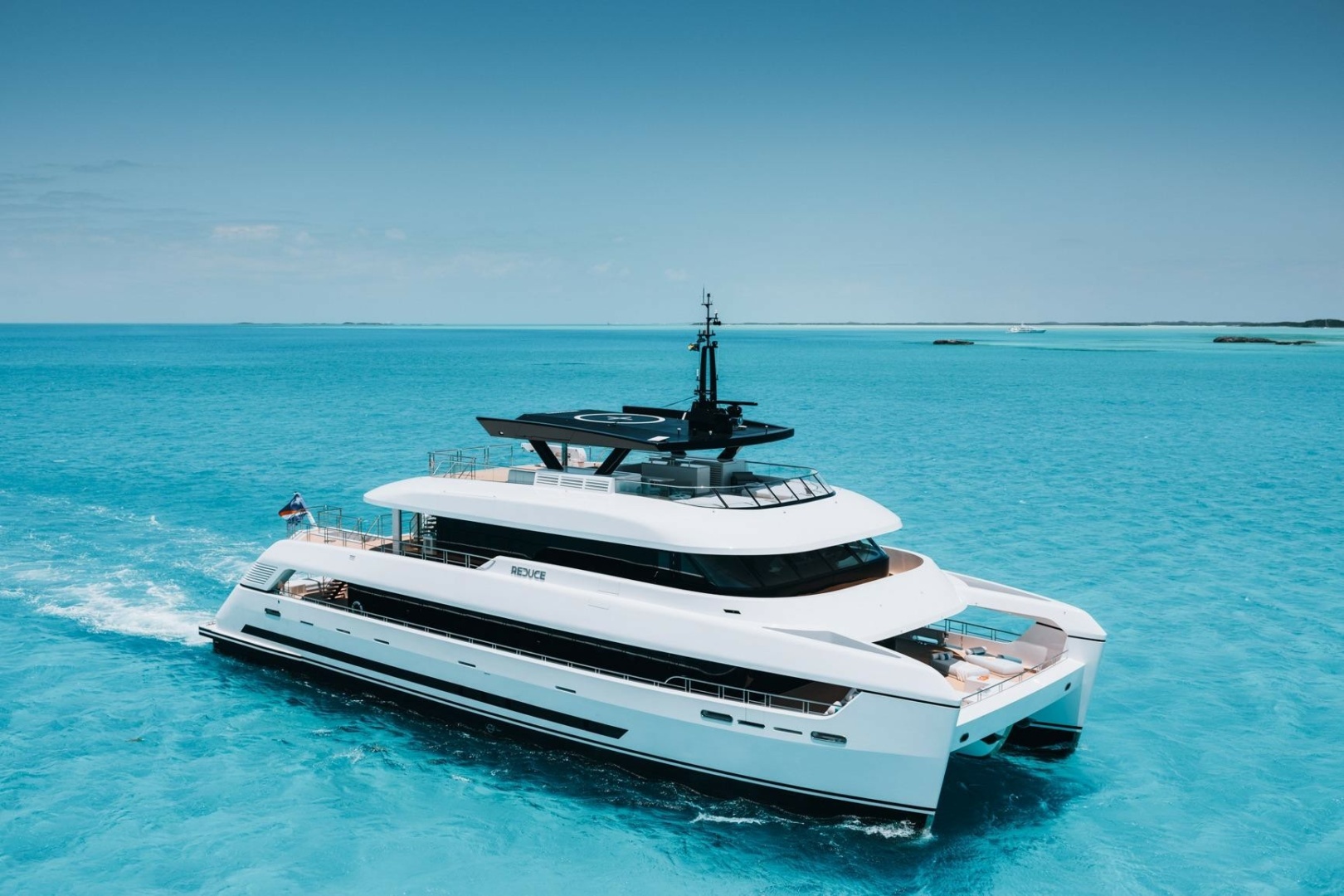
2024 Silver Yachts
$25,400,000
117
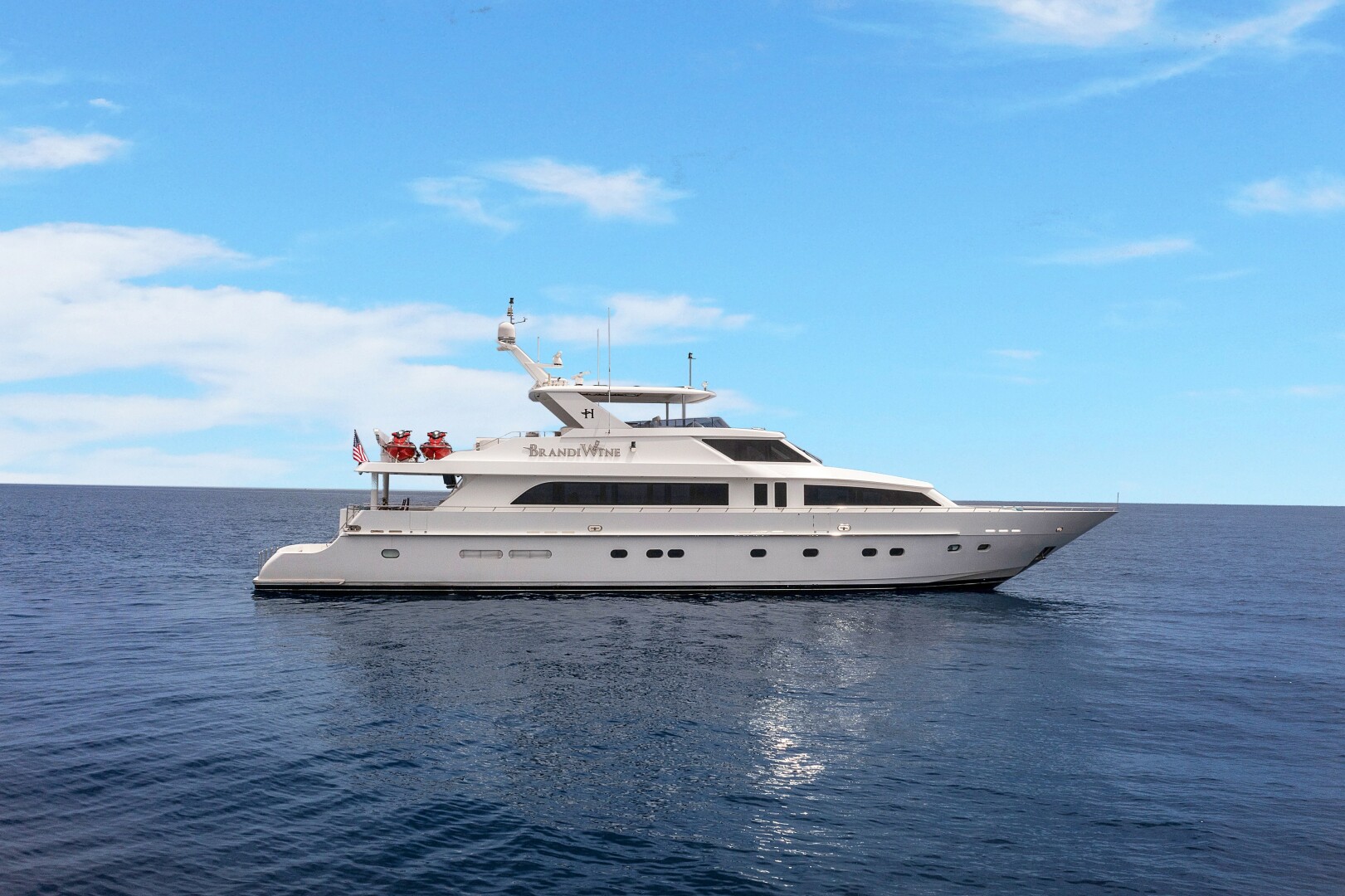
2009 Hargrave BRANDI WINE
$2,500,000
114
Fort Lauderdale Florida

2028 Extra Yachts
$20,350,000
100
Ancona

2028 Alpha
$12,100,000
100
Ft Lauderdale Florida

2028 Extra Yachts Extra 96
$9,495,000
96
Ancona
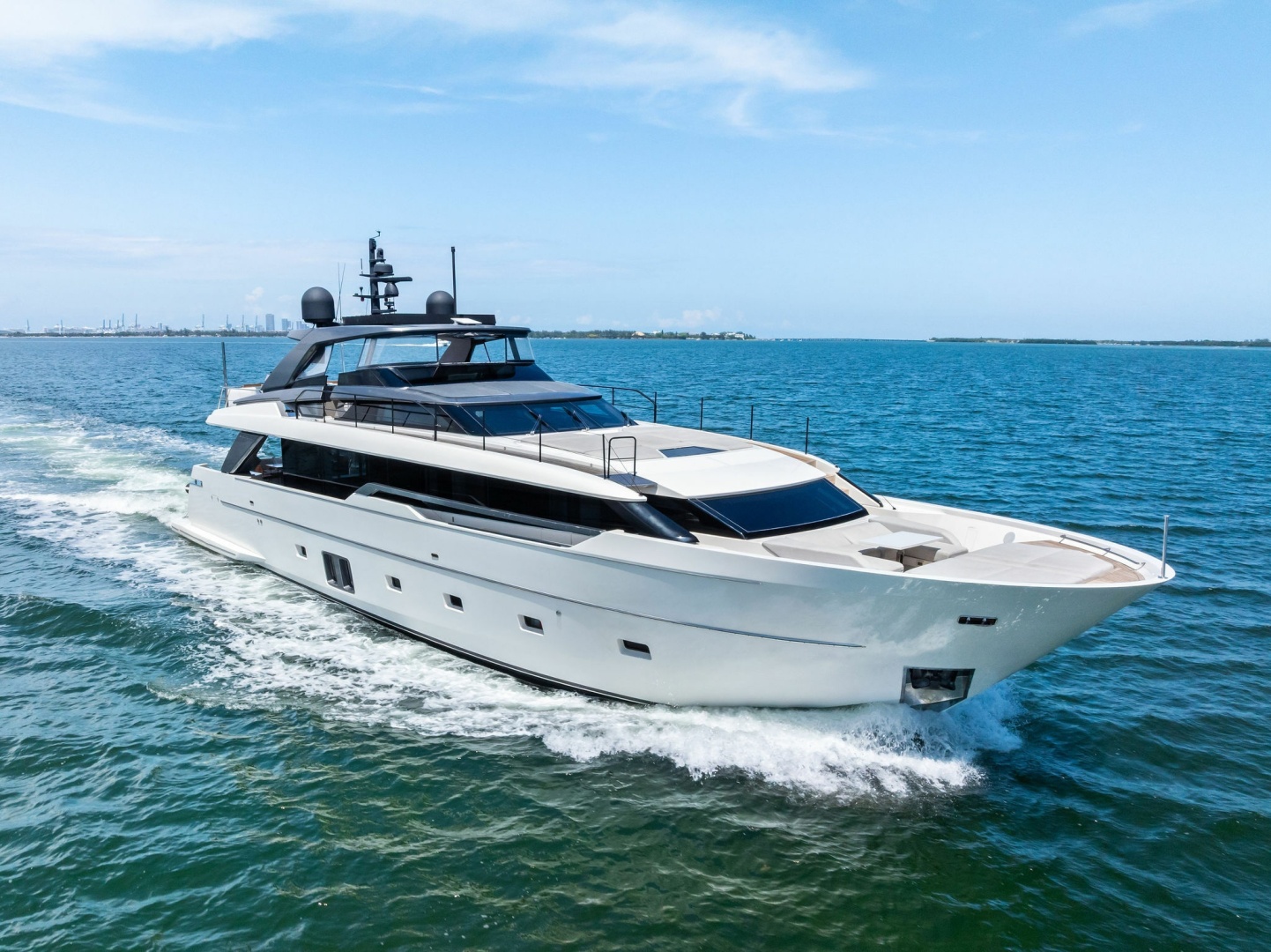
2021 Sanlorenzo GATSBY
$6,795,000
96
Fort Lauderdale Florida
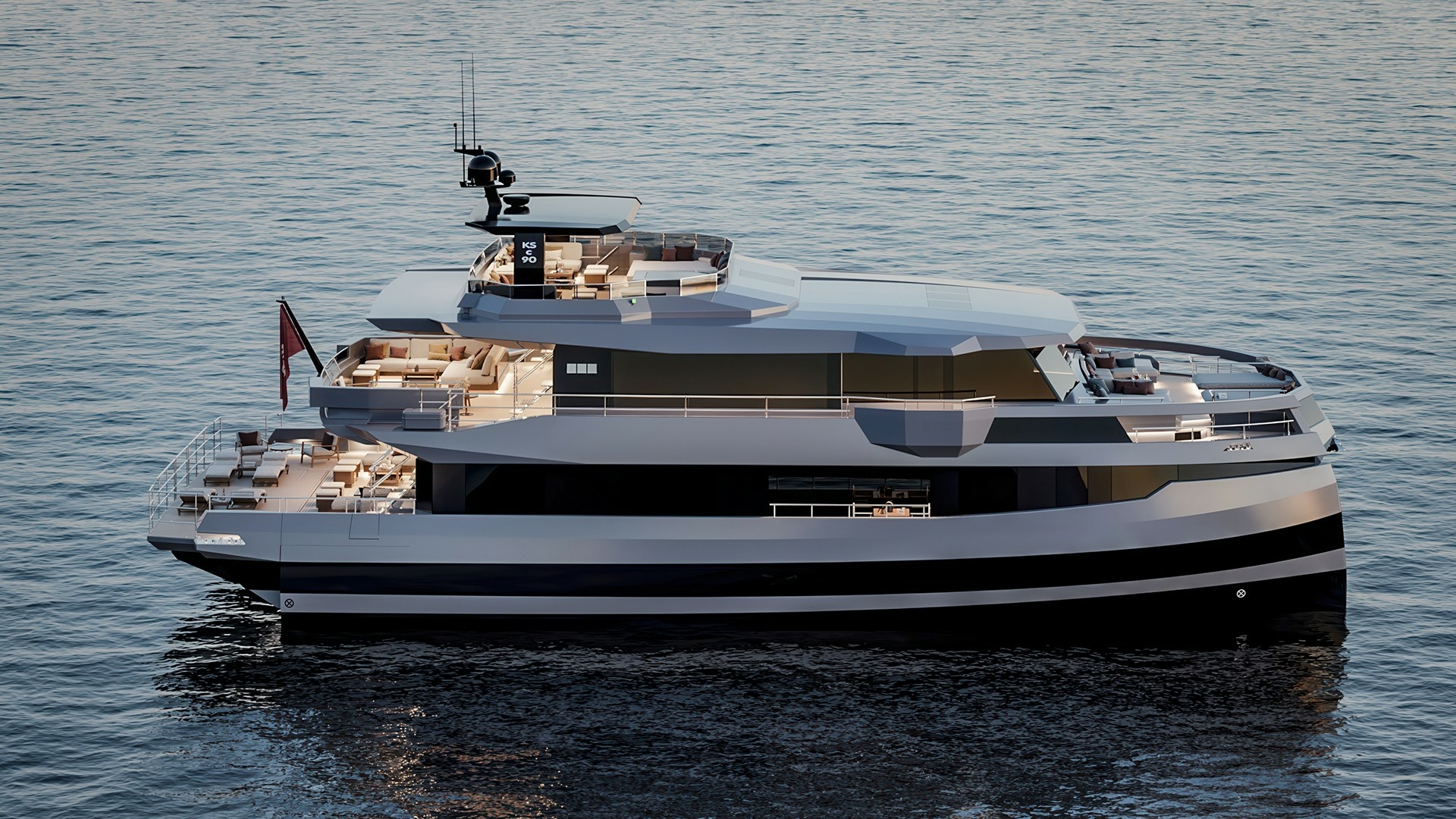
2028 Kingship
$11,990,000
90
2028 Alpha
$9,894,500
90
Fano
2023 Azimut COMPASS
$7,950,000
88
Miami Beach Florida

1999 Northern Marine OFF LINE
$2,495,000
84
Ft Lauderdale Florida
2013 Pershing DOROTHY ANN
$1,375,000
82
Fort Lauderdale Florida

1997 Ferretti Yachts
$825,000
80
La Paz
2008 Princess Yachts OCARALIA
$1,095,000
75
Charleston South Carolina
2014 Sunseeker
$1,400,000
68
New York New York

2024 Fairline
$2,750,000
68
Ft. Lauderdale Florida
2019 Vanquish Yachts IMPULSIVE
$1,799,000
58
Miami Beach Florida
2021 Ferretti Yachts HAVEN
$1,595,000
57
Fort Lauderdale Florida
2025 Formula BREAKTHROUGH III
$1,895,000
53
Miami Beach Florida

2023 Fairline
$900,000
45
Fort Lauderdale Florida
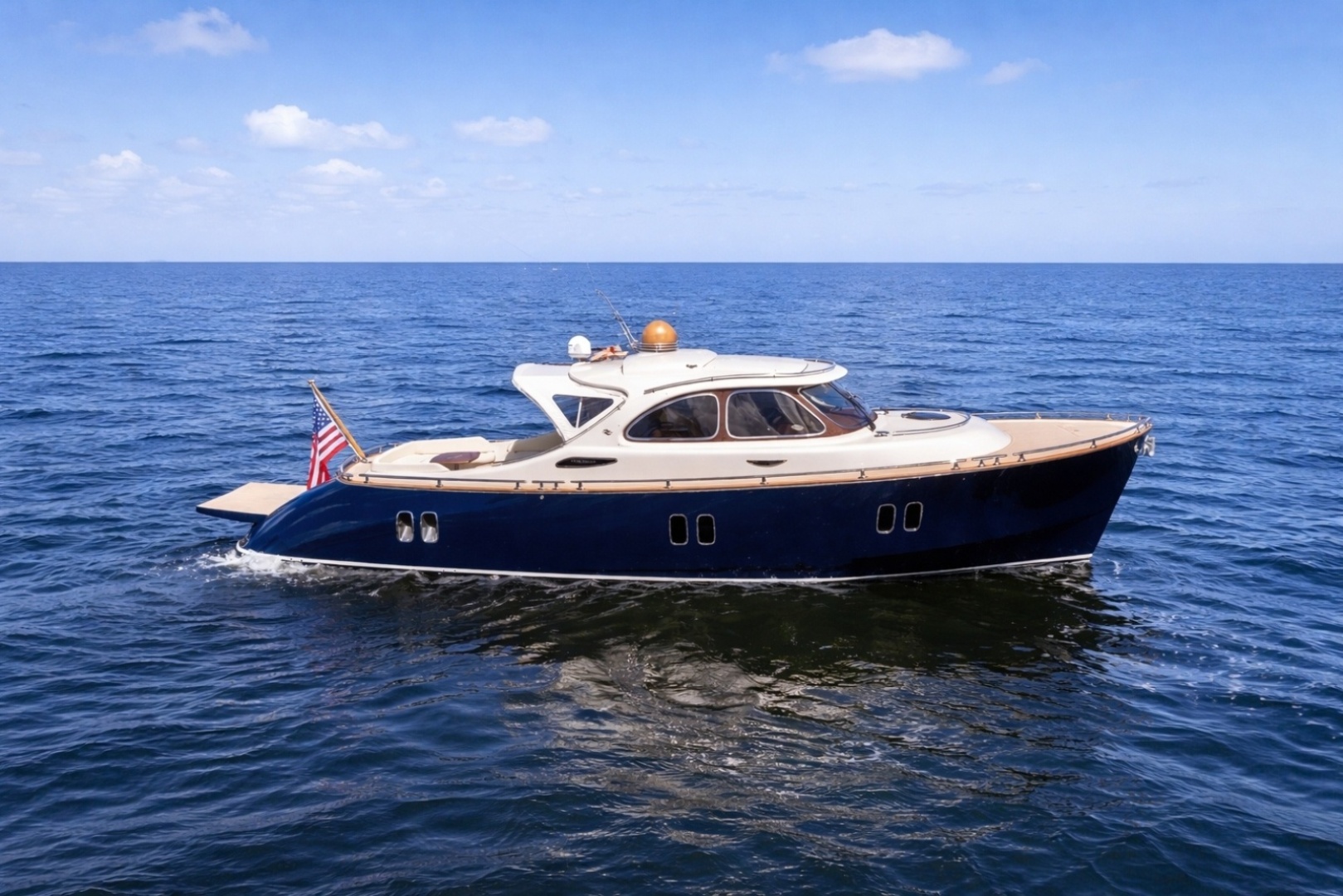
2012 Zeelander Mississippi Queen
$575,000
44
West Palm Beach Florida
2028 Columbus Yachts 137'
$22,900,008
2012 Benetti 132'
$10,975,000
2028 Kingship 125'
$20,350,000
2024 Silver Yachts 117'
$25,400,000
2009 Hargrave 114'
$2,500,000
2028 Extra Yachts 100'
$20,350,000
2028 Alpha 100'
$12,100,000
2028 Extra Yachts 96'
$9,495,000
2021 Sanlorenzo 96'
$6,795,000
2028 Kingship 90'
$11,990,000
2028 Alpha 90'
$9,894,500
2023 Azimut 88'
$7,950,000
1999 Northern Marine 84'
$2,495,000
2013 Pershing 82'
$1,375,000
1997 Ferretti Yachts 80'
$825,000
2008 Princess Yachts 75'
$1,095,000
2014 Sunseeker 68'
$1,400,000
2024 Fairline 68'
$2,750,000
2019 Vanquish Yachts 58'
$1,799,000
2021 Ferretti Yachts 57'
$1,595,000
2025 Formula 53'
$1,895,000
2023 Fairline 45'
$900,000
2012 Zeelander 44'
$575,000