

Overview: A long range motor yacht is the right vessel for you if your cruising ambitions extend beyond weekend coastal hops and into genuine ocean passages, remote archipelagos, or multi-week self-sufficient voyages. In practical terms, the industry treats any motor yacht capable of 1,500 nautical miles or more at a single fuel load as “long range,” though the most capable expedition-class vessels push well past 3,000 nm. Three elements separate these boats from ordinary cruisers:
- Range and tankage: Fuel capacity sized for ocean passages, not day trips
- Hull type: Displacement or semi-displacement hulls that prioritize efficiency over speed
- Redundancy: Backup systems, dual tanks, and secondary propulsion for open-water safety
If those priorities match your plans, the next step is shortlisting models and engaging an experienced broker who can match your intended routes to real-world fuel burn data. Read on for the benchmarks, the checklist, and the math.
Pro Tip: Before you fall in love with a model, write down your three most ambitious intended routes in nautical miles. Every spec conversation with a broker should start there.
Key Takeaways
Long range motor yachts capable of 3,000+ nautical miles require displacement or semi-displacement hulls, large baffled tankage, and documented redundancy systems to be genuinely ocean-ready.
| Point | Details |
|---|---|
| Range threshold | Industry treats 1,500+ nm as long range; serious ocean crossings demand 3,000+ nm with a 20–25% reserve margin. |
| Hull type determines range | Displacement and semi-displacement hulls deliver the fuel economy that makes transoceanic passages practical. |
| Manufacturer figures need adjustment | Stated ranges assume calm water and economy speed; reduce by 20–25% for real-world passage planning. |
| Survey and sea trial are non-negotiable | Tank inspection, engine hours, and fuel consumption logged at passage speed are the three most critical data points before purchase. |
| Yachts-bysteve | Provides route-first brokerage for long-range buyers, from vetted shortlists and engineering vetting to sea trial coordination and closing. |
Table of Contents
- What makes a motor yacht truly long range?
- Which long range motor yacht models match your routes?
- How do you choose the right long range motor yacht?
- Where do you find and buy a long range motor yacht?
- Can a 50-ft motor yacht cross the Atlantic? The fuel math
- How Yachts-bysteve guides long range buyers from search to sea trial
- Yachts-bysteve: your specialist for sourcing long range motor yachts
- Sources
What makes a motor yacht truly long range?
The phrase “long range” gets applied loosely in marketing, so it helps to anchor it to engineering. A motor yacht earns the designation when its design choices, not just its tank size, allow it to complete ocean passages safely and comfortably without relying on frequent fuel stops.
Hull types and displacement regimes
The hull is where range is won or lost before a drop of fuel is burned. Full-displacement hulls, like those on classic trawler yachts and expedition vessels, operate below hull speed and deliver the best fuel economy per nautical mile. Semi-displacement hulls offer a compromise: they can push slightly above hull speed when conditions allow, at a fuel penalty, but settle into efficient displacement mode for long passages. Planing hulls, by contrast, consume fuel at a rate that makes transoceanic passages impractical without extraordinary tankage.
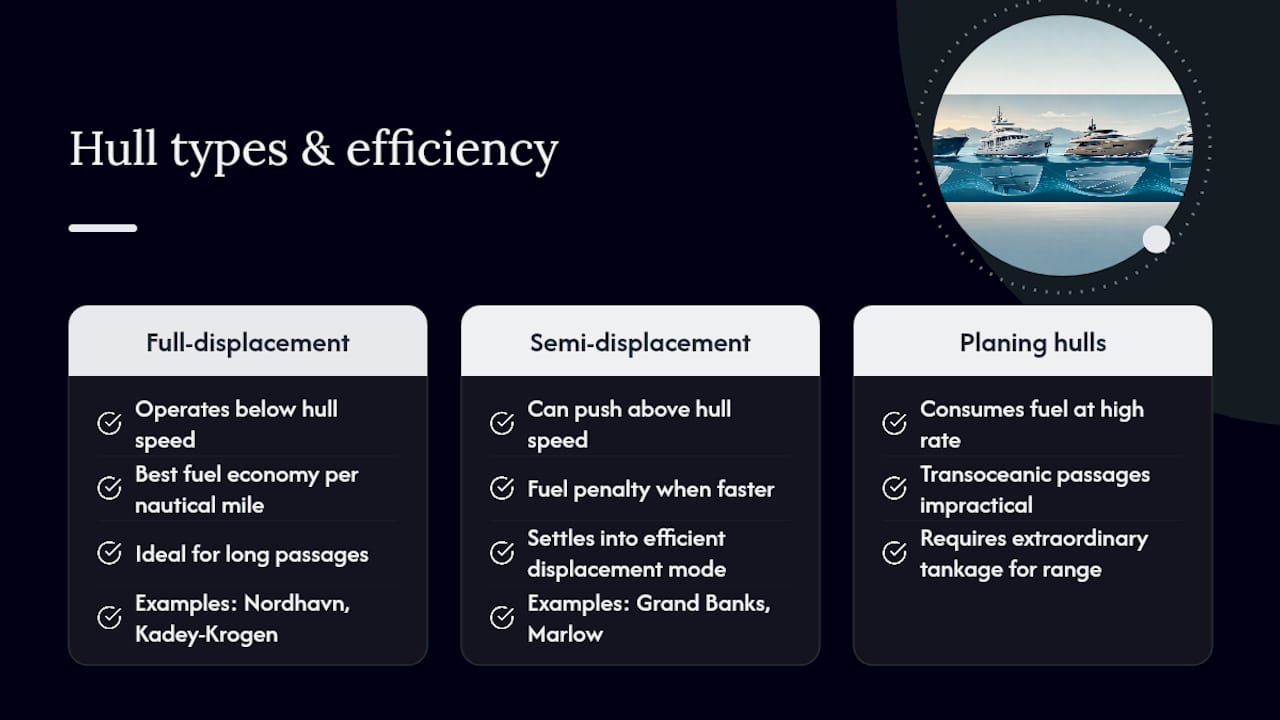
Most serious bluewater motor yachts fall into one of three categories: full-displacement trawlers (think Nordhavn, Kadey-Krogen), semi-displacement cruisers (Grand Banks, Marlow), and motor catamarans (Fountaine Pajot, Silent Yachts). Each hull form has a different speed-to-efficiency curve, and that curve determines your real-world range more than any single spec on the sheet.
Key specs to read on any listing
When you pull up a spec sheet, these are the numbers that actually matter for range planning:
- LOA and beam: Larger hulls carry more fuel and provisions but cost more to berth
- Fuel capacity (gallons or liters): The raw ceiling on your range before any efficiency calculation
- Cruising speed: The speed at which the stated range is achieved, almost always the most fuel-efficient setting
- Stated range (nm): The manufacturer’s figure, which assumes calm seas and a single efficient speed
- Freshwater generation: Watermakers rated in gallons per hour determine how long you can stay offshore
- Battery bank and solar capacity: Affects generator runtime and daily fuel consumption at anchor
- Redundancy: Dual fuel tanks with independent feeds, backup gensets, and emergency steering
The American Boat and Yacht Council (ABYC) publishes the technical standards that govern fuel systems, electrical systems, and battery installations on vessels like these. Any long-range yacht you survey should meet or exceed ABYC standards on all three. Understanding how technology drives safety and performance at sea gives you a useful frame for evaluating these systems before you step aboard.
Pro Tip: Manufacturer range figures assume calm water and a single economy speed. That is the number to test against your routes.
Range reality check: Southern Boating’s 2025 roundup of luxury long-range cruisers confirms that stated ranges assume efficient-speed, calm-water conditions. Real-world passages routinely come in below the brochure figure.
Which long range motor yacht models match your routes?
The table below draws from manufacturer specifications and industry reporting to give you a working comparison. Cruising speed is the speed at which the stated range is achieved.
A few models deserve a closer look beyond the numbers.
Nordhavn has built its reputation on expedition trawlers that treat tank layout, baffling, and redundancy as seriously as raw capacity. The Nordhavn 51 and 71 are among the most surveyed and sea-proven vessels in the long-range category, with a global network of owners who have completed circumnavigations.
The Marlow Voyager 90V achieves its 3,000–3,500 nm range through composite construction that keeps displacement low relative to LOA, allowing the hull to operate efficiently at 9–11 knots. Owners who prioritize range typically cruise at the lower end of that band, where fuel burn per mile drops meaningfully.
Grand Banks uses its V-Warp hull technology paired with large fuel tankage to approach 3,000 nm in the GB85. The design philosophy favors efficiency over outright speed, which is exactly the right tradeoff for buyers planning extended passages.
At the far end of the range spectrum, the Arksen 85 claims 7,000 nm courtesy of its Modeshift hullform, which is purpose-built for endurance rather than performance. Hybrid and silent-running capability adds operational flexibility at anchor and in protected waters.
Silent Yachts takes a different approach entirely. The Silent 62’s 16.8 kW solar array and large battery bank reduce daily generator runtime, which lowers fuel consumption for onboard systems during passages and at anchor. Ocean crossings still depend on primary engines, but the solar contribution meaningfully extends practical autonomy for day-to-day use and cuts operating costs over a season.
Range note: Every figure in that table assumes calm conditions and a single economy speed.
How do you choose the right long range motor yacht?
Benchmarks narrow the field. The right checklist closes it. Here is how experienced buyers and their brokers move from a shortlist to a signed contract.
Prioritized decision criteria
Start with route fit, not aesthetics. The vessel’s stated range, adjusted for real-world conditions, must comfortably cover your longest planned passage with a meaningful reserve. From there, work through:
- Crew requirements: A 90-ft displacement yacht on an ocean passage typically needs at least a captain and one mate. Factor crew quarters and wages into your total cost picture before you fall for a large hull. The full story on crew quarters is worth reading before you commit to a size.
- Hull stability: Displacement hulls are generally more stable in beam seas than semi-displacement at speed. Ask for sea-trial data in conditions above 10 knots of wind.
- Fuel consumption profile: Request the fuel burn curve, not just the single economy-speed figure. You want to know what happens at 80% throttle in a 15-knot headwind.
- Maintenance footprint: High-hour engines on a vessel with no documented refit history are a red flag, not a negotiating chip.
- Resale: Established builders with global service networks (Nordhavn, Grand Banks, Marlow) tend to hold value better than bespoke builds with limited parts availability.
Questions to ask your broker or builder
- What is the documented fuel burn at cruising speed, and from which sea trial?
- How are the fuel tanks laid out, and are they baffled and cross-connected?
- What is the engine hours count, and what major service has been completed?
- Is there a full survey on file, and when was the last out-of-water inspection?
- What redundancy exists for propulsion, steering, and electrical systems?
- What is the freshwater generation capacity, and has the watermaker been recently serviced?
Red flags on survey and sea trial
- Single-engine configuration with no bow thruster or emergency propulsion option
- Fuel tanks without proper baffling or with evidence of contamination
- High-hour main engines (typically above 3,000–4,000 hours depending on type) with no documented overhaul
- Corroded or undersized electrical runs in the engine room
- Delamination or osmotic blistering on the hull below the waterline
Custom design choices around tankage layout and weight distribution can also affect range in ways that don’t show up on a spec sheet. If a previous owner added significant weight through customization, the effective range may be lower than the manufacturer’s baseline figure.
Where do you find and buy a long range motor yacht?
The acquisition path for a bluewater motor yacht differs from buying a coastal cruiser. The pool of suitable vessels is smaller, the due diligence is more technical, and the right broker relationship saves both time and money.
Primary acquisition channels
- Brokerage listings: The most common route for buyers of pre-owned vessels. A specialist broker with long-range experience will have access to off-market listings and can filter for vessels with documented passage history.
- New-build semi-custom: Builders like Nordhavn, Marlow, and Arksen offer semi-custom programs where buyers specify tankage, propulsion, and interior layout. Lead times typically run 18–36 months.
- Boat shows: The Fort Lauderdale International Boat Show and the Monaco Yacht Show regularly feature long-range and expedition-class vessels. Shows are useful for comparing models in person, though the best inventory often moves before it reaches a show floor.
- Brokers’ networks: Many of the finest long-range vessels change hands through broker-to-broker introductions before any public listing appears.
The typical buying timeline
- Define your route and range requirements (1–2 weeks): Write down your three most demanding intended passages in nautical miles. This becomes the filter for every vessel you consider.
- Engage a specialist broker (ongoing): A broker with long-range experience narrows the field, surfaces off-market options, and coordinates technical vetting.
- Shortlist and view vessels (4–12 weeks): Expect to view three to six vessels before identifying a strong candidate.
- Sea trial (1–2 days): Conduct the trial at passage speed, not just at the dock. Request fuel consumption data logged during the trial.
- Survey (3–5 days): Commission a full marine survey including out-of-water inspection, tank inspection, and engine survey. For long-range vessels, add a structural survey if the hull is composite.
- Negotiation and closing (2–4 weeks): Offer, counter, escrow, and closing documentation including bill of sale.
- Delivery and commissioning (variable): Budget time for systems checks, provisioning, and crew familiarization before your first passage.
Working with an experienced broker compresses steps two through five considerably. A broker who has handled long-range transactions knows which surveyors specialize in expedition-class vessels, which builders have the strongest service networks, and where the off-market inventory sits.
Can a 50-ft motor yacht cross the Atlantic? The fuel math
This is the question every serious long-range buyer eventually asks. The answer is yes, with the right vessel and realistic planning. Here is how to run the numbers.
Operating cost buckets
Before the math, a clear-eyed look at what you are actually paying to operate a long-range motor yacht:
- Fuel: The largest variable cost. A 50-ft displacement yacht burning 5–8 gallons per hour at 7–8 knots will consume roughly 1,000–1,500 gallons on a 1,500 nm passage.
- Maintenance and refit: Budget 10–15% of vessel value annually for a well-maintained long-range cruiser. Ocean passages accelerate wear on running gear, anodes, and seals.
- Insurance: Offshore passage coverage carries a premium over coastal policies. Expect underwriters to require documented crew qualifications and a vessel survey dated within 12 months.
- Crew wages: A professional captain on a 50–70 ft vessel runs roughly $5,000–$10,000 per month depending on experience and route. Add a mate for passages above 60 ft.
- Berthing and marina fees: Highly variable by region. Budget $100–$400 per night in European marinas; less in the Caribbean and Pacific.
- Provisioning: A two-person crew on a 30-day passage typically budgets $3,000–$5,000 for food, water, and consumables.
Understanding yacht fuel efficiency in detail helps you stress-test any vessel’s range claim against your actual route before you commit.
The Atlantic crossing worked example
The North Atlantic crossing from the Canary Islands to Barbados (the classic trade-wind route) covers approximately 2,700 nm. Here is the math for a representative 50-ft displacement trawler:
- Fuel capacity: 1,500 gallons
- Fuel burn at 7.5 knots: 6 gallons per hour
- Endurance hours: 1,500 ÷ 6 = 250 hours
- Nautical miles at 7.5 knots: 250 × 7.5 = 1,875 nm
- With 20% weather/reserve reduction: ~1,500 nm practical range
That vessel cannot cross the Atlantic non-stop on a single tank. It would need to fuel at the Azores or carry supplemental bladder tanks. Now run the same math for the Kadey-Krogen 60 Open, which claims over 4,005 nm at 7 knots:
- Fuel capacity: Sized for 4,000+ nm at economy speed
- Practical range (20% reduction): ~3,200 nm
- Canaries to Barbados: 2,700 nm — comfortably within range with reserve
The crossing is entirely feasible for a properly specified long-range vessel. The 50-ft trawler example illustrates why hull selection and tankage matter more than LOA alone.
Pro Tip: *Always plan your Atlantic crossing with a fuel stop identified, even if your range math says you do not need one.
For owners planning extended Mediterranean cruising, sustainable yacht travel practices are increasingly relevant as emission regulations tighten in European waters. The IMO’s MARPOL regulations govern waste management and discharge standards for vessels on international passages, and compliance is non-negotiable for any yacht operating across multiple jurisdictions.
How Yachts-bysteve guides long range buyers from search to sea trial
Finding the right bluewater motor yacht is a technical and personal process. At Yachts-bysteve, the buyer journey is structured around one principle: match the vessel to the route before anything else.
The Yachts-bysteve buyer process for long-range vessels works as follows:
- Route and range consultation: We map your intended passages and establish the minimum range, tankage, and redundancy requirements before we open a single listing.
- Vetted shortlist: Our network surfaces both listed and off-market vessels that meet your technical criteria, filtered for survey history, engine hours, and documented passage experience.
- Engineering and fuel vetting: We coordinate with specialist surveyors who understand expedition-class systems, including tank inspection, watermaker condition, and electrical redundancy.
- Sea trial coordination: We arrange trials at passage speed, not dock speed, and log fuel consumption data you can use in your range calculations.
- Negotiation and closing: From offer through escrow to bill of sale, we manage the transaction so nothing falls through the cracks.
- Post-closing support: Crew sourcing, commissioning, and first-passage logistics are part of the service for buyers who want a genuinely complete handover.
A note from the helm
Long-range ownership is not for everyone, and that is not a criticism. It is a clarification. The buyers who thrive in this world are the ones who have thought carefully about what they actually want from the water: not just the destination, but the passage itself. The weeks at sea, the self-sufficiency, the quiet satisfaction of arriving somewhere genuinely remote under your own power.
The clients who find the most joy in these vessels are rarely the ones who bought on spec sheet alone. They are the ones who ran the route math, asked hard questions during the sea trial, and chose a hull that matched their ambitions rather than their ego. That discipline, applied early, is what separates a great long-range purchase from an expensive lesson.
The checklist in this article is a starting point. The broker relationship is what turns it into a vessel you will still love three passages from now.
Yachts-bysteve: your specialist for sourcing long range motor yachts
Serious buyers of ocean crossing motor yachts need more than a listing portal. They need a broker who understands the difference between a manufacturer’s range claim and a real-world passage plan, and who has the network to surface the right vessel before it hits the open market.
Yachts-bysteve offers exactly that: a personalized, technically grounded brokerage service built for buyers who know what they want and need a trusted partner to find it. From the first route consultation through survey coordination, negotiation, and delivery, every step is handled with the care that a purchase of this magnitude deserves.
Ready to match a vessel to your route? Start with how to buy a yacht for a step-by-step overview of the process, or go straight to choosing the right yacht broker to understand what to look for in a specialist. Contact Yachts-bysteve directly to begin your search.
Sources
A short list of primary sources worth bookmarking as you research specific models and technical standards:
- Best Long-Range Cruising Yachts for 2025 – Southern Boating & Yachting
- Voyager 90V – Marlow Yachts
- Nordhavn Trawler Yachts – Nordhavn Yachts
- Grand Banks (official site)
Recommended
Featured Listings

2028 Columbus Yachts
$22,900,008
137
Ancona

2012 Benetti PATIENCE
$10,975,000
132
Fort Lauderdale Florida

2028 Kingship Kingship
$20,350,000
125

2024 Silver Yachts
$25,400,000
117

2009 Hargrave BRANDI WINE
$2,500,000
114
Fort Lauderdale Florida

2028 Extra Yachts
$20,350,000
100
Ancona

2028 Alpha
$12,100,000
100
Ft Lauderdale Florida

2028 Extra Yachts Extra 96
$9,495,000
96
Ancona

2021 Sanlorenzo GATSBY
$6,795,000
96
Fort Lauderdale Florida

2028 Kingship
$11,990,000
90

2028 Alpha
$9,894,500
90
Fano

2023 Azimut COMPASS
$7,950,000
88
Miami Beach Florida

1999 Northern Marine OFF LINE
$2,495,000
84
Ft Lauderdale Florida

2013 Pershing DOROTHY ANN
$1,375,000
82
Fort Lauderdale Florida

1997 Ferretti Yachts
$825,000
80
La Paz

2008 Princess Yachts OCARALIA
$1,095,000
75
Charleston South Carolina

2014 Sunseeker
$1,400,000
68
New York New York

2024 Fairline
$2,750,000
68
Ft. Lauderdale Florida

2019 Vanquish Yachts IMPULSIVE
$1,799,000
58
Miami Beach Florida

2021 Ferretti Yachts HAVEN
$1,595,000
57
Fort Lauderdale Florida

2025 Formula BREAKTHROUGH III
$1,895,000
53
Miami Beach Florida

2023 Fairline
$900,000
45
Fort Lauderdale Florida

2012 Zeelander Mississippi Queen
$575,000
44
West Palm Beach Florida
2028 Columbus Yachts 137'
$22,900,008
2012 Benetti 132'
$10,975,000
2028 Kingship 125'
$20,350,000
2024 Silver Yachts 117'
$25,400,000
2009 Hargrave 114'
$2,500,000
2028 Extra Yachts 100'
$20,350,000
2028 Alpha 100'
$12,100,000
2028 Extra Yachts 96'
$9,495,000
2021 Sanlorenzo 96'
$6,795,000
2028 Kingship 90'
$11,990,000
2028 Alpha 90'
$9,894,500
2023 Azimut 88'
$7,950,000
1999 Northern Marine 84'
$2,495,000
2013 Pershing 82'
$1,375,000
1997 Ferretti Yachts 80'
$825,000
2008 Princess Yachts 75'
$1,095,000
2014 Sunseeker 68'
$1,400,000
2024 Fairline 68'
$2,750,000
2019 Vanquish Yachts 58'
$1,799,000
2021 Ferretti Yachts 57'
$1,595,000
2025 Formula 53'
$1,895,000
2023 Fairline 45'
$900,000
2012 Zeelander 44'
$575,000