

Onboarding yacht sellers step by step is the structured preparation process that transforms a vessel from a personal asset into a market-ready listing. Done well, it directly determines how fast your yacht sells and at what price. The full yacht selling process typically spans 3–8 months from valuation to closing, but sellers who front-load their preparation consistently move through that window faster. This guide covers every phase: documentation, physical preparation, listing strategy, offer negotiation, and final handover. Whether you are selling for the first time or have been through it before, the details in each stage matter more than most sellers expect.
What documents and yacht information do you need to gather first?
Onboarding is much more than signing a listing agreement. It is about building a transparent digital portfolio that buyers and brokers rely upon from day one. Sellers who arrive at this stage unprepared lose weeks, sometimes months, chasing paperwork that should have been ready at the start.
The core documents every seller needs to assemble include:
- Certificate of Registry or documentation of title (flag state issued)
- VAT status certificate (critical for EU sales and charter history)
- Builder’s specification sheet and original purchase contract
- Full maintenance logs covering engine hours, service records, and parts replacements
- Safety equipment certificates (life rafts, EPIRBs, fire suppression)
- Insurance history for the past 3–5 years
- Any existing survey reports from the past 24 months
Organize these into a single digital folder, often called a data room in professional brokerage. An organized digital data room builds immediate buyer trust and measurably reduces time to sale. Buyers who can review complete records before a viewing arrive more confident and more committed.
Commission a pre-listing survey before you go to market. This step feels counterintuitive because surveys cost money, but they protect you. A survey surfaces defects you can fix on your terms, rather than ones a buyer’s surveyor discovers and uses to renegotiate price.
Pro Tip: Order your pre-listing survey at least six weeks before your target launch date. This gives you time to address findings without rushing repairs, which always cost more under deadline pressure.
How should you prepare your yacht physically before listing?
A well-presented vessel signals good care. A cluttered, worn one invites buyer caution and lower offers. Poor staging directly leads to slower negotiations and reduced bids, because buyers read the condition of a yacht as a proxy for how it has been maintained below the waterline.
Follow this preparation sequence before any photography or viewings:
- Deep clean every surface. Teak decks, stainless fittings, upholstery, bilges, and engine rooms all need attention. Buyers open every hatch.
- Declutter the interior completely. Remove personal items, excess gear, and anything that makes cabins feel small. Buyers need to picture their own life aboard.
- Address cosmetic defects. Scratched gelcoat, worn varnish, and faded canvas are inexpensive to fix but expensive in buyer perception.
- Test all systems. Generators, air conditioning, navigation electronics, and watermakers should all run without fault during viewings.
- Stage the interior with light. Open blinds, replace dim bulbs, and add fresh flowers or neutral scents. Buyers evaluate “liveability” through their senses.
- Present the deck professionally. Coil lines, stow fenders, and polish cleats. The deck is the first thing a buyer sees when they step aboard.
Once the yacht is physically ready, invest in professional photography and a video walkthrough. Buyers form their shortlist online before they ever contact a broker. Bright, uncluttered images are not a luxury at this stage. They are the entry ticket to serious enquiries.
Pro Tip: Schedule photography on a clear morning when natural light fills the interior. Avoid midday shoots where harsh shadows flatten the cabin and make spaces look smaller than they are.

How do you list and market your yacht to reach serious buyers?
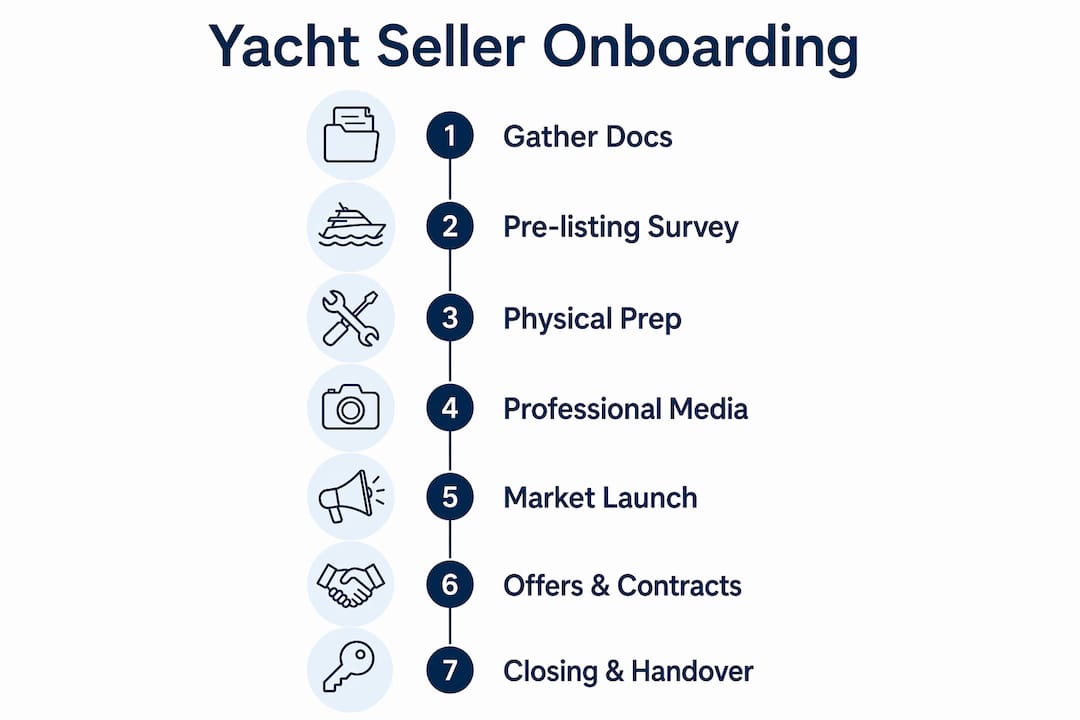
The initial marketing launch is the most critical moment in the entire yacht listing process. Most buyer enquiry concentrates in the first few weeks after launch, and momentum is genuinely hard to recover once it fades. Getting the launch right is not optional.
The core decisions at this stage include:
- Broker vs. private listing. A professional broker brings access to established buyer networks, qualified leads, and negotiation experience. A private listing saves commission but typically reaches a fraction of the audience and requires the seller to manage all enquiries, viewings, and legal steps personally.
- Multi-channel distribution. Effective listings appear across broker networks, major online yacht platforms, and targeted social media campaigns. Each channel reaches a different buyer profile.
- Pricing strategy. Price your yacht at fair market value from day one. Overpricing at launch burns the critical early window and forces a price reduction later, which signals weakness to buyers.
- Enquiry management. Respond to every serious enquiry within 24 hours. Buyers at the luxury end of the market expect attentive service, and slow responses cost viewings.
- Viewing protocols. Prepare a consistent viewing experience. The yacht should be in the same staged condition for every visit. Most yachts sell to the third to seventh serious viewer, so consistency across multiple showings matters.
Track market response weekly. If enquiries are low after two weeks, revisit your price or photography before the launch window closes entirely. The luxury yacht marketing workflow for 2026 places significant weight on early momentum, and sellers who adjust quickly outperform those who wait.
How do offers, contracts, and deposits work step by step?
Receiving an offer feels like the finish line. It is actually the start of the most legally consequential phase of the process. Handle it carefully.
- Evaluate the offer in context. Buyers typically open below asking price. Assess the offer against current comparable sales, not just your asking price. A well-documented yacht in excellent condition commands less discount than one with known defects.
- Sign the Memorandum of Agreement (MoA). The MoA is the binding contract that governs the sale. It defines the agreed price, deposit terms, survey and sea trial rights, and the closing timeline. Review it with a maritime lawyer before signing.
- Collect the deposit. A 10% good-faith deposit is standard upon MoA signing. This deposit is held in a licensed escrow account, not released to the seller, until the transaction completes.
- Set firm contingency windows. The MoA should specify a clear 2–3 week window for the buyer’s survey and sea trial. Limiting this contingency window protects you against buyers who use extended trials to delay commitment or renegotiate price.
- Manage the survey outcome. If the buyer’s survey reveals defects, expect a renegotiation. Decide in advance which repairs you will make and which price adjustments you will accept. Having your pre-listing survey as a reference gives you a strong position.
“Regulating the contingency window rigorously in the MoA protects sellers against extended buyer delays and misuse of sea trials. A firm deadline keeps both parties focused on closing, not on finding reasons to reopen negotiation.”
The parallel experience of luxury consignment processes in other high-value asset categories confirms the same principle: clear contractual timelines reduce the risk of deals collapsing at the final stage.
What are the final steps from closing to handover?
Once the survey and sea trial are accepted, the transaction moves into its final phase. Closing typically takes 1–2 weeks if all prior steps were completed properly. Sellers who skipped documentation steps earlier often find this phase takes much longer.
| Closing step | What it involves | Typical timeline |
|---|---|---|
| Final contract signing | Both parties execute the Bill of Sale and any addenda | Day 1–2 |
| Escrow funds release | Buyer’s full payment clears; deposit released to seller | Day 2–5 |
| Deregistration | Yacht removed from current flag state registry | Day 3–7 |
| Re-registration | Buyer registers under new flag or ownership | Day 5–10 |
| Insurance transfer | Seller cancels coverage; buyer activates new policy | Day 1–3 |
| Berth fee settlement | Outstanding marina fees cleared before handover | Day 1–5 |
The Bill of Sale is the document that legally transfers ownership. It must accurately reflect the agreed sale price, the vessel’s identification details, and the date of transfer. Flag state deregistration and re-registration requirements vary significantly, so confirm the specific process with your broker or maritime lawyer well before closing day.
Coordinate insurance carefully. Your coverage must remain active until the moment of handover. A gap in coverage, even for a few hours, creates liability exposure that no seller should accept.
Key Takeaways
Successful yacht seller onboarding requires documentation, physical preparation, and a timed marketing launch to protect both sale speed and final price.
| Point | Details |
|---|---|
| Build a digital data room early | Assemble all documents before listing to build buyer trust and reduce delays. |
| Stage before photography | Physical preparation and professional images drive enquiry volume at launch. |
| Protect the MoA contingency window | Limit survey and sea trial periods to 2–3 weeks to prevent buyer overreach. |
| Secure the 10% deposit in escrow | A licensed escrow account protects both parties until closing is complete. |
| Close within 1–2 weeks post-acceptance | Complete all deregistration, Bill of Sale, and insurance steps in sequence. |
What I have learned from watching sellers get this wrong
Sellers consistently underestimate how much the first two weeks on the market define the entire sale. I have watched beautifully maintained yachts sit for months simply because the launch was rushed. The photography was flat, the documents were incomplete, and the price was set by hope rather than comparable sales data. By the time those issues were corrected, the early buyer pool had moved on.
The staging mistake I see most often is personal clutter. Sellers live aboard or store gear on their yachts, and they forget that buyers cannot see past it. One seller I worked with had a 25-meter motor yacht in excellent mechanical condition. The interior was full of personal artwork, family photos, and a decade of accumulated equipment. The first three viewings produced no offers. After a full declutter and restage, the fourth viewing resulted in an offer within 48 hours. The yacht had not changed. The perception had.
My strongest advice for the MoA phase: write the contingency deadline into the contract before you sign, not after. Buyers occasionally use the survey and sea trial window as a negotiating tool, requesting extensions and using the time to shop for alternatives. A firm 2–3 week window, agreed in writing, keeps the process honest. For sellers who want to prepare their yacht for sale with the right sequence from the start, the preparation phase is where the sale is actually won or lost.
— Jason
How Yachts-bysteve supports sellers through every stage
Selling a luxury yacht without professional support is possible. It is also the most common reason sellers leave money on the table or watch deals collapse at the contract stage. Yachts-bysteve works with sellers from the earliest documentation phase through to final handover, providing access to qualified buyer networks, professional marketing, and experienced negotiation support. If you are weighing your options, understanding how to choose a yacht broker is the right place to start. The right brokerage relationship does not just simplify the process. It protects the value of what you have built.
FAQ
What does onboarding a yacht for sale actually mean?
Onboarding is the preparation process that gets your yacht, documents, and listing strategy ready before going to market. It covers documentation assembly, physical staging, pre-listing surveys, and pricing, all completed before the first buyer enquiry arrives.
How long does the yacht selling process take?
The full process typically takes 3–8 months from valuation to closing. Once an offer is accepted, the transactional phase from Memorandum of Agreement to handover usually completes in 4–8 weeks.
What deposit is standard when an offer is accepted?
A 10% good-faith deposit is the industry standard upon signing the Memorandum of Agreement. This deposit is held in a licensed escrow account until the transaction closes.
How do I protect myself during the survey and sea trial phase?
Limit the contingency window in the MoA to 2–3 weeks. A firm deadline prevents buyers from using extended trials to delay commitment or reopen price negotiations after the contract is signed.
Do I need a broker to sell my yacht?
A broker is not legally required, but professional brokerage provides access to qualified buyer networks, legal document support, and negotiation experience that private sellers rarely replicate. Most sellers who go it alone reach a smaller buyer pool and manage more risk at the contract stage.
Recommended
Featured Listings

2028 Columbus Yachts
$22,900,008
137
Ancona

2012 Benetti PATIENCE
$10,975,000
132
Fort Lauderdale Florida

2028 Kingship Kingship
$20,350,000
125

2024 Silver Yachts
$25,400,000
117

2009 Hargrave BRANDI WINE
$2,500,000
114
Fort Lauderdale Florida

2028 Extra Yachts
$20,350,000
100
Ancona

2028 Alpha
$12,100,000
100
Ft Lauderdale Florida

2028 Extra Yachts Extra 96
$9,495,000
96
Ancona

2021 Sanlorenzo GATSBY
$6,795,000
96
Fort Lauderdale Florida

2028 Kingship
$11,990,000
90

2028 Alpha
$9,894,500
90
Fano

2023 Azimut COMPASS
$7,950,000
88
Miami Beach Florida

1999 Northern Marine OFF LINE
$2,495,000
84
Ft Lauderdale Florida

2013 Pershing DOROTHY ANN
$1,375,000
82
Fort Lauderdale Florida

1997 Ferretti Yachts
$825,000
80
La Paz

2008 Princess Yachts OCARALIA
$1,095,000
75
Charleston South Carolina

2014 Sunseeker
$1,400,000
68
New York New York

2024 Fairline
$2,750,000
68
Ft. Lauderdale Florida

2019 Vanquish Yachts IMPULSIVE
$1,799,000
58
Miami Beach Florida

2021 Ferretti Yachts HAVEN
$1,595,000
57
Fort Lauderdale Florida

2025 Formula BREAKTHROUGH III
$1,895,000
53
Miami Beach Florida

2023 Fairline
$900,000
45
Fort Lauderdale Florida

2012 Zeelander Mississippi Queen
$575,000
44
West Palm Beach Florida
2028 Columbus Yachts 137'
$22,900,008
2012 Benetti 132'
$10,975,000
2028 Kingship 125'
$20,350,000
2024 Silver Yachts 117'
$25,400,000
2009 Hargrave 114'
$2,500,000
2028 Extra Yachts 100'
$20,350,000
2028 Alpha 100'
$12,100,000
2028 Extra Yachts 96'
$9,495,000
2021 Sanlorenzo 96'
$6,795,000
2028 Kingship 90'
$11,990,000
2028 Alpha 90'
$9,894,500
2023 Azimut 88'
$7,950,000
1999 Northern Marine 84'
$2,495,000
2013 Pershing 82'
$1,375,000
1997 Ferretti Yachts 80'
$825,000
2008 Princess Yachts 75'
$1,095,000
2014 Sunseeker 68'
$1,400,000
2024 Fairline 68'
$2,750,000
2019 Vanquish Yachts 58'
$1,799,000
2021 Ferretti Yachts 57'
$1,595,000
2025 Formula 53'
$1,895,000
2023 Fairline 45'
$900,000
2012 Zeelander 44'
$575,000