

For long-range visibility and separating tight clusters of targets, an open array wins, plain and simple. For boats under 30 feet, limited topside real estate, or trailer-and-launch routines, a dome earns its keep instead. The real decision hinges on antenna length, available mounting strength, and how much power your electrical system can spare, not just the range number printed on the box.
TL;DR:
- Larger open arrays offer better range, target separation, and bearing resolution but require stronger mounting structures and higher power consumption.
- Small to mid-sized boats under 30 feet benefit more from lightweight domes with shorter range, easier installation, and lower power draw.
- Technological advances like pulse compression and phased-array steering are narrowing the performance gap between domes and open arrays.
- Proper mounting structure, wind load capacity, and electrical compatibility must be checked before installing an open array, especially on older vessels.
- The choice depends on vessel size and typical range requirements, with offshore boats needing open arrays and inshore boats comfortably served by high-quality domes.
Table of Contents
- Open Array vs Dome Radar: How the Two Compare Side by Side
- Why Do Open Array and Dome Radars Perform So Differently?
- What Should You Check Before Mounting an Open Array?
- Will Your Electrical System Handle the Radar You Want?
- Which Boat Sizes Pair Best with Each Radar Type?
- What Does Each Radar Type Cost to Own Over Time?
- What Do Buyers Actually Prioritize When Choosing Radar?
- The Bottom Line on Choosing Your Radar Scanner
- Sources
Open Array vs Dome Radar: How the Two Compare Side by Side
Every yacht captain who has stood at the helm in a fog bank knows the difference between “seeing a blip” and “knowing what that blip is.” That distinction comes down to hardware, and the table below lays out where each design earns its keep.
| Factor | Open array | Dome (radome) |
|---|---|---|
| Typical effective range | Varies with antenna size, generally longer for larger open arrays | Up to roughly 48 nautical miles on higher-end 18" units |
| Horizontal beam width / target separation | Narrower beam, sharper separation between close targets | Wider beam (around 5° or more), softer separation |
| Installation demands | Heavier, larger footprint, meaningful wind load on the mount | Lightweight, compact, minimal structural stress |
| Power draw | Higher, often several times a comparable dome | Lower, easier on smaller DC systems |
| Short-range clarity | Good, though close-in clutter can be more pronounced | Often excellent, tuned for tight, near-vessel picture |
| Best for | Offshore cruisers, sportfish boats, long passages | Coastal runabouts, center consoles, trailered boats |
A few things jump out once you sit with these numbers. Antenna aperture, not marketing copy, is what drives the range and separation gap. A well-specified 18-inch dome can push out to 48 nautical miles with a 4 kW transmitter and a beam width near 5.2 degrees, which is respectable for a unit you can practically lift with one hand, according to one 18" dome radar spec sheet. But Furuno’s own buying guidance confirms that longer open arrays consistently deliver tighter bearing resolution at comparable power, simply because a longer antenna narrows the beam.
Weigh these takeaways before you commit:
- Range on paper matters less than the picture quality at the range you actually run.
- Beam width, not raw power, is usually the reason two targets merge into one blob on a dome versus staying distinct on an array.
- Wind load and topside strength often disqualify an open array before performance ever does.
- Power draw differences are real but rarely a dealbreaker on boats over 30 feet with adequate house banks.
Why Do Open Array and Dome Radars Perform So Differently?
The gap between these two designs starts with geometry, not electronics. An open array is essentially a long, rotating slotted waveguide. Stretch that antenna out, and you narrow the horizontal beam, which is the direct reason open arrays separate two boats sitting 200 yards apart while a dome merges them into one return. Furuno’s technical guidance puts it bluntly: aperture size drives bearing resolution, full stop.
Modern domes close some of that gap through processing rather than size. Pulse compression, digital signal processing, and features once reserved for open arrays now show up in domes under two feet across. The HALO Dome Radar from Simrad is a good example: pulse compression, dual-range scanning, and bird mode packed into a housing you can mount on a hardtop without a second thought.
The next frontier is phased-array technology, which trades the spinning antenna for electronic beam steering. Instead of physically rotating, a phased array steers its beam with tiny timing shifts across dozens of elements, achieving beam dwell times on the order of a few milliseconds and enabling near-instantaneous 360-degree scans, according to research on phased-array beam steering. A 2025 simulation study on hybrid beamforming reported high multi-target detection accuracy in noisy conditions, exceeding that of simpler conventional setups, per Nature’s 2025 phased-array research. That technology is mostly still finding its way into recreational marine radar, but it tells you where mechanically scanned open arrays and domes are both heading.
What this actually changes on the water:
- Better bearing resolution means fewer “ghost” bird flocks that turn out to be two boats.
- Clutter rejection in rain and chop improves with both larger apertures and modern processing chips.
- Multi-target tracking, useful when you’re threading a channel at night, benefits most from narrow beam width.
What Should You Check Before Mounting an Open Array?
Before you fall in love with a 4-foot open array, put a tape measure on your arch or hardtop and be honest about what it can carry. Wind-load studies on large radar antennas show measurable structural stress at cruising and storm-condition wind speeds, and that stress compounds with vessel motion, not just static weight, according to wind load research on large radar antennas.
Work through this before you order anything:
- Measure your actual mounting footprint on the arch, mast, or radar pole, not just where you’d like it to go.
- Pull the manufacturer’s topside load spec and compare it against your structure’s rated capacity.
- Get a rigger or marine surveyor to inspect the mount point, especially on boats over ten years old.
- Decide whether a radome makes more sense if you trailer the boat or store it in a low-clearance slip.
Pro Tip: Ask your rigger for the dynamic wind-load figure, not just the static weight rating. A 4-foot open array spinning at 24 RPM in a 40-knot crosswind puts far more stress on a T-top than the same antenna sitting still on a dock.
If you’re evaluating a used boat with an existing radar mount, our guide on yacht surveys walks through exactly what a surveyor should flag on deck hardware like this.
Will Your Electrical System Handle the Radar You Want?
Power draw is where a lot of buyers get caught off guard mid-project. Open arrays typically pull more current than domes of similar vintage, and that difference matters most on smaller battery banks or boats without a dedicated house circuit for electronics.
Keep these integration points on your checklist:
- Confirm your MFD supports dual-range or split-screen display if that feature matters for your fishing style.
- Verify MARPA target-tracking compatibility between the radar dome or array and your chosen chartplotter before you buy either piece separately.
- Check antenna cable run length and grounding points; installers most often find corrosion or poor grounding at the pedestal base, not the antenna itself.
- Ask whether your network backbone (NMEA 2000 or a proprietary bus) supports the specific radar model you’re considering.
Which Boat Sizes Pair Best with Each Radar Type?
Matching scanner size to mission beats chasing the biggest number on the spec sheet. As Raymarine’s own buyer guidance puts it, a well-matched modern dome will outperform an aging open array in daily use, and that holds true across most recreational boats.
- 20 to 30 foot boats: an 18 to 24 inch dome covers inshore and coastal navigation with room to spare, and keeps weight off the hardtop.
- 30 to 45 foot boats running offshore: a 4-foot open array adds the range and separation needed to spot squalls and traffic well before they’re a problem.
- Tournament-level sportfish boats: a 6-foot open array delivers the tightest possible target separation for picking bait schools and working birds at range.
- Coastal cruisers who fish occasionally: a feature-rich dome with bird mode and dual-range often covers 90 percent of real use without the weight penalty.
Doppler processing on both dome and array systems helps flag small, fast-moving targets like center consoles crossing your bow, which matters more in traffic than raw range ever will.
What Does Each Radar Type Cost to Own Over Time?
Sticker price is only the entry fee. Open arrays run higher on both purchase price and installation labor, since mounts often need reinforcement, longer cable runs, and sometimes a dedicated pedestal.
- Expect meaningfully higher install costs on open arrays once mount reinforcement and wiring are factored in.
- Domes carry sealed motors and drive assemblies with fewer exposed moving parts, generally translating to lower routine maintenance.
- Open arrays have exposed bearings and drive gears that need periodic lubrication and inspection, especially in salt air.
- Budget for a rigger’s structural review at survey time or annual haul out, particularly on open array installs older than five years.
Coating the mount and pedestal with a quality marine ceramic protective coating can meaningfully cut down on corrosion-related maintenance for either radar type, since salt exposure is what usually shortens hardware life, not the electronics inside.
What Do Buyers Actually Prioritize When Choosing Radar?
Every buyer we work with eventually asks the same question: “Do I need the big array, or am I overbuilding this boat?” Refit decisions almost always come down to how the vessel is actually used, not how it’s marketed. A center console owner running twenty miles offshore for tuna has very different needs than a 55-foot sportfish captain running tournaments in the Bahamas.
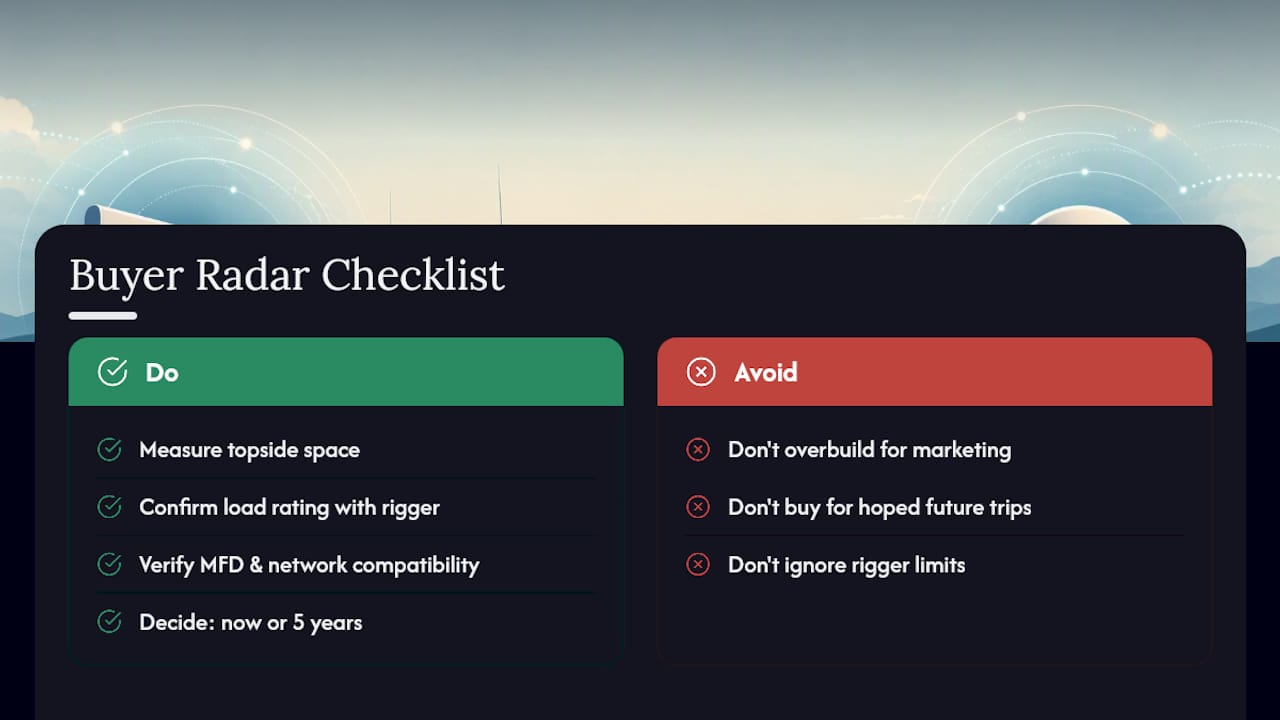
The checklist we walk clients through: measure your topside mounting space, confirm the load rating with a rigger, verify MFD and network compatibility before ordering hardware, and decide honestly whether you’re buying for today’s trips or the ones you hope to take in five years. That last question separates satisfied owners from ones who regret undersizing their electronics package.
— Jason
The Bottom Line on Choosing Your Radar Scanner
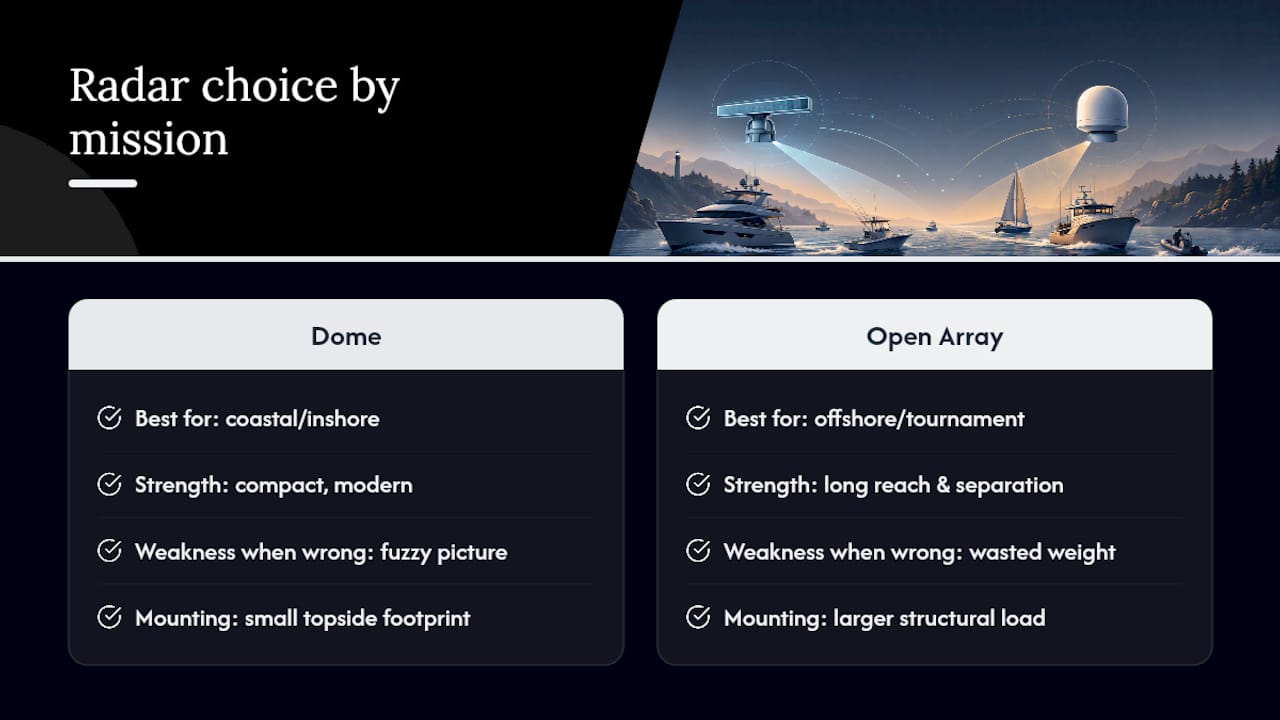
Match the radar to the mission, not the other way around. Coastal and inshore boats do fine with a modern dome, offshore and tournament boats need the reach and separation an open array provides, and the wrong choice usually shows up as either wasted weight or a fuzzy picture right when you need clarity most.
Three things to do before you buy: measure your actual topside mounting footprint, get a rigger or surveyor to confirm structural capacity, and verify your MFD and network support the features you’re paying for. If you’re weighing a full electronics refit as part of a purchase or sale, our brokers at Yachts-bysteve can walk you through how radar specs factor into a vessel’s overall value and readiness for your next passage.
Sources
- Opensky
- Hybrid beamforming for phased array radar (Nature, 2025)
- Wind load assessment of a large radar antenna (ResearchGate)
- Selecting a radar system – radome or open array (Furuno knowledge base)
Recommended
Featured Listings

2028 Columbus Yachts
$22,900,008
137
Ancona

2012 Benetti PATIENCE
$10,975,000
132
Fort Lauderdale Florida

2028 Kingship Kingship
$20,350,000
125

2024 Silver Yachts
$25,400,000
117

2009 Hargrave BRANDI WINE
$2,500,000
114
Fort Lauderdale Florida

2028 Extra Yachts
$20,350,000
100
Ancona

2028 Alpha
$12,100,000
100
Ft Lauderdale Florida

2028 Extra Yachts Extra 96
$9,495,000
96
Ancona

2021 Sanlorenzo GATSBY
$6,795,000
96
Fort Lauderdale Florida

2028 Kingship
$11,990,000
90

2028 Alpha
$9,894,500
90
Fano

2023 Azimut COMPASS
$7,950,000
88
Miami Beach Florida

1999 Northern Marine OFF LINE
$2,495,000
84
Ft Lauderdale Florida

2013 Pershing DOROTHY ANN
$1,375,000
82
Fort Lauderdale Florida

1997 Ferretti Yachts
$825,000
80
La Paz

2008 Princess Yachts OCARALIA
$1,095,000
75
Charleston South Carolina

2014 Sunseeker
$1,400,000
68
New York New York

2024 Fairline
$2,750,000
68
Ft. Lauderdale Florida

2019 Vanquish Yachts IMPULSIVE
$1,799,000
58
Miami Beach Florida

2021 Ferretti Yachts HAVEN
$1,595,000
57
Fort Lauderdale Florida

2025 Formula BREAKTHROUGH III
$1,895,000
53
Miami Beach Florida

2023 Fairline
$900,000
45
Fort Lauderdale Florida

2012 Zeelander Mississippi Queen
$575,000
44
West Palm Beach Florida
2028 Columbus Yachts 137'
$22,900,008
2012 Benetti 132'
$10,975,000
2028 Kingship 125'
$20,350,000
2024 Silver Yachts 117'
$25,400,000
2009 Hargrave 114'
$2,500,000
2028 Extra Yachts 100'
$20,350,000
2028 Alpha 100'
$12,100,000
2028 Extra Yachts 96'
$9,495,000
2021 Sanlorenzo 96'
$6,795,000
2028 Kingship 90'
$11,990,000
2028 Alpha 90'
$9,894,500
2023 Azimut 88'
$7,950,000
1999 Northern Marine 84'
$2,495,000
2013 Pershing 82'
$1,375,000
1997 Ferretti Yachts 80'
$825,000
2008 Princess Yachts 75'
$1,095,000
2014 Sunseeker 68'
$1,400,000
2024 Fairline 68'
$2,750,000
2019 Vanquish Yachts 58'
$1,799,000
2021 Ferretti Yachts 57'
$1,595,000
2025 Formula 53'
$1,895,000
2023 Fairline 45'
$900,000
2012 Zeelander 44'
$575,000