

A displacement hull pushes through the water on buoyancy alone, trading speed for range, comfort, and quiet efficiency. A planing hull rises up and skims across the surface on hydrodynamic lift, trading fuel economy for speed and agility. If you want long-range cruising and a soft ride offshore, choose displacement. If you want to cover ground fast for watersports or day trips, choose planing. Semi-displacement hulls split the difference.
TL;DR:
- Buyers should honestly assess their cruising needs and sea conditions to determine if displacement, semi-displacement, or planing hulls best suit their mission.
- Displacement hulls max out at the hull speed determined by waterline length, which for a 50-foot yacht is roughly 9.1 knots, requiring much more power for marginal speed increases.
- Planing hulls provide significantly higher speeds, often 30 to 60 knots, but are less comfortable and more fuel-intensive in choppy water or when heavily loaded.
- Semi-displacement hulls offer a balanced option, allowing for faster cruising speeds around 18 to 22 knots while maintaining comfort and efficiency in open water.
- Load conditions heavily influence hull performance, making full, realistic sea trials crucial to accurately gauge how each hull type performs under actual cruising loads.
Table of Contents
- Displacement Hulls: Steady, Efficient, and Built for the Long Haul
- Planing Hulls: Built to Fly Across the Surface
- Semi-Displacement Hulls: The Compromise Buyers Actually Choose
- The Math and the Reality: Hull Speed, Power, and Rough Seas
- Buyer Checklist: Matching Hull Type to Your Mission
- How Yachts-Bysteve Sees Hull Choice Play Out in Real Listings
- Where the Conventional Advice Gets This Wrong
- Sources
Displacement Hulls: Steady, Efficient, and Built for the Long Haul
A displacement hull moves the way a duck does. It shoulders its weight through buoyancy, shoving water aside and letting it flow back together at the stern rather than climbing up and skating over the surface. That single mechanical fact explains almost everything else about how these boats feel and perform.
Most displacement hulls wear a round-bilge shape with a fine, tapered entry at the bow. There’s no hard corner where the hull meets the water, which is exactly why these boats cut through waves instead of pounding across them. Sailboats, classic trawlers, and full-displacement motor yachts almost all share this family resemblance.
The trade for that comfort is a hard ceiling on speed. Hull speed is approximated by 1.34 times the square root of the waterline length in feet, and pushing a displacement hull past that number burns dramatically more fuel for almost no extra knots. A 40 foot boat with a 36 foot waterline tops out theoretically around its hull speed, calculated using standard formulas. Add more horsepower and you don’t go faster. You just burn more diesel making a bigger wake.
What buyers get in return:
- Superior stability and a gentler motion in open, rough water, since the hull is designed to cut through waves rather than ride over them
- Significantly better fuel efficiency at cruising speed
- More usable volume below deck for cabins, tankage, and storage
- Predictable, seaworthy behavior in a building sea
Pro Tip: During a sea trial, ask the captain to push a displacement hull past its calculated hull speed for sixty seconds. Watch the fuel-flow gauge. It’s the fastest way to feel physics prove a point that specs alone won’t. Learn more about how waterline length shapes why yacht length matters for real-world cruising range.
Planing Hulls: Built to Fly Across the Surface
Planing is what happens when hydrodynamic lift takes over from buoyancy as the dominant force holding the boat up. Below a certain speed, a planing hull behaves just like a displacement hull, pushing through the water. Above that threshold, it rises and rides on top of it. That transition is why hydrodynamic lift becomes the primary upward force), and it’s the single biggest mechanical difference separating these two hull families.
Look for a flat, wide run aft and sharp hard chines where the hull sides meet the bottom at a defined angle. These features deflect water downward instead of letting it wrap around the hull, generating lift the way a water ski generates lift. Lightweight construction matters here too, since getting up on plane demands a favorable power-to-weight ratio.
The payoff is speed most displacement boats can’t touch. Smaller planing craft routinely reach 30 to 60 knots, which is why runabouts, RIBs, center consoles, and watersports boats are almost universally built this way.
The trade-offs show up at the extremes:
- Rough, choppy water can turn a fast planing hull into a jarring, tiring ride
- Fuel burn spikes hard climbing over the “hump” to reach plane
- Added weight, extra fuel, extra passengers, and gear can quietly prevent a marginal hull from planing at all
- Interior volume aft is often sacrificed to that flat running surface
Pro Tip: Load your planing boat the way you actually intend to use it before a sea trial, full fuel, full crew, full cooler. A boat that planes easily empty can struggle to get on plane loaded.
Semi-Displacement Hulls: The Compromise Buyers Actually Choose
Semi-displacement was invented specifically to close the gap between the other two hull types. Designers modify the aft sections, often flattening or adding a mild chine, to let the hull generate partial lift and run faster than a pure displacement shape while keeping more of the comfort a planing hull gives up in a sea. Many express cruisers, sportfishing yachts, and mid-size motor yachts live in this category.
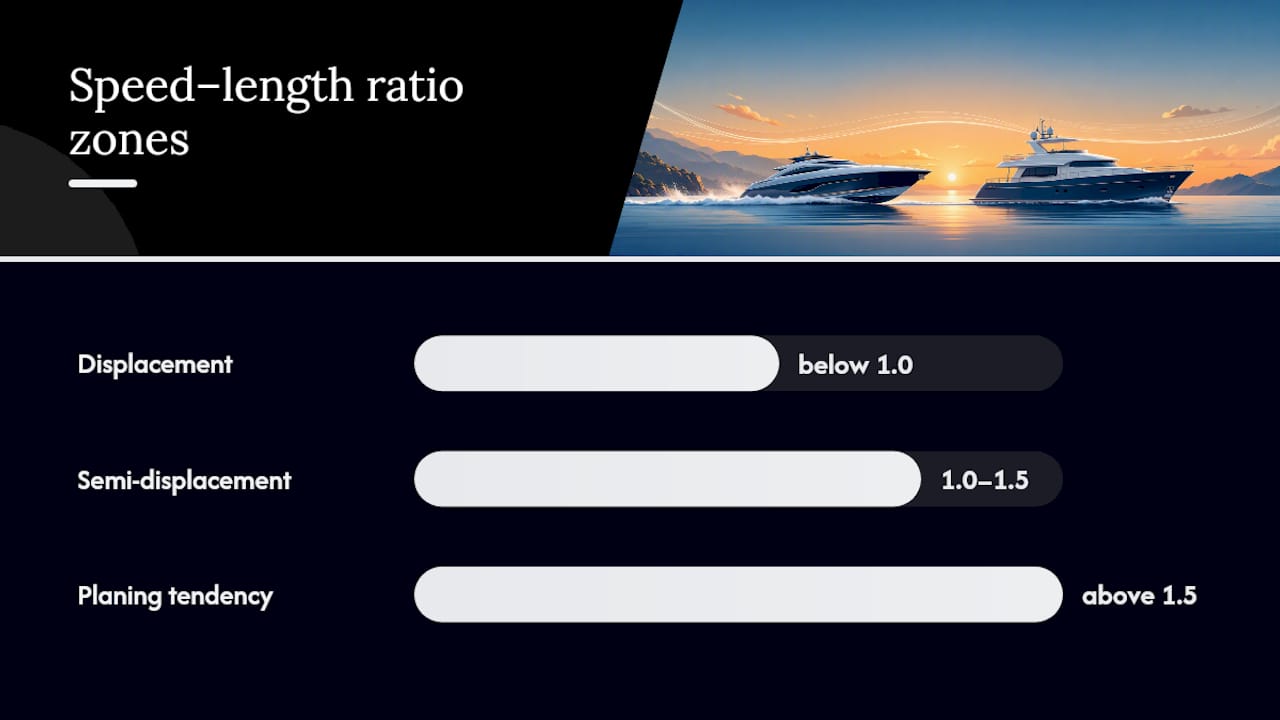
The speed-length ratio (speed divided by the square root of waterline length) is the quickest way to place a hull on the spectrum:
- Below roughly 1.0: the boat is operating as a true displacement hull, efficient and slow.
- Roughly 1.0 to 1.5: semi-displacement territory, where the hull is generating some lift but hasn’t broken free of the water.
- Above roughly 1.5: the hull is tending toward planing, riding increasingly on top of the surface.
Semi-displacement is always a balancing act rather than a clean win. Designers give up some top-end speed and some pure planing efficiency in exchange for a narrower but comfortable operating band, so the boat runs well at, say, 18 to 22 knots without punishing the crew. Choose semi-displacement when you want meaningfully more speed than a trawler without committing to the rough-water compromises of a full planing hull.
The Math and the Reality: Hull Speed, Power, and Rough Seas
The hull-speed formula sounds academic until you run your own numbers. A 50 foot yacht with a 46 foot waterline calculates to roughly 9.1 knots of theoretical hull speed. Everything above that is inefficient for a displacement design, which is why naval architects treat the formula as a hard planning ceiling, not a suggestion.
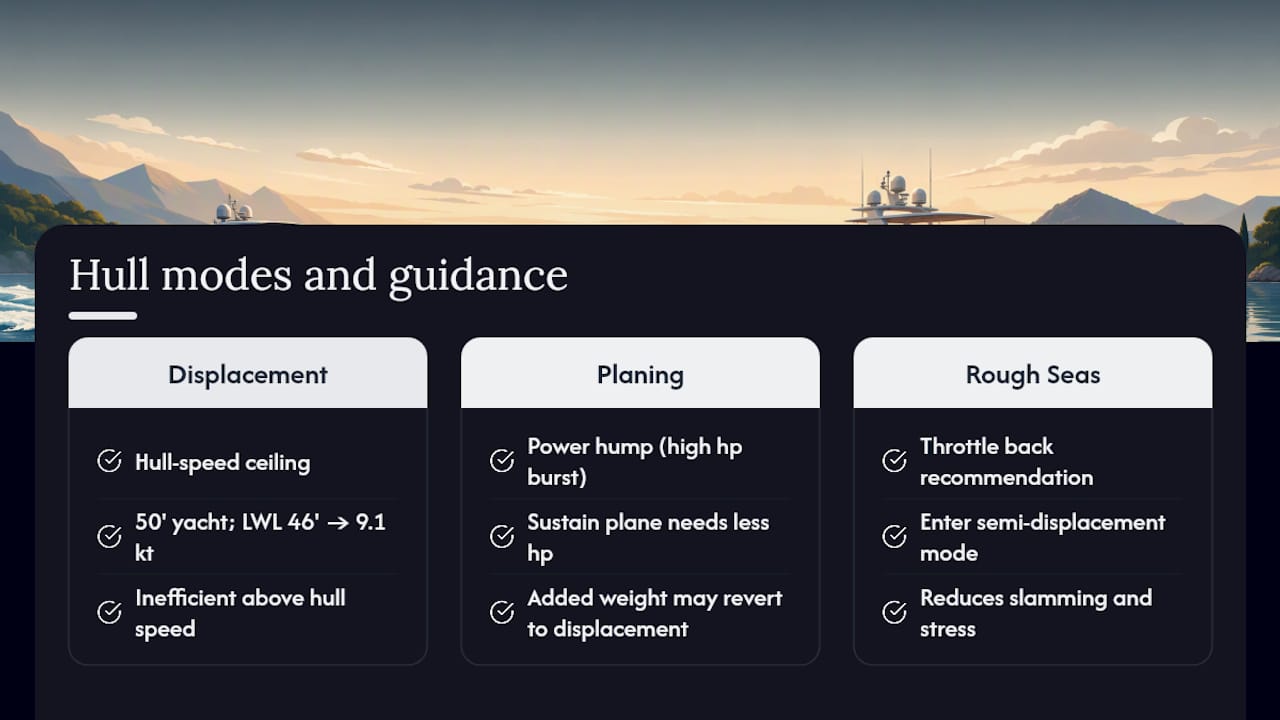
Planing hulls face a different math problem: the power hump. Getting a heavy boat up onto plane demands a disproportionate burst of horsepower compared to what’s needed to sustain plane once achieved, and added weight from passengers, fuel, or gear can push a marginal hull back into displacement mode entirely.
Operationally, this is where seasoned captains earn their reputation. Pushing a planing hull hard through rough seas risks violent slamming and real structural stress, so the right move is throttling back and letting the hull settle into a semi-displacement mode until conditions ease. Check your fuel range expectations against both hull speed and sea state before committing to a passage plan.
Buyer Checklist: Matching Hull Type to Your Mission
Start with brutal honesty about how you’ll actually use the boat, not the postcard version.
- Define the mission first. Long-range cruising and overnight comfort point toward displacement or semi-displacement. Day trips, watersports, and fishing runs favor planing.
- Run the speed-length check. Divide your target cruising speed by the square root of the waterline length. Above 1.5, you’re shopping planing hulls; below 1.0, you’re shopping displacement.
- Verify fuel expectations against the hull type. A fuel efficiency overview helps you sanity-check a builder’s claimed range against the hull form’s known behavior.
- Ask about typical operating sea states. A boat built for protected bays handles differently than one rated for open-water passages.
- Check load capacity and draft. A planing hull loaded near capacity may never reach plane; a displacement hull’s draft may limit which marinas and anchorages you can use.
- Sea trial in real conditions, fully loaded. Ask the broker to demonstrate the transition to plane, if applicable, and note how long it takes and how much throttle it demands.
Pro Tip: Ask any broker or builder for the boat’s actual speed-length ratio at cruising RPM, not just top speed on a calm day. It’s the single fastest gut check on whether the performance claims match the hull physics.
How Yachts-Bysteve Sees Hull Choice Play Out in Real Listings
Working through listings day in and day out, hull choice shapes almost every downstream decision a buyer makes. Long-range cruising clients gravitate toward displacement and semi-displacement designs because the interior volume and motion comfort matter more to them than shaving hours off a passage. Buyers chasing watersports, day cruising, or a faster commute to the islands lean planing without much debate.
Hull form also quietly dictates layout. A flat planing run aft changes how usable that space is compared to a displacement hull’s rounder, more voluminous stern, something worth exploring further in our guide to custom yacht design. Buyers weighing a build from scratch often start with our primer on what a semi-custom yacht actually offers before locking in a hull form.
If you’re ready to translate these trade-offs into an actual shortlist of yachts, that’s exactly the conversation to have with a broker who knows the inventory. Yachts-bysteve works directly with buyers to match mission, budget, and hull form to real listings, and understanding how to choose a yacht broker is the right next step before you start scheduling sea trials.
Where the Conventional Advice Gets This Wrong
Most hull comparisons treat this like a horsepower argument: planing good for fun, displacement good for boring old cruising. That framing misses the point entirely. The real question isn’t which hull is objectively better, it’s which hull matches the sea states you’ll actually encounter and the distances you’ll actually travel.
I’d push back harder than most guides do on one thing: buyers chronically underestimate how much a marginal planing hull suffers the moment you load it for real cruising, full fuel, full water, guests, gear. A boat that felt electric on a light sea trial can feel sluggish and wet the first time it’s loaded for a real trip. That’s not a hull defect. It’s a buyer expectation problem, and it’s entirely avoidable with an honest sea trial under real load.
The other overlooked nuance is that semi-displacement isn’t a lesser compromise, it’s often the smarter engineering answer for anyone who cruises coastally but occasionally wants to move with some urgency. Don’t let anyone talk you out of it as “neither fish nor fowl.” Match the hull to your actual mileage and your actual sea states, not to whichever hull sounds more exciting in a brochure.
— Jason
Sources
- How different hull types react in rough water — Soundings Online
- Understanding hull design — Power & Motoryacht
- Hull form: displacement, planing and semi-displacement — R Santos Design
Recommended
Featured Listings

2028 Columbus Yachts
$22,900,008
137
Ancona

2012 Benetti PATIENCE
$10,975,000
132
Fort Lauderdale Florida

2028 Kingship Kingship
$20,350,000
125

2024 Silver Yachts
$25,400,000
117

2009 Hargrave BRANDI WINE
$2,500,000
114
Fort Lauderdale Florida

2028 Extra Yachts
$20,350,000
100
Ancona

2028 Alpha
$12,100,000
100
Ft Lauderdale Florida

2028 Extra Yachts Extra 96
$9,495,000
96
Ancona

2021 Sanlorenzo GATSBY
$6,795,000
96
Fort Lauderdale Florida

2028 Kingship
$11,990,000
90

2028 Alpha
$9,894,500
90
Fano

2023 Azimut COMPASS
$7,950,000
88
Miami Beach Florida

1999 Northern Marine OFF LINE
$2,495,000
84
Ft Lauderdale Florida

2013 Pershing DOROTHY ANN
$1,375,000
82
Fort Lauderdale Florida

1997 Ferretti Yachts
$825,000
80
La Paz

2008 Princess Yachts OCARALIA
$1,095,000
75
Charleston South Carolina

2014 Sunseeker
$1,400,000
68
New York New York

2024 Fairline
$2,750,000
68
Ft. Lauderdale Florida

2019 Vanquish Yachts IMPULSIVE
$1,799,000
58
Miami Beach Florida

2021 Ferretti Yachts HAVEN
$1,595,000
57
Fort Lauderdale Florida

2025 Formula BREAKTHROUGH III
$1,895,000
53
Miami Beach Florida

2023 Fairline
$900,000
45
Fort Lauderdale Florida

2012 Zeelander Mississippi Queen
$575,000
44
West Palm Beach Florida
2028 Columbus Yachts 137'
$22,900,008
2012 Benetti 132'
$10,975,000
2028 Kingship 125'
$20,350,000
2024 Silver Yachts 117'
$25,400,000
2009 Hargrave 114'
$2,500,000
2028 Extra Yachts 100'
$20,350,000
2028 Alpha 100'
$12,100,000
2028 Extra Yachts 96'
$9,495,000
2021 Sanlorenzo 96'
$6,795,000
2028 Kingship 90'
$11,990,000
2028 Alpha 90'
$9,894,500
2023 Azimut 88'
$7,950,000
1999 Northern Marine 84'
$2,495,000
2013 Pershing 82'
$1,375,000
1997 Ferretti Yachts 80'
$825,000
2008 Princess Yachts 75'
$1,095,000
2014 Sunseeker 68'
$1,400,000
2024 Fairline 68'
$2,750,000
2019 Vanquish Yachts 58'
$1,799,000
2021 Ferretti Yachts 57'
$1,595,000
2025 Formula 53'
$1,895,000
2023 Fairline 45'
$900,000
2012 Zeelander 44'
$575,000