

Private yacht sales carry real legal and financial exposure, because maritime liens can attach to the vessel itself and survive a change of ownership, unlike most private asset sales. Before either party wires a dollar, three things need to happen: pull an Abstract of Title or Coast Guard transcript, put the deposit into escrow with clear release conditions, and hire an independent surveyor and your own legal counsel. Skip any one of those three, and you are negotiating blind.
TL;DR:
- Verifying the Abstract of Title and Coast Guard transcript is essential, as they reveal recorded liens and prior ownership but may miss unrecorded claims like recent mechanic liens.
- Proper escrow conditions, including a deposit holdback and clear release terms, are crucial to protect against unknown maritime liens or undisclosed encumbrances.
- Ensuring a formal release of any outstanding mortgages and obtaining lender confirmation prevents post-sale mortgage claims or repossession issues.
- Conducting a thorough independent survey and sea trial with your own specialists reduces the risk of hidden damage or system failures.
- Rushing the closing process without complete due diligence increases exposure to expensive legal, lien, or tax surprises, making a carefully structured timeline vital.
Table of Contents
- What Are the Main Categories of Private Yacht Sale Risks?
- Why Do Maritime Liens Follow the Yacht Instead of the Seller?
- How Do Financed Yachts Complicate a Private Sale?
- What Should a Survey and Sea Trial Cover Before You Buy?
- What Documents Actually Transfer Ownership?
- Do You Have to Pay Taxes on a Private Yacht Sale?
- Why Do Ownership Structures Create Sanctions and Compliance Risk?
- What Happens at Closing to Protect Both Parties?
- Your Step-by-Step Risk Mitigation Checklist
- How Yachts-bysteve Coordinates Diligence and Closing
- The One Mistake That Causes the Biggest Losses
- How Yachts-bysteve Reduces Risk in Your Yacht Sale
- Primary Sources to Verify These Claims
- Sources
- FAQ
What Are the Main Categories of Private Yacht Sale Risks?
A yacht is not a house and it is not a car. It floats between jurisdictions, changes flags, gets financed offshore, and accumulates claims that follow the hull rather than the person who incurred them. That single fact drives almost every category of risk in a private sale.
Here is the terrain, in the order most brokers and maritime attorneys would triage it:
- Maritime liens: unpaid crew wages, fuel bills, shipyard invoices, and salvage claims that attach directly to the vessel.
- Financing and mortgages: an outstanding preferred ship mortgage that must be paid off and formally released.
- Survey defects: hidden hull, engine, or systems damage a seller may not know about, or may not disclose.
- Documentation gaps: missing or forged bills of sale, lien releases, and registration transcripts.
- Tax exposure: state use tax, sales tax, and cross-border VAT complications.
- Sanctions and KYC risk: opaque ownership through shell entities or beneficial owners who cannot legally sell.
- Insurance gaps: coverage lapses between the old policy ending and the new one binding.
- Ownership structure complications: LLCs and trusts that complicate who can actually sign the transfer.
Verify the first three immediately, because they are the ones most likely to blow up a closing that otherwise looks clean on paper.
Why Do Maritime Liens Follow the Yacht Instead of the Seller?
A maritime lien is a legal claim against the vessel itself, not against the person who owns it. Unpaid crew wages, a shipyard bill for engine work, an unpaid fuel dock, even a salvage claim from a tow last season, all of these can attach to the hull and stay there through a sale. That is the single biggest structural difference between buying a yacht and buying almost any other high-value asset.
In the United States, these liens sit inside a formal statutory framework. 46 U.S.C. Chapter 313 governs preferred ship mortgages and maritime liens, and it is the reason a buyer can end up facing an in rem claim, meaning a lawsuit against the vessel itself, months after a sale closes cleanly on paper.
The primary defense is the Abstract of Title, sometimes called the NVD transcript, pulled from the Coast Guard’s National Vessel Documentation Center. It shows:
- Recorded mortgages and preferred liens filed against the vessel.
- Prior owners of record and documentation history.
- Any recorded satisfaction or release of past claims.
What it will not show: unrecorded “necessaries” liens, like a marina that never filed paperwork for last month’s dockage, or a mechanic who did rush work and never recorded a claim. Legal guides on superyacht transactions consistently flag this gap as the single most dangerous blind spot in private sales, because a clean transcript can still hide an active claim that simply has not been filed yet.
The practical fix is layered protection: a seller warranty of clear title, an indemnity clause that survives closing, and an escrow holdback specifically earmarked for any lien that surfaces within a defined window after the sale. None of these cost much to add to a contract. Skipping them costs considerably more when a claim shows up.
How Do Financed Yachts Complicate a Private Sale?
A preferred ship mortgage has to be formally released at closing, which means the seller’s lender has to issue a payoff letter and the closing agent has to confirm the payoff amount before funds move anywhere else.
Three scenarios come up often enough that buyers should ask about them directly:
- The seller is upside down on the loan, meaning the payoff exceeds the negotiated sale price, and the deal cannot close until that gap is resolved in writing.
- The vessel was previously repossessed, which can leave behind a messier title history that needs extra scrutiny during the transcript review.
- A lender is selling directly, which usually means a cleaner mortgage picture but fewer seller disclosures about the vessel’s condition.
Every one of these scenarios points to the same closing clause: funds should not release to the seller until the lender confirms, in writing, that the mortgage payoff has cleared and a release will be filed. Coordinate that step through escrow, not a handshake, and the timing risk mostly disappears.
What Should a Survey and Sea Trial Cover Before You Buy?
An independent, buyer-contracted survey is the single most consequential step in the entire diligence process, more consequential than the paperwork review in most cases, because it is the only step that tells you what is actually wrong with the boat rather than what the registry says about who owns it.
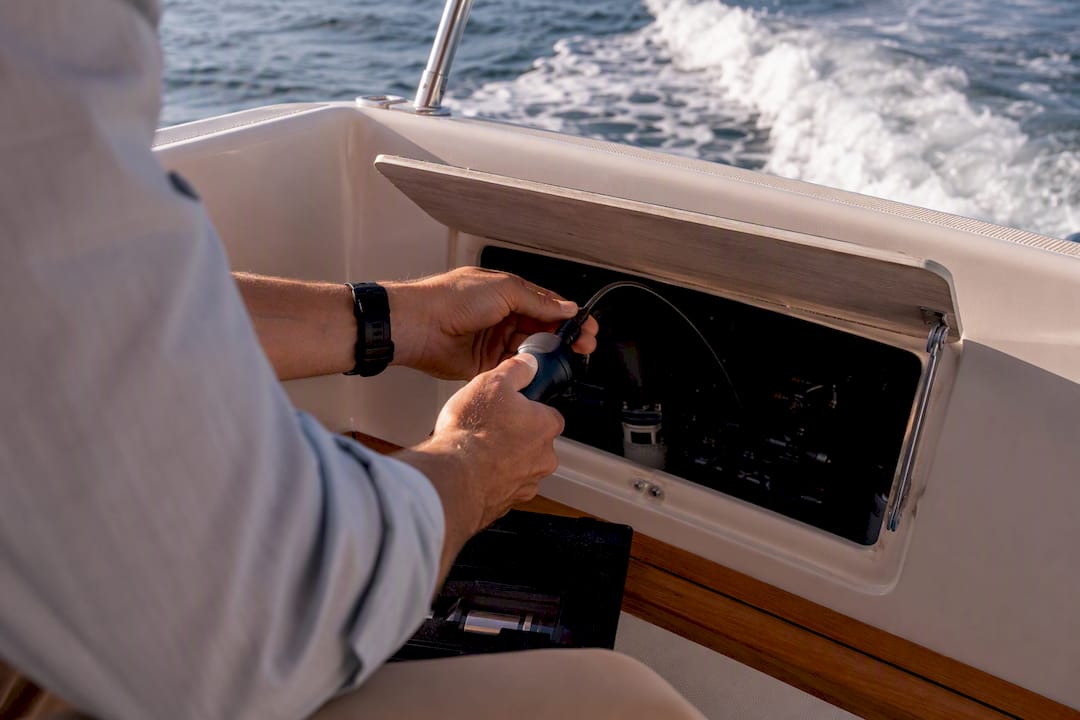
The survey should cover the hull, both engines, all major systems, and a full review of class society records if the vessel is classed. Sea trials serve a different purpose: they test how the vessel performs under load, at speed, and in maneuvering conditions that a static survey cannot replicate.
Bring the right people to the sea trial:
- A prospective captain, if you have already engaged one.
- A chief engineer or independent mechanical specialist.
- The surveyor who conducted the hull and systems inspection.
Pro Tip: Never rely on a surveyor the seller introduces you to, even if that surveyor seems perfectly competent. Contract your own, ideally one experienced with the specific class and size of vessel you are buying, because an independent survey is the only version that legally protects your interests if a dispute arises later.
Link the survey findings directly into your contract with an inspection contingency clause that spells out your remedies: repair credit, price reduction, or a walk-away right, all tied to a defined acceptance period after the survey is complete.
What Documents Actually Transfer Ownership?
Ownership does not transfer because two parties shook hands and money changed accounts. It transfers because specific paperwork gets filed correctly, and this is where a surprising number of otherwise sound deals stall out.
For documented vessels, the core document is the CG-1340 bill of sale, filed with the Coast Guard’s National Vessel Documentation Center. Smaller boats that are not federally documented instead go through state titling, which follows different rules depending on where the vessel is registered.
The essential paperwork stack includes:
- The CG-1340 bill of sale (for federally documented vessels).
- The Abstract of Title / NVD transcript confirming clean status.
- Lien release documentation for any prior mortgage or claim.
- A foreign deletion certificate, if the yacht previously carried a foreign flag.
Common errors that delay or invalidate a transfer include misfiled Coast Guard forms, a missing lien release that never got recorded, and confusion over what qualifies as a proper bill of sale versus an informal receipt. None of these are exotic problems. They are clerical ones, and clerical problems are exactly the kind that a careful closing checklist catches before they become legal problems.
Do You Have to Pay Taxes on a Private Yacht Sale?
Yes, in most cases, and this is one of the most misunderstood parts of a private transaction. Many states impose use tax or sales tax on private yacht sales, and the rules vary significantly depending on where the boat is registered, where it is delivered, and whether the transaction is structured through a dealer or purely peer-to-peer.
International sales add another layer: VAT exposure depends heavily on where delivery and title transfer actually occur, and the flag under which the vessel is documented afterward. A yacht that changes hands in one jurisdiction and gets flagged in another can trigger tax obligations neither party anticipated.
Retain a tax advisor early, not after the contract is signed, and bring them the bill of sale, the delivery location, and the intended flag state. Those three facts are usually enough for an experienced advisor to flag exposure before it becomes a post-closing surprise.
Why Do Ownership Structures Create Sanctions and Compliance Risk?
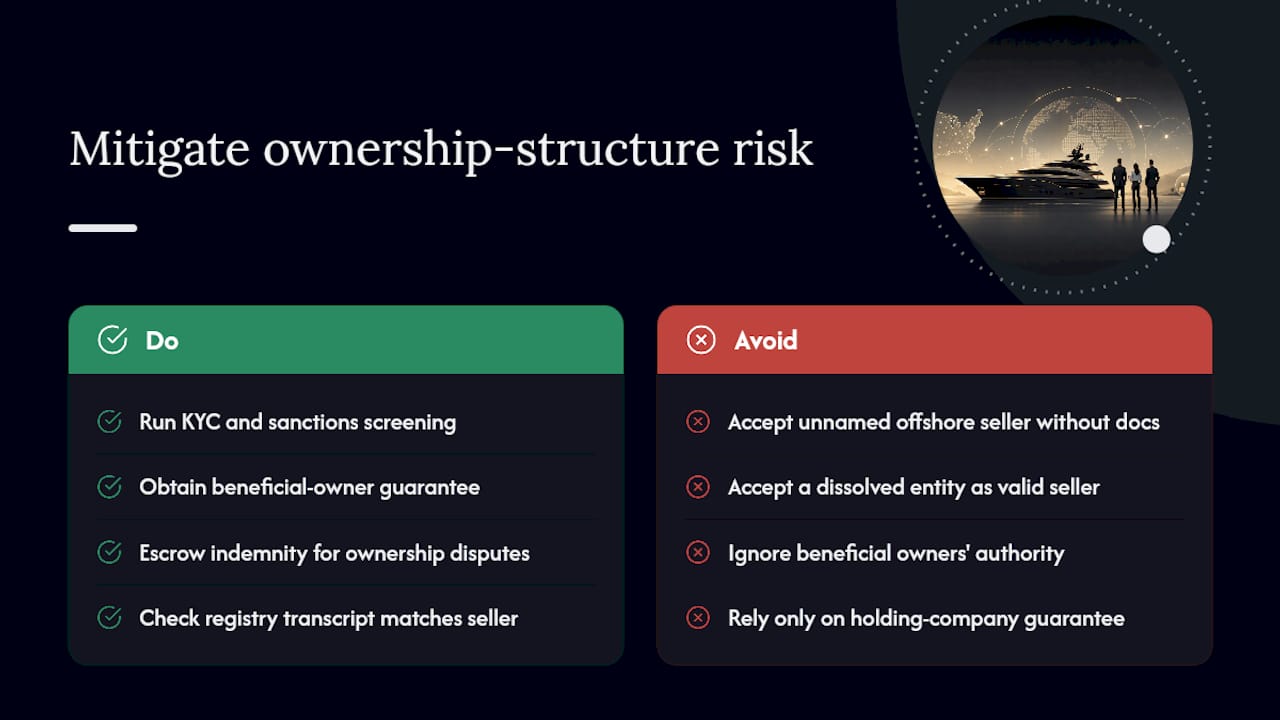
Banks, brokers, and closing attorneys are all required to run some level of KYC and sanctions screening on parties to a yacht transaction, and that screening gets considerably harder when the seller is a single-purpose offshore company rather than a named individual.
The risk is not theoretical. A dissolved entity, or one with beneficial owners who never properly documented their authority to sell, can leave a buyer holding a contract that a court later finds was never validly executed. Ownership through an LLC or trust also affects insurance and liability, and imperfectly maintained corporate formalities can expose the beneficial owner personally, which complicates who actually has standing to sign the sale.
Practical protections include a beneficial-owner guarantee attached to the closing documents, an escrowed indemnity specifically covering ownership disputes, and a registry transcript check confirming the selling entity matches the documented owner of record. A personal guarantee from the actual beneficial owner, not just the holding company, meaningfully reduces a buyer’s exposure when the seller is a shell entity.
What Happens at Closing to Protect Both Parties?
Closing day is where every earlier diligence step either pays off or gets exposed as incomplete. A typical structure starts with a deposit, usually 10 percent, held in escrow with defined release triggers tied to survey acceptance and title confirmation.
The coordination checklist at this stage looks like this:
- Confirm the lender payoff has cleared and the mortgage release is filed.
- File the transfer with the National Vessel Documentation Center.
- Confirm the buyer’s insurance binder is active before funds release.
- Complete crew handover and orientation, if the vessel carries crew.
- Hold back a defined escrow amount for any lien or defect discovered within the post-closing window.
The last-minute tripwire that catches the most buyers is a gap between the seller’s insurance lapsing and the buyer’s binder taking effect. Structure the closing so insurance coverage is continuous, not sequential, and that single fix eliminates one of the most common post-closing headaches.
Your Step-by-Step Risk Mitigation Checklist
Treat this as your working order of operations, not a menu to pick from selectively.
- Order the Abstract of Title / NVD transcript first, before spending money on anything else.
- Commission an independent, buyer-contracted survey and sea trial.
- Require an escrowed deposit with explicit release conditions tied to survey and title acceptance.
- Obtain written lender payoff instructions if the vessel is financed.
- Secure seller no-lien statements and a personal indemnity from the beneficial owner.
- Confirm the insurance binder is active and continuous through closing.
- Review tax treatment with an advisor before signing the final contract.
Pro Tip: Add two to three extra weeks to your diligence timeline specifically for lien and sanctions checks. Rushed closings almost always benefit the seller more than the buyer, since the seller already knows what is in the boat’s history and the buyer does not.
Insist on contract language that ties every deposit release to a specific, satisfied condition, never to a calendar date alone. For a fuller walkthrough of how these steps fit together, see this buyer’s guide to due diligence in yacht sales.
How Yachts-bysteve Coordinates Diligence and Closing
The entire sequence of coordinating the independent survey, structuring escrow terms, facilitating lender payoff communications on financed vessels, and introducing clients to legal counsel who specialize in maritime transfers is typically managed as part of International Buyer Agents: Shaping Riviera Luxury Deals brokerage services. That coordination role is exactly where a brokerage earns its place in a transaction, because the paperwork and timing issues described above are precisely where private deals go sideways without an experienced hand managing the sequence. Buyers and sellers working through Yachts-bysteve get a structured closing process built around the same checklist items outlined here, including documentation that satisfies both Coast Guard filing requirements and lender payoff conditions simultaneously.
The One Mistake That Causes the Biggest Losses
Every costly yacht deal I have studied traces back to the same root cause: somebody let the calendar drive the closing instead of the checklist. Sellers benefit from speed, because urgency discourages scrutiny. Buyers almost never benefit from it, since the transcript, the survey, and the lien search all take the time they take, and shortening that window only shifts risk onto the buyer’s shoulders.
The pattern is so consistent that industry advisers now recommend building in extra weeks specifically for diligence rather than treating a fast closing as a sign of a smooth deal. A fast closing is usually a sign that nobody checked the things worth checking.
If a seller pressures you to close before your surveyor or your attorney has signed off, that pressure is the signal, not the boat.
— Jason
How Yachts-bysteve Reduces Risk in Your Yacht Sale
Yachts-bysteve exists for exactly the moment this article describes: the point where a private yacht deal needs professional coordination instead of a hopeful handshake. Rather than leaving buyers and sellers to chase down transcripts, chase down lenders, and hope a surveyor’s report gets read before funds move, Yachts-bysteve manages the diligence sequence, escrow structuring, and closing coordination as part of standard brokerage service. That matters most on complex private sales, where financing, offshore ownership, or cross-border delivery adds layers a solo transaction rarely handles cleanly. If you are weighing whether to sell privately or bring in representation, start with this guide on how to choose a yacht broker and reach out for a consultation before you sign anything.
Primary Sources to Verify These Claims
- 46 U.S.C. Chapter 313, the statutory basis for maritime liens and preferred ship mortgages.
- Boat International’s legal guide to buying and selling superyachts.
- Daeryun Law’s vessel sale practice notes on title clearance and closing formalities.
Sources
- 46 U.S.C. Chapter 313 — Preferred Ship Mortgage and Maritime Liens
- Navigating legal waters: A guide to buying and selling superyachts — Boat International
- Vessel sale and purchase practice notes — Daeryun Law
FAQ
What is the 10 percent rule for yachts?
It typically refers to the industry norm of holding a 10 percent deposit in escrow, released only when survey and title conditions specified in the contract are satisfied.
Do I have to pay taxes if I sell my boat privately?
In most states, yes. Use tax or sales tax obligations often apply to private boat sales, and the specific rules depend on the vessel’s registration state and delivery location, so confirm with a tax advisor before closing.
What is the 12-person yacht rule?
This generally refers to passenger-carrying limits under maritime regulations that distinguish private, uninspected vessels from those requiring commercial passenger vessel certification, and it varies by vessel size and use.
Are yacht prices going down in 2026?
Pricing trends shift by size class and market segment, and the more reliable move for any buyer is confirming clean title and survey condition before focusing on price alone, since a title or lien problem erases any pricing advantage instantly.
How do I check for maritime liens before buying a yacht?
Order an Abstract of Title or NVD transcript from the Coast Guard’s National Vessel Documentation Center, then supplement it with seller indemnities and an escrow holdback to cover unrecorded claims the transcript will not show.
Recommended
Featured Listings

2028 Columbus Yachts
$22,900,008
137
Ancona

2012 Benetti PATIENCE
$10,975,000
132
Fort Lauderdale Florida

2028 Kingship Kingship
$20,350,000
125

2024 Silver Yachts
$25,400,000
117

2009 Hargrave BRANDI WINE
$2,500,000
114
Fort Lauderdale Florida

2028 Extra Yachts
$20,350,000
100
Ancona

2028 Alpha
$12,100,000
100
Ft Lauderdale Florida

2028 Extra Yachts Extra 96
$9,495,000
96
Ancona

2021 Sanlorenzo GATSBY
$6,795,000
96
Fort Lauderdale Florida

2028 Kingship
$11,990,000
90

2028 Alpha
$9,894,500
90
Fano

2023 Azimut COMPASS
$7,950,000
88
Miami Beach Florida

1999 Northern Marine OFF LINE
$2,495,000
84
Ft Lauderdale Florida

2013 Pershing DOROTHY ANN
$1,375,000
82
Fort Lauderdale Florida

1997 Ferretti Yachts
$825,000
80
La Paz

2008 Princess Yachts OCARALIA
$1,095,000
75
Charleston South Carolina

2014 Sunseeker
$1,400,000
68
New York New York

2024 Fairline
$2,750,000
68
Ft. Lauderdale Florida

2019 Vanquish Yachts IMPULSIVE
$1,799,000
58
Miami Beach Florida

2021 Ferretti Yachts HAVEN
$1,595,000
57
Fort Lauderdale Florida

2025 Formula BREAKTHROUGH III
$1,895,000
53
Miami Beach Florida

2023 Fairline
$900,000
45
Fort Lauderdale Florida

2012 Zeelander Mississippi Queen
$575,000
44
West Palm Beach Florida
2028 Columbus Yachts 137'
$22,900,008
2012 Benetti 132'
$10,975,000
2028 Kingship 125'
$20,350,000
2024 Silver Yachts 117'
$25,400,000
2009 Hargrave 114'
$2,500,000
2028 Extra Yachts 100'
$20,350,000
2028 Alpha 100'
$12,100,000
2028 Extra Yachts 96'
$9,495,000
2021 Sanlorenzo 96'
$6,795,000
2028 Kingship 90'
$11,990,000
2028 Alpha 90'
$9,894,500
2023 Azimut 88'
$7,950,000
1999 Northern Marine 84'
$2,495,000
2013 Pershing 82'
$1,375,000
1997 Ferretti Yachts 80'
$825,000
2008 Princess Yachts 75'
$1,095,000
2014 Sunseeker 68'
$1,400,000
2024 Fairline 68'
$2,750,000
2019 Vanquish Yachts 58'
$1,799,000
2021 Ferretti Yachts 57'
$1,595,000
2025 Formula 53'
$1,895,000
2023 Fairline 45'
$900,000
2012 Zeelander 44'
$575,000