

What yacht registries actually do for your vessel
Overview: The role of yacht registries extends far beyond a bureaucratic formality. Every yacht that ventures onto international waters must carry a legal nationality, and that nationality comes from its flag state registry. Think of it as a passport for your vessel, one that determines which laws govern it, which safety standards it must meet, and which country’s consular protection it can call upon when things go sideways in a foreign port.
Under the International Convention on the Law of the Sea (UNCLOS), all vessels sailing internationally must be registered and carry official documentation as evidence of their nationality. A yacht without registration is legally stateless, which means it can be seized, detained, and subjected to local rather than international law. That is not a theoretical risk. It is a practical one that affects port entry, insurance coverage, and your ability to charter or sell the vessel.
The registry you choose shapes your yacht’s entire operational and financial life:
- Legal nationality and jurisdiction: The flag state governs maritime law, safety regulations, and crew certification requirements aboard your vessel.
- Safety compliance: Registries enforce international conventions including SOLAS (Safety of Life at Sea), MARPOL (marine pollution prevention), STCW (crew training), and the MLC (Maritime Labour Convention).
- Ownership documentation: Registration creates a public record of ownership and provides the mechanism for recording liens and mortgages.
- Economic implications: Your flag choice directly affects registration fees, annual tonnage dues, VAT exposure, insurance premiums, and tax obligations.
- Operational freedom: Some registries permit limited chartering under private registration; others require full commercial certification before a single charter guest boards.
- Reputation at port: Registries on the Paris MoU White List face fewer inspections and enjoy smoother passage through international ports.
Choosing the right registry is, without exaggeration, one of the most consequential decisions in the entire yacht ownership process.
How the legal framework of yacht registries actually works
The legal weight a registry places on your vessel is substantial. When you register under a flag state, you place that vessel under the jurisdiction of that country for all matters of maritime law, safety regulation, and operational standards. The flag state then bears responsibility for ensuring your yacht complies with international conventions and conducts or authorizes the surveys and inspections that verify that compliance.
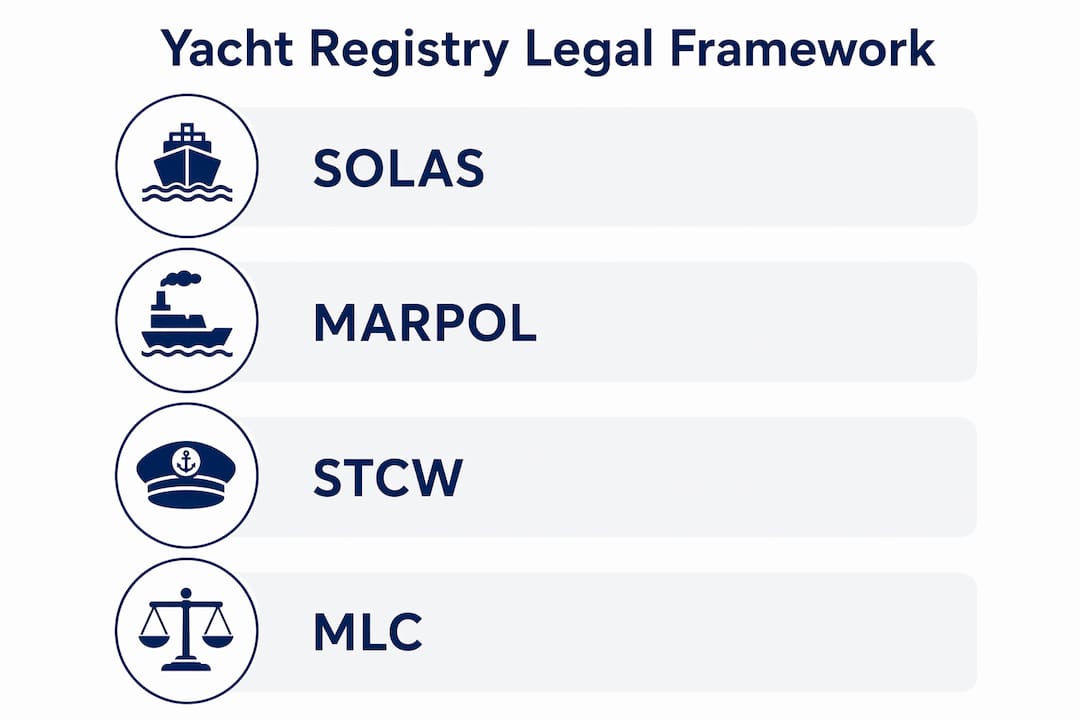
The four pillars of international maritime law that registries enforce are SOLAS, MARPOL, STCW, and the MLC. Each one carries real operational weight. STCW, for instance, dictates the qualifications your captain and crew must hold, and different flag states recognize different national certificates of competency. If your preferred captain holds qualifications from one country, you need to confirm those qualifications are recognized by your chosen registry before you commit.
The 12-passenger rule deserves particular attention. Under SOLAS, carrying more than 12 guests automatically reclassifies a yacht as a passenger ship, triggering construction and operational demands that most private vessels cannot meet. Exemptions exist, but they are narrow. The UK Maritime and Coastguard Agency has confirmed that exemptions for sea-going voyages with more than 12 passengers are not available under the Large Yacht Code, regardless of whether the yacht is private or commercial. Owners who assume otherwise risk voiding their insurance coverage entirely.
A few other legal dimensions worth understanding:
- Ownership proof vs. registration: The Certificate of Registry confirms a vessel’s registration and official number. It is not proof of ownership. Ownership is evidenced by separate documents such as a Builder’s Certificate or Bill of Sale. Confusing the two is a common and costly mistake.
- Lien recording: Registries provide the public record through which mortgages and maritime liens are recorded, which matters enormously to lenders and to buyers conducting due diligence before a purchase. Sound yacht ownership documentation protects all parties in a transaction.
- Port state control: Even with a strong flag state, your yacht is subject to inspection by port authorities in every country it visits. A registry on the Paris MoU White List reduces the frequency and intensity of those inspections.
- Insurance implications: Underwriters assess flag state reputation when setting premiums. P&I clubs view vessels flagged under well-regulated registries more favorably, which translates into better terms and lower costs over the life of the yacht.
The MCA’s position on the 12-passenger rule is unambiguous: carrying 13 or more guests on a sea-going voyage without Passenger Yacht Code certification voids compliance and exposes owners to severe penalties and insurance voidance.
Economic implications of your flag choice
Flag choice is a financial decision as much as a legal one. The economic factors tied to registration include registration fees, annual tonnage dues, survey costs, VAT exposure, insurance premiums, and the tax treatment of any charter income. Getting this right from the outset saves owners from expensive restructuring later.
Here is how the economics break down across the key variables:
- VAT and tax neutrality: Offshore registries like the Cayman Islands offer complete tax neutrality, with no income tax, capital gains tax, or VAT on vessel-owning companies. The Isle of Man allows non-EU resident owners to use the Temporary Admission regime, keeping a yacht in EU waters for up to 18 months at a time without paying VAT on its value, renewable every 18 months for up to 10 years. On a yacht valued in the tens of millions, that is a material saving.
- Registration and annual fees: Fees vary considerably across registries. Commercially registered yachts face more frequent surveys and formal safety management requirements, which add to the annual cost base. The direct cost of flagging offshore is generally not the largest line item, but it compounds with compliance obligations.
- Insurance premiums: Registries with strong port state control records attract better underwriting terms. A yacht flagged under a well-regulated registry typically pays lower premiums than one flagged under a registry with a poor inspection record.
- Resale value and marketability: A vessel registered under a reputable flag, particularly within the Red Ensign Group, carries a credibility premium in the resale market. Buyers and their brokers recognize the regulatory rigor behind those flags, and lenders are more comfortable financing vessels with clean, well-documented registry histories.
- Charter income and commercial registration: Owners who want to charter must weigh the regulatory burden of commercial registration against the revenue opportunity. Some registries allow limited chartering under private registration, which can be an attractive middle ground.
- Corporate ownership structures: Offshore registration is commonly paired with a special purpose vehicle (SPV) holding structure, where the vessel is owned by a company incorporated in either the same jurisdiction or a complementary one. This combination can unlock the full range of legal, tax, and governance benefits available, though it requires specialist advice to structure correctly.
Pro Tip: The flag state and the ownership jurisdiction are two separate decisions. A Cayman-flagged yacht held through a Jersey company is a common and entirely legitimate arrangement. Each jurisdiction should be chosen on its own merits, not defaulted to because a broker or management company finds it convenient.
Major yacht registries that US owners actually use
For American yacht owners, the choice of registry typically comes down to a handful of well-established options, each with distinct strengths.
The Red Ensign Group
The Red Ensign Group (REG) is a collection of British registries comprising the UK and its Crown Dependencies and Overseas Territories, including the Cayman Islands, Isle of Man, Bermuda, Gibraltar, the British Virgin Islands, Jersey, and Guernsey. Vessels registered within the REG fly the Red Ensign flag and benefit from British consular assistance and Royal Naval protection. The REG is widely regarded as the gold standard for superyacht registration, and the MCA’s regulatory oversight through the Large Yacht Code (LY3) is thorough and professionally administered. Classification societies, surveyors, and crew worldwide are familiar with Red Ensign requirements, which simplifies everything from port inspections to insurance underwriting. For US owners who want maximum credibility and the broadest international acceptance, a REG registry is the natural starting point.

The Cayman Islands Registry
The Cayman Islands Shipping Registry (CISR) holds an estimated 50% of the world’s fleet of yachts over 30 meters, and an even larger share of megayachts over 80 meters. That concentration is not accidental. The Cayman Islands offers complete tax neutrality, no VAT, Paris MoU and Tokyo MoU White List status, and USCG Qualship 21 Program recognition, which means fewer port inspections worldwide. Registration does not require the vessel to physically visit the Cayman Islands, and the process is conducted in English. For large US-owned yachts, particularly those held through offshore corporate structures, the Cayman registry is often the first choice considered.
The Isle of Man Registry
The Isle of Man Ship Registry consistently ranks among the top-performing flag states on the Paris MoU White List and is also a Category 1 British Registry within the REG. Its 0% corporate tax rate and VAT relief schemes for commercial charter services make it particularly attractive for owners who intend to generate charter income. The Isle of Man’s Yacht Engaged in Trade (YET) scheme, launched in 2025, allows privately registered yachts to undertake limited chartering in designated EU waters, adding flexibility without requiring full commercial certification. For US owners with European cruising plans and charter ambitions, this registry deserves serious consideration.
The Marshall Islands Registry
The Republic of the Marshall Islands operates one of the largest ship registries in the world and has become an increasingly popular flag state for superyachts. Its pragmatic regulatory approach and competitive fees appeal to owners who want international recognition without the more prescriptive framework of the Red Ensign’s LY3. The Marshall Islands has worked closely with the US Coast Guard to give Marshall Islands-registered yachts automatic rights to a cruising permit for US territorial waters, a practical advantage for American owners. The registry also allows qualifying private yachts to charter up to 84 days per year, subject to specific survey requirements. Owners who want operational flexibility and a lighter regulatory touch often find the Marshall Islands a compelling alternative.
Delaware domestic registration
For US owners who keep their yacht in American waters and have no intention of chartering or cruising internationally, Delaware’s domestic registry offers a straightforward path. The process is relatively simple, and domestic registration satisfies US legal requirements for vessels operating within American jurisdiction. The trade-off is that domestic registration rarely offers the tax, legal, or operational advantages available through offshore registries, and it carries less weight with international insurers and port authorities. It suits a specific profile: a privately used vessel that stays close to home.
Strategic factors experts consider when choosing a registry
Maritime experts consistently describe registry selection as a foundational strategy, not an administrative afterthought. The choice touches tax exposure, charter opportunities, crew qualification, insurance conditions, and the ease of selling the vessel years down the line. Owners who treat it as a checkbox exercise tend to discover the consequences later, usually at significant cost.
The most important principle is independence. A broker or management company may have commercial relationships with specific registries, and their recommendation may reflect convenience rather than your best interests. Independent analysis, ideally with a maritime lawyer who has no registry affiliations, is the only way to be certain the choice is genuinely optimized for your situation. You can get a clearer sense of what that process involves by reviewing the yacht registration process in detail before committing to any flag.
Several factors consistently shape the expert recommendation:
- Regulatory rigor vs. operational flexibility: The Red Ensign Group offers the strongest regulatory framework and the best international reputation, but it also imposes the most detailed compliance obligations. The Marshall Islands offers more flexibility with a lighter touch. Neither is universally better. The right answer depends on how you intend to use the vessel.
- Survey schedules and crew qualifications: Different registries impose different survey frequencies and recognize different crew certificates. If your captain holds qualifications from a specific country, confirm those are accepted before you commit to a flag.
- Charter intentions: If you plan to charter, even occasionally, the registry must support that activity legally. Misregistering a commercially operated yacht as a private vessel is a serious compliance failure with insurance and legal consequences.
- The 12-passenger rule in practice: Owners who routinely host large groups need to understand this rule precisely. Carrying a 13th guest on a sea-going voyage without proper certification is not a gray area. It voids insurance and creates personal liability.
- Corporate structure and flag state pairing: Combining an offshore flag with a complementary corporate ownership jurisdiction can unlock meaningful tax and governance benefits. Jersey and Guernsey, for example, are popular ownership jurisdictions paired with Cayman or Isle of Man flags. Both Channel Islands offer 0% corporate tax and mature legal frameworks based on English common law.
- Errors are expensive to unwind: If the ownership structure is not properly designed from the outset, restructuring involves professional fees, potential tax exposure, and operational disruption. Getting it right the first time is always cheaper than fixing it later.
Pro Tip: When evaluating registries, check the Paris MoU White List status for the current year. In 2025, the White List contained 40 flag states. A yacht flagged under a White List jurisdiction can expect smoother port inspections and a better-regarded certificate of registry worldwide.
The team at Yachts-bysteve works with owners at every stage of the acquisition process, from initial registry consultation to connecting you with the right legal and maritime advisors. If you are considering a purchase and want to understand how registry choice affects your investment, that conversation is worth having before you sign anything. Reach out through how to choose a yacht broker to begin with the right guidance from the start.
Key Takeaways
Yacht registry choice is a legal, financial, and operational decision that shapes every aspect of ownership, from port inspections to resale value, and getting it right from the outset is always less costly than restructuring later.
| Point | Details |
|---|---|
| Legal nationality is mandatory | Under UNCLOS, every internationally sailing yacht must be registered; an unregistered vessel is stateless and can be seized. |
| The 12-passenger rule is absolute | Carrying more than 12 guests on a sea-going voyage without Passenger Yacht Code certification voids insurance and triggers passenger ship classification under SOLAS. |
| Cayman Islands dominates large yachts | The Cayman Islands registry holds an estimated 50% of the world’s fleet of yachts over 30 meters, offering tax neutrality and no VAT. |
| Flag state and ownership jurisdiction are separate | A Cayman-flagged yacht held through a Jersey company is common practice; each jurisdiction should be chosen independently on its own merits. |
| Paris MoU White List status matters | In 2025, the White List contained 40 flag states; yachts flagged under these registries face fewer port inspections and better insurance terms. |
Recommended
Featured Listings

2028 Columbus Yachts
$22,900,008
137
Ancona

2012 Benetti PATIENCE
$10,975,000
132
Fort Lauderdale Florida

2028 Kingship Kingship
$20,350,000
125

2024 Silver Yachts
$25,400,000
117

2009 Hargrave BRANDI WINE
$2,500,000
114
Fort Lauderdale Florida

2028 Extra Yachts
$20,350,000
100
Ancona

2028 Alpha
$12,100,000
100
Ft Lauderdale Florida

2028 Extra Yachts Extra 96
$9,495,000
96
Ancona

2021 Sanlorenzo GATSBY
$6,795,000
96
Fort Lauderdale Florida

2028 Kingship
$11,990,000
90

2028 Alpha
$9,894,500
90
Fano

2023 Azimut COMPASS
$7,950,000
88
Miami Beach Florida

1999 Northern Marine OFF LINE
$2,495,000
84
Ft Lauderdale Florida

2013 Pershing DOROTHY ANN
$1,375,000
82
Fort Lauderdale Florida

1997 Ferretti Yachts
$825,000
80
La Paz

2008 Princess Yachts OCARALIA
$1,095,000
75
Charleston South Carolina

2014 Sunseeker
$1,400,000
68
New York New York

2024 Fairline
$2,750,000
68
Ft. Lauderdale Florida

2019 Vanquish Yachts IMPULSIVE
$1,799,000
58
Miami Beach Florida

2021 Ferretti Yachts HAVEN
$1,595,000
57
Fort Lauderdale Florida

2025 Formula BREAKTHROUGH III
$1,895,000
53
Miami Beach Florida

2023 Fairline
$900,000
45
Fort Lauderdale Florida

2012 Zeelander Mississippi Queen
$575,000
44
West Palm Beach Florida
2028 Columbus Yachts 137'
$22,900,008
2012 Benetti 132'
$10,975,000
2028 Kingship 125'
$20,350,000
2024 Silver Yachts 117'
$25,400,000
2009 Hargrave 114'
$2,500,000
2028 Extra Yachts 100'
$20,350,000
2028 Alpha 100'
$12,100,000
2028 Extra Yachts 96'
$9,495,000
2021 Sanlorenzo 96'
$6,795,000
2028 Kingship 90'
$11,990,000
2028 Alpha 90'
$9,894,500
2023 Azimut 88'
$7,950,000
1999 Northern Marine 84'
$2,495,000
2013 Pershing 82'
$1,375,000
1997 Ferretti Yachts 80'
$825,000
2008 Princess Yachts 75'
$1,095,000
2014 Sunseeker 68'
$1,400,000
2024 Fairline 68'
$2,750,000
2019 Vanquish Yachts 58'
$1,799,000
2021 Ferretti Yachts 57'
$1,595,000
2025 Formula 53'
$1,895,000
2023 Fairline 45'
$900,000
2012 Zeelander 44'
$575,000