

Overview: your first move after inheriting a yacht is not calling a broker. It is confirming you have the legal right to sell it. That means a death certificate, the will or Letters Testamentary, and proof of how the boat was titled, all in hand before you touch the listing photos.
Skip that step and you risk a closing that collapses at the notary’s desk, or worse, a buyer’s lien search turning up debt attached to a boat you thought was free and clear.
Start today with three moves. First, gather the death certificate, title or registration, and the will or Letters Testamentary/Letters of Administration. Second, run a lien search and, if the vessel carries a Coast Guard document rather than a state title, confirm its NVDC status. Third, request a market-orientation valuation or a surveyor’s quote so you know roughly what you are selling before anyone else tells you.
- Confirm legal authority to act (executor, Letters, transfer-on-death, or joint ownership)
- Verify title and registration status, and check for outstanding liens
- Get a preliminary valuation or survey estimate before listing
Most failed inherited-yacht sales trace back to one of these three steps being skipped, not to a weak market or a stubborn buyer.
Key Takeaways
Selling an inherited yacht comes down to confirming legal authority and clearing title and liens before you set a price or contact a single buyer.
| Point | Details |
|---|---|
| Confirm authority first | Gather the death certificate, will, and Letters Testamentary before doing anything else. |
| Match the title path to the boat | State-titled boats and NVDC-documented vessels follow different, non-interchangeable processes. |
| Run a lien search early | Maritime liens attach to the vessel and can survive a sale if left unresolved. |
| Get a survey before pricing | A surveyor’s report anchors your asking price and your negotiating position. |
| Match the route to the value | Private sale suits lower values; Yachts by Steve fits higher-value or documentation-complex inherited yachts. |
Table of Contents
- What You Need to Gather Before Selling an Inherited Yacht
- How Do You Transfer Legal Title to an Inherited Yacht?
- Could Liens or Unpaid Bills Complicate Your Sale?
- How Much Is an Inherited Yacht Worth?
- Which Selling Route Fits an Inherited Yacht Best?
- How Should You Prepare an Inherited Yacht for Sale?
- What Taxes Apply When You Sell an Inherited Yacht?
- What Paperwork Closes an Inherited Yacht Sale?
- How Yachts by Steve Supports Heirs Selling an Inherited Yacht
- How Long Does It Take and What Does It Cost?
- What Heirs Get Wrong About Selling an Inherited Yacht
- A Faster, Safer Way to Sell an Inherited Yacht
- Frequently Asked Questions
- Sources
What You Need to Gather Before Selling an Inherited Yacht
Buyers, title agencies, and (if the boat is documented) the NVDC will all ask for paper. Assemble it early so you are not scrambling mid-negotiation.
- State title or registration, or the Certificate of Documentation if the vessel is federally documented
- Original bill of sale, if the deceased kept one
- Death certificate (certified copy, not a photocopy)
- Will and Letters Testamentary or Letters of Administration
- Trust paperwork, if the yacht was held in a trust
- Insurance policy and maintenance or service logs
If the title or bill of sale has gone missing, check with the marina or yard where the boat was kept, the original selling broker, or the manufacturer for a builder’s certificate. For yachts with any European history, locate VAT or T2L paperwork now. A missing VAT-paid certificate is one of the most common reasons cross-border sales fall apart late in the process.
State agencies typically want the title, a death certificate, and probate documents. The NVDC wants something more specific: a certified court order, not just a copy of the will. That distinction trips up more heirs than any other paperwork issue in this process.
How Do You Transfer Legal Title to an Inherited Yacht?
Which path applies depends entirely on how the yacht was titled and whether the estate has to pass through probate.
Probate route. If the deceased left a will (or died without one) and the estate goes through probate, the court appoints an executor or administrator who receives Letters Testamentary or Letters of Administration. The executor signs the title transfer as the estate’s representative and submits the probate paperwork alongside it to the state titling agency.
Small-estate affidavits. Many states let smaller estates skip full probate entirely. If the yacht and the rest of the estate fall under your state’s dollar threshold, a small-estate affidavit can move the title in a fraction of the time.
Joint ownership with right of survivorship. If the deceased co-owned the boat this way, the surviving owner usually just presents a death certificate. Many state DMV or DNR offices process this same day.
Federally documented vessels. This is where things slow down. The NVDC requires a certified court order appointing an executor or personal representative before it will touch the documentation. Expect to file Coast Guard forms CG-1258 and a notarized CG-1340 bill of sale, sometimes alongside CG-1270. Processing can stretch several months depending on the regional backlog.
- Identify how the boat is titled: state title or U.S. Coast Guard documentation.
- Determine whether the estate requires full probate, qualifies for a small-estate affidavit, or transfers via survivorship.
- Assemble the death certificate, Letters, and any trust documents.
- File with the state title agency or submit the certified court order to the NVDC.
- Confirm the transferred title is lien-free before you list the boat for sale.
Pro Tip: Heirs almost always get stuck at the same point: assuming a photocopy of the will satisfies the NVDC. It does not. Order a certified copy of the court order the moment probate opens, since that document alone can add months to your timeline if you wait.
Could Liens or Unpaid Bills Complicate Your Sale?
Yes, and this is the step most heirs underestimate. Maritime liens attach to the vessel itself, not to the person who incurred them, and they can survive a change of ownership entirely. A yacht that looks debt free on paper can still carry unpaid dockage, a repair bill from a yard that never got settled, unpaid crew wages, a Preferred Ship Mortgage, or a state tax lien.
Search for these before you list, not after a buyer’s attorney finds them for you:
- State title agency records and UCC filings
- NVDC records, for documented vessels
- Marina and yard billing history
- An independent maritime lien search service
Pro Tip: If the estate has any complexity at all, run the closing through an escrow agent or an attorney experienced in yacht transactions. It costs little relative to the deal size, and it means funds and title change hands at the exact same moment, which is where private deals usually go wrong.
How Much Is an Inherited Yacht Worth?
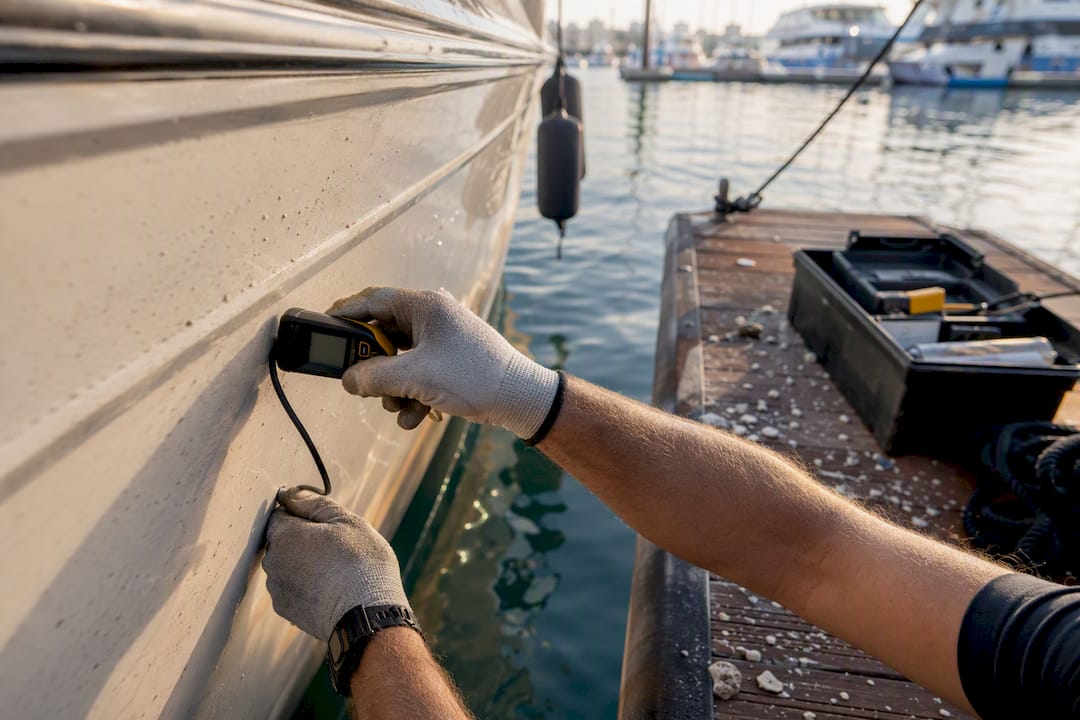
A qualified marine surveyor gives you something a Craigslist comparison never will: a documented, third-party condition report a serious buyer will actually trust. Ask for a condition and pre-purchase survey, plus an engine survey if the yacht has significant hours. The report should cover hull integrity, systems, safety equipment, and any deferred maintenance, and it becomes your primary evidence once negotiations start.
Comps matter too, but treat asking prices with skepticism. Closed sales tell you what buyers actually paid, not what sellers hoped for. A broker valuation earns its cost when the yacht’s value is unclear, when documentation is complicated, or when the market has shifted since the last comparable sale.
Location, condition, maintenance history, VAT/T2L status, and even the season all move the number. A boat listed in October in a cold-weather market rarely commands the price it would in April.
Pro Tip: A clean survey is negotiation leverage. A rough one is not necessarily a lost sale; it is often a chance to offer a price adjustment instead of chasing every repair a buyer requests.
Which Selling Route Fits an Inherited Yacht Best?
Four routes exist, and the right one depends on value, documentation complexity, and how quickly you need to close.
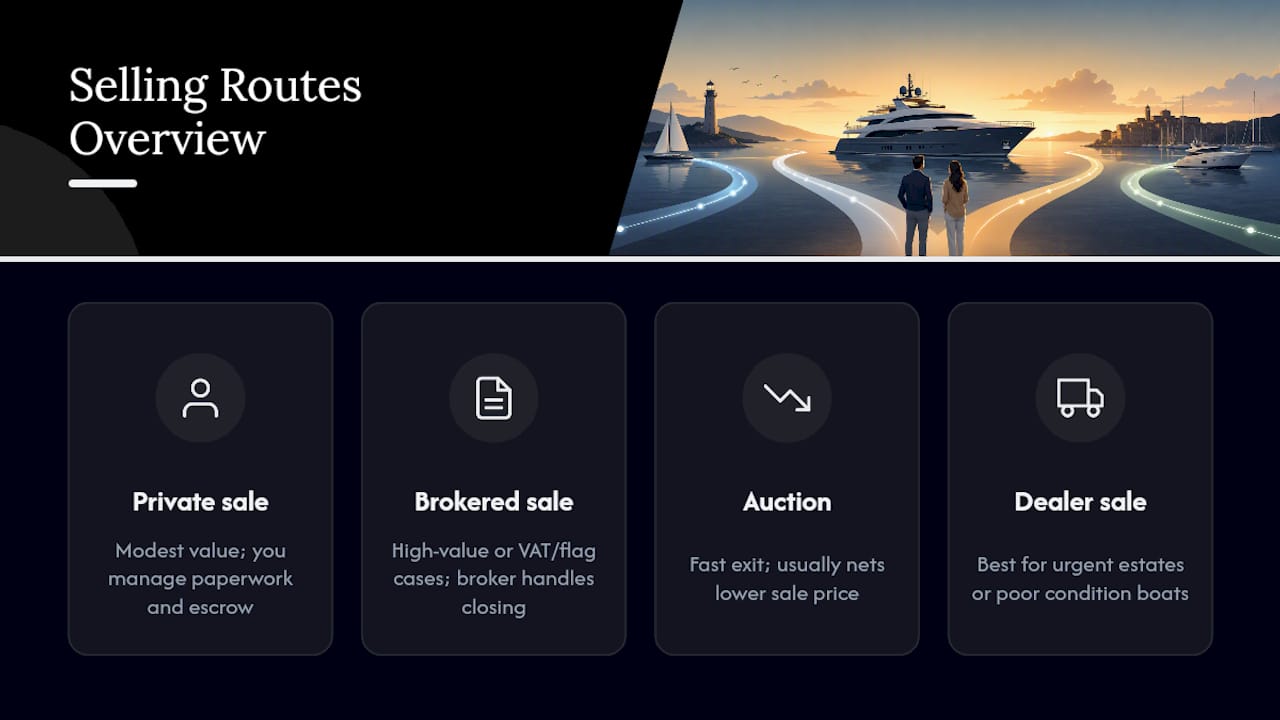
Private sale works when the boat’s value is modest or you already have a buyer lined up. The savings look appealing on paper, but private sellers often net only a small edge over broker commissions once you account for a longer time on market and lower final offers. You also carry the full weight of paperwork, escrow, and buyer vetting yourself.
Brokered sale earns its commission on higher-value vessels, boats with VAT or flag complications, or when the likely buyer pool is international. A broker markets to buyers a private listing never reaches, manages the survey and negotiation process, and coordinates the closing paperwork so nothing gets missed, as demonstrated by services like Virgin Charter Yachts. This is why sellers typically list through a brokerage once a boat’s value climbs into six or seven figures.
Auction trades price for speed. It rarely nets top dollar, but it works when heirs need a fast, clean exit and the estate can absorb a lower sale price.
Quick dealer sale is the fastest and lowest-yield option of all, best reserved for boats in poor condition or estates under real time pressure.
As a rule of thumb: lower value plus simple documentation plus no urgency favors private sale. Higher value, VAT or documentation complexity, or multiple heirs who need a clean, defensible process almost always favors a broker.
How Should You Prepare an Inherited Yacht for Sale?
You do not need a rebuild. You need the boat to show well and the paperwork to be spotless.
Focus first on safety equipment, basic engine and propulsion checks, and any visible wear a buyer will notice on a walkthrough. These are the items that shape a buyer’s first impression and the survey findings that follow.
- Deep clean, inside and out, before any photos are taken
- Fix small, visible items: upholstery tears, corrosion, non-functioning electronics
- Assemble the documentation pack: title, survey, maintenance logs, builder’s certificate, VAT/T2L if applicable
- Take professional photos and prepare an accurate spec sheet
- Get the boat sea-trial ready
Pro Tip: Spend on repairs that show up in a survey report, not on cosmetic upgrades a buyer will never value at cost. A $400 upholstery repair often does more for your final price than a $4,000 electronics upgrade nobody asked for.
What Taxes Apply When You Sell an Inherited Yacht?
Inherited property in the United States generally receives a stepped-up basis, meaning your cost basis resets to the yacht’s fair market value on the date of death rather than what the original owner paid. Sell close to that appraised value and you may owe little or no federal capital gains tax; sell well above it and the gain becomes taxable.
State sales and use tax works differently. Most states do not tax the inheritance transfer itself, but a buyer purchasing the yacht from you afterward will typically owe sales tax in their state, and documentation requirements vary widely.
Talk to a CPA before you finalize a sale price if the basis is disputed among heirs, if the estate is claiming any exemptions, or if VAT questions apply to a cross-border buyer. Tax rules on inherited vessels vary by state and by circumstance, so treat this section as a starting point for that conversation, not a substitute for it.
What Paperwork Closes an Inherited Yacht Sale?
Every closing needs a small stack of documents to change hands correctly, and getting the signatures right matters as much as having the paperwork at all.
| Document | Who signs it | Where it’s filed |
|---|---|---|
| Signed title or bill of sale (state or CG-1340) | Executor or estate administrator | State title agency or NVDC |
| Lien release or mortgage satisfaction | Lienholder or lender | Filed with title transfer |
| Proof of inheritance (Letters, death certificate) | Court/estate | Submitted with title paperwork |
| Survey acceptance or repair acknowledgement | Buyer and seller | Kept with closing file |
| Insurance transfer or cancellation | Buyer (new policy) / seller (cancellation) | Insurance carrier |
Hold the boat and the title until funds fully clear. Use a yacht-specific escrow arrangement or an attorney trust account rather than a handshake and a wire transfer. It is the single cheapest insurance policy in the entire transaction.
- Confirm the bill of sale is signed by the correct party (executor, not an heir who lacks authority)
- Verify the lien release is in hand before releasing funds
- Keep insurance active on the vessel until the title officially transfers
How Yachts by Steve Supports Heirs Selling an Inherited Yacht
Selling a yacht you inherited is not the same transaction as selling one you bought yourself, and Yachts by Steve treats it that way. Our team coordinates title clearance, runs maritime lien checks alongside your attorney, arranges surveyor scheduling, and markets the yacht to buyers who are actually qualified to close, not just browse.
We also manage escrow and closing logistics so heirs, whether there is one of you or five, get a transaction that holds up to scrutiny. If you want a hands-on read on where your inherited yacht stands, our seller onboarding process is the fastest way to find out what you are working with.
- Title and lien clearance coordination
- Survey scheduling and negotiation support
- Marketing to a vetted buyer pool
- Escrow and closing management
How Long Does It Take and What Does It Cost?
Timelines vary sharply depending on which title path applies to your yacht. Joint-ownership transfers with survivorship rights can close in a day or two. Small-estate and transfer-on-death routes usually run two to six weeks. Full probate, or any transfer requiring NVDC approval, can stretch from several weeks to several months.
Budget for state title and registration fees, NVDC filing fees if the vessel is documented, surveyor fees, ongoing yard or storage costs, broker commission if you use one, and legal or escrow fees for the closing itself.
Pro Tip: Yard storage and maintenance costs add up fast while a yacht sits unsold, and they are often the real reason heirs decide to accept a slightly lower offer sooner rather than wait for a marginally better one later.
What Heirs Get Wrong About Selling an Inherited Yacht
Most guidance on this topic treats an inherited yacht like any other used boat sale, just with extra paperwork tacked on. That framing undersells the actual risk. The paperwork is not a formality here; it is the entire transaction. A yacht with a clean survey and a murky lien history is worth less, and often unsellable, compared to a rougher boat with title fully cleared.
The conventional advice to “get it appraised and list it” skips the part that actually determines whether the deal closes: does the estate have legal authority to sell, and is the vessel actually free of encumbrances? I would put lien clearance ahead of valuation every time, because a beautiful survey means nothing if a maritime lien surfaces during closing and kills the deal at the notary’s table.
If there is one thing heirs should prioritize first, it is getting the certified court order in hand before anything else, especially for documented vessels where the NVDC will not budge without it. Everything else, the survey, the price, the marketing, matters, but it is downstream of that one document.
A Faster, Safer Way to Sell an Inherited Yacht
Handling an inherited yacht sale yourself means managing title clearance, lien searches, surveyor coordination, and buyer vetting all at once, on top of settling an estate. Yachts by Steve exists for exactly this moment: a specialized brokerage that takes on the title verification, lien checks, and closing logistics so you are not learning maritime law while grieving a loss.
We work with heirs whose yachts range from modest daysailers to seven-figure motor yachts, and we tailor the process to whichever title path applies to your situation. If your inherited yacht carries real value or any documentation complexity, our brokerage services are built to get you a clean, defensible sale rather than a drawn-out private listing. Request a valuation consultation today and find out what your inherited yacht is actually worth before you set a price.
Frequently Asked Questions
Do I need probate to sell an inherited yacht?
Only if the estate does not qualify for a small-estate affidavit and the boat was not held jointly with survivorship rights. Check your state’s dollar threshold for small-estate transfers before assuming full probate is required.
How long does selling an inherited yacht typically take?
Title transfer alone can run from same-day for survivorship cases to several months for NVDC-documented vessels requiring a certified court order. The actual sale timeline adds weeks to months on top of that, depending on the route you choose.
Can I sell the yacht before the title is transferred into my name?
No. You need clear legal authority to sell, whether that is executor status, Letters Testamentary, or confirmed survivorship rights, before any buyer’s attorney will proceed with closing.
What happens if there’s a lien on the inherited yacht?
The lien must be resolved or a release obtained before the sale closes. Unresolved liens can attach to the vessel even after a change in ownership, which is why an independent lien search matters before you list.
Is a broker worth it for a lower-value inherited yacht?
Not always. For modest-value boats with straightforward title and a known buyer, private sale can work fine. Above a certain price point, or with any documentation complexity, a broker’s reach and closing support typically pay for the commission.
Sources
For federally documented vessels, review NVDC transfer requirements and the CG-1258 and CG-1340 form instructions directly from the Coast Guard. For state-titled boats, a step-by-step registration guide walks through probate versus small-estate routes. Pair either path with an independent maritime lien search and a certified marine surveyor before you list.
- How to Register an Inherited Boat: Step-by-Step Guide (2026)
- Understanding liens on boats: what to check before you buy
- Sellyourboat
- Private Yacht Sales – Safe Closings With Legal Counsel
Recommended
Featured Listings

2028 Columbus Yachts
$22,900,008
137
Ancona

2012 Benetti PATIENCE
$10,975,000
132
Fort Lauderdale Florida

2028 Kingship Kingship
$20,350,000
125

2024 Silver Yachts
$25,400,000
117

2009 Hargrave BRANDI WINE
$2,500,000
114
Fort Lauderdale Florida

2028 Extra Yachts
$20,350,000
100
Ancona

2028 Alpha
$12,100,000
100
Ft Lauderdale Florida

2028 Extra Yachts Extra 96
$9,495,000
96
Ancona

2021 Sanlorenzo GATSBY
$6,795,000
96
Fort Lauderdale Florida

2028 Kingship
$11,990,000
90

2028 Alpha
$9,894,500
90
Fano

2023 Azimut COMPASS
$7,950,000
88
Miami Beach Florida

1999 Northern Marine OFF LINE
$2,495,000
84
Ft Lauderdale Florida

2013 Pershing DOROTHY ANN
$1,375,000
82
Fort Lauderdale Florida

1997 Ferretti Yachts
$825,000
80
La Paz

2008 Princess Yachts OCARALIA
$1,095,000
75
Charleston South Carolina

2014 Sunseeker
$1,400,000
68
New York New York

2024 Fairline
$2,750,000
68
Ft. Lauderdale Florida

2019 Vanquish Yachts IMPULSIVE
$1,799,000
58
Miami Beach Florida

2021 Ferretti Yachts HAVEN
$1,595,000
57
Fort Lauderdale Florida

2025 Formula BREAKTHROUGH III
$1,895,000
53
Miami Beach Florida

2023 Fairline
$900,000
45
Fort Lauderdale Florida

2012 Zeelander Mississippi Queen
$575,000
44
West Palm Beach Florida
2028 Columbus Yachts 137'
$22,900,008
2012 Benetti 132'
$10,975,000
2028 Kingship 125'
$20,350,000
2024 Silver Yachts 117'
$25,400,000
2009 Hargrave 114'
$2,500,000
2028 Extra Yachts 100'
$20,350,000
2028 Alpha 100'
$12,100,000
2028 Extra Yachts 96'
$9,495,000
2021 Sanlorenzo 96'
$6,795,000
2028 Kingship 90'
$11,990,000
2028 Alpha 90'
$9,894,500
2023 Azimut 88'
$7,950,000
1999 Northern Marine 84'
$2,495,000
2013 Pershing 82'
$1,375,000
1997 Ferretti Yachts 80'
$825,000
2008 Princess Yachts 75'
$1,095,000
2014 Sunseeker 68'
$1,400,000
2024 Fairline 68'
$2,750,000
2019 Vanquish Yachts 58'
$1,799,000
2021 Ferretti Yachts 57'
$1,595,000
2025 Formula 53'
$1,895,000
2023 Fairline 45'
$900,000
2012 Zeelander 44'
$575,000