

Yes, solar can run most hotel loads on a well-designed yacht, and on select catamarans and demonstration builds, it can support propulsion too. It cannot yet replace diesel for continuous ocean passages with heavy air conditioning and stabilizer loads. The technology rewards owners who commit to maintenance: routine cleaning and inspection improve panel performance by around 15%. Salt buildup at just 10% surface coverage can cut output by roughly 9.69%](https://www.sciencedirect.com/science/article/abs/pii/S0038092X26003142).
Solar on yachts works best for a specific group of owners:
- Liveaboards who want quiet, low-drama power for lights, refrigeration, and electronics at anchor.
- Coastal and day cruisers who rarely need generator backup for short runs.
- Catamaran owners with wide, flat decks that offer real panel real estate.
- Owners of specialized power yachts built with solar as part of the original hull design, not bolted on afterward.
Key Takeaways
Solar on yachts delivers real, measurable power for hotel loads and quiet anchoring, but usable output depends far more on maintenance, mounting, and battery chemistry than on headline panel wattage.
| Point | Details |
|---|---|
| Feasibility depends on use case | Solar covers hotel loads and anchoring well but rarely replaces diesel on long, heavy-load ocean passages. |
| Maintenance recovers real output | Regular rinsing and inspection can restore around 15% of lost panel performance over time. |
| Salt buildup costs measurable power | Panel output drops roughly 9.69% at 10% salt coverage and 14.52% at 20% coverage. |
| Usable energy beats headline Ah | Lithium banks deliver far more usable kWh per pound than AGM at comparable rated capacity. |
| Get impartial guidance before buying | Yachts-bysteve reviews solar specifications, vets installers, and coordinates surveys for buyers evaluating solar-equipped yachts. |
Table of Contents
- What Goes Into a Solar Setup for Yachts
- Which Yacht Types Actually Benefit from Solar?
- How Much Power Loss Should Owners Expect at Sea?
- How Do You Size Solar Panels and Batteries for Your Yacht?
- Lithium vs AGM Marine Batteries: Which Delivers More Usable Energy?
- Mounting, Bonding, and Certification for Marine Solar Installs
- What Does Solar Actually Cost, and What Does It Save?
- Which Builders and Suppliers Lead in Yacht Solar Systems?
- What Installers Rarely Tell Buyers Upfront
- Regulatory and Safety Considerations for Solar Installations
- How Solar Panels Change Yacht Design and Weight Balance
- Combining Solar with Diesel, Wind, and Other Power Sources
- A Broker’s View on Solar-Equipped Yachts
- How Yachts by Steve Helps You Buy the Right Solar-Equipped Yacht
- Sources
What Goes Into a Solar Setup for Yachts
A functional yacht solar system is really six parts working in sequence, and skipping any one of them is where most installations disappoint their owners.
-
PV modules — rigid glass panels, semi-flexible laminates, or fully flexible sheets, each suited to different deck geometry.
-
Mounting and bonding hardware — brackets, adhesive systems, or frames that hold panels against wind, spray, and foot traffic.
-
MPPT charge controllers — regulate voltage from the array to the battery bank far more efficiently than older PWM controllers.
-
Battery bank — the buffer that stores what the sun delivers and releases it on demand.
-
Inverter/charger — converts stored DC power into usable AC for onboard appliances.
-
Isolation, protection, and monitoring — breakers, fuses, and a display or app that shows what’s actually happening in the system.
Power flows in one direction: panels generate, the MPPT controller optimizes and steps that energy down to charge the batteries, and the inverter draws from the bank to run everything from the espresso machine to the autopilot.
Pro Tip: Keep cable runs as short as possible and use larger-gauge conductors than you think you need. Every extra foot of thin wire between the panel and the controller bleeds voltage you paid for and never gets back.
Which Yacht Types Actually Benefit from Solar?
Not every hull profile makes solar worthwhile, and matching expectations to vessel type saves owners from disappointment.
- Small cruising sailing yachts — solar acts as a trickle charger, topping off house batteries between passages rather than running the whole boat.
- Liveaboard cruisers — moderate hotel loads (fridge, lights, water pump, entertainment) often align well with a mid-size array.
- Solar-assisted motor yachts and catamarans — flat coachroofs and bimini tops allow bigger arrays that extend silent anchoring time significantly.
- Demonstration superyachts — a handful of builds run largely or entirely on solar and battery power, proving feasibility rather than setting the norm.
Solar works well for anchoring, coastal hops, and low-load liveaboard routines. It struggles on continuous ocean crossings where air conditioning, desalinators, and stabilizers draw far more than any deck-mounted array can replace. Some catamarans run refrigeration and lighting on solar alone for days at anchor. Few yachts run air conditioning on solar alone for more than a few hours.
How Much Power Loss Should Owners Expect at Sea?
Marine solar panels fight a harsher environment than rooftop arrays ever face. Salt spray, UV exposure, thermal cycling from hot decks to cool nights, and constant vibration from engines and wave slap all chip away at output over time.
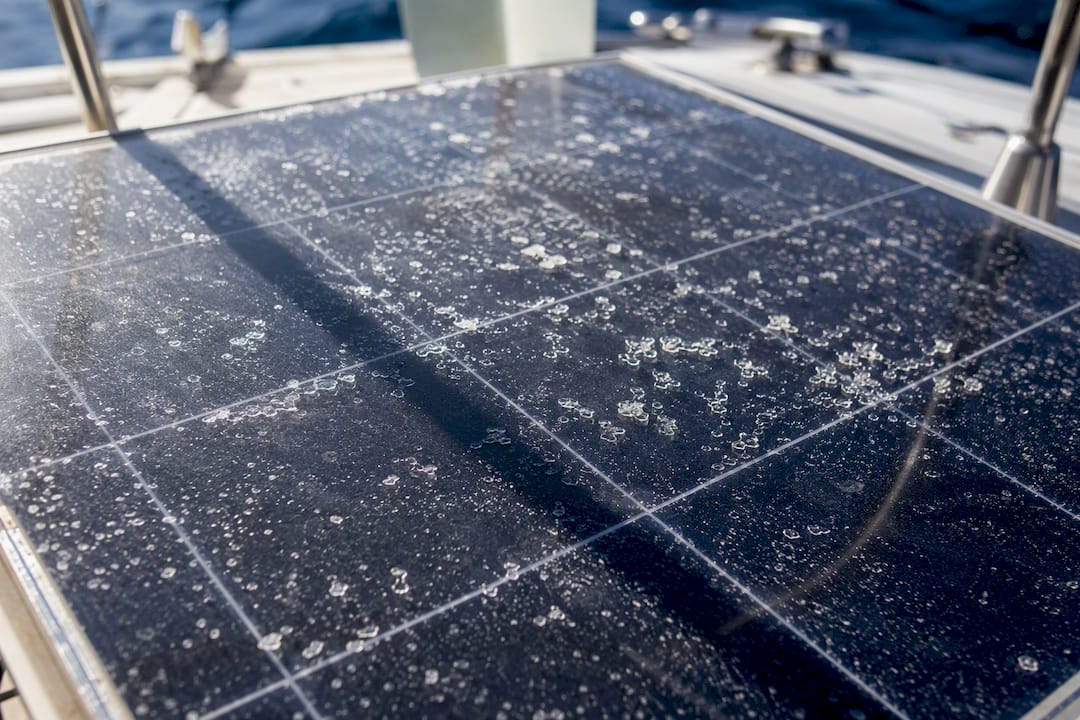
The numbers tell the real story. Salt crystallizing on panel glass at just 10% surface coverage reduces output by about 9.69%, and that loss nearly doubles to 14.52% once coverage reaches 20%. Left unaddressed for a season, a panel can quietly lose more capacity than most owners realize until they check the monitoring app and wonder why the battery bank never tops off anymore.
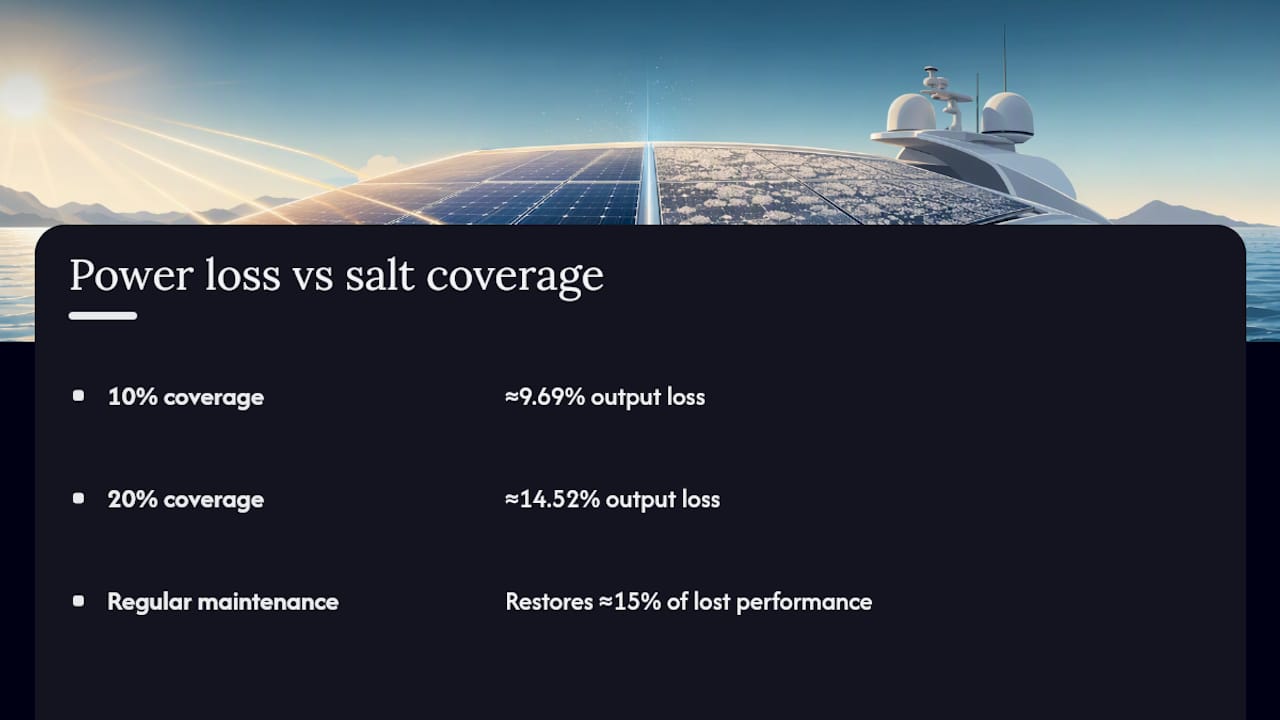
The fix is unglamorous but effective. Regular maintenance, mostly freshwater rinsing and periodic inspection, restores roughly 15% of lost performance on panels that have been neglected. Lab ratings on a spec sheet describe a panel in a climate-controlled test facility, not one bolted to a coachroof in the Caribbean.
A sensible cadence: rinse panels every one to two weeks in salt-heavy cruising grounds, do a visual check for hazing or micro-cracks each month, and inspect junction box seals at the start and end of each season.
Pro Tip: Check junction boxes and cable glands after any period of heavy weather. Water intrusion at a connector is a slower, sneakier failure than a cracked panel, and it’s the one most owners miss during a quick walk-around.
How Do You Size Solar Panels and Batteries for Your Yacht?
Sizing a system correctly is arithmetic, not guesswork, and most disappointment traces back to skipping this step.
- Add up your daily energy demand in watt-hours, listing every load honestly, including the refrigerator you forget runs around the clock.
- Apply a system loss factor of roughly 20 to 25% to account for wiring resistance, controller inefficiency, and battery charge/discharge losses, a standard deduction for marine installs.
- Divide the adjusted figure by the effective sun hours for your cruising ground, not the theoretical daily maximum.
- The result is your required panel wattage.
- Size the battery bank for at least two days of consumption so cloudy days don’t leave you running the generator anyway.
For a 15-meter cruising yacht with a fridge, LED lighting, chartplotter, autopilot, and occasional watermaker use, daily demand often lands between 2,000 and 3,000 Wh. In Mediterranean conditions with five effective sun hours, that translates to a 400W to 600W array, paired with enough battery capacity to bridge two overcast days without anxiety.
Gather these before you talk to an installer: a realistic load list, effective sun hours for where you actually cruise, expected cable and controller losses, and your target battery reserve.
Lithium vs AGM Marine Batteries: Which Delivers More Usable Energy?
The battery you choose matters more than the panels you buy, because usable energy, not nominal capacity, determines how long your systems actually run.
Depth of discharge (DoD) is the percentage of a battery’s capacity you can safely draw before recharging. Lithium chemistries tolerate deep cycling; AGM lead-acid batteries don’t, and pushing them past their comfort zone shortens their life fast.
A worked comparison from Victron Energy illustrates the gap clearly: a 24V, 180Ah lithium bank delivers around 3.8 kWh of usable energy at 80% DoD, while two 220Ah AGM batteries wired for 24V deliver only about 2.64 kWh at a conservative 50% DoD. To match lithium’s usable output, an AGM bank typically needs a substantially larger capacity, which means more weight, more space, and more cost in enclosures and wiring.
| Factor | Lithium-ion | AGM |
|---|---|---|
| Usable energy at practical DoD | High (around 80% DoD) | Lower (around 50% DoD) |
| Charge/discharge behavior | Accepts fast charge, minimal voltage sag | Slower charge, more voltage sag under load |
| Cycle life | Generally several thousand cycles | Generally several hundred cycles |
| Weight and space for equal usable energy | Lower | Higher (roughly double the Ah needed) |
| Cost shape | Higher upfront, lower lifetime cost per usable kWh | Lower upfront, higher lifetime cost per usable kWh |
- Compare usable kWh, never headline Ah ratings, when a supplier pitches a battery bank.
- Ask what DoD assumption the quoted capacity is based on.
- Factor in weight distribution, since AGM’s extra bulk affects trim on smaller hulls.
Pro Tip: Lead-acid batteries lose usable capacity faster in cold water and under high discharge rates, a behavior described by Peukert’s effect. Lithium banks are far less sensitive to this, which matters more than most brochures admit if you cruise in cooler climates.
Mounting, Bonding, and Certification for Marine Solar Installs
Rigid framed panels suit flat coachroofs and hardtop biminis where structure already exists to carry the load. Semi-flexible panels bend gently over curved surfaces without full bonding. Fully flexible panels, the kind used on arches and softer bimini tops, need complete adhesion to a rigid substrate to bear foot traffic; Solbian’s SP Series, certified to the IEC 61701 salt-mist standard, is walkable only when bonded this way.
- Specify 316 stainless steel fasteners and marine-grade anodized aluminum framing to avoid galvanic corrosion between dissimilar metals.
- Insist on IP-rated junction boxes and vibration-isolating mounts near engine bays or high-flex bimini frames.
- For classed vessels, confirm equipment meets IEC 61730 and IEC 61215 type approval, with DNV environmental testing where applicable.
- Confirm the mounting surface can bear foot traffic before calling a flexible panel “walkable.”
- Check fastener material against the hull’s existing hardware to rule out bi-metallic corrosion.
- Request the certification documents, not just a verbal assurance.
Pro Tip: A protective marine coating on adjacent gel coat or hull surfaces, such as ceramic coatings designed for marine use, can reduce salt adhesion around panel edges and make your rinse routine faster.
What Does Solar Actually Cost, and What Does It Save?
A basic trickle-charge setup, enough for lighting and small electronics on a modest sailing yacht, typically runs in the low thousands for panels, a controller, and installation labor. Larger arrays on catamarans or motor yachts, sized in the kilowatt range with a lithium battery bank, climb substantially higher, with the battery bank itself often representing the largest single line item, especially if lithium is specified over AGM.
Return on that investment depends on a handful of variables:
- Panel efficiency and available deck space, since a smaller boat simply has less room to work with.
- Battery sizing and chemistry, which determines how much of the solar harvest actually gets used.
- Local sun hours for your typical cruising grounds.
- Generator runtime avoided, plus the fuel and maintenance that runtime would have consumed.
The operational payoff shows up in daily life more than on a spreadsheet: quieter nights at anchor, less generator wear, and a shift in provisioning habits since you’re not planning fuel stops around hotel loads. Heavier battery banks do shift weight and center of gravity, which matters on smaller hulls and is worth reviewing against overall fuel efficiency strategy before finalizing a spec.
Which Builders and Suppliers Lead in Yacht Solar Systems?
A handful of names come up repeatedly once you start researching specification sheets, and each approaches the problem differently.
- Silent Yachts builds catamarans with solar integrated into the original hull design rather than retrofitted, aimed at extended silent operation.
- Sunreef Yachts offers solar-clad hulls and superstructures on several catamaran and yacht lines, treating panel area as a design feature.
- Solbian specializes in high-efficiency flexible and semi-flexible marine panels, including the salt-mist certified SP Series.
- Victron Energy supplies the MPPT controllers, inverters, and battery monitoring systems that tie most yacht solar installations together.
- Torqeedo builds electric propulsion systems that pair with solar and battery banks on smaller and mid-size vessels.
No single name here is the only right answer for every boat. Read the technical specification sheets closely, confirm marine certification claims directly with the manufacturer, and match the offering to your actual mission profile rather than the most impressive brochure.
What Installers Rarely Tell Buyers Upfront
The gap between a spec sheet and a working system usually comes down to details installers assume you already know.
Mounting surface stiffness, not the panel itself, often decides whether a “walkable” flexible panel actually holds up to foot traffic; without full bonding to a rigid substrate, that claim doesn’t hold.
- Ask for field wear records from actual boats, not lab test summaries.
- Confirm the warranty explicitly covers salt-mist related failures, not just manufacturing defects.
- Request proof of IEC 61701 testing or an equivalent marine standard.
- Ask what cleaning regime the warranty assumes, and what voids it.
Pro Tip: Ask for remote monitoring access before you sign off on installation. A system you can check from your phone catches a failing panel weeks before a visual inspection would.
Regulatory and Safety Considerations for Solar Installations
Solar systems on yachts fall under a patchwork of standards rather than one universal code, and the rules that apply depend heavily on vessel size, flag state, and whether the boat is classed.
Panels and associated electrical equipment intended for marine use should carry IEC 61730 and IEC 61215 type approval, which cover safety and performance testing respectively. For classed vessels, DNV or an equivalent classification society typically requires additional environmental testing before solar equipment can be approved as part of the vessel’s electrical system. Skipping this step on a classed yacht can create real problems at survey time, well after the installation bill has been paid.
Electrical isolation matters just as much as panel certification. DC systems on a boat sit close to bilge water, fuel lines, and constant vibration, so proper fusing, grounding, and bonding aren’t optional extras. A poorly isolated array can introduce stray current corrosion that eats away at underwater metals over months, a problem that has nothing to do with the panels themselves and everything to do with how the system was wired into the boat’s existing DC network.
Fire safety deserves specific attention with lithium battery banks. Reputable installers use battery management systems with thermal cutoffs and physically separate battery compartments from living spaces. Insurance underwriters increasingly ask about battery chemistry and installation documentation during survey, so keeping certification paperwork, wiring diagrams, and installer credentials on file protects both safety and resale value down the line.
How Solar Panels Change Yacht Design and Weight Balance
Adding solar to a yacht is never just a bolt-on decision. It changes how naval architects think about deck layout, structural loading, and where weight sits relative to the waterline.
Rigid glass panels are heavier than flexible laminates, and mounting a meaningful array on a coachroof or bimini top adds weight high above the center of gravity, exactly where added mass has the most effect on stability. Builders like Silent Yachts and Sunreef Yachts address this by designing the hull and superstructure around the array from the start, distributing panel area across a wide catamaran beam rather than concentrating it on a single elevated surface.
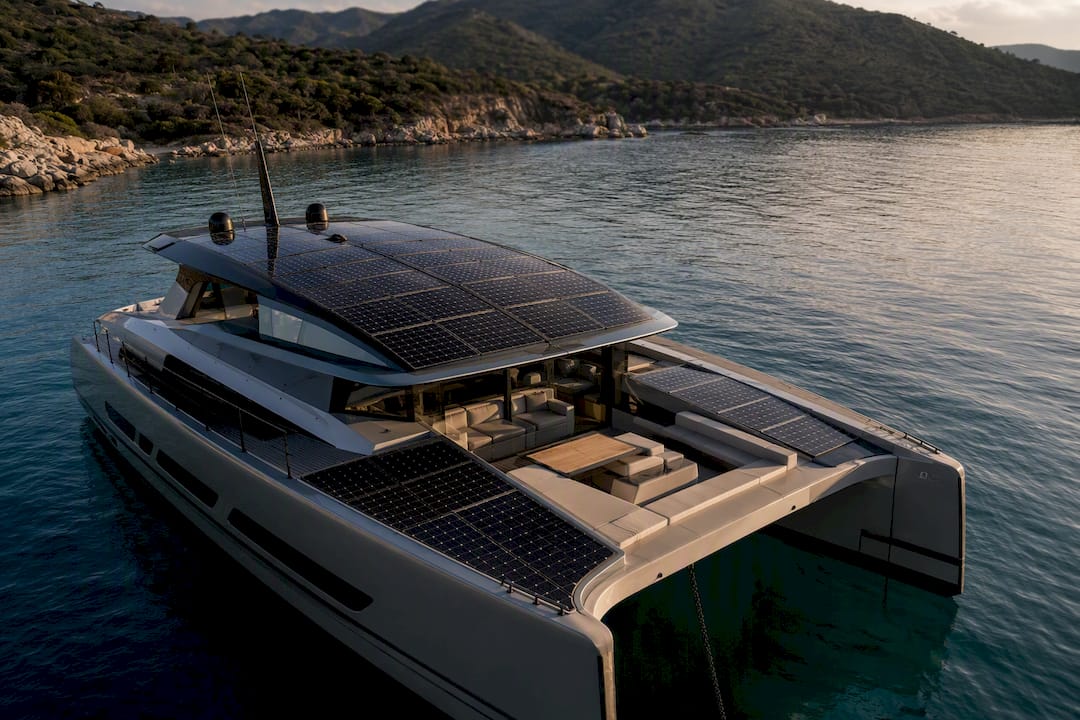
Retrofitting an existing yacht is a different problem entirely. A sailing yacht not originally designed for a large solar array may need reinforced mounting points, revised rigging clearances, and a careful look at how the added weight affects sail trim and heel angle. Motor yachts face similar trade-offs on flybridge and hardtop structures, where panel weight competes with existing equipment like radar arches and tender davits for the same limited space.
The battery bank compounds this further. A lithium system storing the same usable energy as an AGM bank weighs meaningfully less, which matters more on smaller hulls where every kilogram above the waterline affects handling. Buyers comparing two similar yachts, one with a factory-integrated solar package and one retrofitted, should ask how the added weight was accounted for in trim calculations, not just whether the panels look good on the spec sheet. Details like these are worth reviewing alongside broader yacht design considerations before making a final decision.
Combining Solar with Diesel, Wind, and Other Power Sources
Pure solar independence is a nice headline, but most experienced cruisers land on a hybrid approach, and for good reason. Solar reduces generator runtime substantially at anchor and on coastal hops, but it rarely eliminates the need for a generator entirely, especially once air conditioning, watermakers, or long ocean passages enter the equation.
Wind generators pair naturally with solar because they cover the gap solar leaves behind. Solar performs best in the middle of a clear day; wind often picks up at night or during overcast weather, precisely when panel output drops. A yacht running both sources smooths out the daily energy curve far better than either one alone.
Diesel generators still earn their place as the reliable backup for extended cloudy stretches or unusually heavy loads, but a well-sized solar and battery system means that generator runs far less often, which extends its service life and cuts fuel consumption meaningfully over a season. Hydro-generators, which draw power from a spinning propeller while underway, add a third leg for yachts that spend significant time on ocean passages, since they generate power precisely when solar can’t, at night, underway, regardless of weather.
The smartest hybrid systems use an energy management setup, often built around Victron’s monitoring ecosystem, that automatically prioritizes which source charges the battery bank first and signals the crew when generator backup is actually needed rather than just assumed.
A Broker’s View on Solar-Equipped Yachts
Buyers chasing range, comfort, and lower environmental impact often discover those goals hinge on unglamorous spec choices, battery chemistry, panel bonding, controller quality. A broker’s job is reading those spec sheets critically, matching the system to how you actually intend to cruise, and pushing back when a warranty or survey doesn’t hold up to scrutiny.
How Yachts by Steve Helps You Buy the Right Solar-Equipped Yacht
Reading a solar spec sheet correctly, and knowing which claims to verify before you sign, is where most buyers need a second set of eyes. Yachts-bysteve gives you that impartial read: we review technical specifications line by line, vet supplier and installer credentials, and coordinate independent surveys so a “walkable panel” or “marine-certified battery” claim gets checked before it becomes your problem. Because brokerage is commission-based on a completed transaction, our incentive is a yacht that actually performs as specified, not a quick sale.
If you’re comparing solar-equipped catamarans, motor yachts, or a retrofit candidate, start by understanding what to ask for in writing. Our guide on how to choose a yacht broker walks through exactly what impartial representation should look like, and it’s the right first step before you put an offer on any solar-equipped vessel. Reach out and we’ll help you build a buyer’s checklist specific to the systems that matter most to you.
Sources
For readers who want to check the technical detail behind these figures, these sources go deeper than this guide’s scope allows:
- Everything you need to know about yacht solar power – Yachting Monthly
- Seawater-induced deposition and corrosion of PV glass and their impacts on module performance – ScienceDirect
- Batteries: lithium-ion vs AGM — Victron Energy blog
- Maritimepage
Always cross-check vendor datasheets and, on classed vessels, confirm requirements directly with the relevant class society before finalizing any installation.
Recommended
Featured Listings

2028 Columbus Yachts
$22,900,008
137
Ancona

2012 Benetti PATIENCE
$10,975,000
132
Fort Lauderdale Florida

2028 Kingship Kingship
$20,350,000
125

2024 Silver Yachts
$25,400,000
117

2009 Hargrave BRANDI WINE
$2,500,000
114
Fort Lauderdale Florida

2028 Extra Yachts
$20,350,000
100
Ancona

2028 Alpha
$12,100,000
100
Ft Lauderdale Florida

2028 Extra Yachts Extra 96
$9,495,000
96
Ancona

2021 Sanlorenzo GATSBY
$6,795,000
96
Fort Lauderdale Florida

2028 Kingship
$11,990,000
90

2028 Alpha
$9,894,500
90
Fano

2023 Azimut COMPASS
$7,950,000
88
Miami Beach Florida

1999 Northern Marine OFF LINE
$2,495,000
84
Ft Lauderdale Florida

2013 Pershing DOROTHY ANN
$1,375,000
82
Fort Lauderdale Florida

1997 Ferretti Yachts
$825,000
80
La Paz

2008 Princess Yachts OCARALIA
$1,095,000
75
Charleston South Carolina

2014 Sunseeker
$1,400,000
68
New York New York

2024 Fairline
$2,750,000
68
Ft. Lauderdale Florida

2019 Vanquish Yachts IMPULSIVE
$1,799,000
58
Miami Beach Florida

2021 Ferretti Yachts HAVEN
$1,595,000
57
Fort Lauderdale Florida

2025 Formula BREAKTHROUGH III
$1,895,000
53
Miami Beach Florida

2023 Fairline
$900,000
45
Fort Lauderdale Florida

2012 Zeelander Mississippi Queen
$575,000
44
West Palm Beach Florida
2028 Columbus Yachts 137'
$22,900,008
2012 Benetti 132'
$10,975,000
2028 Kingship 125'
$20,350,000
2024 Silver Yachts 117'
$25,400,000
2009 Hargrave 114'
$2,500,000
2028 Extra Yachts 100'
$20,350,000
2028 Alpha 100'
$12,100,000
2028 Extra Yachts 96'
$9,495,000
2021 Sanlorenzo 96'
$6,795,000
2028 Kingship 90'
$11,990,000
2028 Alpha 90'
$9,894,500
2023 Azimut 88'
$7,950,000
1999 Northern Marine 84'
$2,495,000
2013 Pershing 82'
$1,375,000
1997 Ferretti Yachts 80'
$825,000
2008 Princess Yachts 75'
$1,095,000
2014 Sunseeker 68'
$1,400,000
2024 Fairline 68'
$2,750,000
2019 Vanquish Yachts 58'
$1,799,000
2021 Ferretti Yachts 57'
$1,595,000
2025 Formula 53'
$1,895,000
2023 Fairline 45'
$900,000
2012 Zeelander 44'
$575,000