

The most reliable sold yacht prices come from dedicated databases like SoldBoatPrice, broker recent-sales pages such as IYC’s listings, and market reports that track actual closings rather than ambitions. The single caveat that trips up nearly every buyer and seller is this: an asking price is a hope, a sold price is a fact, and the two rarely match. Verify with sale documentation before you build a valuation around either one.
TL;DR:
- Verified sold yacht prices are most reliably sourced from specialized databases, broker recent-sales pages, and market reports that confirm actual closings.
- Expect discrepancies between asking prices, last asking prices, and actual sale prices, with actual transactions often closing for lower amounts due to negotiations and credits.
- Yachts in the 30 to 40 foot range typically sell between mid five figures and low six figures, while larger vessels over 100 feet often command prices exceeding $10 million.
- A thorough valuation requires analyzing multiple comparables, adjusting for vessel condition and upgrades, and building a price band rather than relying on a single figure.
- Confirm sale documentation and broker confirmation to ensure sold prices are accurate, especially for off-market or private transactions not reflected in public records.
Table of Contents
- Where to Find Verified Sold Yacht Prices
- Sold Vs. Asking: Why the Numbers Rarely Match
- What Yachts Actually Sell for by Size in 2026
- Reading the Timeline in a Sold Record
- Turning Sold Records into a Real Valuation
- Notes From the Deck: Verifying Sold Prices in Practice
- How Yachts-bysteve Verifies Sold Prices for You
- Sources
- FAQ
Where to Find Verified Sold Yacht Prices
Finding a number online is easy. Finding a number you can trust takes a little more digging, and the sources fall into a few distinct camps, each with its own quirks.
Sold-price databases are the most direct route. SoldBoatPrice catalogs thousands of sold boats across the US, and many entries include the sale date and final sale price side by side, which is the exact pairing you want. Broker recent-sales pages come next. Brokerages like IYC publish named recent sales, often with size, model year, and a brief description of the deal. Market reports from yachting publications round out the picture, tracking trends across hundreds of transactions rather than single vessels. Community threads on boating forums are worth a scan too. Anglers and sailors have been trading tips on where to find sold boat prices for years, and they usually point right back to the same databases and broker lists.
When you search, work the specifics:
- Search by hull identification number (HIN) or model and year, not just the boat’s name.
- Cross-reference broker name and sale date to catch duplicate or stale listings.
- Narrow date ranges to isolate seasonal pricing shifts, especially for boat-show months.
Before trusting any record, run it through a short quality checklist: does it list a sale date, a distinct sale price field, a hull or registration number, and some form of broker attribution or supporting documentation? Records missing two or more of those are guesses dressed up as data.
Sold Vs. Asking: Why the Numbers Rarely Match
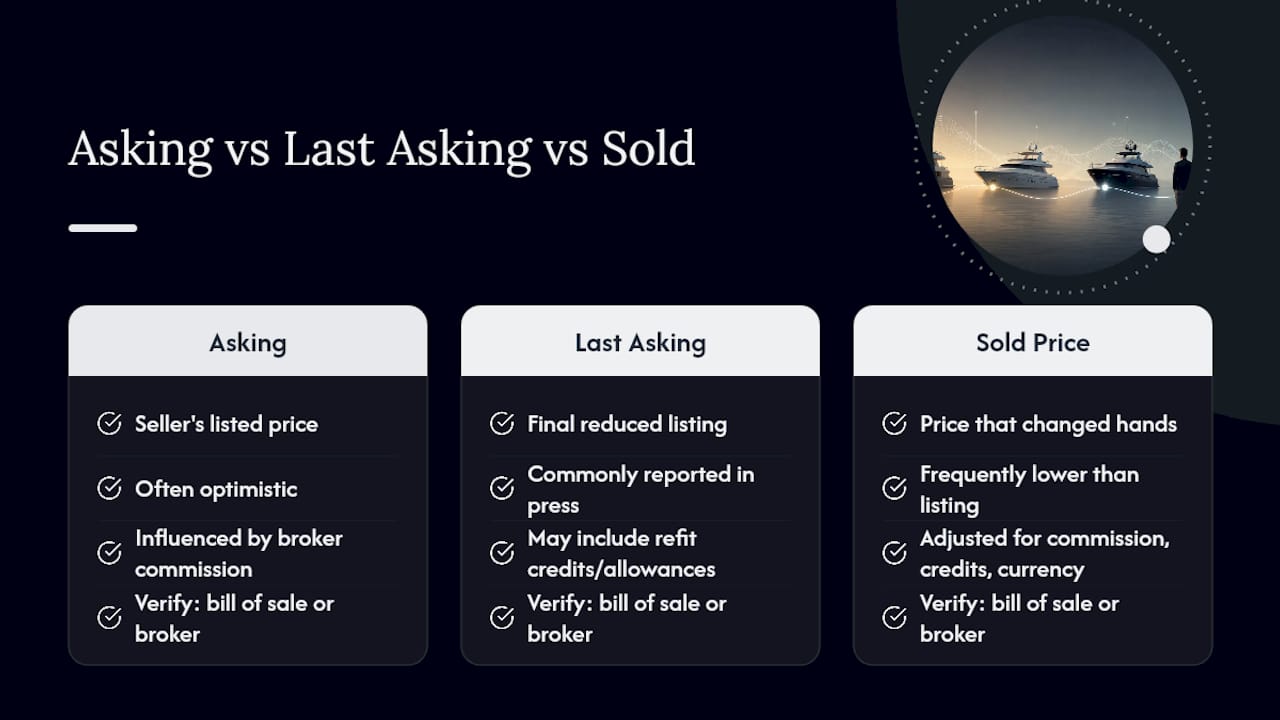
Three different numbers get thrown around in yacht sales, and treating them as interchangeable is where most valuation mistakes start. The asking price is what the seller lists at, often set optimistically. The last asking price is whatever the number was reduced to right before the deal closed, and it’s the figure most press notices report. The sold price is what actually changed hands, and it’s frequently lower than either of the other two.
Discrepancies show up for a handful of reasons. Broker commissions, typically negotiated as a percentage of the final price, can shape how a seller frames their net expectations. Refit credits and equipment allowances get baked into a deal without ever touching the headline number. Currency conversions on international sales introduce another layer of fuzziness if a source doesn’t specify the original denomination.
Even respected outlets fall into this trap. A 2026 report on the sale of a 36-meter Mulder motor yacht noted the vessel’s “last asking” figure rather than confirming the true closing price, a common pattern in yacht sale journalism.
The fix is straightforward: request a bill of sale, a transfer record, or direct broker confirmation before you treat any published figure as gospel.
Pro Tip: Prioritize sold records that pair a hull or VIN number with clear broker attribution. Records with both are far less likely to be recycled asking-price rumors dressed up as closed sales.
What Yachts Actually Sell for by Size in 2026
Sold prices cluster into fairly predictable bands by size, though condition and refit history can swing any given boat by a wide margin. Published guidance puts used 30 to 40 foot yachts in a roughly mid-to-upper five-figure to low six-figure range, with plenty of well-maintained older hulls trading toward the lower end. The 40 to 60 foot segment climbs into the mid six figures to just over $1 million, depending heavily on engine hours and electronics upgrades. Yachts in the 60 to 80 foot range typically sell between $1.5 million and $4 million, and 80 to 120 foot vessels stretch from roughly $4 million into the low tens of millions. Beyond 100 feet, the market becomes genuinely bespoke, with sold prices ranging from $10 million well past $50 million depending on builder, age, and refit status, based on broadly cited size-by-size pricing guidance.
The pre-owned superyacht market told two different stories in early 2026: transaction volume in some segments dipped year over year, while total sales value actually rose, driven by larger vessels changing hands even as smaller boats moved less often.
Layered on top of that split, market commentary from early 2026 shows asking prices have softened roughly 7% from 2023 peaks. The takeaway for anyone reading sold records right now:
- Well-priced hulls are moving quickly, often within weeks of a realistic listing.
- Overpriced boats are sitting for months, sometimes with multiple price cuts before a sale ever closes.
- Every range above needs adjusting for location, since a boat sold in South Florida rarely behaves like one sold in the Pacific Northwest.
Reading the Timeline in a Sold Record
A sold listing tells a story if you know how to read the sequence. Watch for these markers as you review any record:
- Listing date — the boat’s original entry into the market, your baseline for measuring days-on-market.
- Price reductions — each cut is a data point on where the seller’s confidence started slipping.
- Survey date — often signals a serious buyer has entered the picture, since surveys cost money nobody pays for casually.
- Sale date — the actual close, which may lag the last price reduction by weeks or months.
A yacht that sells within days of listing at close to asking price signals accurate initial pricing. One that sits for eight months and drops price three times before selling tells you the market corrected a seller’s optimism. Either pattern is useful information once you’re building your own comps.
Turning Sold Records into a Real Valuation
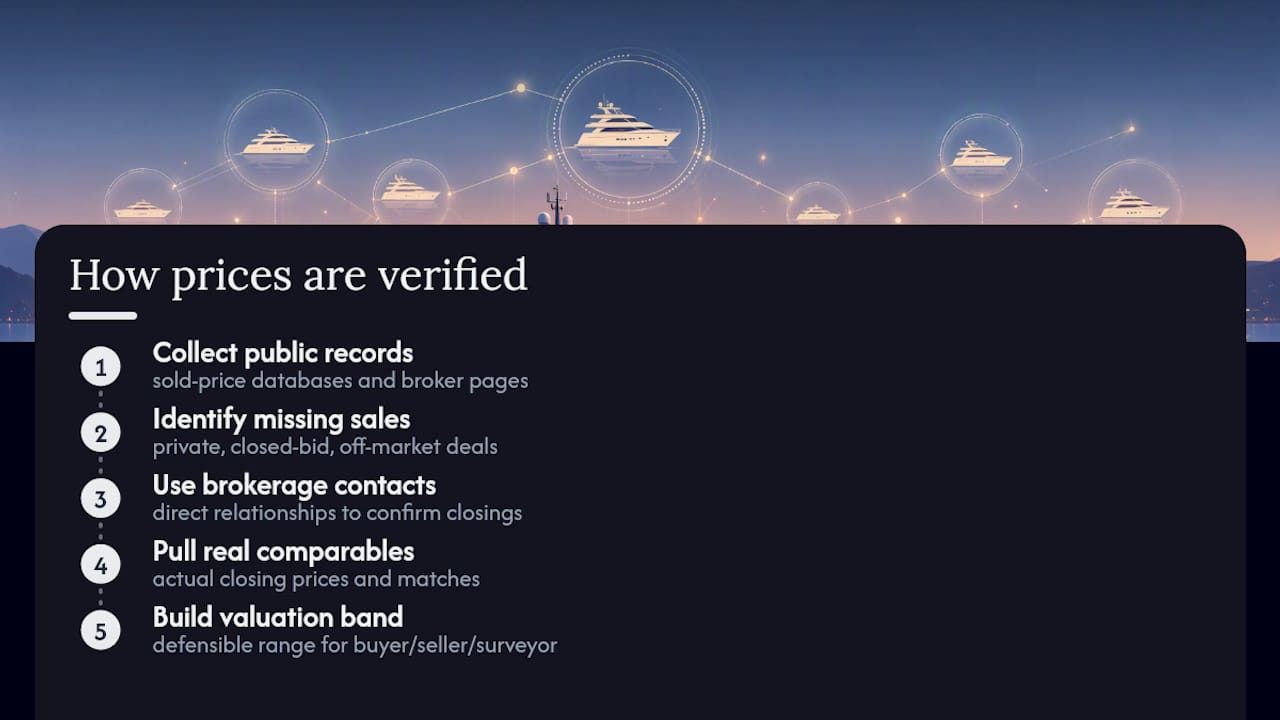
Raw sold prices are only useful once you convert them into a valuation band that accounts for your specific boat. The process brokers use isn’t complicated, but it does require discipline.
- Pull five to eight comparable sold records, matched by size, builder, and age within a few years.
- Convert each to a price-per-foot figure, then adjust for refits, electronics, and engine hours.
- Weight recent sales (last six to twelve months) more heavily than older ones, since the market moves.
- Build a price band, not a single number. A range gives sellers room to negotiate and buyers a benchmark for spotting overpriced listings.
Sellers should anchor their asking price near the middle of that band, not the top, unless their boat has documented upgrades that justify a premium. Buyers and brokers use the same math in reverse. A resource like our yacht pricing strategy guide walks through the price-per-foot adjustment method in more detail, and it’s the same approach that separates a defensible offer from a guess.
Bring the comps to the table, not just an opinion.*
Notes From the Deck: Verifying Sold Prices in Practice
Sold records are a great starting point, never the final word. Private sales and off-market deals almost never show up in public databases, which means a phone call to a broker who was actually in the room beats any spreadsheet. Before you list or bid on anything meaningful, confirm the underlying sale documents exist and match what’s published.
— Jason
How Yachts-bysteve Verifies Sold Prices for You
Sold-price databases and broker recent-sales pages get you most of the way there, but private transactions, closed-bid sales, and off-market deals rarely make it into any public record. That’s exactly where a direct brokerage relationship pays for itself. An experienced yacht brokerage can work directly with clients to confirm actual closing prices, pull real comparables, and build a valuation band you can defend to a buyer, a seller, or a surveyor. If you’re weighing whether a listing is priced fairly or wondering what your own boat should command in today’s market, reach out through Yachts-bysteve and get a straight answer instead of another guess.
Sources
Start here: SoldBoatPrice for raw sold data, IYC recent sales for broker-confirmed deals, and First Owner’s Reference for market trend context.
- Soldboatprice
- How Much Does a Yacht Cost in 2026? Prices by Size & Type | Boat Tomorrow
- 36m Mulder motor yacht Solemates V sold
FAQ
Can You Buy a Yacht for $500,000?
Yes, though your options at that price point sit mostly in the used 40 to 60 foot range rather than new construction. Published size-based pricing guidance puts many well-equipped yachts in that segment within reach of the mid six-figure range, especially with some negotiating room built in from sold-price research.
Who Owns the Most Expensive Superyacht in the World?
Ownership of the world’s priciest superyachts is typically kept private, and public reporting on any single record-setting vessel changes frequently as the market shifts. Rather than chase a headline figure, focus on verified sold records for the size and class of boat you’re actually shopping.
What Is the 10% Rule for Yachts?
The 10% rule is a rough industry shorthand suggesting annual ownership costs, fuel, crew, maintenance, dockage, run about 10 to 15% of a yacht’s purchase price each year. It’s a useful starting estimate, but actual costs vary significantly by size and usage, according to ownership cost guidance.
Are Boat Prices Going Down in 2026?
Asking prices have softened, dropping roughly 7% from their 2023 peak according to 2026 market reporting, but the picture isn’t uniform. Well-priced boats are still selling quickly, while overpriced listings are sitting on the market longer and absorbing multiple price cuts before closing.
How Does Yachts-bysteve Help Verify a Sold Price?
Yachts-bysteve works directly with buyers and sellers to confirm actual closing prices behind a listing, especially for private or off-market deals that never reach public databases. Current service details and contact options are available on the Yachts-bysteve site.
Recommended
Featured Listings

2028 Columbus Yachts
$22,900,008
137
Ancona

2012 Benetti PATIENCE
$10,975,000
132
Fort Lauderdale Florida

2028 Kingship Kingship
$20,350,000
125

2024 Silver Yachts
$25,400,000
117

2009 Hargrave BRANDI WINE
$2,500,000
114
Fort Lauderdale Florida

2028 Extra Yachts
$20,350,000
100
Ancona

2028 Alpha
$12,100,000
100
Ft Lauderdale Florida

2028 Extra Yachts Extra 96
$9,495,000
96
Ancona

2021 Sanlorenzo GATSBY
$6,795,000
96
Fort Lauderdale Florida

2028 Kingship
$11,990,000
90

2028 Alpha
$9,894,500
90
Fano

2023 Azimut COMPASS
$7,950,000
88
Miami Beach Florida

1999 Northern Marine OFF LINE
$2,495,000
84
Ft Lauderdale Florida

2013 Pershing DOROTHY ANN
$1,375,000
82
Fort Lauderdale Florida

1997 Ferretti Yachts
$825,000
80
La Paz

2008 Princess Yachts OCARALIA
$1,095,000
75
Charleston South Carolina

2014 Sunseeker
$1,400,000
68
New York New York

2024 Fairline
$2,750,000
68
Ft. Lauderdale Florida

2019 Vanquish Yachts IMPULSIVE
$1,799,000
58
Miami Beach Florida

2021 Ferretti Yachts HAVEN
$1,595,000
57
Fort Lauderdale Florida

2025 Formula BREAKTHROUGH III
$1,895,000
53
Miami Beach Florida

2023 Fairline
$900,000
45
Fort Lauderdale Florida

2012 Zeelander Mississippi Queen
$575,000
44
West Palm Beach Florida
2028 Columbus Yachts 137'
$22,900,008
2012 Benetti 132'
$10,975,000
2028 Kingship 125'
$20,350,000
2024 Silver Yachts 117'
$25,400,000
2009 Hargrave 114'
$2,500,000
2028 Extra Yachts 100'
$20,350,000
2028 Alpha 100'
$12,100,000
2028 Extra Yachts 96'
$9,495,000
2021 Sanlorenzo 96'
$6,795,000
2028 Kingship 90'
$11,990,000
2028 Alpha 90'
$9,894,500
2023 Azimut 88'
$7,950,000
1999 Northern Marine 84'
$2,495,000
2013 Pershing 82'
$1,375,000
1997 Ferretti Yachts 80'
$825,000
2008 Princess Yachts 75'
$1,095,000
2014 Sunseeker 68'
$1,400,000
2024 Fairline 68'
$2,750,000
2019 Vanquish Yachts 58'
$1,799,000
2021 Ferretti Yachts 57'
$1,595,000
2025 Formula 53'
$1,895,000
2023 Fairline 45'
$900,000
2012 Zeelander 44'
$575,000