

A USCG Abstract of Title is the official ownership and lien history the National Vessel Documentation Center keeps for every federally documented vessel, showing every bill of sale, mortgage, and claim ever recorded against it. If you’re buying, selling, or lending against a yacht, this document is how you confirm the vessel is actually free to transfer. You order one directly from the National Vessel Documentation Center using Form CG-7043, either through the NVDC eStorefront or by mail, and a small fee applies.
People typically request one for a few reasons:
- Confirming clear title before closing on a purchase
- Satisfying a marine lender’s financing requirements
- Investigating a suspected lien or ownership dispute
Key Takeaways
A USCG Abstract of Title is the only record that reveals a documented vessel’s full ownership and lien history, and ordering one through the NVDC before closing is the single most reliable way to confirm clear title.
| Point | Details |
|---|---|
| Order through NVDC directly | Use Form CG-7043 via the eStorefront or by mail for the official, authoritative record. |
| Check satisfactions carefully | Confirm every mortgage or lien entry has a matching release with a correct instrument number. |
| Expect fast standard turnaround | Most eStorefront orders return within 24 to 48 business hours; archived records take longer. |
| Liens don’t expire on their own | A notice of claim of lien stays active until formally satisfied, regardless of age. |
| Know when to escalate | Bring in a documentation specialist or broker when an abstract shows unresolved liens or recording gaps. |
Table of Contents
- What a USCG Abstract of Title Actually Contains
- Who Actually Needs to Order One
- How to Order Your Abstract of Title From the NVDC
- What the Abstract Costs and How Long It Takes
- Reading the Fine Print: Mortgages, Liens, and Satisfactions
- Federal Documentation vs. State Registration: Which Record Applies
- What Yachts by Steve Watches for on High-Value Deals
- Editorial Take: Why Most Buyers Read the Abstract Wrong
- Sources
What a USCG Abstract of Title Actually Contains
An abstract reads like a vessel’s autobiography. It lists the full chain of ownership, every recorded bill of sale, each preferred mortgage, and any notices of claim of lien filed against the boat, along with the satisfactions or releases that closed them out. This is the definitive ownership history lenders and title companies rely on, because it captures encumbrances no other public record tracks.
Every entry ties back to identifiers that keep the record unambiguous:
- The USCG documentation number, unique to the vessel for life
- Current and prior vessel names on file
- Hull identification number, when one was recorded
Older records sometimes show gaps or inconsistent formatting from earlier NVDC systems, particularly for vessels documented decades ago. That’s a quirk of the archive, not a red flag on its own, but it’s worth noting when you’re reviewing a boat with a long ownership history.
Who Actually Needs to Order One
You need an abstract any time money or ownership is about to change hands on a documented vessel, and three groups request them constantly:
- Buyers and brokers conducting due diligence before a purchase agreement gets signed
- Marine lenders who require a clean abstract before releasing financing
- Sellers and claimants confirming that old liens or mortgages were properly satisfied
If you’re on the buying side, pairing an abstract review with a broader due diligence checklist catches problems the abstract alone won’t flag, like undisclosed damage history.
How to Order Your Abstract of Title From the NVDC
Getting an abstract is a paperwork exercise, not a bureaucratic maze, provided you have the right vessel details on hand. Here’s the actual sequence.
- Download Form CG-7043. The CG-7043 Abstract of Title or Certified Copy of COD Request is a fillable PDF straight from the NVDC, and it carries current OMB filing information you should check for expiration before submitting.
- Gather your vessel data. You’ll need the USCG documentation number, the current vessel name, the owner of record, and your own contact information. Missing or mismatched details are the single biggest reason requests bounce back for correction.
- Choose your order method. The NVDC eStorefront handles most requests online with a card payment and account setup, and it’s the faster path for anything recorded in recent years. Mailing the form works too, but expect it to take longer.
- Pick your delivery option. Abstracts typically arrive by email, though postal delivery is available if you need a physical copy for a closing file.
- File a FOIA request for older instruments. If you need certified copies of a specific recorded document, like a decades-old mortgage release, and it predates digital archiving, a Freedom of Information Act request through NVDC is the route to retrieve it. Archival retrieval takes noticeably longer than a standard eStorefront order.
Pro Tip: Order the abstract before you sign anything binding, not after. Sellers rarely object to a short delay for title verification, but a lien discovered post signature turns into a legal headache instead of a simple negotiating point.
What the Abstract Costs and How Long It Takes
Fees and timing are governed by 46 CFR § 67.535, which authorizes the NVDC to issue abstracts and charge for them. The exact fee schedule appears on the CG-7043 form itself and on the NVDC’s official pages, so check those directly before ordering since amounts are updated periodically.
Most eStorefront orders for currently active vessels come back by email within 24 to 48 business hours. Requests involving archived instruments or older documentation numbers take longer, sometimes considerably so, because staff have to pull physical or legacy digital records. Fees are generally non-refundable once processed, so double-check your documentation number and vessel name before you submit.
Reading the Fine Print: Mortgages, Liens, and Satisfactions
The abstract’s real value shows up in three specific entry types, and knowing how to read them separates a clean deal from a costly surprise.
- Preferred mortgage entries get priority treatment under federal maritime law, meaning a lender holding one gets paid ahead of most other claims if the vessel is ever seized or sold to satisfy debt. This is exactly the protection abstracts exist to reveal, since state title systems don’t track it.
- Notices of claim of lien stay on the record indefinitely once filed, remaining active until someone formally satisfies or releases them. A lien that’s three owners old is still a live problem if it was never cleared.
- Satisfaction and release entries are what you want to see paired with every mortgage or lien. Look for language that explicitly references the original instrument number, not a vague note that debt was “paid.”
Pro Tip: A lien without a matching satisfaction entry is not settled just because the current owner says it was handled. Get the actual release document, or have your closing attorney confirm it before funds move.
Federal Documentation vs. State Registration: Which Record Applies
Not every boat has an abstract, and that’s by design. USCG documentation generally applies to vessels of five net tons or larger used in specific trades, while smaller recreational boats are typically registered with the state instead.
- State DMV and marine registration records never contain the federal chain-of-title or lien history an abstract shows
- A documented vessel won’t be fully trackable through state boat registration databases
- If an NVDC search comes back empty, check the vessel’s state registration next. It may simply never have been federally documented.
Our guide on what yacht documentation actually covers breaks down which vessels qualify and why documentation matters for financing and insurance, not just title verification.
What Yachts by Steve Watches for on High-Value Deals
Reviewing an abstract on a modest runabout is straightforward. Reviewing one on a multimillion-dollar motor yacht with three prior owners and an offshore mortgage is a different exercise entirely, and it’s where experience pays off.
Before recommending a client move forward, we check for:
- A complete, unbroken chain of ownership with no unexplained gaps between transfers
- Every mortgage entry matched to a corresponding satisfaction or release, with instrument numbers that actually correspond
- Any notice of claim of lien, no matter how old, cross-referenced against current owner disclosures
- Vessel name and hull identifiers matching exactly across every recorded instrument
In practice, brokers handling significant yacht transactions order certified copies of any recorded preferred mortgage alongside the abstract itself, and read every satisfaction entry against its original instrument reference before letting escrow release funds. A one-word mismatch between a release and the mortgage it’s supposed to clear is often the first sign something wasn’t properly closed out.
When an abstract turns up an unresolved lien or a documentation specialist is needed to untangle a recording error, that’s the moment to bring in a broker who has handled exactly this problem before, rather than trying to resolve it solo mid-transaction.
Editorial Take: Why Most Buyers Read the Abstract Wrong
Most guidance on this topic treats the abstract as a formality, a box to check before closing. That undersells it badly. The document’s real function is warning you about priority, not just history: a preferred mortgage doesn’t just disclose debt, it tells you who gets paid first if things go sideways, and that detail changes how much leverage you actually have in a negotiation.
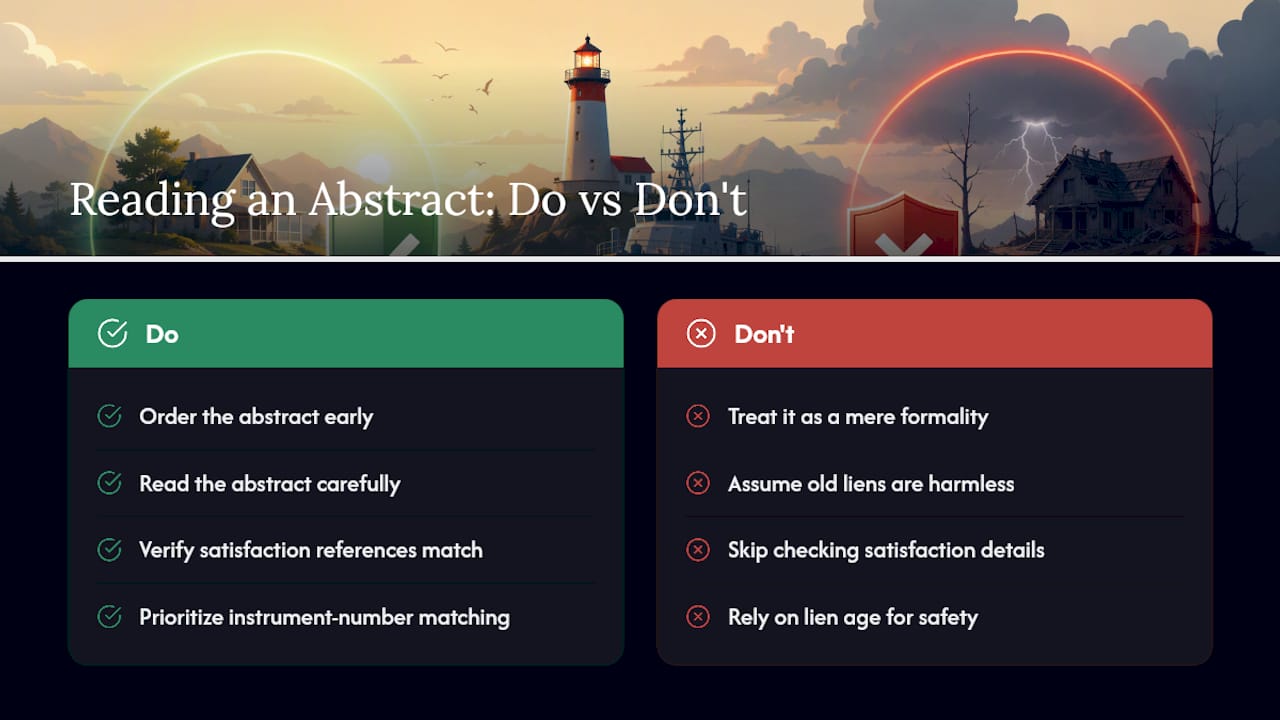
The conventional advice, “order it early and read it,” is correct but incomplete. The part people skip is verifying that every satisfaction entry actually references the instrument it claims to close. I’ve seen the assumption that a lien is “old, so it doesn’t matter” cause real problems, because an unsatisfied notice of claim of lien has no expiration date under federal law. Age offers no protection.
If you take one thing from this: prioritize matching instrument numbers between liens and their releases before you worry about anything else on the page. That single habit catches more real problems than any other step in the review, and it costs nothing but attention.
— Jason
Sources
- Dco
- 46 CFR § 67.535 – Issuance of Abstract of Title. | Legal Information Institute
- Vessel Documentation Search: Ownership, Liens, and Records – LegalClarity
Recommended
Featured Listings

2028 Columbus Yachts
$22,900,008
137
Ancona

2012 Benetti PATIENCE
$10,975,000
132
Fort Lauderdale Florida

2028 Kingship Kingship
$20,350,000
125

2024 Silver Yachts
$25,400,000
117

2009 Hargrave BRANDI WINE
$2,500,000
114
Fort Lauderdale Florida

2028 Extra Yachts
$20,350,000
100
Ancona

2028 Alpha
$12,100,000
100
Ft Lauderdale Florida

2028 Extra Yachts Extra 96
$9,495,000
96
Ancona

2021 Sanlorenzo GATSBY
$6,795,000
96
Fort Lauderdale Florida

2028 Kingship
$11,990,000
90

2028 Alpha
$9,894,500
90
Fano

2023 Azimut COMPASS
$7,950,000
88
Miami Beach Florida

1999 Northern Marine OFF LINE
$2,495,000
84
Ft Lauderdale Florida

2013 Pershing DOROTHY ANN
$1,375,000
82
Fort Lauderdale Florida

1997 Ferretti Yachts
$825,000
80
La Paz

2008 Princess Yachts OCARALIA
$1,095,000
75
Charleston South Carolina

2014 Sunseeker
$1,400,000
68
New York New York

2024 Fairline
$2,750,000
68
Ft. Lauderdale Florida

2019 Vanquish Yachts IMPULSIVE
$1,799,000
58
Miami Beach Florida

2021 Ferretti Yachts HAVEN
$1,595,000
57
Fort Lauderdale Florida

2025 Formula BREAKTHROUGH III
$1,895,000
53
Miami Beach Florida

2023 Fairline
$900,000
45
Fort Lauderdale Florida

2012 Zeelander Mississippi Queen
$575,000
44
West Palm Beach Florida
2028 Columbus Yachts 137'
$22,900,008
2012 Benetti 132'
$10,975,000
2028 Kingship 125'
$20,350,000
2024 Silver Yachts 117'
$25,400,000
2009 Hargrave 114'
$2,500,000
2028 Extra Yachts 100'
$20,350,000
2028 Alpha 100'
$12,100,000
2028 Extra Yachts 96'
$9,495,000
2021 Sanlorenzo 96'
$6,795,000
2028 Kingship 90'
$11,990,000
2028 Alpha 90'
$9,894,500
2023 Azimut 88'
$7,950,000
1999 Northern Marine 84'
$2,495,000
2013 Pershing 82'
$1,375,000
1997 Ferretti Yachts 80'
$825,000
2008 Princess Yachts 75'
$1,095,000
2014 Sunseeker 68'
$1,400,000
2024 Fairline 68'
$2,750,000
2019 Vanquish Yachts 58'
$1,799,000
2021 Ferretti Yachts 57'
$1,595,000
2025 Formula 53'
$1,895,000
2023 Fairline 45'
$900,000
2012 Zeelander 44'
$575,000