

Overview — A sportfish yacht is a purpose-built offshore fishing vessel that combines the raw capability of a bluewater fishing platform with the refined accommodations of a true luxury yacht. Think of it as two boats in one: a serious fishing machine that can chase marlin far offshore, and a comfortable sanctuary where guests sleep, dine, and unwind between runs.
- Purpose-built for offshore big-game fishing while offering cabins, heads, and living areas suitable for days or weeks at sea
- Sized roughly in a broad range suitable for offshore fishing, with cruising speeds common for vessels in this category
- Designed to operate well beyond the Continental Shelf, with hull engineering that meets real bluewater seakeeping demands
- Yachts-bysteve specializes in exactly this category, matching serious anglers with the right vessel for their mission
Table of Contents
- What makes a sportfish yacht different from other yachts?
- Which configuration fits your fishing mission?
- What do sportfish yachts cost in the U.S. market?
- How to define your mission profile before you start shopping
- Buying and selling a sportfish yacht: what the process looks like
- What does it actually cost to own a sportfish yacht?
- How a luxury broker makes the sportfish transaction work
- Key Takeaways
- The detail most buyers overlook
- Ready to buy or sell a sportfish yacht?
What makes a sportfish yacht different from other yachts?
The defining features of a sportfish yacht are not cosmetic. They are structural, mechanical, and purpose-driven — and a buyer who understands them will make a far sharper inspection checklist.
Hull and seakeeping
Deep-V hull designs and significant displacement give sportfish yachts their offshore composure. The hull’s mass and flare absorb chop and swell that would punish a lighter vessel, keeping the crew functional and the fish in the water. Long-range convertibles carry large fuel tanks capable of covering several hundred miles offshore — some up to 600 miles from the U.S. coast on a single load.
Fishing systems and cockpit layout
The cockpit is the heart of the boat. Standard equipment on a well-outfitted sportfisher includes fighting chairs, outriggers, downriggers, rod holders, livewells, fishboxes, and dedicated tackle stations. The transom design matters too: a low, wide transom with a door or gate allows anglers to work large fish close to the boat without climbing over obstructions.
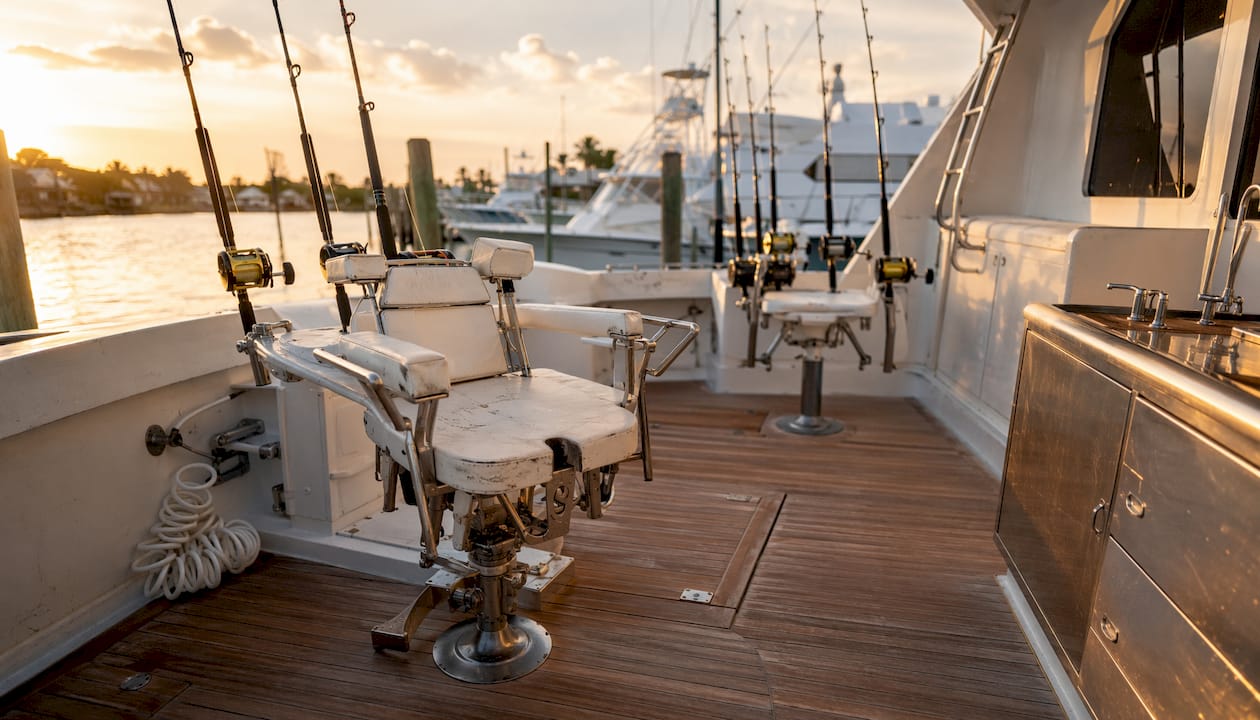
Visibility and control
Tuna towers and flybridges place the helm high above the waterline, giving the captain a commanding view for spotting bait schools, weed lines, and color changes. Cantilevered helm stations on the flybridge keep sightlines clear while the mate works the cockpit below.
Electronics and technology
Modern sportfish yachts carry integrated navigation suites: multifunction displays, sonar and fishfinder arrays, radar, autopilot, and often underwater cameras for monitoring baits. For buyers interested in how onboard technology shapes performance and safety, the electronics package is as important as the engine room.
| Feature | What to look for |
|---|---|
| Hull design | Deep-V with significant deadrise; check for stress cracks at the keel |
| Cockpit | Fighting chair mounts, livewell capacity, fishbox volume, transom gate |
| Tuna tower | Structural integrity, spreader lights, outrigger mounts |
| Fuel capacity | Tank size relative to target range; check for corrosion or leaks |
| Electronics | Sonar, radar, autopilot integration; confirm software is current |
| Engines | Hours logged, service records, alignment, exhaust color on sea trial |
Pro Tip: Ask the seller for engine room photos before scheduling a viewing. A clean, dry bilge with organized wiring tells you more about an owner’s standards than any listing description.
Which configuration fits your fishing mission?
Sportfish yachts come in several configurations, and choosing the wrong one for your mission is an expensive mistake.
- Convertible sportfish (typically 40–65+ feet): the most versatile layout, with full interior accommodations and long-range capability. Ideal for owners who fish tournaments, host guests overnight, and want a vessel that doubles as a cruising yacht. The convertible’s enclosed bridge and salon make multi-day offshore passages genuinely comfortable.
- Express sportfish: a sleeker, lower-profile option with a more open cockpit and a smaller interior. Faster off the dock and easier to single-hand, but less suited for extended offshore expeditions or large guest groups.
- Center-console sportfish: 360-degree fishability and exceptional speed, often preferred by owners who prioritize pure fishing performance over overnight amenities. Crew comfort is secondary; fish-catching efficiency is primary.
- Custom and semi-custom builds: for buyers with a specific tournament circuit, target species, or far-offshore expedition in mind, a custom build allows precise mission-fit that production boats rarely achieve.
What do sportfish yachts cost in the U.S. market?
Size and condition drive price more than any other variable. Here are conservative ballpark ranges for the U.S. market — not guarantees, but honest starting points for budget conversations.
Entry-level (30–45 feet): Pre-owned sportfishers in this range vary widely in price depending on condition and equipment, depending heavily on builder reputation, engine hours, and refit history. Production builders dominate this tier.
Mid-market (45–60 feet): Prices for well-maintained mid-sized sportfish yachts from recognized builders vary considerably. Tournament-prepped boats with recent electronics and engine overhauls command the upper end.
Large and bluewater (60–80+ feet): Premium convertibles and custom builds in this size range often command high prices, reflecting their capabilities and custom features. Custom fishing features, twin-engine redundancy, and extended-range fuel systems push values higher.
Sportfish yachts that serve dual roles — competitive fishing and family cruising — tend to hold value well, but their outfitting and maintenance budgets reflect that multifunctionality. A comprehensive marine survey and comparable listing analysis are the only reliable ways to validate any asking price.
How to define your mission profile before you start shopping
The single most time-saving thing a buyer can do before viewing a single boat is answer these questions honestly:
- Target species: Billfish, tuna, wahoo, or inshore species? Each demands different cockpit setups and range.
- Typical distance offshore: Day trips within 50 miles, or multi-day runs to the canyons or beyond?
- Crew and guest mix: Owner-operated with a mate, or fully crewed? How many guests overnight?
- Tournament vs. recreational: Tournament fishing demands specific rigging, speed, and cockpit ergonomics that recreational owners may not need.
- Overnight vs. day trips: If you’re sleeping aboard regularly, interior stateroom quality matters as much as cockpit space.
Mission answers change the priority order dramatically. A canyon tuna fisherman needs range and fuel capacity above all else. A tournament billfish angler needs speed and cockpit ergonomics. A family who fishes on weekends and cruises on holidays needs luxury yacht amenities alongside fishing capability. These are genuinely different boats.
Pro Tip: Write your mission answers down and send them to your broker before the first viewing. It eliminates mismatches early and focuses the search on boats that actually fit your life.
Buying and selling a sportfish yacht: what the process looks like
For buyers
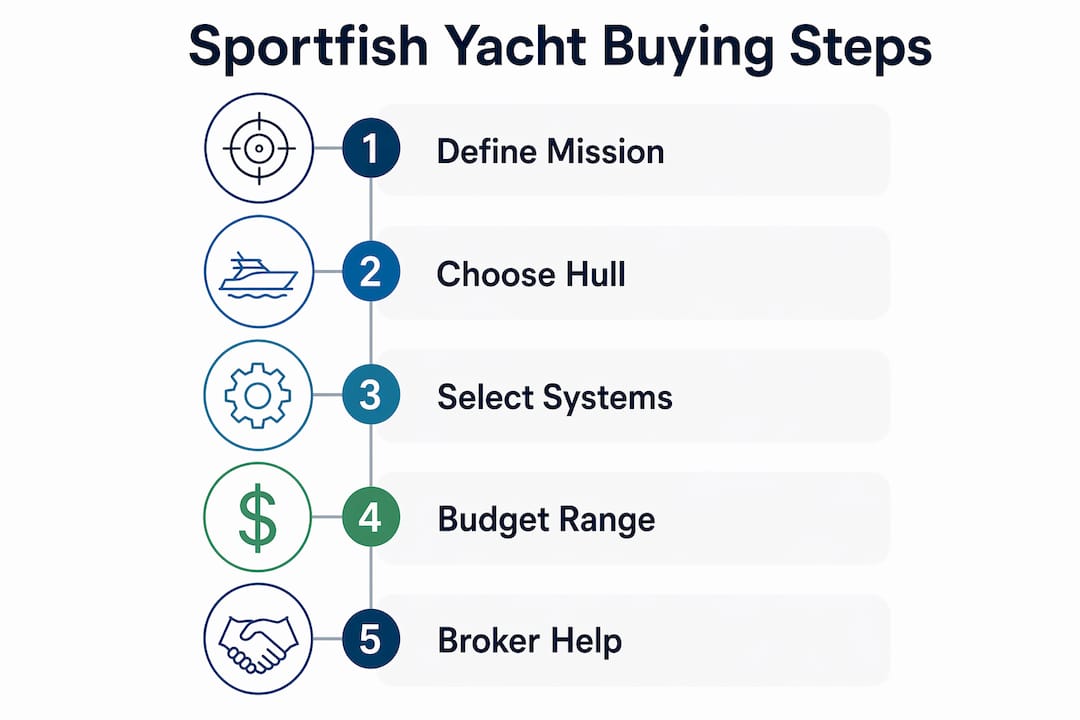
- Define your search brief and mission profile (see above)
- Review listings with a broker; prioritize boats with documented service histories
- Schedule viewings and confirm sea trial availability before traveling
- Conduct a full marine survey and independent mechanical inspection
- Review title history and any outstanding liens
- Negotiate based on survey findings, then proceed to escrow and closing
Well-maintained used sportfishers command higher prices due to their condition and service history.
For sellers
- Gather all documentation: title, registration, engine logs, survey history, electronics manuals
- Complete pre-sale servicing and address any deferred maintenance
- Stage the cockpit and interior for professional photography
- Price based on comparable listings and recent survey data, not sentiment
- Coordinate sea trial logistics with your broker
A U.S.-based sportfish transaction typically takes a few weeks to several months from accepted offer to delivery, depending on survey findings, financing (if applicable), and closing complexity. Buyers should budget for survey costs that vary depending on vessel size and survey scope, title search fees, state registration, and applicable sales or use tax, which varies by state.
What does it actually cost to own a sportfish yacht?
Purchase price is only the beginning. Annual operating costs for sportfish yachts vary widely by size and crew, including fuel, maintenance, insurance, dockage, crew salaries if applicable, and periodic refits.
These figures are representative estimates for U.S. markets and vary by home port, usage intensity, and vessel condition. Engine service intervals on diesel sportfishers generally occur regularly, based on operational hours as recommended by manufacturers.; hull paint and bottom work happen annually in most U.S. coastal climates.
How a luxury broker makes the sportfish transaction work
A sportfish yacht transaction has more moving parts than most buyers anticipate. The broker’s role is to compress the timeline, protect the client’s interests, and surface information that never appears in a listing.
For buyers, Yachts-bysteve handles mission-profile mapping, curated searches across available inventory, sea-trial coordination, survey management, and closing support. For sellers, the team manages staged marketing, targeted outreach to qualified buyers, professional photography and specification write-ups, and negotiation through to delivery. Understanding how yacht brokerage works before entering the market gives both buyers and sellers a meaningful advantage.
The practical value shows up in the details: knowing which builders hold value, which electronics packages are worth negotiating, and which survey findings are deal-breakers versus routine maintenance items. That knowledge is not available in a listing database.
Key Takeaways
A sportfish yacht is the definitive offshore fishing platform for serious bluewater anglers who also demand genuine yacht-level comfort, range, and accommodations.
| Point | Details |
|---|---|
| Dual-purpose design | Built for offshore big-game fishing and luxury cruising; not a compromise between the two. |
| Mission profile first | Define target species, range, guest count, and tournament needs before viewing any boat. |
| Survey is non-negotiable | A full marine survey and service history review protect value on both sides of the transaction. |
| Yachts-bysteve advantage | Expert mission-mapping, curated inventory access, and end-to-end transaction management for buyers and sellers. |
The detail most buyers overlook
There is a version of this conversation that happens too late: a buyer falls in love with a boat at a show, skips the mission-profile work, and ends up with a 65-foot convertible when a 48-foot express would have served them better — or vice versa. The cockpit is too small for the tournaments they planned to fish, or the interior is too sparse for the family weekends they imagined.
The sportfish category is genuinely exciting, and that excitement can short-circuit the analytical work that makes a purchase satisfying for years rather than months, especially when attending marquee events like the Monaco Yacht Show. The buyers who get it right are the ones who treat the mission profile as seriously as the sea trial. They know their target species, their typical distance offshore, and their guest count before they ever step aboard a boat. That discipline is what separates a great purchase from an expensive lesson.
For sellers, the equivalent discipline is honest pre-sale preparation. A sportfish that arrives at market with clean engine logs, recent service records, and a freshly staged cockpit commands a different conversation than one that doesn’t. The listing strategy matters as much as the asking price.
Ready to buy or sell a sportfish yacht?
Yachts-bysteve works exclusively with serious buyers and sellers in the luxury sportfish market. Whether you’re defining a mission profile for the first time or preparing a bluewater convertible for sale, the process starts with a confidential conversation — not a generic listing search.
For buyers, that means a curated shortlist built around your actual fishing life, not just your budget. For sellers, it means targeted outreach to qualified buyers and a marketing approach that reflects the true value of a well-maintained sportfisher. Start by reviewing how to choose a yacht broker to understand what a high-caliber brokerage relationship looks like, or browse current sportfish listings to get a feel for the market. When you’re ready to talk, reach out directly through the Yachts-bysteve website to schedule a private consultation.
Useful sources for further reading
- Sportfishing Yacht — Discover Boating: the clearest consumer-facing primer on the sportfish category, covering design purpose and dual-use appeal
- Guide to Buying a Sportfishing Yacht — Cape Yachts: practical buyer guidance on mission profiles, used-boat inspection, and range expectations
- What Is a Yacht? — Yacht.com: useful for understanding how sportfishers fit within the broader yacht classification system
- Sport Fishing Boat — Wikipedia: a solid technical reference for hull types, cockpit configurations, and historical context
Recommended
Featured Listings

2028 Columbus Yachts
$22,900,008
137
Ancona

2012 Benetti PATIENCE
$10,975,000
132
Fort Lauderdale Florida

2028 Kingship Kingship
$20,350,000
125

2024 Silver Yachts
$25,400,000
117

2009 Hargrave BRANDI WINE
$2,500,000
114
Fort Lauderdale Florida

2028 Extra Yachts
$20,350,000
100
Ancona

2028 Alpha
$12,100,000
100
Ft Lauderdale Florida

2028 Extra Yachts Extra 96
$9,495,000
96
Ancona

2021 Sanlorenzo GATSBY
$6,795,000
96
Fort Lauderdale Florida

2028 Kingship
$11,990,000
90

2028 Alpha
$9,894,500
90
Fano

2023 Azimut COMPASS
$7,950,000
88
Miami Beach Florida

1999 Northern Marine OFF LINE
$2,495,000
84
Ft Lauderdale Florida

2013 Pershing DOROTHY ANN
$1,375,000
82
Fort Lauderdale Florida

1997 Ferretti Yachts
$825,000
80
La Paz

2008 Princess Yachts OCARALIA
$1,095,000
75
Charleston South Carolina

2014 Sunseeker
$1,400,000
68
New York New York

2024 Fairline
$2,750,000
68
Ft. Lauderdale Florida

2019 Vanquish Yachts IMPULSIVE
$1,799,000
58
Miami Beach Florida

2021 Ferretti Yachts HAVEN
$1,595,000
57
Fort Lauderdale Florida

2025 Formula BREAKTHROUGH III
$1,895,000
53
Miami Beach Florida

2023 Fairline
$900,000
45
Fort Lauderdale Florida

2012 Zeelander Mississippi Queen
$575,000
44
West Palm Beach Florida
2028 Columbus Yachts 137'
$22,900,008
2012 Benetti 132'
$10,975,000
2028 Kingship 125'
$20,350,000
2024 Silver Yachts 117'
$25,400,000
2009 Hargrave 114'
$2,500,000
2028 Extra Yachts 100'
$20,350,000
2028 Alpha 100'
$12,100,000
2028 Extra Yachts 96'
$9,495,000
2021 Sanlorenzo 96'
$6,795,000
2028 Kingship 90'
$11,990,000
2028 Alpha 90'
$9,894,500
2023 Azimut 88'
$7,950,000
1999 Northern Marine 84'
$2,495,000
2013 Pershing 82'
$1,375,000
1997 Ferretti Yachts 80'
$825,000
2008 Princess Yachts 75'
$1,095,000
2014 Sunseeker 68'
$1,400,000
2024 Fairline 68'
$2,750,000
2019 Vanquish Yachts 58'
$1,799,000
2021 Ferretti Yachts 57'
$1,595,000
2025 Formula 53'
$1,895,000
2023 Fairline 45'
$900,000
2012 Zeelander 44'
$575,000