

Overview: A flybridge is an elevated, open upper deck on a motor yacht, positioned above the main cabin, that carries a duplicate helm station alongside outdoor living space. Merriam-Webster defines it precisely as “an open deck on a cabin cruiser located above the bridge, usually having a duplicate set of navigating equipment.” The primary draw is the combination of commanding visibility for the captain and generous al fresco space for guests — all without stretching the hull a single foot longer. The honest trade-off: you are exposed to the elements up there, and the raised mass shifts the center of gravity higher, which matters in rough seas and affects fuel efficiency at speed. This guide covers everything a prospective buyer needs: how a flybridge looks and operates, how it compares with alternative designs, what builders offer in the U.S. market, and the exact checklist to bring to a sea trial.
Key Takeaways
A flybridge is the single most effective way to add elevated visibility and outdoor living space to a motor yacht without extending the hull — but it rewards buyers who inspect carefully and match the design to their actual cruising habits.
| Point | Details |
|---|---|
| Core definition | A flybridge is an elevated open deck with a duplicate helm, above the main cabin on a motor yacht. |
| Primary benefits | Delivers 360-degree visibility for maneuvering and a full social deck for entertaining guests. |
| Main trade-offs | Weather exposure, higher center of gravity, and greater maintenance on canopies and exposed electronics. |
| Inspection priority | Verify linked engine alarms, canopy condition, and helm integration at both stations before committing. |
| Yachts-bysteve | Provides targeted flybridge search, survey coordination, and negotiation support for U.S. buyers. |
Table of Contents
- What does a flybridge look like on a yacht?
- Why do owners choose a flybridge yacht?
- How the flybridge helm station actually works
- How does a flybridge compare with a sportsbridge, pilothouse, or hardtop?
- What sizes and builders offer flybridge yachts in the U.S. market?
- The honest pros and cons of a flybridge yacht
- Your flybridge inspection checklist before you buy
- A broker’s perspective on buying a flybridge yacht
- How Yachts-bysteve helps you find the right flybridge yacht
- Sources
What does a flybridge look like on a yacht?
Boat International describes the flybridge as a deck added above the main level that functions simultaneously as a helm station and an open-air living area, typically offering 360-degree views. In practice, that translates to a platform sitting aft of the mast or superstructure, reached by either a steep ladder on smaller vessels or a proper integrated staircase on anything above roughly 45 feet.
The layout varies by yacht size, but most flybridge decks share a recognizable set of features:
- Secondary helm station with steering wheel, throttle controls, and basic navigation instruments
- Seating and dining area, often configured for six to twelve guests on larger yachts
- Sunpads forward or aft of the helm, sometimes convertible to additional seating
- Wet bar or grill station, making the deck self-sufficient for a full afternoon on the water
- Bimini or hardtop canopy for shade — fiberglass hardtops on production yachts, retractable canvas on others
- Occasional jacuzzi or plunge pool on yachts above 60 feet, where deck footprint allows
Terminology shifts with size. On smaller motor yachts, “flybridge” is the standard term. On larger superyachts, the equivalent space is often called a “sun deck,” and the “flybridge” may be positioned on a lower deck, closer to the pilothouse. When reading listings, check the deck plan rather than relying on the label alone. Materials range from fiberglass and composite panels to teak decking underfoot and stainless steel fittings throughout — all details worth scrutinizing in listing photos and during an in-person inspection. For a broader look at why yachts are built with multiple decks, the design logic runs deeper than aesthetics alone.
Why do owners choose a flybridge yacht?
The short answer: visibility and space, delivered together. From the flybridge helm, a captain sits several feet above the waterline, which transforms close-quarters maneuvering in a crowded marina from a stressful exercise into a confident one. You can see the dock, the neighboring boats, and the water ahead simultaneously — a genuine operational advantage that experienced captains rarely give up once they have it.
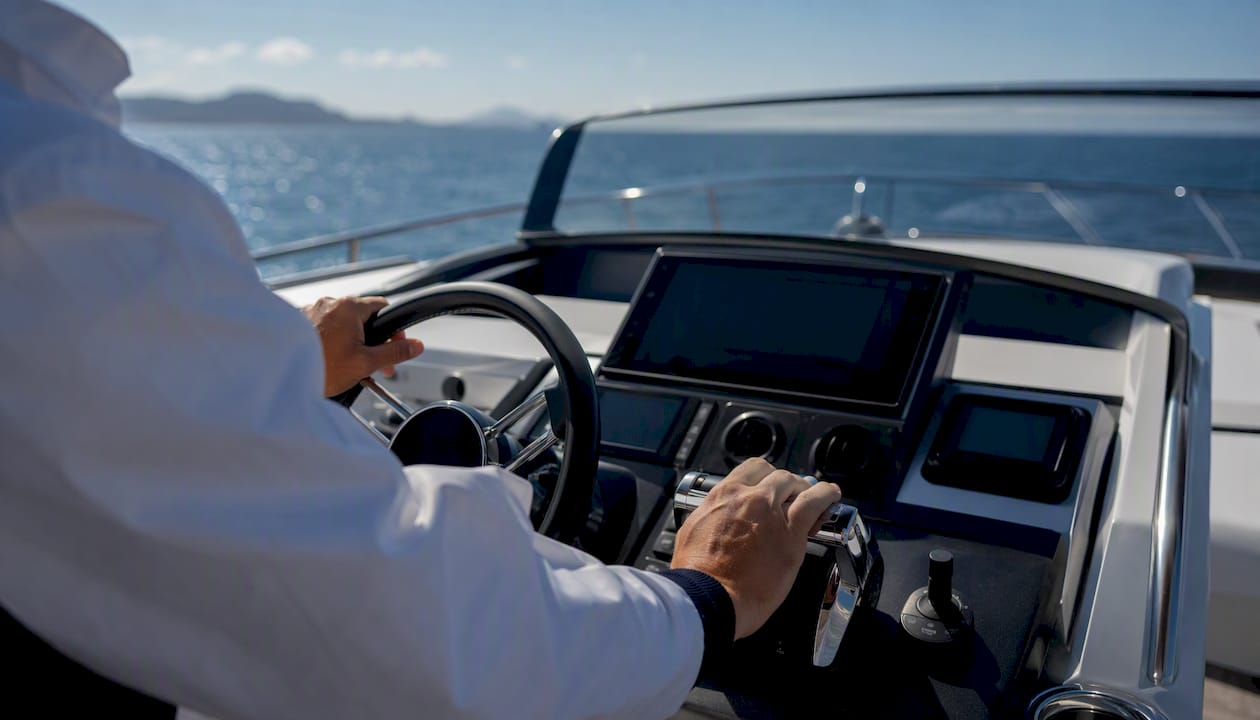
Beyond navigation, the flybridge functions as the social heart of the yacht. GeorgeYachts notes that on Mediterranean charters, the flybridge often replaces the saloon as the most-used living area — guests gravitate upstairs for dining, sunbathing, and cocktails, leaving the interior as a cooler retreat. That dynamic makes flybridge yachts particularly appealing for charter operators and owners who entertain regularly.
The lifestyle fit matters as much as the specs. Day cruising along the Florida Keys, island-hopping in the Bahamas, or spending a week in the Chesapeake Bay — these are the scenarios where a flybridge earns its keep. The deck adds usable square footage without increasing hull footprint, which means you get more living space from the same slip length and the same fuel burn at displacement speeds. Charter guests, in particular, respond to the sense of openness and elevation that a flybridge provides — something worth considering if rental income is part of your ownership plan. You can explore how flybridge yachts perform in real charter settings to get a feel for how guests actually use the space.
How the flybridge helm station actually works
Most flybridge yachts carry two helm stations: the flybridge station used in fair weather and calm conditions, and a primary interior or pilothouse station for all-weather operation. The flybridge helm typically duplicates steering, throttle, bow and stern thruster controls, and a basic suite of navigation instruments — chart plotter, VHF radio, and engine monitoring gauges at minimum.
What often stays below: the primary electronics suite, radar processing units, and deeper systems like watermaker controls or generator management. The flybridge station is designed for situational awareness and maneuvering, not for running a transatlantic passage in a gale.
Pro Tip: During a sea trial, verify that engine alarms trigger at both stations simultaneously. A flybridge helm that does not receive the same alarm signals as the interior station is a safety gap, not a minor inconvenience. Also confirm that the autopilot can be engaged and disengaged from the flybridge — some older installations require you to go below to activate it.
Operationally, experienced captains use the flybridge for harbor entries, anchorage approaches, and coastal cruising in settled weather. Night passages and heavy-weather runs belong below, where the enclosed station offers protection and the full electronics suite is at hand. That division of use is not a limitation — it is the design working as intended.
How does a flybridge compare with a sportsbridge, pilothouse, or hardtop?
Choosing an upper-deck configuration is one of the more consequential decisions in a yacht purchase. Each design reflects a different set of priorities.
| Design | Best for | Visibility advantage | Upper-deck space | Performance/windage | Maintenance complexity | Typical size segment |
|---|---|---|---|---|---|---|
| Flybridge | Entertaining, day cruising | Excellent 360° views | High — full social deck | Moderate windage; higher CoG | Higher (canopy, upholstery, exposed electronics) | 35–100+ ft motor yachts |
| Sportsbridge | Performance cruising | Good forward visibility | Minimal — helm only | Lower windage; better speed | Lower (minimal structure) | 35–65 ft sport cruisers |
| Pilothouse | All-weather, long-range | Good from enclosed bridge | Moderate — deck above possible | Lower profile; efficient | Moderate (enclosed, protected) | 45–80 ft passagemakers |
| Hardtop/Sun deck | Shade + entertaining | Similar to flybridge | High — fixed shade structure | Similar to flybridge | Lower than canvas bimini | 35–100+ ft |
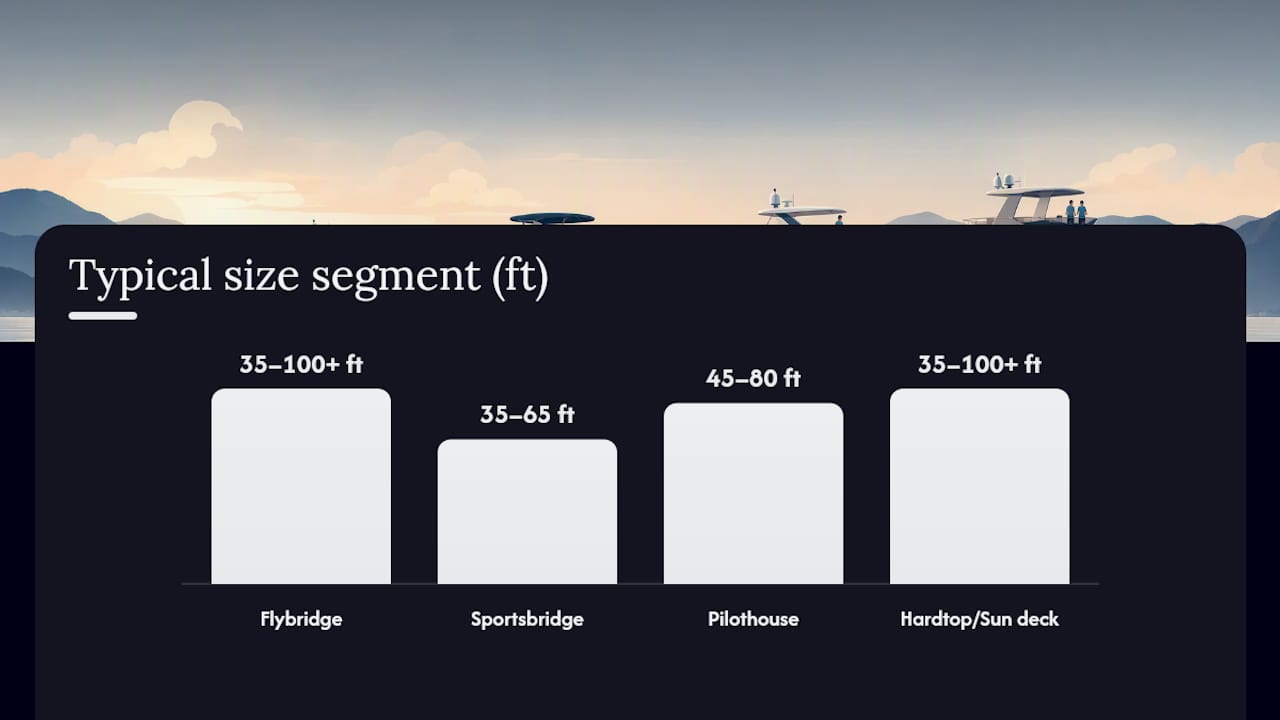
The sportsbridge is essentially a flybridge stripped back to its helm function. Adria Yachts explains the contrast clearly: a sportsbridge prioritizes a low aerodynamic profile and speed, sacrificing the social deck that makes a flybridge so appealing for entertaining. If you cruise fast and solo, a sportsbridge makes sense. If guests are part of every trip, it feels spartan quickly.
A pilothouse design moves the elevated helm indoors, protecting the captain in all conditions while still providing good sightlines. The trade-off is the loss of that open-air, sun-drenched experience that flybridge owners prize.
When choosing, ask yourself three questions:
- Do you entertain regularly on the water, or do you cruise primarily with a small crew?
- Is your typical cruising ground sheltered (ICW, bays, islands) or exposed (offshore passages, North Atlantic)?
- Does speed matter more than deck space?
If the first answer is “entertain,” the flybridge wins almost every time.
What sizes and builders offer flybridge yachts in the U.S. market?
Flybridge designs are most common on motor yachts from roughly 35 feet to well over 100 feet. YachtWorld lists flybridge powerboats across a wide range of sizes and price points, reflecting strong manufacturer support and a healthy resale market in the United States.
At the smaller end, expect a single flybridge helm, a modest seating area, and a bimini rather than a hardtop. Dining capacity is typically four to six. These yachts suit weekend cruising and day trips, and they are the most accessible entry point into the flybridge category.
Mid-range flybridge yachts represent a design segment where the flybridge space significantly expands. Dual helms become more common, hardtops replace canvas, and the deck gains enough footprint for a proper dining table, wet bar, and sunpads. Some models in this range incorporate a small jacuzzi. Charter operators in Florida, the Carolinas, and the Pacific Northwest favor this segment for its balance of guest capacity and operating cost.
At larger sizes, the flybridge often functions as a full sun deck with dedicated crew access, sophisticated electronics integration, and sometimes a separate captain’s helm console. At this scale, reading the deck plan carefully matters — the naming conventions shift, and what the builder calls the “flybridge” may be one deck below the actual top deck. For guidance on interpreting listing specifications, the yacht specifications guide for buyers is a useful reference before you start shortlisting.
The honest pros and cons of a flybridge yacht
Advantages worth owning:
Elevated visibility makes marina maneuvering genuinely safer. The additional deck adds living space without hull growth. Charter appeal is real — guests consistently prefer the open-air experience. And resale demand for flybridge yachts remains solid across U.S. markets, partly because the design suits the warm-water cruising grounds where most American owners operate.
Trade-offs that deserve honest consideration:
Weather exposure is the most immediate. Rain, spray, and direct sun hit the flybridge helm and everything on it. Canopies and upholstery degrade faster than interior materials, and electronics mounted on the flybridge face a harsher environment than those below. Budget for more frequent replacement cycles.
The higher center of gravity is a real handling consideration, particularly in beam seas or at higher speeds. Flybridge yachts are not the choice for owners who prioritize offshore performance or fuel efficiency at planing speeds. At displacement speeds — the pace most flybridge owners actually cruise — the effect is manageable, but it is not zero.
Maintenance load is higher than a comparable express cruiser. The flybridge canopy, teak decking, stainless fittings, and exposed electronics all require regular attention. Factor that into your annual ownership budget.
On safety and regulations: the U.S. Coast Guard does not impose specific flybridge-use restrictions, but common sense and seamanship dictate that the interior helm is the right station for heavy weather, night passages in unfamiliar waters, and any condition where visibility or stability is compromised. Life raft placement and access routes should be verified during inspection — a flybridge can obstruct deck access if not thoughtfully designed.
Your flybridge inspection checklist before you buy
A flybridge adds complexity to a pre-purchase survey. Work through these steps methodically on inspection day and during the sea trial.
- Inspect the hardtop or bimini structure for delamination, stress cracks, and UV degradation — composite hardtops can hide moisture intrusion that only a tap test or moisture meter reveals.
- Check the staircase or ladder integrity — fasteners, handrails, non-slip surfaces, and hinge mechanisms on folding ladders all wear faster than they look.
- Examine deck drainage around the flybridge perimeter; blocked scuppers cause standing water that accelerates teak and fiberglass deterioration.
- Inspect all fittings and fasteners for corrosion, particularly where stainless meets aluminum or where deck hardware penetrates the hardtop.
- Test the duplicate helm systems — steering response, throttle synchronization, and thruster controls should feel identical to the interior station.
- Verify linked engine alarms at both stations; ask the surveyor to confirm wiring continuity between the flybridge and the engine room monitoring system.
- Confirm autopilot integration — engage and disengage from the flybridge station, and verify that the display mirrors the interior chartplotter.
- Inspect flybridge upholstery and cushions for UV damage, mold, and water ingress at seam lines; replacement costs add up quickly on a full flybridge seating set.
- Ask the seller directly: when was the canopy last replaced, has the flybridge structure ever been repaired after an impact (bridge strikes are more common than buyers expect), and is there documented service history for the flybridge electronics?
- During the sea trial: run the yacht at speed and note any vibration or unusual movement in the flybridge structure; then maneuver at low speed from the flybridge helm to assess visibility and control feel.
For a broader look at luxury yacht features worth prioritizing, cross-referencing your checklist against a full amenities guide helps ensure nothing gets overlooked.
A broker’s perspective on buying a flybridge yacht
There is a moment in almost every flybridge consultation that tells you everything about whether the buyer has made the right call. A client once came in set on a 65-foot flybridge for extended Mediterranean cruising — he had seen the photos, loved the open deck, and was ready to sign. The right move was to slow him down and put him on the flybridge helm in a 15-knot breeze first.
He loved it. But he also noticed, for the first time, that the canopy on that particular vessel was original and had not been recently replaced. The surveyor found moisture in the composite structure. That single detail resulted in renegotiation of a significant discount on the asking price and saved him a refit headache in his first season.
The broker’s job in a flybridge purchase is not just to match the buyer to a listing. It is to ask the questions the buyer does not yet know to ask — about canopy age, helm integration, structural history, and whether the deck layout actually matches how the buyer plans to use the yacht. Space and performance are not the same thing, and a flybridge that looks spectacular in a marina can feel very different on a beam reach in open water.
The history of the flying bridge traces back to naval command platforms — elevated positions built for visibility and control. Modern pleasure craft kept the elevation and added the living space. That dual purpose is exactly what makes the flybridge so compelling, and exactly what makes it worth evaluating carefully before you commit.
How Yachts-bysteve helps you find the right flybridge yacht
Flybridge buyers who work with Yachts-bysteve get more than a list of available listings. The brokerage process starts with a targeted search matched to your preferred size range, flybridge configuration, and cruising grounds — whether that means a 55-foot hardtop flybridge for Florida day cruising or an 80-foot dual-helm vessel suited to Bahamas passages.
From there, Yachts-bysteve coordinates survey scheduling, connects buyers with qualified marine surveyors experienced in flybridge-specific inspections, and provides sea-trial support so the checklist above gets worked through properly. Negotiation draws on current market data and comparable sales, not guesswork.
To get started, learn how to choose the right yacht broker for a luxury purchase — then reach out with your preferred size range, must-have flybridge features, and any listing links you have already shortlisted. The conversation from there is straightforward.
Sources
These are the authoritative references used to build this guide, recommended for readers who want original definitions, builder glossaries, or deeper survey guidance.
- FLYBRIDGE Definition & Meaning
- What is a flybridge yacht?
- What Is a Yacht Flybridge? The Top-Deck Space (2026)
- Bridge (nautical)
- What Is a Flybridge Yacht? Everything You Need to Know Before You Buy
Recommended
Featured Listings

2028 Columbus Yachts
$22,900,008
137
Ancona

2012 Benetti PATIENCE
$10,975,000
132
Fort Lauderdale Florida

2028 Kingship Kingship
$20,350,000
125

2024 Silver Yachts
$25,400,000
117

2009 Hargrave BRANDI WINE
$2,500,000
114
Fort Lauderdale Florida

2028 Extra Yachts
$20,350,000
100
Ancona

2028 Alpha
$12,100,000
100
Ft Lauderdale Florida

2028 Extra Yachts Extra 96
$9,495,000
96
Ancona

2021 Sanlorenzo GATSBY
$6,795,000
96
Fort Lauderdale Florida

2028 Kingship
$11,990,000
90

2028 Alpha
$9,894,500
90
Fano

2023 Azimut COMPASS
$7,950,000
88
Miami Beach Florida

1999 Northern Marine OFF LINE
$2,495,000
84
Ft Lauderdale Florida

2013 Pershing DOROTHY ANN
$1,375,000
82
Fort Lauderdale Florida

1997 Ferretti Yachts
$825,000
80
La Paz

2008 Princess Yachts OCARALIA
$1,095,000
75
Charleston South Carolina

2014 Sunseeker
$1,400,000
68
New York New York

2024 Fairline
$2,750,000
68
Ft. Lauderdale Florida

2019 Vanquish Yachts IMPULSIVE
$1,799,000
58
Miami Beach Florida

2021 Ferretti Yachts HAVEN
$1,595,000
57
Fort Lauderdale Florida

2025 Formula BREAKTHROUGH III
$1,895,000
53
Miami Beach Florida

2023 Fairline
$900,000
45
Fort Lauderdale Florida

2012 Zeelander Mississippi Queen
$575,000
44
West Palm Beach Florida
2028 Columbus Yachts 137'
$22,900,008
2012 Benetti 132'
$10,975,000
2028 Kingship 125'
$20,350,000
2024 Silver Yachts 117'
$25,400,000
2009 Hargrave 114'
$2,500,000
2028 Extra Yachts 100'
$20,350,000
2028 Alpha 100'
$12,100,000
2028 Extra Yachts 96'
$9,495,000
2021 Sanlorenzo 96'
$6,795,000
2028 Kingship 90'
$11,990,000
2028 Alpha 90'
$9,894,500
2023 Azimut 88'
$7,950,000
1999 Northern Marine 84'
$2,495,000
2013 Pershing 82'
$1,375,000
1997 Ferretti Yachts 80'
$825,000
2008 Princess Yachts 75'
$1,095,000
2014 Sunseeker 68'
$1,400,000
2024 Fairline 68'
$2,750,000
2019 Vanquish Yachts 58'
$1,799,000
2021 Ferretti Yachts 57'
$1,595,000
2025 Formula 53'
$1,895,000
2023 Fairline 45'
$900,000
2012 Zeelander 44'
$575,000