

Overview: Gross tonnage (GT) is a unitless measure of a yacht’s total enclosed internal volume, calculated under the International Tonnage Convention 1969 (ITC 69), and used to determine which safety regulations, crew requirements, survey schedules, and port fee structures apply to that vessel. For U.S. buyers and owners, understanding GT is less about bragging rights and more about knowing exactly what you’re signing up for operationally and financially before the ink dries.
Three things GT determines immediately:
- Which regulations govern the vessel — SOLAS, MARPOL, and the ISM Code all have GT-based thresholds that trigger mandatory compliance.
- What it costs to operate — crew certification levels, survey frequency, insurance premiums, port dues, and pilotage fees all scale with GT.
- Whether the 500 GT line applies — crossing that threshold is the single most consequential regulatory moment in a yacht’s life.
One point worth anchoring early: GT is a volumetric measure, not a weight. It tells you nothing about how much the vessel displaces in the water. Only an official Tonnage Certificate, issued by a Recognized Organization or flag administration, is definitive.
Table of Contents
- What does yacht gross tonnage actually measure?
- How is GT calculated? The ITC 69 formula, step by step
- How does GT differ from LOA and from gross registered tonnage?
- Why does GT matter so much for owners and buyers?
- How do you find or verify a yacht’s official GT in the United States?
- What do different GT ranges actually look like in practice?
- How GT thresholds shape design decisions — and what buyers should know
- Key Takeaways
- Why verifying GT early is the smartest move a buyer can make
- Yachts-bysteve helps you verify GT and find the right vessel
- Useful sources for further reading
What does yacht gross tonnage actually measure?
The legal foundation is ITC 69, the International Tonnage Convention of 1969, which established a single global standard for measuring enclosed vessel volume. Before ITC 69, countries used different measurement systems, creating chaos for international trade and regulation. The Convention brought uniformity: one formula, one standard, applied worldwide.
In plain terms, GT represents the total enclosed internal volume of a vessel, expressed as a dimensionless number. The word “tonnage” is historical baggage, a relic of the days when English customs officials taxed ships based on how many “tuns” (large wine casks) they could carry. Today, GT carries no unit of weight whatsoever.
What counts toward GT:
- Enclosed cabins, salons, and guest staterooms
- Engine rooms and machinery spaces
- Crew quarters and service areas
- Enclosed superstructure and wheelhouse
What is typically excluded:
- Inaccessible voids and structural cavities
- Certain non-functional aesthetic spaces, per TM.5/Circ.6 guidance for novel craft
- Open deck areas without overhead enclosure
Pro Tip: Many buyers confuse GT with displacement or overall length (LOA). A 40-meter yacht with generous beam and multiple enclosed decks can easily have double the GT of a sleeker 40-meter vessel with an open-plan layout. GT is about what’s inside, not how long the hull is.
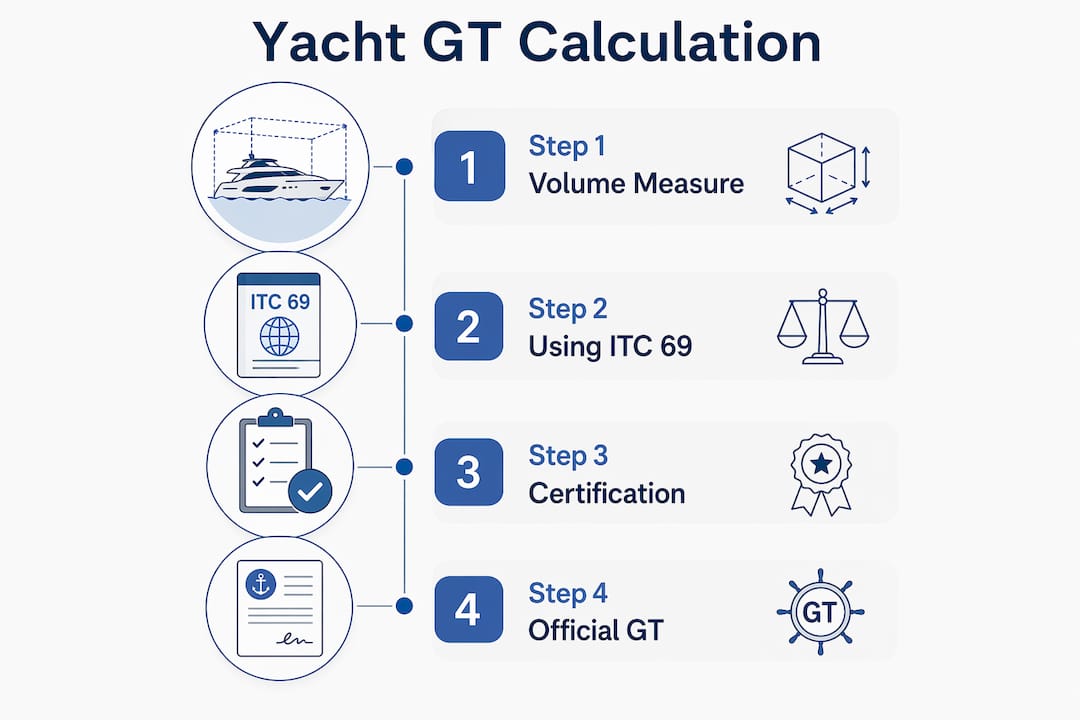
How is GT calculated? The ITC 69 formula, step by step
The formula is elegantly simple on paper: GT = K × V
- V = total enclosed volume of the vessel, measured in cubic meters
- K = a coefficient derived from V, calculated as K = 0.2 + 0.02 × log₁₀(V)
K is not a fixed number. It rises gradually as V increases, which means GT scales faster than volume alone as vessels grow larger. For a yacht with 1,000 m³ of enclosed volume, K = 0.2 + 0.02 × 3 = 0.26, giving a GT of 260.
Step-by-step: how V is measured
- Obtain the General Arrangement (GA) drawings from the shipyard or designer, showing all enclosed spaces by deck.
- Identify all enclosed spaces that qualify under ITC 69 — cabins, machinery spaces, enclosed superstructure, and service areas.
- Calculate the volume of each space using numerical integration on cross-sectional areas (classification societies typically apply the trapezoidal rule or similar methods across GA sections).
- Sum all qualifying volumes to arrive at total V in cubic meters.
- Apply the K formula using log₁₀(V) to derive the coefficient.
- Multiply K × V to produce the GT figure.
A useful mental anchor: one gross ton equals approximately 2.83 cubic meters (historically 100 cubic feet). So a yacht with 1,415 m³ of enclosed volume carries roughly 500 GT — which is precisely why that threshold matters so much in practice.
Key caveats for the calculation:
- Original shipyard drawings are often required for official measurement.
- Classification societies publish their own measurement instructions and may apply specific interpretations for unusual hull forms.
- Administrations may allow adjusted approaches for novel craft under IMO guidance.
Only a Recognized Organization acting on behalf of a flag state, or the flag administration itself, can issue an official Tonnage Certificate. Online calculators and broker estimates are useful for orientation but carry no regulatory weight.
How does GT differ from LOA and from gross registered tonnage?
Length overall (LOA), displacement, and gross tonnage each answer a different question. Conflating them is one of the most common errors in yacht purchasing conversations.

| Metric | What it measures | Format | Primary uses | When to rely on it |
|---|---|---|---|---|
| LOA (Length Overall) | Linear length from bow to stern | Meters or feet | Marina berth allocation, general size comparison | Comparing physical footprint, berthing costs |
| Displacement | Mass of water displaced | Metric tons | Naval architecture, stability, fuel range | Engineering and performance calculations |
| Gross Tonnage (GT) | Total enclosed internal volume | Unitless number | Regulatory compliance, crew rules, port dues, insurance | All regulatory and operational planning |
| Gross Registered Tonnage (GRT) | Net enclosed cargo/passenger volume (older standard) | “Tons” (historical) | Older documentation, pre-ITC 69 vessels | Reading legacy paperwork only |
The shift from GRT to GT happened as ITC 69 was adopted internationally. GRT measured only revenue-earning spaces, which created incentives to exclude certain areas from measurement. GT captures total enclosed volume, making it harder to manipulate and more consistent across vessel types. Older listings and some flag state documents still show GRT, which can create genuine confusion when comparing vessels across eras. If a listing shows GRT rather than GT, request updated documentation.
Why does GT matter so much for owners and buyers?
GT is the number that governs almost every significant operational and financial decision in a yacht’s life. The 500 GT threshold is the most consequential regulatory milestone in commercial and large private yachting.
Operational impacts that scale with GT:
- Survey frequency — higher GT triggers more frequent classification surveys and flag state inspections.
- SOLAS, MARPOL, and ISM applicability — at 500 GT and above, these international conventions apply with full force, mandating safety management systems, pollution prevention plans, and documented procedures.
- Crew certification — larger GT requires more certified officers and crew, with specific STCW endorsements tied to vessel size. See how crew quarters and staffing scale with vessel complexity.
- Firefighting and lifesaving equipment — standards become significantly more demanding above 500 GT.
- Insurance premiums — underwriters use GT as a primary reference for risk classification and premium calculation.
- Port dues and pilotage — many ports calculate fees directly from GT; pilotage becomes mandatory at certain thresholds in U.S. waters under 46 CFR Part 69.
- Classification society requirements — yachting regulations that apply above 500 GT often require continuous class maintenance with a recognized society such as Lloyd’s Register, ABS, Bureau Veritas, or RINA.
The cost and complexity difference between a 499 GT yacht and a 501 GT yacht is not marginal. Owners routinely describe it as the difference between running a private vessel and running a small ship.
Pro Tip: The “design to 499 GT” tactic is well-documented in the industry. Designers and owners deliberately cap enclosed volume to stay just below the 500 GT line, maximizing interior comfort while avoiding the full weight of SOLAS and ISM obligations. The trade-off: a vessel optimized to 499 GT may have slightly less interior volume than its hull could theoretically accommodate, and any future modifications that increase enclosed space could push it over the threshold, triggering a cascade of compliance requirements.
How do you find or verify a yacht’s official GT in the United States?
Verifying GT before purchase is not optional for serious buyers. Here is how to do it properly.
Step-by-step verification checklist:
- Request the Tonnage Certificate from the seller or broker. This is the primary document, issued by a Recognized Organization (Lloyd’s Register, ABS, Bureau Veritas, RINA, or similar) or directly by the flag administration.
- Check the flag state registration — for U.S.-flagged vessels, the U.S. Coast Guard issues documentation under 46 U.S.C. Chapter 143, and the official GT appears on the Certificate of Documentation.
- Cross-reference with the classification society — if the vessel is classed, the society’s records will show the measured GT and any conditions of class.
- Review the builder’s GA drawings to confirm that the measured spaces match the current configuration. Modifications after original measurement can change GT without triggering a re-measurement unless the owner requests it.
- Confirm the measurement date — if significant modifications have been made since the last official measurement, request a re-survey.
Documents to request from a seller or broker:
- Official Tonnage Certificate (flag state or Recognized Organization)
- Builder’s General Arrangement drawings and sectional area calculations
- Classification society measurement records
- USCG Certificate of Documentation (for U.S.-flagged vessels)
- Any modification records that could affect enclosed volume
Pro Tip: When asking a broker for GT confirmation, phrase it specifically: “Please provide the current official Tonnage Certificate and confirm whether any structural modifications have been made since the last official measurement.” A broker who cannot produce the Tonnage Certificate within a reasonable timeframe is a red flag. For any transaction involving financing or insurance, lenders and underwriters will require verified GT documentation — do not rely on a listing’s stated figure alone. The yacht documentation guide at Yachts-bysteve covers the full documentation checklist for buyers.
What do different GT ranges actually look like in practice?
GT numbers can feel abstract until you map them to real vessels. These are practical heuristics, not rigid rules — beam, deck count, and superstructure design create wide variance.
- Under 50 GT — typically recreational yachts in the 15–24 meter LOA range. Think a well-appointed motor yacht with two or three guest cabins, a salon, and a modest engine room. Regulatory burden is relatively light; USCG documentation applies for U.S.-flagged vessels, but international commercial conventions generally do not.
- 50–300 GT — coastal cruisers and larger recreational yachts, roughly 24–45 meters LOA. This range covers a broad swath of the brokerage market. Owners in this band face flag state survey requirements but typically remain below the 500 GT threshold that triggers SOLAS and ISM.
- 300–3,000 GT — the superyacht range. A 60-meter vessel with generous beam and multiple enclosed decks might sit around 1,000–1,500 GT. The 3,000 GT mark is sometimes cited as a demarcation for very large superyachts, though LOA equivalents vary considerably depending on design.
- 3,000+ GT — megayachts and large expedition vessels. The superyacht Dilbar, for example, registers at approximately 15,917 GT, illustrating how GT scales far faster than length as beam and deck count increase.
A useful way to visualize volume: using the 2.83 m³ per GT conversion, a 500 GT yacht contains roughly 1,415 cubic meters of enclosed space, as explained in how Italian yacht design shaped luxury fashion and Cruise apparel wear. Picture ten full-height guest suites, each about 30 m², with 4.7-meter ceiling heights — that is approximately the interior volume you are measuring. The yacht types guide at Yachts-bysteve offers further context on how size classifications map to real-world usage.
How GT thresholds shape design decisions — and what buyers should know
The relationship between GT thresholds and yacht design is one of the more fascinating dynamics in the industry. It is not purely engineering; it is economics and regulation intertwined.
“Designers and owners frequently target 499 GT as a deliberate ceiling, maximizing interior volume while avoiding the full suite of SOLAS Chapter II-1, MARPOL Annex I, and ISM Code obligations that activate at 500 GT. The result is a market segment of vessels engineered to a regulatory boundary rather than to a pure design ideal.” — The Owners Club, “Speaking Volumes” white paper
This design-to-499-GT dynamic creates a genuine market of vessels optimized around a regulatory number. For buyers, that is worth understanding on both sides. A 499 GT yacht may offer slightly less interior volume than its hull could theoretically support, but it also carries meaningfully lower operational costs, a smaller required crew, and simpler survey obligations. A vessel at 520 GT, by contrast, demands a full ISM Safety Management System, MARPOL pollution prevention documentation, and SOLAS-compliant safety equipment — all of which add to annual operating budgets.
The trade-off is not always obvious from a listing. Consider a theoretical 58-meter yacht with an unusually wide beam and four enclosed decks: depending on how the superstructure is configured, it could measure anywhere from 480 GT to 540 GT. That 60-GT difference carries a compliance cost that can run to hundreds of thousands of dollars annually in additional crew, surveys, and equipment.
Buyer checklist for evaluating GT implications:
- Ask the designer or broker: “What is the measured GT, and has the vessel been re-measured after any modifications?”
- Confirm whether the vessel is classed with Lloyd’s Register, ABS, Bureau Veritas, or RINA, and request the class certificate.
- If GT is close to 500, ask specifically whether any planned modifications could push it over the threshold.
- Review the applicable regulatory texts: ITC 69 for measurement, SOLAS for safety, MARPOL for pollution, and the ISM Code for management systems.
- For U.S.-flagged vessels, consult 46 CFR Part 69 for domestic tonnage measurement rules.
- Understand that larger GT isn’t automatically better — it is a trade-off between interior volume and operational complexity.
The yacht design trends shaping the current market reflect this tension directly, with architects finding creative ways to maximize perceived spaciousness without unnecessarily inflating measured GT.

Key Takeaways
Gross tonnage is the single most consequential number in a yacht’s regulatory identity, and verifying it before purchase protects buyers from unexpected compliance costs and operational obligations.
| Point | Details |
|---|---|
| GT is volumetric, not weight | GT measures total enclosed internal volume under ITC 69, not displacement or mass. |
| The 500 GT threshold is critical | Crossing 500 GT triggers SOLAS, MARPOL, and ISM Code obligations, larger certified crew, and higher survey frequency. |
| GT differs from LOA and GRT | LOA measures length; GRT is an outdated standard; GT is the current regulatory measure for all international compliance purposes. |
| Only official certificates count | Only a Recognized Organization or flag administration can issue a definitive Tonnage Certificate — estimates and listing figures are not authoritative. |
| Yachts-bysteve verifies GT paperwork | Yachts-bysteve helps buyers request and review official Tonnage Certificates and classification records before making an offer. |
Why verifying GT early is the smartest move a buyer can make
There is a particular kind of clarity that comes from reviewing a vessel’s Tonnage Certificate before you fall in love with the listing photos. More than once, a careful look at the official measurement records has revealed that a yacht underwent a superstructure extension after its original survey — adding enclosed volume that was never re-measured and never reflected in the GT figure on the listing. The regulatory implications of that undocumented change can be significant: a vessel that should be classed at 510 GT operating as though it were 490 GT is not a minor paperwork issue.
The single most protective step a buyer can take is to request the Tonnage Certificate and classification measurement records before making an offer, not after. Yachts-bysteve makes that verification process part of every transaction it guides, so you are never left reading the fine print alone.
Yachts-bysteve helps you verify GT and find the right vessel
Tonnage paperwork is where many luxury yacht transactions quietly go sideways. Yachts-bysteve brings brokerage-grade due diligence to every search: verifying official Tonnage Certificates, reviewing classification society measurement records, and matching buyers to vessels whose GT profile aligns with their intended use and operational budget. Whether you are evaluating a 200 GT coastal cruiser or a 1,500 GT superyacht, the difference between a smooth purchase and a costly surprise often comes down to one document reviewed at the right moment.
Ready to find a yacht whose specifications hold up under scrutiny? Work with a yacht broker at Yachts-bysteve to get a verified shortlist and a clear picture of what each vessel’s GT means for your ownership experience.
Useful sources for further reading
- International Tonnage Convention 1969 (ITC 69) — the primary legal text governing GT measurement globally; available through the IMO’s official publications.
- IMO tonnage guidance — the International Maritime Organization publishes circulars including TM.5/Circ.6, which addresses novel craft and exclusions under ITC 69.
- Red Ensign Group tonnage guidelines — regulatory tonnage guidance for yachts covering measurement approaches, novel spaces, and exclusions.
- U.S. Code of Federal Regulations, 46 CFR Part 69 — domestic tonnage measurement rules for U.S.-flagged vessels, administered by the U.S. Coast Guard.
- 46 U.S.C. Chapter 143 — federal statute governing vessel documentation and tonnage for U.S.-flagged commercial and private vessels.
- Classification societies — Lloyd’s Register, ABS (American Bureau of Shipping), Bureau Veritas, and RINA each publish measurement instructions and issue Tonnage Certificates as Recognized Organizations under ITC 69.
- The Owners Club, “Speaking Volumes” white paper — industry analysis of GT design trade-offs and the 499 GT optimization dynamic.
Recommended
Featured Listings

2028 Columbus Yachts
$22,900,008
137
Ancona

2012 Benetti PATIENCE
$10,975,000
132
Fort Lauderdale Florida

2028 Kingship Kingship
$20,350,000
125

2024 Silver Yachts
$25,400,000
117

2009 Hargrave BRANDI WINE
$2,500,000
114
Fort Lauderdale Florida

2028 Extra Yachts
$20,350,000
100
Ancona

2028 Alpha
$12,100,000
100
Ft Lauderdale Florida

2028 Extra Yachts Extra 96
$9,495,000
96
Ancona

2021 Sanlorenzo GATSBY
$6,795,000
96
Fort Lauderdale Florida

2028 Kingship
$11,990,000
90

2028 Alpha
$9,894,500
90
Fano

2023 Azimut COMPASS
$7,950,000
88
Miami Beach Florida

1999 Northern Marine OFF LINE
$2,495,000
84
Ft Lauderdale Florida

2013 Pershing DOROTHY ANN
$1,375,000
82
Fort Lauderdale Florida

1997 Ferretti Yachts
$825,000
80
La Paz

2008 Princess Yachts OCARALIA
$1,095,000
75
Charleston South Carolina

2014 Sunseeker
$1,400,000
68
New York New York

2024 Fairline
$2,750,000
68
Ft. Lauderdale Florida

2019 Vanquish Yachts IMPULSIVE
$1,799,000
58
Miami Beach Florida

2021 Ferretti Yachts HAVEN
$1,595,000
57
Fort Lauderdale Florida

2025 Formula BREAKTHROUGH III
$1,895,000
53
Miami Beach Florida

2023 Fairline
$900,000
45
Fort Lauderdale Florida

2012 Zeelander Mississippi Queen
$575,000
44
West Palm Beach Florida
2028 Columbus Yachts 137'
$22,900,008
2012 Benetti 132'
$10,975,000
2028 Kingship 125'
$20,350,000
2024 Silver Yachts 117'
$25,400,000
2009 Hargrave 114'
$2,500,000
2028 Extra Yachts 100'
$20,350,000
2028 Alpha 100'
$12,100,000
2028 Extra Yachts 96'
$9,495,000
2021 Sanlorenzo 96'
$6,795,000
2028 Kingship 90'
$11,990,000
2028 Alpha 90'
$9,894,500
2023 Azimut 88'
$7,950,000
1999 Northern Marine 84'
$2,495,000
2013 Pershing 82'
$1,375,000
1997 Ferretti Yachts 80'
$825,000
2008 Princess Yachts 75'
$1,095,000
2014 Sunseeker 68'
$1,400,000
2024 Fairline 68'
$2,750,000
2019 Vanquish Yachts 58'
$1,799,000
2021 Ferretti Yachts 57'
$1,595,000
2025 Formula 53'
$1,895,000
2023 Fairline 45'
$900,000
2012 Zeelander 44'
$575,000