

Overview: A yacht watermaker, formally known as a reverse osmosis desalination system, converts seawater into clean, potable fresh water onboard. For luxury yacht owners cruising the open ocean, it is the difference between true freedom and a constant, logistical tether to the nearest marina.
Table of Contents
- What is a yacht watermaker, and why does it matter?
- The two main types of watermakers for yachts
- Key benefits of a watermaker on a luxury yacht
- Water quality and treatment considerations onboard
- Practical considerations: energy, installation, and maintenance
- How watermakers shape the luxury yacht market
- What does a yacht watermaker cost?
- Key Takeaways
What is a yacht watermaker, and why does it matter?
A yacht watermaker is an onboard desalination system that forces seawater through a semi-permeable membrane at high pressure, stripping out salt, bacteria, and contaminants to produce fresh drinking water. The industry also calls these devices desalinators, and the two terms are fully interchangeable. What they share is the same elegant principle: reverse osmosis, or RO, doing quietly what once required a port stop.
For a luxury vessel crossing the Atlantic or anchoring off a remote Caribbean cay, that independence is not a convenience. It is a safety net. The core advantages are worth naming plainly:
- True autonomy: No dependency on shore water supplies, particularly critical in remote or underdeveloped anchorages.
- Safety assurance: Reliable fresh water during extended offshore passages, regardless of conditions.
- Superior water quality: Output often cleaner than what many marinas supply.
- Weight and performance gains: Smaller onboard tanks mean a lighter, faster vessel.
- Lifestyle freedom: Extended off-grid cruising without rationing or resupply detours.
Watermakers have moved from optional luxury to expected standard equipment on serious offshore yachts. Buyers in the U.S. market increasingly treat them the way they treat navigation electronics: non-negotiable on any vessel meant for real passage-making.
The two main types of watermakers for yachts
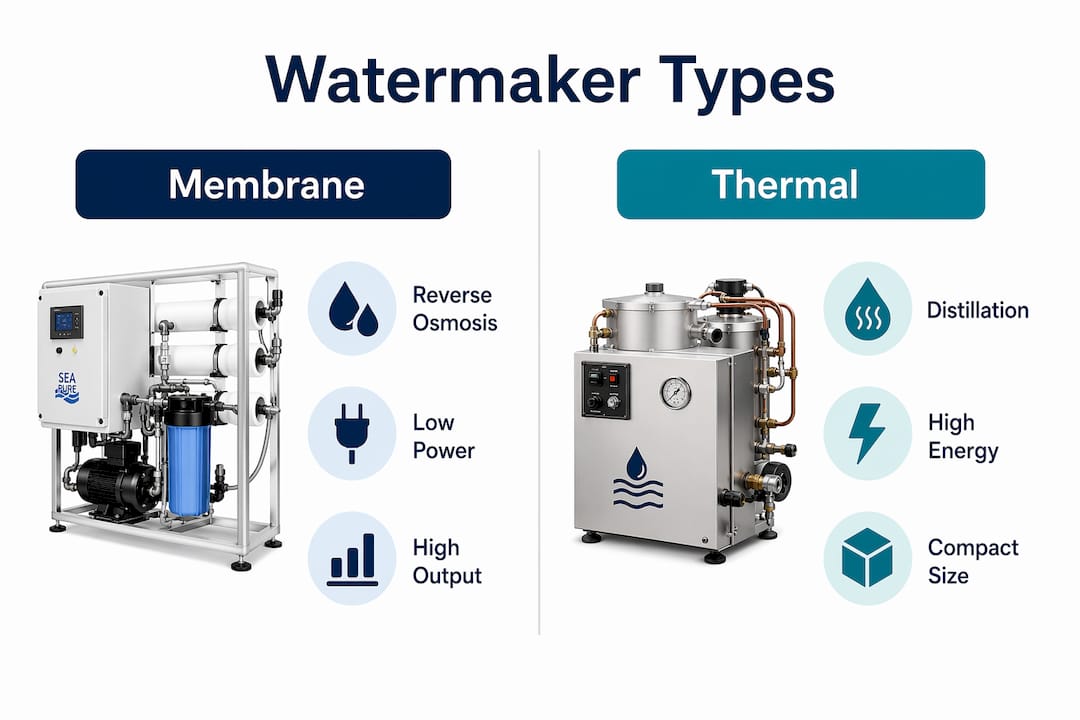
Watermakers fall into two categories: traditional high-pressure pump systems and energy recovery device (ERD) systems, most commonly built around a Clark pump. Both produce the same result, but they get there very differently.
- Traditional high-pressure systems use a CAT-style pump to generate the roughly 56 bar of pressure needed to push seawater through the RO membrane. They are fast and mechanically simple, but they draw significant power, typically requiring AC voltage and a running generator.
- ERD systems (Clark pump) use a low-pressure pump combined with reciprocating pistons that recycle the energy from pressurized discharge water to boost inlet pressure. The result is a system that draws about one-fifth the power of a traditional unit.
- DC compatibility: ERD watermakers can often run from 12V or 24V DC systems, making them ideal for solar-powered or battery-limited sailing yachts.
- Output rates: A typical 50–60 ft motoryacht needs an output rate sufficient to meet daily demand within a moderate run cycle.
- Power source flexibility: Traditional systems suit generator-equipped motor yachts; ERD systems suit sailing yachts and eco-conscious owners.
The choice between them is less about which is better and more about which matches your vessel’s power architecture and cruising style.
Key benefits of a watermaker on a luxury yacht
The practical case for installing a watermaker is grounded in performance, not just comfort. Reducing large, heavy water tanks lowers vessel weight, improves fuel economy, and extends range. On a long passage, that translates directly into fewer stops and greater flexibility.
Statistic: An average yacht passenger consumes 30–100 gallons of water daily, a demand that makes a reliable onboard production system far more practical than carrying equivalent tank capacity.
- Extended range: Less water weight means better fuel efficiency and a longer effective range between ports.
- Off-grid capability: Owners can anchor in pristine, remote locations for days without resupply.
- Water quality: Output frequently surpasses marina tap water in purity, and the finest systems produce water clean enough to wash topsides without leaving residue.
- ERD energy efficiency: Low power draw pairs naturally with solar arrays and lithium battery banks, supporting a greener onboard footprint.
- Crewed charter appeal: For crewed yacht operations, a watermaker removes a logistical variable that can otherwise disrupt guest experience.
Water quality and treatment considerations onboard
Reverse osmosis output is exceptionally pure but mineral-free, which can produce a flat or slightly unfamiliar taste at first. Many owners add a remineralization cartridge or activated carbon post-filter to restore a more natural flavor profile. Think of it as the final polish on an already refined product.
- Pre-filtration: Most systems include sediment pre-filters and an oil-water separator to protect the RO membrane from suspended particles and hydrocarbons.
- UV sterilization: Ultraviolet sterilizers on the product water outlet kill any microorganisms that pass through the membrane before water reaches the fresh tank.
- Continuous flow flushing: Water flowing across the membrane face carries away concentrated brine, preventing pore blockage.
- Remineralization: A post-treatment stage adds calcium and magnesium back into the output, improving taste and providing trace minerals.
The membrane is the heart of the system, and protecting it determines how long the whole investment lasts.
Practical considerations: energy, installation, and maintenance
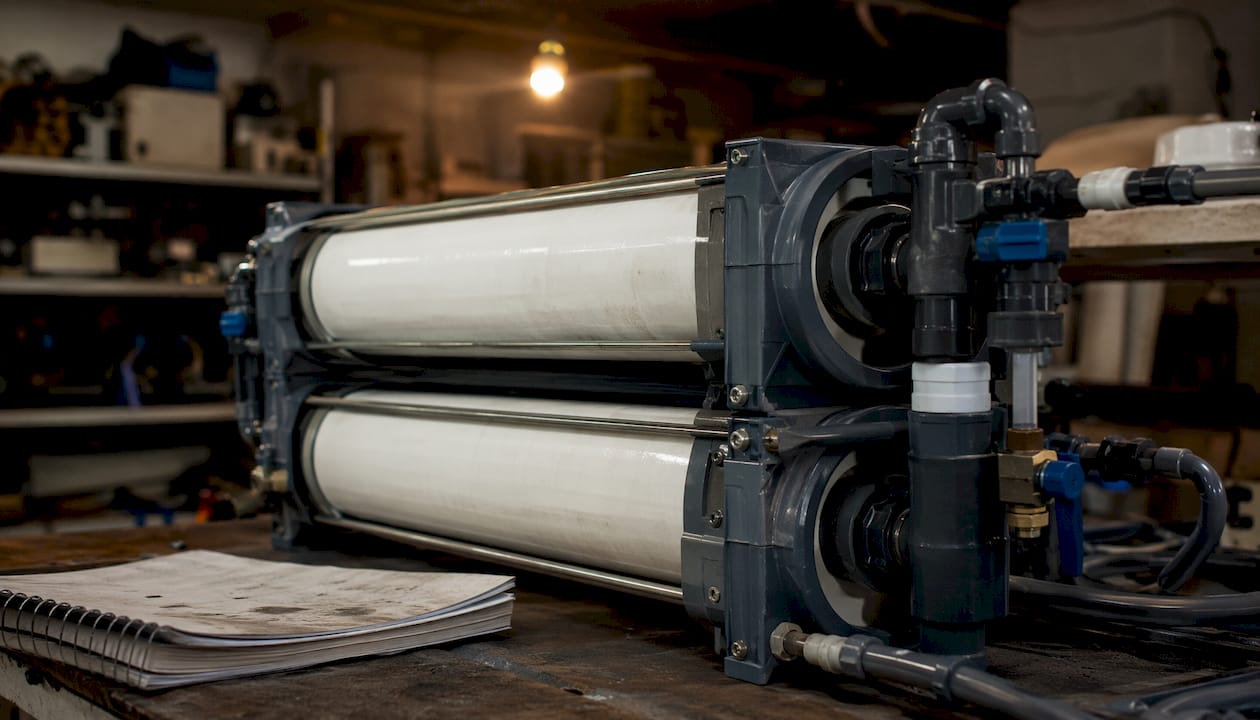
Pro Tip: Match your watermaker’s output rating to your actual daily usage and voyage profile before purchasing. Oversizing wastes power; undersizing creates rationing anxiety on passage.
Installation placement matters as much as unit selection. The seawater intake must sit below the waterline, away from turbulence, to prevent air ingestion. Discharge lines go above the waterline. Modular systems allow components to be distributed across available spaces; all-in-one units fit neatly into an engine room or lazarette.
- TDS monitoring: A handheld or inline total dissolved solids meter confirms output purity. Seawater typically reads 30,000 ppm; safe drinking water falls below 750 ppm, and a well-tuned system delivers 200–300 ppm.
- Membrane flushing: Never flush with chlorinated tap water. Chlorine permanently damages RO membranes. Use fresh, non-chlorinated water only.
- Temperature and salinity effects: Colder or saltier water reduces output. Manufacturers rate performance at 25°C and 3.5% salinity; expect lower yields in northern Atlantic or Pacific waters.
- Storage footprint: Compact all-in-one units preserve more usable space than modular arrangements, a real consideration on vessels where every cubic foot counts.
- Automation: Modern systems handle pressure fine-tuning and back-flushing automatically, removing the manual discipline that older units demanded.
How watermakers shape the luxury yacht market
Watermakers have become a genuine selling point in the U.S. luxury yacht market, not merely a technical checkbox. Buyers evaluating luxury yacht acquisitions increasingly ask about watermaker capacity alongside engine hours and navigation systems. A vessel equipped with a capable, well-maintained system commands stronger interest, particularly among buyers planning extended blue-water passages or liveaboard lifestyles.
At Yachts-bysteve, the pattern is consistent: buyers who prioritize autonomy and performance place watermaker specification near the top of their criteria. Sellers who can demonstrate a properly serviced system with documented maintenance logs present a more compelling listing. The technology signals that the vessel has been managed with intention, not just maintained to minimum standards. Astilleros de Mallorca, one of the Mediterranean’s most respected refit facilities, notes that watermaker upgrades rank among the most requested modifications during pre-sale refits, reflecting how directly the feature influences perceived vessel value.
Motor Boat & Yachting has highlighted that watermakers fundamentally shift how owners relate to their vessels, transforming a weekend cruiser into a genuinely capable offshore platform. That shift resonates deeply with the U.S. buyer who wants a yacht that performs as beautifully as it looks.
What does a yacht watermaker cost?
Purchase and installation costs for yacht watermakers range from $5,000 to $20,000 depending on output capacity, system type, and automation level. DC-powered ERD units for sailing yachts sit at the lower end; high-output AC systems for large motoryachts occupy the upper range. Operational costs include periodic membrane replacement, pre-filter cartridges, and UV lamp changes, all of which are modest relative to the system’s value over a multi-year ownership period.
For a luxury vessel, the return on that investment shows up in reduced marina dependency, lower fuel burn from carrying less water weight, and the kind of itinerary flexibility that money alone cannot buy at a fuel dock.
Choosing the right system for your vessel’s size, power setup, and cruising ambitions is exactly where expert guidance pays for itself. The team at Yachts-bysteve works with buyers and sellers to evaluate onboard systems as part of a complete vessel assessment. Choosing the right yacht broker ensures that technical details like watermaker specification are factored into every transaction, not discovered after the deal closes.
Key Takeaways
A yacht watermaker converts seawater into potable fresh water via reverse osmosis, giving luxury vessels true autonomy, better performance, and superior water quality compared to shore supplies.
| Point | Details |
|---|---|
| Core technology | Reverse osmosis forces seawater through a semi-permeable membrane, removing salt, bacteria, and contaminants. |
| Two system types | Traditional high-pressure pumps need generator power; ERD systems draw about one-fifth the power and run on 12V or 24V DC. |
| Daily water demand | Average yacht passengers consume 30–100 gallons of water daily, making onboard production practical for extended passages. |
| Output purity target | A well-tuned system delivers 200–300 ppm TDS; seawater starts at 30,000 ppm. |
| Cost range | Installed systems typically cost $5,000–$20,000, with ongoing expenses limited to filters, membranes, and UV lamps. |
Recommended
Featured Listings

2028 Columbus Yachts
$22,900,008
137
Ancona

2012 Benetti PATIENCE
$10,975,000
132
Fort Lauderdale Florida

2028 Kingship Kingship
$20,350,000
125

2024 Silver Yachts
$25,400,000
117

2009 Hargrave BRANDI WINE
$2,500,000
114
Fort Lauderdale Florida

2028 Extra Yachts
$20,350,000
100
Ancona

2028 Alpha
$12,100,000
100
Ft Lauderdale Florida

2028 Extra Yachts Extra 96
$9,495,000
96
Ancona

2021 Sanlorenzo GATSBY
$6,795,000
96
Fort Lauderdale Florida

2028 Kingship
$11,990,000
90

2028 Alpha
$9,894,500
90
Fano

2023 Azimut COMPASS
$7,950,000
88
Miami Beach Florida

1999 Northern Marine OFF LINE
$2,495,000
84
Ft Lauderdale Florida

2013 Pershing DOROTHY ANN
$1,375,000
82
Fort Lauderdale Florida

1997 Ferretti Yachts
$825,000
80
La Paz

2008 Princess Yachts OCARALIA
$1,095,000
75
Charleston South Carolina

2014 Sunseeker
$1,400,000
68
New York New York

2024 Fairline
$2,750,000
68
Ft. Lauderdale Florida

2019 Vanquish Yachts IMPULSIVE
$1,799,000
58
Miami Beach Florida

2021 Ferretti Yachts HAVEN
$1,595,000
57
Fort Lauderdale Florida

2025 Formula BREAKTHROUGH III
$1,895,000
53
Miami Beach Florida

2023 Fairline
$900,000
45
Fort Lauderdale Florida

2012 Zeelander Mississippi Queen
$575,000
44
West Palm Beach Florida
2028 Columbus Yachts 137'
$22,900,008
2012 Benetti 132'
$10,975,000
2028 Kingship 125'
$20,350,000
2024 Silver Yachts 117'
$25,400,000
2009 Hargrave 114'
$2,500,000
2028 Extra Yachts 100'
$20,350,000
2028 Alpha 100'
$12,100,000
2028 Extra Yachts 96'
$9,495,000
2021 Sanlorenzo 96'
$6,795,000
2028 Kingship 90'
$11,990,000
2028 Alpha 90'
$9,894,500
2023 Azimut 88'
$7,950,000
1999 Northern Marine 84'
$2,495,000
2013 Pershing 82'
$1,375,000
1997 Ferretti Yachts 80'
$825,000
2008 Princess Yachts 75'
$1,095,000
2014 Sunseeker 68'
$1,400,000
2024 Fairline 68'
$2,750,000
2019 Vanquish Yachts 58'
$1,799,000
2021 Ferretti Yachts 57'
$1,595,000
2025 Formula 53'
$1,895,000
2023 Fairline 45'
$900,000
2012 Zeelander 44'
$575,000