

Overview: A yacht with complete, verified service records can command a significantly higher resale value than an identical vessel without them. That gap is not incidental. Service records are the documentary proof of a vessel’s entire maintenance life: engine hours logged, repairs invoiced, winterization completed, inspections signed off, and incidents disclosed. For anyone buying or selling a luxury yacht, these records are the difference between a confident transaction and an expensive gamble.
Yacht service records, sometimes called a vessel maintenance history or technical documentation file, capture every significant action taken to keep a vessel safe, functional, and seaworthy. They answer the question every serious buyer eventually asks: How well has this yacht actually been cared for? A pristine hull and a polished interior tell one story. The records tell the real one.
The stakes have risen sharply in 2026. Insurance underwriters now scrutinize maintenance logs during policy renewals. Class societies request digital records before a surveyor even steps aboard. And in US maritime litigation, jury verdicts above $10 million are increasingly common in cases where documentation gaps become the central issue. Buyers, sellers, and owners who treat service records as optional paperwork are carrying risk they may not fully see until it surfaces at the worst possible moment.
Why yacht service records matter: what they include and why they exist
A complete maintenance history is not a single document. It is a living archive, built over the life of the vessel, that proves consistent, responsible ownership. Knowing what belongs in that archive is the first step toward evaluating any yacht with confidence.
A thorough maintenance file typically contains:
- Service receipts and repair invoices: Dated records from qualified technicians covering engine servicing, electrical work, hull repairs, and equipment replacements.
- Engine hour logs: Cumulative running hours for main engines, generators, and tenders, tied to service intervals and manufacturer recommendations.
- Winterization and lay-up records: Documentation of seasonal preparation, especially critical for vessels kept in northern climates where freeze protection and corrosion management require specific procedures.
- Inspection and survey reports: Third-party assessments of hull integrity, structural condition, and safety equipment, often required by insurers and class societies.
- Warranty claims and refit documentation: Records of any manufacturer warranty work and major refit projects, including change orders, installation records, and sea trial results.
- Incident and damage logs: A chronological account of any collisions, groundings, or onboard incidents, along with corrective actions taken. As the UK Maritime and Coastguard Agency notes in its guidance on vessel damage documentation, a damage log allows owners and repair yards to distinguish original material from previously repaired sections.
Records may be stored on paper, digitally, or in a hybrid format. What matters most is completeness and chronological consistency. Gaps in the timeline raise questions that no amount of verbal reassurance can fully answer. Logging all known conditions from the present forward, even when historical data is incomplete, establishes a baseline that protects owners and builds trust with future buyers.

How to verify a yacht’s service history before you commit
Reviewing records on paper is only the beginning. Verification means confirming that what is documented actually reflects what happened to the vessel.
- Review physical and digital documentation together. Cross-reference paper receipts with digital logs where both exist. Inconsistencies in dates, service intervals, or technician names can signal altered or incomplete records.
- Commission a professional survey. A qualified marine surveyor will inspect the vessel’s mechanical and structural condition and compare findings against the documented history. Discrepancies between the surveyor’s observations and the records on file are a significant red flag.
- Interview previous owners, crew, or brokers. Sellers who are transparent about a vessel’s history, including its challenges, tend to be more credible than those who present only a polished narrative. Ask specifically about any periods where the log appears thin.
- Check for missing intervals. A log that jumps from one year to the next with no entries during a period of known use deserves a direct explanation. Class societies now request records retrieval before physical inspection, and gaps surface immediately as audit findings.
- Use third-party verification services and history reports. Several maritime history services can cross-reference a vessel’s registration, flag state records, and known incident history against what the seller presents.
Pro Tip: Cross-reference maintenance patterns with the vessel’s known usage and operating environment. A yacht kept in saltwater year-round should show more frequent corrosion-related maintenance than one stored in a freshwater marina. If the records do not reflect the environment, ask why.
One detail buyers often overlook: engine hours alone are a poor reliability indicator. Engines with fewer hours but neglected service can be in worse condition than high-hour engines with documented, consistent upkeep. The records prove the care, not the clock.
How maintenance records shape resale value and buyer confidence
The financial case for thorough documentation is direct. A yacht with documented maintenance history can command 15–20% higher resale value than an identical vessel without such records.
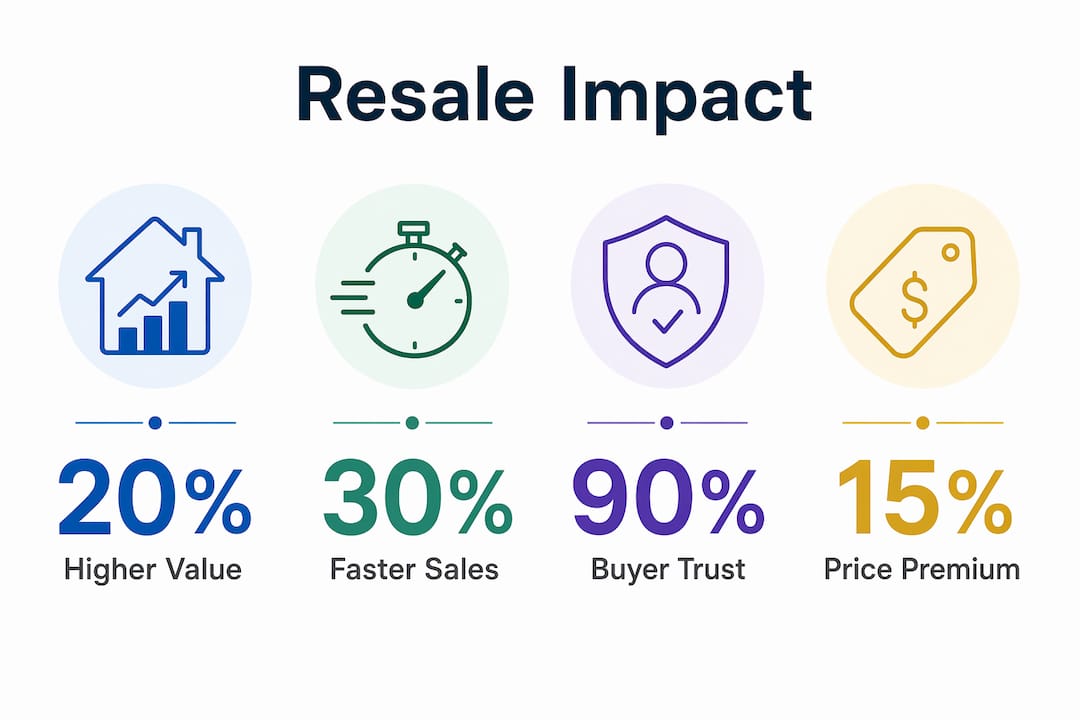
Beyond price, records reduce the friction that slows transactions. Buyers who can see a clean, consistent service history hesitate less, negotiate less aggressively, and move to closing faster. The documentation does the trust-building work that would otherwise fall to the seller’s word alone.
Insurance is another dimension where records carry real weight. Well-documented loss records can support some premium reductions in hull and P&I insurance. Conversely, gaps in maintenance documentation push renewals toward the higher end of the rate range, and in some cases, insurers have denied claims entirely when owners could not prove adherence to manufacturer maintenance guidelines.
The risks of incomplete records compound over time:
- Price reductions during negotiation, as buyers price in the uncertainty of unknown maintenance.
- Slower sales, as cautious buyers wait for additional inspections or walk away entirely.
- Increased liability exposure, particularly if a post-sale mechanical failure can be traced to undisclosed deferred maintenance.
- Failed charter vetting, since major charterer programs require multi-year operational history before approving a vessel.
For a deeper look at how yacht valuation connects to documentation quality, the factors are more intertwined than most buyers initially expect.
What separates strong maintenance records from weak ones
Not all documentation is created equal. A folder of loose receipts is not the same as a structured, verifiable maintenance archive. The distinction matters when a surveyor, insurer, or class society auditor asks for proof.
Strong records share several defining characteristics:
- Timely, consistent logging. An entry made on time, even if brief, is more valuable than a detailed entry reconstructed from memory weeks later. Consistency over time is the quality that auditors and buyers actually trust.
- Digital records with timestamps, photos, and detailed notes. Digital maintenance platforms enable AI analysis to detect equipment issues weeks in advance, a capability that static paper logs cannot replicate. Photos of completed work add a layer of verification that written entries alone cannot provide.
- Both preventive and corrective maintenance documented. A record that shows only repairs, with no evidence of scheduled servicing, suggests that maintenance was reactive rather than planned. Preventive maintenance costs roughly one-tenth of reactive repairs, and the records should reflect that discipline.
- Equipment-linked records. Centralized document databases link each document to the specific piece of equipment it relates to. When a surveyor pulls up the generator record, the manual, service bulletins, and calibration certificates are all in one place.
- Verification by authorized personnel. Signatures from qualified technicians, class society surveyors, or flag state inspectors carry weight that self-certified entries do not. A comprehensive, consistent service log verified by authorized personnel provides contractual evidence during disputes.
The difference between a vessel that passes an audit in thirty seconds and one that consumes an entire afternoon of frantic searching often comes down to whether records were built into the operational routine or treated as an afterthought.
Smart practices for buyers and sellers navigating service records
Whether you are preparing to list a vessel or evaluating one for purchase, the approach to service records shapes the outcome of the transaction.
For buyers:
- Demand complete, verifiable service histories before making an offer. A seller who cannot produce organized records is asking you to price the uncertainty yourself.
- Engage a qualified marine surveyor to independently assess the vessel’s condition against the documented history. A survey is not a formality; it is the mechanism by which records are tested against reality.
- Pay particular attention to the yacht documentation covering the past three to five years, when deferred maintenance is most likely to surface as a current problem.
For sellers:
- Organize and digitize records before listing. A well-presented, searchable maintenance archive signals the same care and attention that buyers hope to find in the vessel itself.
- Fill gaps where possible by contacting previous service yards, marinas, or technicians who may have records you no longer hold.
- Maintain a log of all service actions going forward, even after the sale is complete. Future buyers will ask the same questions the current buyer is asking now.
Pro Tip: Centralized digital platforms that link records to specific equipment, crew changes, and operational logs create what the industry calls “transferable operational memory.” When a vessel changes hands, that memory transfers with it, reducing the new owner’s onboarding time and protecting the seller’s asking price.
Both parties benefit from engaging a professional broker who understands how to evaluate and present documentation. The right broker does not just facilitate the transaction; they help ensure the records tell the story the vessel deserves.
Why the industry is treating service records as a strategic asset in 2026
The shift happening across the luxury yacht market in 2026 is not subtle. Service records have moved from compliance paperwork to operational evidence, and the consequences of gaps are measurable.
Insurance underwriters now rigorously review maintenance logs and incident records during policy renewals. Record gaps cause operational delays, failed audits, and charter vetting failures, each carrying direct financial consequences. ABS, DNV, and other class societies explicitly emphasize preplanning for records retrieval, with records arriving before the surveyor steps aboard. Gaps in the historical archive surface immediately and convert into audit findings.
US jury verdicts above $10 million are increasingly common in maritime litigation, with documentation discipline directly affecting recovery outcomes in claims disputes.
The legal dimension is particularly striking. The Fifth Circuit’s decision in Three Fifty Markets v. ARGOS M (february 2, 2026) confirmed how charter party governance and lien disputes hinge on the documentary chain. The MV Dali Baltimore Key Bridge case continues to shape how insurers assess claims. When a claim arises, the central question becomes whether the operator can produce a time-stamped operational record proving the vessel was maintained and operated to standard at the relevant moment.
Technical knowledge embedded in maintenance records creates what industry experts describe as transferable operational memory. Crew turnover is a constant reality in yachting. Senior engineers leave. Captains change. Without structured records, the vessel’s operational context departs with them, leaving the next crew to rediscover information that should already be documented. That rediscovery costs time, money, and sometimes safety.
Pro Tip: Prioritize digital, searchable logs over paper binders. A single prevented equipment failure worth $5,000–$20,000 covers years of software subscription costs, and the audit-readiness benefit compounds every year the records grow.
Understanding the full scope of yachting regulations that now govern documentation requirements helps owners stay ahead of the compliance curve rather than scrambling to catch up when an audit arrives.
Key Takeaways
Yacht service records are the single most powerful tool a buyer or seller has for establishing trust, protecting value, and reducing transaction risk in 2026.
| Point | Details |
|---|---|
| Resale value premium | Documented maintenance history supports 15–20% higher resale prices compared to identical vessels without records. |
| Insurance impact | Well-documented loss records can support some premium reductions in hull and P&I insurance. |
| Legal and audit stakes | US jury verdicts above $10 million are increasingly common in maritime litigation where documentation gaps are central to the dispute. |
| Digital records outperform paper | AI-enabled digital platforms detect equipment issues weeks in advance and produce audit-ready reports in seconds, not hours. |
| Yachts-bysteve advantage | Yachts-bysteve helps buyers and sellers navigate service record complexities, connecting clients with qualified inspection resources and ensuring documentation accuracy throughout the transaction. |
The records tell the story the vessel cannot tell itself
There is a perspective worth holding onto when you are standing on the deck of a yacht you are considering buying, or preparing to list one you have loved for years. The vessel’s condition is visible. Its history is not. That history lives in the records, and without them, you are asking the next owner to take your word for it.
The conventional wisdom in yacht transactions has long been that a beautiful boat sells itself. That view misses something the market has been quietly correcting for years. Buyers in 2026 are not simply assessing aesthetics and specification. They are assessing risk. How well has this vessel been managed? How much operational knowledge is embedded in the asset itself, rather than residing in the memory of whoever happened to be onboard at inspection? A yacht with strong technical continuity answers those questions before they are asked.
What tends to get underestimated is the compounding nature of good record-keeping. A single year of consistent logging does not transform a transaction. But five years of timestamped, equipment-linked, professionally verified documentation creates something genuinely rare: clarity. Buyers pay for clarity. Insurers reward it. Class societies trust it. The records are not just proof of maintenance. They are proof of ownership character.
The industry is moving toward digital platforms not because it is fashionable, but because the operational advantages are too significant to ignore. Paper binders lose institutional knowledge with every crew rotation. A digital system preserves it. That preservation is, ultimately, what protects the vessel’s value across its full working life.
Yachts-bysteve: expert guidance through every layer of a yacht transaction
Navigating service records, surveys, and documentation audits is genuinely complex territory, and the stakes are high enough that having the right expertise alongside you changes the outcome. Yachts-bysteve specializes in exactly this kind of transaction support, connecting luxury buyers and sellers with the resources, market knowledge, and professional networks needed to move confidently from first inquiry to final signature.
Whether you are a buyer who wants complete assurance about a vessel’s history or a seller who wants documentation organized to command the best possible price, choosing the right broker is the decision that shapes everything that follows. Yachts-bysteve brings the depth of experience to vet maintenance records, coordinate qualified surveys, and present your vessel’s story with the clarity that discerning buyers expect. Explore the full range of brokerage services and see how personalized guidance turns a complex process into a confident one.
Recommended
Featured Listings

2028 Columbus Yachts
$22,900,008
137
Ancona

2012 Benetti PATIENCE
$10,975,000
132
Fort Lauderdale Florida

2028 Kingship Kingship
$20,350,000
125

2024 Silver Yachts
$25,400,000
117

2009 Hargrave BRANDI WINE
$2,500,000
114
Fort Lauderdale Florida

2028 Extra Yachts
$20,350,000
100
Ancona

2028 Alpha
$12,100,000
100
Ft Lauderdale Florida

2028 Extra Yachts Extra 96
$9,495,000
96
Ancona

2021 Sanlorenzo GATSBY
$6,795,000
96
Fort Lauderdale Florida

2028 Kingship
$11,990,000
90

2028 Alpha
$9,894,500
90
Fano

2023 Azimut COMPASS
$7,950,000
88
Miami Beach Florida

1999 Northern Marine OFF LINE
$2,495,000
84
Ft Lauderdale Florida

2013 Pershing DOROTHY ANN
$1,375,000
82
Fort Lauderdale Florida

1997 Ferretti Yachts
$825,000
80
La Paz

2008 Princess Yachts OCARALIA
$1,095,000
75
Charleston South Carolina

2014 Sunseeker
$1,400,000
68
New York New York

2024 Fairline
$2,750,000
68
Ft. Lauderdale Florida

2019 Vanquish Yachts IMPULSIVE
$1,799,000
58
Miami Beach Florida

2021 Ferretti Yachts HAVEN
$1,595,000
57
Fort Lauderdale Florida

2025 Formula BREAKTHROUGH III
$1,895,000
53
Miami Beach Florida

2023 Fairline
$900,000
45
Fort Lauderdale Florida

2012 Zeelander Mississippi Queen
$575,000
44
West Palm Beach Florida
2028 Columbus Yachts 137'
$22,900,008
2012 Benetti 132'
$10,975,000
2028 Kingship 125'
$20,350,000
2024 Silver Yachts 117'
$25,400,000
2009 Hargrave 114'
$2,500,000
2028 Extra Yachts 100'
$20,350,000
2028 Alpha 100'
$12,100,000
2028 Extra Yachts 96'
$9,495,000
2021 Sanlorenzo 96'
$6,795,000
2028 Kingship 90'
$11,990,000
2028 Alpha 90'
$9,894,500
2023 Azimut 88'
$7,950,000
1999 Northern Marine 84'
$2,495,000
2013 Pershing 82'
$1,375,000
1997 Ferretti Yachts 80'
$825,000
2008 Princess Yachts 75'
$1,095,000
2014 Sunseeker 68'
$1,400,000
2024 Fairline 68'
$2,750,000
2019 Vanquish Yachts 58'
$1,799,000
2021 Ferretti Yachts 57'
$1,595,000
2025 Formula 53'
$1,895,000
2023 Fairline 45'
$900,000
2012 Zeelander 44'
$575,000