

Crew quarters are defined as the dedicated, private living spaces aboard a yacht where the crew sleeps, rests, and recharges between shifts. Understanding why yachts have crew quarters reveals something most guests never see: the entire architecture of luxury service depends on what happens below deck. Without a proper place to rest, a crew cannot maintain the alertness, warmth, and precision that transforms a good charter into an unforgettable one. The boat may be the stage, but the crew are the stars, and every star needs a place to rest before the curtain rises again.
Why yachts have crew quarters: the operational case
Crew quarters exist because continuous, high-quality service at sea is physically impossible without them. A yacht does not anchor at 5:00 PM and resume at 9:00 AM. It operates around the clock, crossing time zones, managing weather changes, and responding to guest needs at any hour. The crew must rotate through shifts without compromising safety or hospitality, and that rotation requires a private, functional space to sleep and recover.
Crew rest areas are recognized safety features that prevent fatigue-related errors in navigation and mechanical operations. Fatigue degrades judgment, reaction time, and decision-making. On open water, those degraded functions become genuine risks. Crew quarters are not a comfort bonus. They are a safety prerequisite.
The Maritime Labour Convention (MLC) 2006 sets binding international standards for crew accommodations, including minimum headroom of 203 cm, proper sanitary facility ratios, noise insulation, and adequate ventilation. These regulations apply to commercial yachts and reflect a global consensus: crew welfare is inseparable from vessel safety. Owners who treat crew quarters as an afterthought are not just being unkind. They are operating outside international standards.
Beyond regulation, quality crew accommodations directly affect crew retention. Experienced captains, chefs, and deckhands choose their vessels carefully. A well-appointed crew area signals that an owner values their team. That value translates into loyalty, consistency, and the kind of institutional knowledge that makes every charter run like clockwork.
How crew quarters are designed and where they sit on a yacht
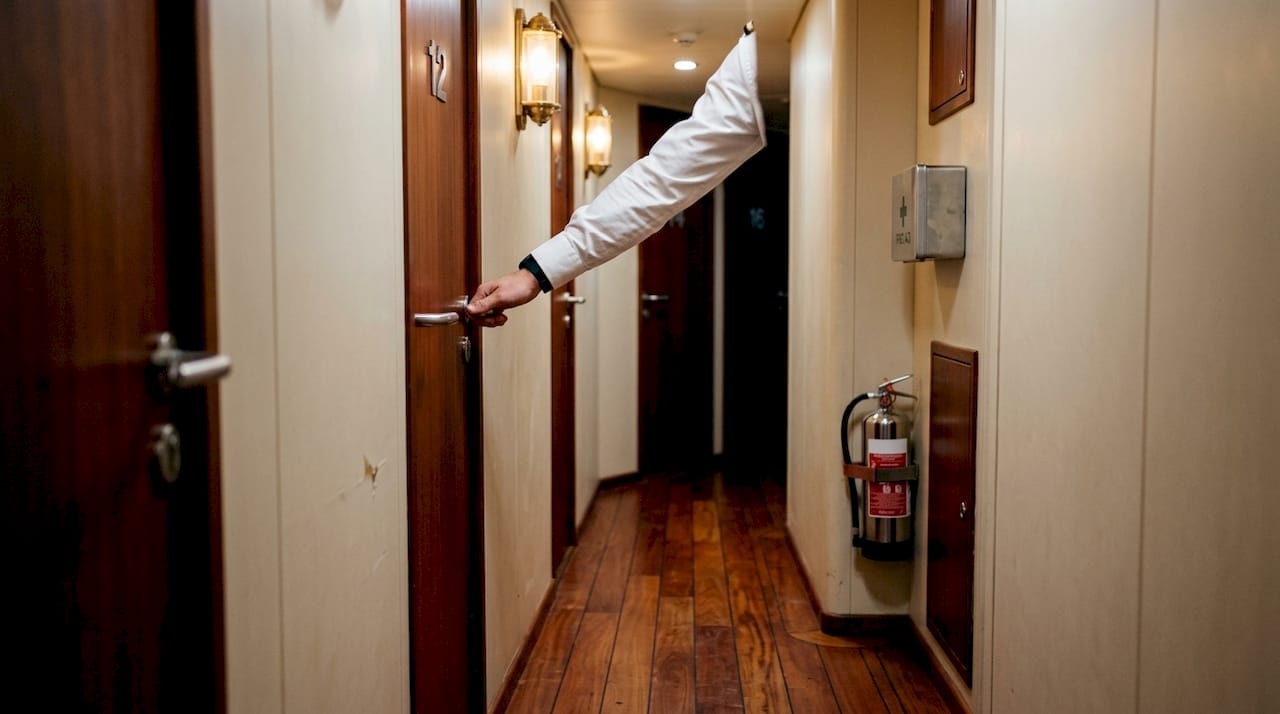
Crew quarters are typically located in the bow or amidships below deck, deliberately separated from guest cabins. This placement is not accidental. It reflects a design philosophy built around two priorities: privacy and operational flow. Guests should never feel the machinery of service. They should simply experience its results.
The separation goes deeper than physical distance. Most well-designed yachts incorporate dedicated crew corridors and service stairwells that allow the team to move through the vessel without crossing guest spaces. A chef can deliver breakfast from the galley to the aft deck without passing through the main saloon. A stewardess can turn down a cabin while guests enjoy sundowners on the flybridge. This invisible service design is the hallmark of a thoughtfully planned yacht.
What a crew service zone actually includes
Crew quarters form the core of a larger service zone that functions as a self-contained unit within the yacht. This zone typically includes:
- Sleeping cabins, often with bunk configurations on smaller vessels and private or shared cabins on larger ones
- A dedicated crew galley separate from the guest galley
- Crew bathrooms and shower facilities
- A laundry room for managing linens, uniforms, and towels
- Storage for crew gear, safety equipment, and maintenance tools
Professional-grade yachts integrate all of these elements into a cohesive service hub. The result is a crew that can operate with full independence from guest spaces, maintaining 24/7 service and upkeep without interruption.
Pro Tip: When evaluating a yacht for purchase or charter, ask specifically about crew corridor access. A yacht with well-planned service routes will consistently deliver a more polished guest experience than one where crew and guests share the same pathways.
How crew quarters protect safety and service quality
The connection between crew rest and service quality is direct and measurable. A rested crew member reads the room correctly, anticipates needs, and responds with calm efficiency. A fatigued one misses cues, makes errors, and creates friction where there should be none. On a luxury vessel, that friction is felt immediately.
“The crew is often considered the most important system aboard a yacht, responsible for safety, guest service, and maintenance. The quality of their accommodations sets the tone for everything that follows.”
This perspective reflects what experienced charter guests already know intuitively. The finest teak decks and the most advanced navigation systems mean little if the team operating them is exhausted. Crew welfare shapes the entire guest experience, from the first greeting at the dock to the final farewell at journey’s end.
Crew quarters also support the complex logistics of 24-hour yacht operations. On a transatlantic passage, a captain and first mate rotate watch schedules through the night. The off-watch officer must sleep deeply and wake alert. That requires acoustic insulation, a dark and cool cabin, and a berth designed for real rest at sea. MLC 2006 mandates these conditions precisely because regulators understand what owners sometimes forget: a tired crew is a dangerous crew.
The importance of yacht crew extends to crew retention as well. Skilled professionals leave vessels with poor accommodations. Turnover disrupts the continuity of service that repeat charter guests and private owners depend on. Investing in quality crew quarters is, in practical terms, an investment in consistency.
How crew quarters shape the luxury guest experience
The luxury guest experience aboard a yacht is built on the feeling that everything happens effortlessly. Meals appear at the right moment. Cabins are refreshed without anyone noticing. Cocktails arrive before the request is fully formed. None of this happens by accident. It happens because well-designed crew zones allow hospitality to feel effortless by keeping the mechanics of service out of sight.
Crew quarters minimize off-duty guest-crew interaction, which matters more than most owners realize. When crew members are visibly resting in shared spaces or navigating guest areas during downtime, the illusion of effortless service breaks down. Dedicated crew spaces preserve the atmosphere of a private sanctuary, which is exactly what guests are paying for.
The operational benefits of good crew accommodations ripple through every aspect of the guest experience:
- Meal service: A crew galley separate from the guest galley allows the chef to prep and plate without disrupting the dining atmosphere.
- Housekeeping: Crew access to laundry facilities means fresh linens and pressed uniforms appear as if by magic.
- Maintenance: Crew storage for tools and equipment keeps the guest deck clear and visually pristine.
- Availability: Rested crew respond faster and more warmly to guest requests at any hour.
High-end yacht designs treat crew comfort as a direct investment in guest satisfaction. A chef who sleeps well cooks better. A stewardess who has a quiet place to decompress between service rounds returns to guests with genuine warmth. The role of yacht management in coordinating these spaces is what separates a well-run vessel from a chaotic one.
How crew quarters vary by yacht size and crew composition
Crew numbers scale predictably with yacht length, and crew accommodations scale with them. Crew requirements range from 3 to 4 on yachts between 24 and 30 meters, rising to 15 to 25 or more on vessels exceeding 60 meters. Each additional crew member requires a berth, storage, and access to shared facilities. The design challenge grows exponentially with the headcount.
| Yacht length | Typical crew count | Accommodation complexity |
|---|---|---|
| 24–30 m | 3–4 crew | Basic shared cabins, one crew head |
| 30–40 m | 5–7 crew | Shared cabins, dedicated crew galley |
| 40–50 m | 8–10 crew | Mix of private and shared cabins, full service zone |
| 50–60 m | 11–14 crew | Multiple private cabins, expanded laundry and galley |
| 60 m+ | 15–25+ crew | Full crew deck, private cabins, dedicated recreation space |
Charter yachts face additional complexity because their crews operate under commercial regulations and must accommodate rotating guest groups with varying expectations. Private yachts may carry smaller, more stable crews, but the accommodation standards remain equally important for long-term crew satisfaction.
Crew costs represent 25%–50% of annual yacht operating budgets. That figure includes salaries, training, and the maintenance of crew quarters themselves. Owners who understand this allocation treat crew accommodations as a core operational asset, not a secondary concern.
Key Takeaways
Crew quarters are the operational foundation of every well-run yacht, directly enabling crew safety, service quality, and the guest experience that defines luxury yachting.
| Point | Details |
|---|---|
| Safety and regulation | MLC 2006 mandates minimum standards for crew quarters, making them a legal and safety requirement. |
| Invisible service design | Separate crew corridors and service zones allow hospitality to feel effortless to guests. |
| Crew welfare drives retention | Quality accommodations attract and retain skilled professionals who deliver consistent service. |
| Scale determines complexity | Crew quarters grow from basic shared cabins on 24 m yachts to full crew decks on 60 m+ vessels. |
| Budget reality | Crew costs represent 25%–50% of annual operating budgets, reflecting their central role in yacht operations. |
The part of the yacht most buyers overlook
I have walked through hundreds of yachts over the years, and the crew quarters are almost always the last stop on the tour. Buyers linger in the master stateroom, admire the saloon, and photograph the sundeck. Then someone opens the door to the crew area and says, “Oh, right, this too.”
That moment tells me everything about how the vessel will actually perform. The crew quarters are not a footnote. They are the engine room of the guest experience. Every flawless meal, every perfectly timed cocktail, every cabin turned down with quiet precision originates in that space below deck.
What I have observed consistently is this: yachts with thoughtfully designed crew accommodations run better. The crew is calmer, more coordinated, and more genuinely hospitable. Yachts where the crew is cramped, sharing inadequate facilities, or sleeping in spaces that feel like afterthoughts produce a subtly different atmosphere. Guests rarely identify the cause, but they feel it.
My advice to any serious buyer is to evaluate the crew quarters with the same attention you give the master cabin. Ask about the berth configuration, the crew galley, the laundry setup, and the acoustic separation from guest spaces. A yacht that takes care of its crew takes care of its guests. That is not sentiment. It is operational truth, as constant as the tide.
— Jason
Yachts-bysteve: finding yachts where crew and guests both thrive
At Yachts-bysteve, the understanding that crew accommodations shape the entire ownership experience informs every listing evaluation and buyer consultation. Knowing how to buy a yacht means knowing which questions to ask about crew quarters, service zone design, and operational layout before committing to a vessel. The team at Yachts-bysteve guides buyers through exactly these considerations, connecting them with yachts that perform as beautifully below deck as they appear above it. For buyers who want expert guidance on evaluating crew accommodations and operational design, working with a trusted yacht broker makes the difference between a yacht that looks right and one that truly works.
FAQ
What are crew quarters on a yacht?
Crew quarters are the dedicated living spaces aboard a yacht where crew members sleep, rest, and store personal belongings. They are typically located in the bow or amidships below deck, separated from guest cabins for privacy and operational efficiency.
Do all yachts have crew quarters?
Larger yachts, particularly those over 24 meters, include dedicated crew quarters as a functional and regulatory necessity. Smaller recreational vessels may not have formal crew accommodations, as they are typically operated by the owner without professional crew.
What regulations govern crew quarters on yachts?
The Maritime Labour Convention (MLC) 2006 sets international standards for crew accommodations, including minimum headroom of 203 cm, sanitary facility ratios, noise insulation, and ventilation requirements. These standards apply to commercially operated yachts worldwide.
How many crew members does a superyacht need?
A superyacht exceeding 60 meters typically carries 15 to 25 or more crew members. Crew numbers scale with vessel length, starting at 3 to 4 crew on yachts between 24 and 30 meters and rising steadily with size.
Why do crew quarters improve the guest experience?
Well-designed crew quarters allow the team to rest properly, operate through dedicated service corridors, and deliver hospitality without intruding on guest spaces. A rested, well-supported crew consistently provides warmer, more attentive service than one working from inadequate accommodations.
Recommended
Featured Listings

2028 Columbus Yachts
$22,900,008
137
Ancona

2012 Benetti PATIENCE
$10,975,000
132
Fort Lauderdale Florida

2028 Kingship Kingship
$20,350,000
125

2024 Silver Yachts
$25,400,000
117

2009 Hargrave BRANDI WINE
$2,500,000
114
Fort Lauderdale Florida

2028 Extra Yachts
$20,350,000
100
Ancona

2028 Alpha
$12,100,000
100
Ft Lauderdale Florida

2028 Extra Yachts Extra 96
$9,495,000
96
Ancona

2021 Sanlorenzo GATSBY
$6,795,000
96
Fort Lauderdale Florida

2028 Kingship
$11,990,000
90

2028 Alpha
$9,894,500
90
Fano

2023 Azimut COMPASS
$7,950,000
88
Miami Beach Florida

1999 Northern Marine OFF LINE
$2,495,000
84
Ft Lauderdale Florida

2013 Pershing DOROTHY ANN
$1,375,000
82
Fort Lauderdale Florida

1997 Ferretti Yachts
$825,000
80
La Paz

2008 Princess Yachts OCARALIA
$1,095,000
75
Charleston South Carolina

2014 Sunseeker
$1,400,000
68
New York New York

2024 Fairline
$2,750,000
68
Ft. Lauderdale Florida

2019 Vanquish Yachts IMPULSIVE
$1,799,000
58
Miami Beach Florida

2021 Ferretti Yachts HAVEN
$1,595,000
57
Fort Lauderdale Florida

2025 Formula BREAKTHROUGH III
$1,895,000
53
Miami Beach Florida

2023 Fairline
$900,000
45
Fort Lauderdale Florida

2012 Zeelander Mississippi Queen
$575,000
44
West Palm Beach Florida
2028 Columbus Yachts 137'
$22,900,008
2012 Benetti 132'
$10,975,000
2028 Kingship 125'
$20,350,000
2024 Silver Yachts 117'
$25,400,000
2009 Hargrave 114'
$2,500,000
2028 Extra Yachts 100'
$20,350,000
2028 Alpha 100'
$12,100,000
2028 Extra Yachts 96'
$9,495,000
2021 Sanlorenzo 96'
$6,795,000
2028 Kingship 90'
$11,990,000
2028 Alpha 90'
$9,894,500
2023 Azimut 88'
$7,950,000
1999 Northern Marine 84'
$2,495,000
2013 Pershing 82'
$1,375,000
1997 Ferretti Yachts 80'
$825,000
2008 Princess Yachts 75'
$1,095,000
2014 Sunseeker 68'
$1,400,000
2024 Fairline 68'
$2,750,000
2019 Vanquish Yachts 58'
$1,799,000
2021 Ferretti Yachts 57'
$1,595,000
2025 Formula 53'
$1,895,000
2023 Fairline 45'
$900,000
2012 Zeelander 44'
$575,000