

The highest-risk mistakes first-time yacht buyers make are underestimating true operating costs, skipping the marine survey and haul-out, buying the wrong yacht for their actual mission, and signing contracts without contingencies. The single best first move is to pause before you view another listing and assemble a small buyer-side team: a buyer’s broker, an accredited surveyor, and a maritime attorney.
TL;DR:
- Proper pre-purchase inspection, including haul-out and sea trial, is essential to detect hidden hull or engine issues that are not visible during dockside viewing.
- First-time buyers should create a detailed mission profile and verify that the yacht’s range, systems accessibility, and space layout match actual usage plans, not just brochure claims.
- Employing an independent buyer’s broker, surveyor, and maritime attorney typically costs nothing extra because broker commissions are often paid by sellers, but their guidance can save thousands.
- Building a three-year operating budget with a contingency buffer and confirming berth availability beforehand are crucial steps to avoid costly logistics and maintenance surprises.
- Reviewing a yacht’s full service history and ownership record helps uncover hidden structural issues, prior damage, or ongoing maintenance neglect that can affect value and insurability.
Table of Contents
- What Are the Most Common Yacht Buyer Mistakes?
- Mistake 1: Underestimating Total Cost of Ownership
- Why Is Skipping the Marine Survey and Sea Trial So Risky?
- How Do You Avoid Buying the Wrong Yacht for Your Mission?
- Why Go It Alone Is the Costliest Word in Yacht Buying
- What Paperwork Mistakes Create Problems After Closing?
- Have You Lined Up Berthing and Logistics Before You Buy?
- How Do Resale Value and Market Signals Affect Your Purchase?
- What Contract Mistakes Turn a Deposit Into a Loss?
- Your Buyer Team and First-Season Checklist
- Failing to Check the Yacht’s Service History and Ownership Record
- Neglecting to Assess Depreciation and Future Value
- Overlooking Operational Costs Beyond the Purchase Price
- Not Planning for Seasonal and Weather Conditions
- Skipping Safety and Environmental Compliance Checks
- A Note on Buyer Psychology and Knowing When to Walk Away
- How Yachts-bysteve Helps You Buy the Right Yacht the First Time
- Sources
- FAQ
What Are the Most Common Yacht Buyer Mistakes?
Nearly every regret we hear about at Yachts-bysteve traces back to one of a handful of decisions made too early, or skipped entirely. Buyers fall for a hull shape or a flybridge layout during a sunset viewing, then discover six months later that the same yacht needs a $40,000 haul-out repair, or that the “coastal cruiser” they bought can’t actually handle the Bahamas crossing they planned for year one. The mistakes below aren’t rare edge cases. They’re the same handful of errors, repeated across price points, from first sportfishers to nine-figure superyachts, because the emotional pull of yacht shopping tends to override the discipline that protects a buyer’s money.
Mistake 1: Underestimating Total Cost of Ownership
Most first-time buyers budget for the purchase price and stop there. That’s the single most expensive miscalculation in yachting.
A widely used rule of thumb pegs annual operating costs at roughly 10 to 15 percent of the yacht’s hull value every year, and crewed yachts routinely land above that range. A $2 million yacht, in other words, can easily demand $200,000 to $300,000 annually before you’ve left the dock.
That budget breaks down across several categories:
- Crew salaries, benefits, and rotation costs
- Insurance premiums (higher for offshore or hurricane-zone coverage)
- Berthing and mooring fees, which vary sharply by region and season
- Fuel, which swings with engine hours and cruising style
- Routine maintenance and haul-outs
- A refit reserve fund for the inevitable multi-year overhaul
- Management fees if you use a yacht management company
Pro Tip: Ask your broker or a yacht management firm for a line-item annual operating estimate before you make an offer, not after. Then build a three-year cash flow projection with a 15 to 20 percent contingency buffer on top. A single year’s estimate almost always understates true ownership cost, because major maintenance items don’t happen every year. They happen all at once, usually in year three.
Why Is Skipping the Marine Survey and Sea Trial So Risky?
Skipping the haul-out is the single costliest shortcut a buyer can take, because hull blistering, corroded through-hulls, and misaligned engines rarely show up in a dockside walk-through.
A proper pre-purchase inspection actually happens in three distinct stages:
- Systems survey: A marine surveyor examines wiring, tanks, plumbing, and structural integrity while the yacht is afloat.
- Haul-out inspection: The yacht comes out of the water so the surveyor can check the hull, running gear, propellers, and through-hull fittings that are invisible below the waterline. Skipping this step is where buyers later discover the most expensive surprises.
- Sea trial: Engines, steering, electronics, and handling get tested under real operating conditions, ideally with the surveyor aboard.
Look for a surveyor accredited by the National Association of Marine Surveyors (NAMS), the Society of Accredited Marine Surveyors (SAMS), or the International Institute of Marine Surveying (IIMS). Lenders and insurers frequently require credentials like these before they’ll finance or underwrite the yacht at all.
Pro Tip: Write the survey as a formal contingency in the purchase and sale agreement, and schedule the surveyor before you get emotionally attached to a specific listing. Our yacht surveys explained guide breaks down what a thorough scope of work should include.
How Do You Avoid Buying the Wrong Yacht for Your Mission?
Length and brand name are the two worst filters for choosing a yacht, yet they’re what most first-time buyers rely on.
The better question is: what is your actual mission profile? Day boating with friends on weekends is a completely different vessel than coastal cruising the Northeast, and both are worlds apart from a Bahamas or Caribbean itinerary, let alone true bluewater passagemaking. A charter hybrid, where you plan to offset costs by chartering part of the year, adds another layer of requirements around guest flow and crew quarters entirely.
Stronger filters than length include:
- Interior volume and how guests and crew actually move through the space
- Systems accessibility for routine service and repairs
- The depth of the local service and parts network for that builder
- Range and sea-keeping ability matched to your real routes, not your dream routes
Write a one-page mission brief before you tour a single yacht. Test three realistic itineraries against each candidate’s actual specifications, not the brochure’s aspirational range figures.
Why Go It Alone Is the Costliest Word in Yacht Buying
Buying without a buyer’s broker is one of the most common and expensive mistakes a first-time purchaser can make, because an independent buyer-side broker protects your interests specifically, not the seller’s.
A proper acquisition team has three distinct roles:
- Buyer’s broker: Represents you exclusively, coordinates the survey, and negotiates on your behalf.
- Surveyor: Provides the technical, independent assessment of the yacht’s condition.
- Maritime attorney: Structures ownership, reviews the contract, and confirms clean title.
- Captain or manager: Handles the operational handover and first-season logistics.
In most transactions, the buyer’s broker is compensated through a share of the commission the seller already pays, meaning representation costs you nothing extra out of pocket. When you’re vetting advisors, ask for references tied specifically to the size and class of yacht you’re buying. Someone who mostly handles 35-foot center consoles isn’t the right fit for a 90-foot motoryacht purchase.
What Paperwork Mistakes Create Problems After Closing?
Administrative shortcuts are invisible until they aren’t, and by then they’re expensive.
Buyers regularly discover encumbrances, unresolved liens, or a title history that doesn’t match what the seller represented, sometimes only after money has changed hands. Common legal mistakes include skipping registry and lien checks or signing an under-specified purchase agreement with no contingency language at all.
Four checks belong on every buyer’s list before closing:
- Registry and title search: Confirm clean ownership history and current flag registration.
- Lien and mortgage search: Verify no outstanding claims against the vessel.
- Tax exposure review: Understand VAT or import tax consequences tied to where you’ll register and use the yacht.
- Insurance underwriting confirmation: Get written pre-approval from your insurer before you close, not after.
A yacht that seems clean on paper can still get declined for coverage once the insurer sees survey findings the seller never disclosed. Request full documentation up front. Our due diligence guide for yacht buyers and documentation guide both walk through exactly what to request and in what order.
Have You Lined Up Berthing and Logistics Before You Buy?
Buying a yacht before you’ve secured somewhere to keep it is how a dream first season turns into a logistics headache.
Before you sign anything, verify:
- Berth availability at your preferred marina, and the actual waiting list if there is one
- What services the marina offers versus what you’ll need to source elsewhere
- Yard and engineer access for routine maintenance near your homeport
- Seasonal rate swings, since summer berthing in popular destinations can cost multiples of off-season rates
- Repositioning or delivery costs if the yacht isn’t already near your intended base
A yacht purchased three states away from qualified service techs racks up extra costs every time something needs attention. Confirm a berth, or a credible temporary arrangement, before you sign, and build repositioning costs into your offer from day one.
How Do Resale Value and Market Signals Affect Your Purchase?
The asking price and the market price are rarely the same number, and buyers who ignore that gap overpay.
A yacht that’s been relisted repeatedly, or sitting for months with price cuts along the way, is telling you something the listing photos won’t: the market has already rejected that price. Pull recent comparable sales before you make an offer, not just active listings.
Specification choices matter just as much for resale as they do for your own enjoyment:
- Upgrades to core systems, navigation electronics, and mechanical reliability tend to hold value
- Highly personalized interior finishes or owner-specific customizations rarely translate into higher offers from the next buyer
- Well-documented refits with receipts and service records support your asking price when you eventually sell
Pro Tip: Keep every refit invoice and service record in one file from the day you take ownership. A documented maintenance history is one of the strongest levers you have when it’s time to sell, and it shortens time-on-market considerably.
What Contract Mistakes Turn a Deposit Into a Loss?
An underspecified purchase and sale agreement is where good intentions turn into lost deposits.
Every yacht purchase agreement needs specific protections written in, not assumed:
- Survey contingency clause: Your right to walk away, or renegotiate, based on survey findings.
- Escrowed deposit terms: Funds held by a neutral third party, released only under agreed conditions.
- Defined acceptance window: A clear timeline for survey, sea trial, and final acceptance.
- Inventory and warranty list: Exactly what’s included in the sale and what warranty coverage survives closing.
- Seller handover obligations: Crew training, systems walkthroughs, and documentation transfer spelled out explicitly.
The most common pitfalls include non-refundable deposits with no cause clause, vague handover timelines, and missing governing law or forum clauses that leave you with no clear venue if a dispute arises. Never put down a deposit without an explicit PSA, an escrow arrangement, and a maritime attorney’s review in hand.
Your Buyer Team and First-Season Checklist
Everything above compresses into a single sequence you can act on this week.
- Write your one-page mission brief before touring any yacht
- Build a realistic three-year operating budget with contingency
- Appoint a buyer’s broker before you make an offer, not after
- Run a full registry, lien, and title check
- Schedule the survey, haul-out, and sea trial early, not as an afterthought
- Confirm your berth or a credible interim plan
- Insist on a PSA with survey, escrow, and acceptance contingencies
- Plan your first season’s support: yard access, crew, and insurance underwriting
The buyer’s broker, the survey, and the ownership structure are the three decisions that determine outcomes most often, and getting any one of them wrong can add real cost after closing. Start by requesting the seller’s full service history and current insurance documentation. Those two documents alone reveal more than most brokers volunteer up front.
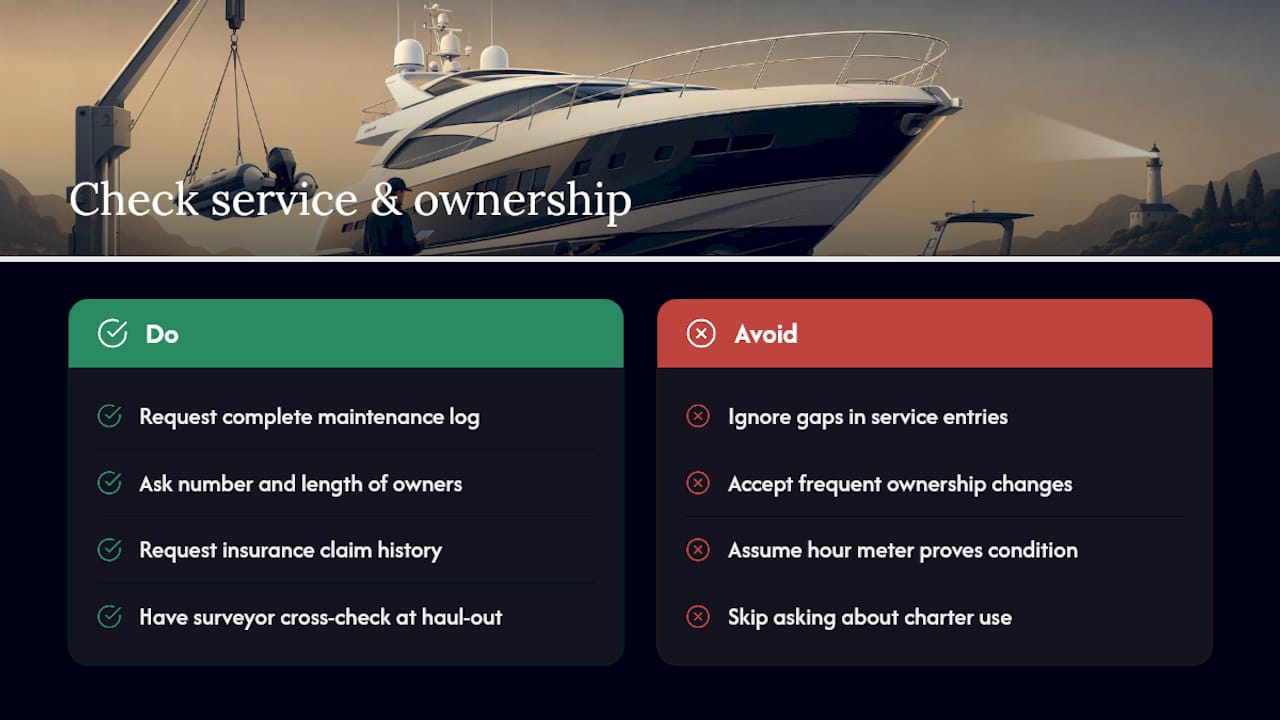
Failing to Check the Yacht’s Service History and Ownership Record
A yacht’s paper trail tells you more than a sea trial ever will, and skipping it is one of the quieter mistakes buyers make.
Every yacht should come with a complete maintenance log: engine hours, oil analysis reports, haul-out dates, and any warranty work performed. Gaps in that record aren’t just inconvenient. They’re a signal. A yacht with three years of missing service entries either had an owner who neglected maintenance or one who’s hiding something the seller doesn’t want surfaced during survey.
Previous ownership history matters just as much as maintenance records. How many owners has the yacht had, and how long did each one keep it? A yacht that’s changed hands four times in six years often has an underlying issue that keeps surfacing after each new owner discovers it. Ask specifically whether the yacht was ever used commercially or for charter, since charter use accelerates wear on systems well beyond what the hour meter suggests.
Insurance claim history is worth requesting directly, since it often reveals prior groundings, storm damage, or fire incidents that never made it into a casual conversation with the seller. A structural repair completed years ago can still affect resale value and insurability today, even when it’s invisible to the eye.
Your surveyor should cross-reference the physical evidence against the paper record during the haul-out. Discrepancies between what the logbook claims and what the surveyor actually finds are one of the clearest warning signs in the entire buying process.
Neglecting to Assess Depreciation and Future Value
Yachts depreciate differently than cars, and buyers who don’t understand the curve often overpay for the wrong stage of a yacht’s life.
New yachts typically see their steepest depreciation in the first three to five years, similar to most large capital assets. After that initial drop, well-maintained yachts from reputable builders tend to plateau, holding value more predictably as long as maintenance stays current and the model remains desirable in the resale market. Buying a yacht at year two, when depreciation has already absorbed most of its steepest hit, can be a far better financial position than buying brand new.
Builder reputation drives long-term value more than almost any other factor. Some manufacturers maintain strong resale demand decades after a model launches, while others see values fall sharply once a builder exits the market or discontinues parts support. Before buying, research whether the builder is still active and whether replacement parts remain readily available.
Market trends shift too. Demand for certain hull types, propulsion systems, or size classes moves with fuel costs, charter market trends, and even generational taste changes among buyers. A yacht that’s fashionable today may sit longer on the market in five years if the category falls out of favor. Buying with at least a passing thought toward exit timing, even if you plan to own for a decade, protects you from surprises when you eventually decide to sell.
Overlooking Operational Costs Beyond the Purchase Price
Crew training and certification costs surprise almost every first-time buyer who assumes hiring a captain is the end of the personnel budget.
Professional crew need current certifications, and those certifications require renewal, ongoing training, and sometimes travel to complete. A captain’s license, STCW safety training, and specialized certifications for larger vessels all carry recurring costs that a first-time buyer rarely budgets for separately from base salary. Add benefits, travel between rotations, and housing during off-charter periods, and crew costs alone can rival the fuel budget on a mid-size yacht.
Beyond crew, ongoing operational costs include software licensing for navigation and safety systems, satellite communication subscriptions, and provisioning that scales with how often you actually use the yacht rather than how often you planned to. A yacht that sits unused for months still needs systems run periodically, batteries maintained, and engines exercised, all of which cost money whether you’re aboard or not.
Our crew cost guide breaks down realistic salary ranges and staffing structures by yacht size, and it’s worth reviewing before you finalize any operating budget. Buyers who treat crew as a line item rather than a full operational category consistently underbudget by tens of thousands annually.
Not Planning for Seasonal and Weather Conditions
A yacht bought for Mediterranean summers behaves very differently in the Pacific Northwest winter, and buyers who don’t map their actual usage calendar against real weather patterns end up disappointed or expensively retrofitting later.
Hurricane season affects both usability and insurance premiums across much of the Atlantic and Gulf coasts, and insurers often require specific haul-out or relocation plans during those months. If your intended homeport sits in a hurricane-prone region, factor that into your annual calendar and your insurance costs from the outset, not as an afterthought once your policy renews.
Winterization is another cost most first-time buyers in northern climates underestimate. Engines, plumbing, and HVAC systems all need proper lay-up procedures if the yacht won’t be used through cold months, and skipping that process risks frozen and cracked components that cost far more to repair than the winterization would have cost to perform.
Even in warmer climates, seasonal humidity and salt exposure accelerate wear on electronics and upholstery differently depending on where the yacht is berthed. A yacht kept in a covered slip in a dry climate ages very differently than one moored open-air in a humid, salt-heavy environment. Ask your broker or surveyor about regional wear patterns typical for the yacht’s specific berth history before you finalize your offer.
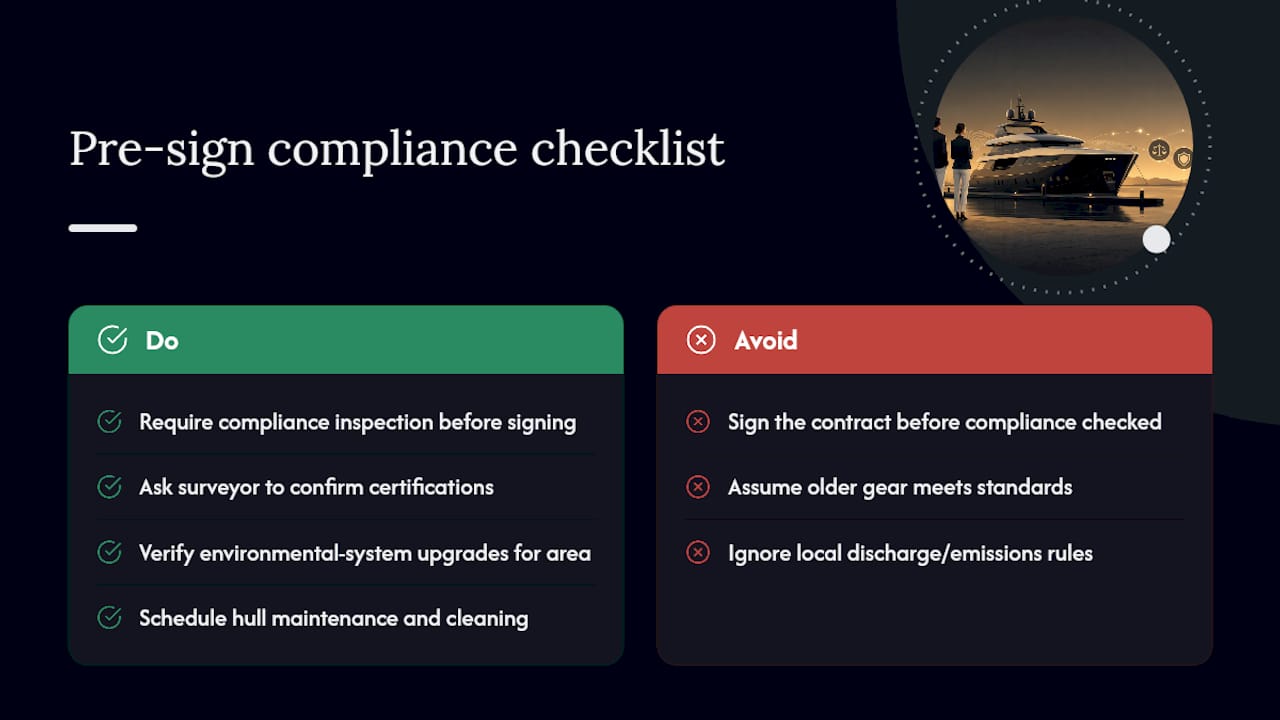
Skipping Safety and Environmental Compliance Checks
A yacht that fails a compliance inspection after you’ve already closed becomes your problem, not the seller’s, which is exactly why this check belongs before signing, not after.
Safety equipment requirements vary by vessel size and intended use, covering life rafts, fire suppression systems, bilge pumps, and emergency locator beacons. An older yacht may carry equipment that technically still functions but no longer meets current certification standards, and bringing it up to date can run into real money depending on what’s outdated.
Environmental regulations have tightened steadily, particularly around wastewater discharge, fuel systems, and emissions in certain cruising zones. A yacht that hasn’t been updated to meet current discharge standards for the waters you intend to cruise may face restrictions on where it can legally operate, which matters enormously if your mission profile includes specific coastal regions with stricter local rules.
Ask your surveyor to specifically confirm current compliance status for safety equipment certifications and environmental systems as part of the standard inspection, since a general condition survey doesn’t always flag regulatory gaps on its own. Regular hull maintenance also plays into environmental compliance in ways buyers overlook. Keeping the hull clean reduces drag and fuel consumption, and proper cleaning timing and technique can extend the interval between haul-outs while keeping the yacht running efficiently.
A Note on Buyer Psychology and Knowing When to Walk Away
There’s a specific moment during almost every yacht viewing when a buyer stops evaluating and starts justifying. The teak looks warm in the afternoon light, the broker mentions another interested party, and suddenly a soft survey report gets rationalized instead of respected.
The fix is procedural, not willpower. Treat viewings as the last step in your process, never the first, and hold every finding against a simple written checklist rather than a feeling. If the evidence is weak, walk. Another yacht always comes along. The structure-first approach exists precisely because desire is a terrible negotiator.
— Jason
How Yachts-bysteve Helps You Buy the Right Yacht the First Time
Every mistake covered here shares one root cause: buying alone, on instinct, without a structured process behind it. Yachts-bysteve exists to be the buyer-side team this guide describes, built from over 25 years in global yachting and manufacturing under Steve Doyle’s direct guidance.
We coordinate the pieces that first-time buyers most often skip: matching your mission profile to real listings across Sunreef catamarans, flybridge cruisers, and top motoryachts, arranging qualified survey and haul-out inspections, and walking you through paperwork before you’re staring down a deposit deadline. If you’re actively searching or considering a purchase in Florida, New York, or Boston, our Premier Yacht Broker Services are built specifically around buyer representation from first call to final handover.
The next step is simple: reach out through the Yachts-bysteve landing page and start with a needs conversation. We’ll help you build your mission brief and introduce your survey and legal contacts before you make an offer, not after.
Sources
- How to Buy a Yacht: Step-by-Step Guide (2026) | Boat Tomorrow
- Why yacht buying should not be fun | SuperyachtNews
- How to Buy a Yacht: A Step-by-Step Buyer’s Guide
FAQ
What Is the 10 Percent Rule for Yachts?
The commonly cited rule of thumb budgets annual operating costs at roughly 10 to 15 percent of the yacht’s hull value every year. Crewed yachts frequently exceed that range once salaries, insurance, and berthing are factored in.
What Is the 12 Person Rule on a Yacht?
This typically refers to commercial passenger limits under maritime safety regulations, where vessels carrying above a specific passenger threshold face stricter certification and crew requirements than private or smaller charter yachts. The exact threshold and requirements depend on the yacht’s flag state and intended use, so confirm the applicable rule with your maritime attorney before finalizing any charter plans.
Are Boat Prices Going Down in 2026?
Pricing varies significantly by segment, builder, and region, so there’s no single answer across the entire market. Reviewing recent comparable sales and time-on-market data for your specific yacht type and size gives a far more reliable read than any general market headline.
Why Don’t You Wear Shoes on a Yacht?
Shoes, especially those with hard soles or dark rubber, can scuff or mark teak decks and other finished surfaces that are expensive to refinish. Most crews ask guests to go barefoot or wear soft, non-marking deck shoes specifically to protect those finishes between refits.
Recommended
Featured Listings

2028 Columbus Yachts
$22,900,008
137
Ancona

2012 Benetti PATIENCE
$10,975,000
132
Fort Lauderdale Florida

2028 Kingship Kingship
$20,350,000
125

2024 Silver Yachts
$25,400,000
117

2009 Hargrave BRANDI WINE
$2,500,000
114
Fort Lauderdale Florida

2028 Extra Yachts
$20,350,000
100
Ancona

2028 Alpha
$12,100,000
100
Ft Lauderdale Florida

2028 Extra Yachts Extra 96
$9,495,000
96
Ancona

2021 Sanlorenzo GATSBY
$6,795,000
96
Fort Lauderdale Florida

2028 Kingship
$11,990,000
90

2028 Alpha
$9,894,500
90
Fano

2023 Azimut COMPASS
$7,950,000
88
Miami Beach Florida

1999 Northern Marine OFF LINE
$2,495,000
84
Ft Lauderdale Florida

2013 Pershing DOROTHY ANN
$1,375,000
82
Fort Lauderdale Florida

1997 Ferretti Yachts
$825,000
80
La Paz

2008 Princess Yachts OCARALIA
$1,095,000
75
Charleston South Carolina

2014 Sunseeker
$1,400,000
68
New York New York

2024 Fairline
$2,750,000
68
Ft. Lauderdale Florida

2019 Vanquish Yachts IMPULSIVE
$1,799,000
58
Miami Beach Florida

2021 Ferretti Yachts HAVEN
$1,595,000
57
Fort Lauderdale Florida

2025 Formula BREAKTHROUGH III
$1,895,000
53
Miami Beach Florida

2023 Fairline
$900,000
45
Fort Lauderdale Florida

2012 Zeelander Mississippi Queen
$575,000
44
West Palm Beach Florida
2028 Columbus Yachts 137'
$22,900,008
2012 Benetti 132'
$10,975,000
2028 Kingship 125'
$20,350,000
2024 Silver Yachts 117'
$25,400,000
2009 Hargrave 114'
$2,500,000
2028 Extra Yachts 100'
$20,350,000
2028 Alpha 100'
$12,100,000
2028 Extra Yachts 96'
$9,495,000
2021 Sanlorenzo 96'
$6,795,000
2028 Kingship 90'
$11,990,000
2028 Alpha 90'
$9,894,500
2023 Azimut 88'
$7,950,000
1999 Northern Marine 84'
$2,495,000
2013 Pershing 82'
$1,375,000
1997 Ferretti Yachts 80'
$825,000
2008 Princess Yachts 75'
$1,095,000
2014 Sunseeker 68'
$1,400,000
2024 Fairline 68'
$2,750,000
2019 Vanquish Yachts 58'
$1,799,000
2021 Ferretti Yachts 57'
$1,595,000
2025 Formula 53'
$1,895,000
2023 Fairline 45'
$900,000
2012 Zeelander 44'
$575,000