

A yacht closing checklist is a step-by-step guide that organizes every critical action from signed contract to ownership transfer, covering legal documents, escrow payments, inspections, and insurance. Without one, buyers and sellers risk costly delays, title disputes, or missing coverage gaps at the moment of delivery. The industry term for this process is “closing,” and it involves a closing agent, escrow account, and a precise sequence of document exchanges. Yachts-bysteve has guided clients through this process across dozens of transactions, and the pattern is always the same: the deals that close without drama are the ones where every box was checked before closing day arrived.
What documents and paperwork must be prepared before closing?
The foundation of any yacht closing checklist is clean, verified paperwork. Typical closing documents include the Purchase and Sale Agreement, Bill of Sale, Closing Statement, and a Vessel Acceptance Acknowledgment. If the vessel is financed, lender documents join that stack as well. Signature of these documents finalizes ownership transfer and payment, so every page must be reviewed before closing day, not during it.
Ownership verification is non-negotiable. The seller must prove clear title and the absence of any liens against the vessel. Federal documentation applies to vessels of five net tons and above, requiring a Certificate of Documentation rather than a state title. Smaller vessels may use a state title instead, depending on the jurisdiction. A closing agent handles the coordination of these documents and confirms that all parties have signed correctly.
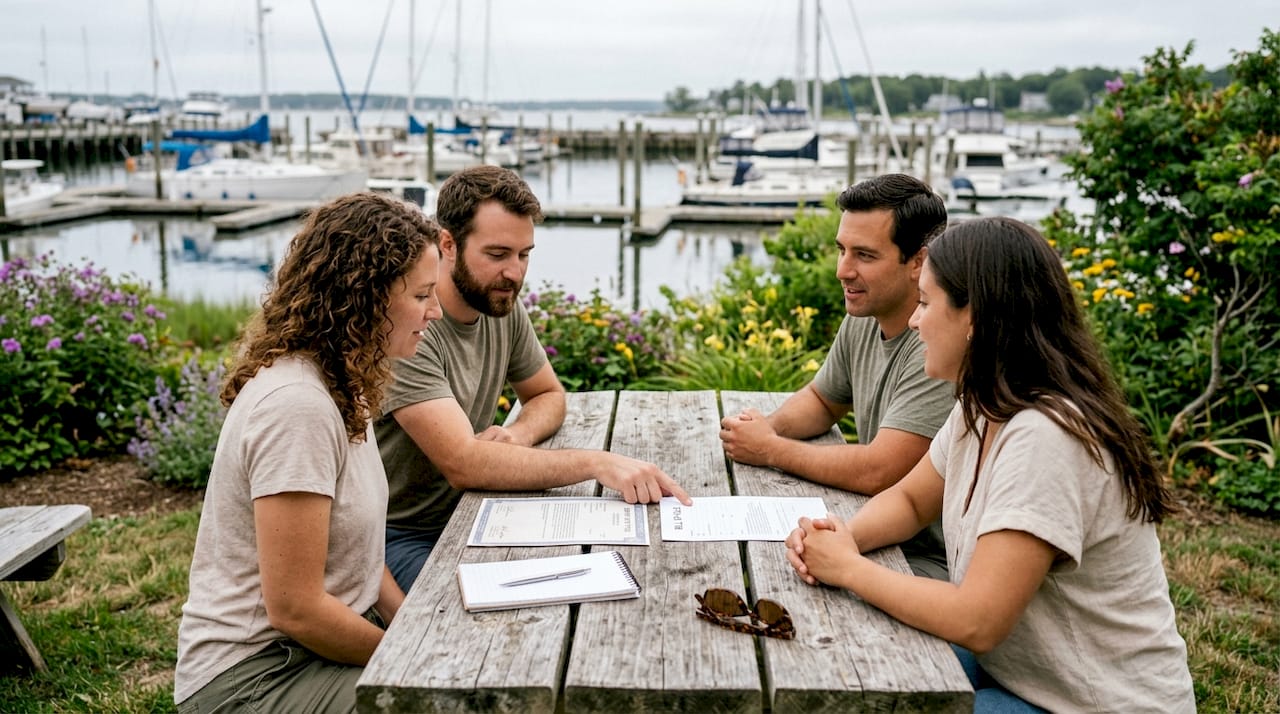
The escrow account holds the buyer’s deposit from the time of the written offer through closing. Funds move through brokerage escrow with the buyer’s payment received before closing and the seller’s net proceeds disbursed at closing. This protects both parties and gives the closing agent a clear record of the transaction.
Here is a document checklist to verify before closing day:
- Purchase and Sale Agreement (fully executed)
- Bill of Sale (signed by seller, notarized where required)
- Closing Statement (itemizing all costs and disbursements)
- Certificate of Documentation or state title (confirmed lien-free)
- Vessel Acceptance Acknowledgment (signed by buyer after final walkthrough)
- Lender documents (if financed)
- Escrow deposit confirmation and wire instructions
Pro Tip: Request a lien search from a marine documentation service at least two weeks before closing. Liens from previous owners can surface late and delay the entire transaction.
How do insurance, financing, and inspections fit into the closing process?
These three prerequisites must be completed before closing day. Skipping any one of them can halt the transaction entirely. Think of them as the three legs of a stool: remove one and the whole thing tips.
Insurance must be in place before the buyer takes ownership, effective the day of delivery. Many insurers require a copy of the recent survey to issue coverage, which makes scheduling the survey early a practical necessity, not just a formality. Without an insurance binder, most closings cannot proceed. Marine insurers treat the survey report as their primary risk assessment tool, so a survey completed months before closing may need to be updated.
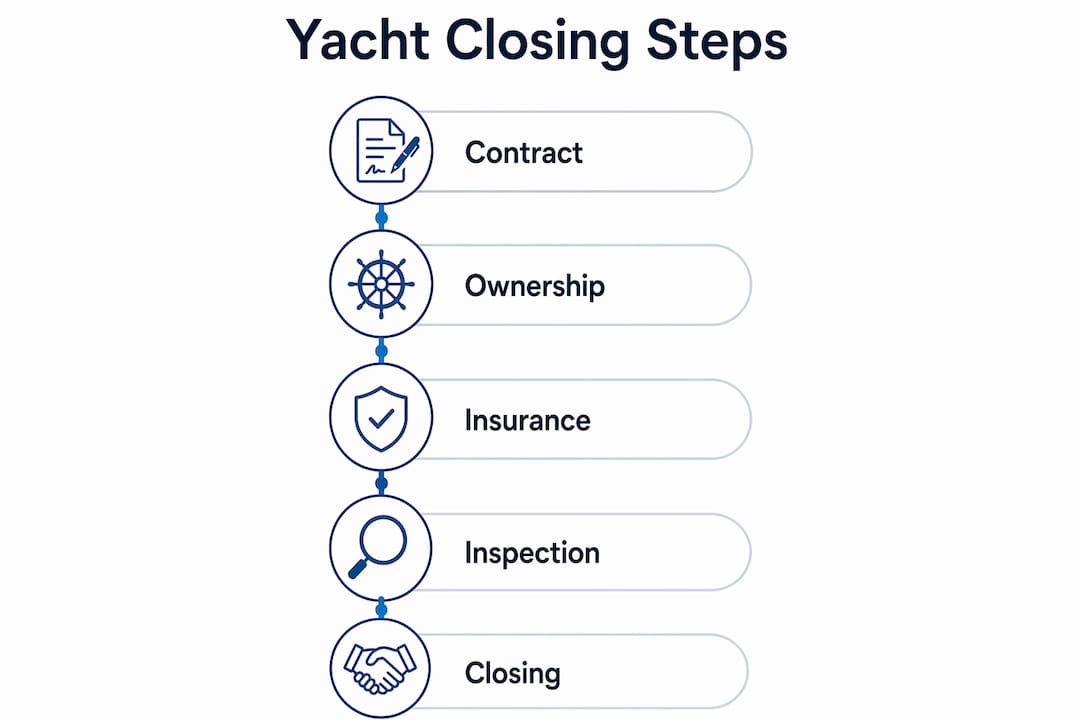
The yacht survey and sea trial are the buyer’s best protection. Survey findings categorize issues into safety and structural, functional, and cosmetic, each carrying different weight in price negotiation. Offers are typically made contingent on a satisfactory survey and sea trial, giving the buyer the right to renegotiate or walk away. A qualified marine surveyor, certified through organizations like the Society of Accredited Marine Surveyors (SAMS) or the National Association of Marine Surveyors (NAMS), should conduct the inspection. For a thorough walkthrough of this step, the yacht inspection process guide from Yachts-bysteve covers every stage in detail.
Marine lenders require recent tax returns, personal financial statements, the survey report, and an insurance binder for financing approval. The lender also handles lien recording as part of closing if the vessel is financed. Buyers using financing should submit their loan application well before the target closing date, as lender review timelines vary and can add weeks to the process.
Prerequisites to confirm before closing:
- Yacht survey completed and report delivered
- Sea trial conducted and accepted
- Insurance binder issued, effective at delivery date
- Financing approved and lender documents prepared
- Escrow deposit confirmed and wire instructions verified
Pro Tip: Schedule the survey and sea trial as early as the Purchase and Sale Agreement allows. Experts emphasize that early survey scheduling is the single most effective way to keep the closing timeline on track.
What does the closing day checklist look like for buyers and sellers?
Closing day has a defined sequence. Deviating from it creates confusion and, occasionally, legal exposure. Whether the closing is conducted in person or remotely, the steps are the same.
Closings are conducted in person or remotely, with remote closings growing in frequency due to geographic distance between parties. Remote digital closings work well when all documents are prepared in advance and a trusted closing agent coordinates the exchange. In-person closings allow for immediate resolution of any last-minute questions.
Here is the closing day sequence:
- Final walkthrough. A final walkthrough on closing day is standard practice, especially if time has passed since the survey. Confirm the vessel’s condition matches what was agreed upon.
- Confirm funds. The buyer verifies that the wire transfer has been sent to escrow. The closing agent confirms receipt before any documents are signed.
- Sign and exchange documents. Both parties sign the Bill of Sale, Closing Statement, and Vessel Acceptance Acknowledgment. Lender documents are signed if applicable.
- Hand over keys, codes, and remotes. The seller transfers all access items, including dock codes, engine keys, and any remote controls for onboard systems.
- Activate and cancel insurance. The buyer confirms insurance coverage is active. Sellers must cancel insurance after closing to avoid paying premiums on a vessel they no longer own.
- Notify the marina. Both parties inform the marina of the ownership change so slip records and billing are updated promptly.
- Update registration. The buyer arranges for registration or documentation transfer with the appropriate federal or state authority.
| Closing Day Task | Responsible Party |
|---|---|
| Final walkthrough | Buyer (with seller present) |
| Wire transfer to escrow | Buyer |
| Sign Bill of Sale and Closing Statement | Both parties |
| Hand over keys and access codes | Seller |
| Activate insurance coverage | Buyer |
| Cancel existing insurance | Seller |
| Notify marina of ownership change | Both parties |
What closing costs should buyers and sellers expect?
Closing costs in yacht brokerage are generally modest compared to real estate, typically limited to documentation fees, state taxes, and lender-required charges. That said, “modest” is relative when the vessel is valued in the millions. Knowing what to expect prevents the unpleasant surprise of a larger-than-anticipated closing statement.
Florida, one of the most active yacht transaction states in the country, collects state sales tax through the closing agent if delivery occurs locally. That tax is often capped at $18,000 as of mid-2026. This cap makes Florida a favorable delivery location for high-value transactions. For detailed examples of what buyers typically pay, the yacht closing costs guide from Yachts-bysteve breaks down each line item clearly.
Common closing costs to budget for:
- State sales tax (varies by state; Florida caps at $18,000)
- Documentation or title transfer fees
- Brokerage escrow service fees
- Marine survey and sea trial costs (paid before closing)
- Lender closing charges (if financed)
- Insurance binder premium (first payment due at or before closing)
The size and type of the vessel affect several of these costs. A 100-foot motor yacht carries different documentation fees than a 45-foot sailing vessel. Confirm every cost in writing before signing the Closing Statement, and ask the closing agent to walk through each line item.
Key Takeaways
A complete yacht closing checklist covering documents, insurance, inspections, and closing day tasks is the most reliable way to protect both buyer and seller throughout the transaction.
| Point | Details |
|---|---|
| Verify documents early | Confirm lien-free title, Bill of Sale, and Certificate of Documentation before closing day. |
| Schedule survey and insurance together | Insurers require the survey report to issue a binder, so both must be arranged in sequence. |
| Follow the closing day sequence | Final walkthrough, fund confirmation, document signing, and key handover must happen in order. |
| Budget for state-specific taxes | Florida caps sales tax at $18,000, but costs vary by state and vessel size. |
| Notify marina and update registration | Both parties must update slip records and registration immediately after closing. |
What I’ve learned from watching closings go sideways
The most common mistake I see is not the one you’d expect. Buyers rarely skip the survey. What they skip is scheduling it early enough. The survey report is the key that unlocks the insurance binder, and the insurance binder is what the lender and closing agent need to proceed. When the survey is booked too late, the entire closing timeline compresses, and everyone feels the pressure.
The second pattern I’ve noticed is sellers underestimating the final walkthrough. Some sellers treat it as a formality and resist it. The reality is that a final walkthrough protects the seller just as much as the buyer. It creates a documented moment of acceptance, which limits disputes about vessel condition after the transaction closes.
Remote closings have improved considerably. When all documents are prepared in advance and the closing agent is experienced with digital coordination, a remote closing can be cleaner than an in-person one. The key is preparation, not proximity. I’ve seen in-person closings fall apart because one party showed up without a required document, while remote closings completed without a single issue because everything was organized days in advance.
The checklist is not bureaucracy. It is the structure that lets both parties walk away with confidence. Every item on it exists because someone, somewhere, learned the hard way that skipping it costs more than the time it takes to complete it.
— Jason
How Yachts-bysteve supports your closing process
Closing a yacht sale involves more moving parts than most buyers and sellers anticipate. Yachts-bysteve works alongside clients at every stage, from the initial offer through escrow management, survey coordination, and final document exchange. The team’s familiarity with closing agents, marine lenders, and documentation services means fewer surprises and faster resolutions when questions arise. Whether you are buying a luxury yacht for the first time or selling a vessel you’ve owned for years, having an experienced brokerage in your corner changes the experience entirely. Contact Yachts-bysteve to discuss your transaction and get a clear picture of what your closing process will look like from start to finish.
FAQ
What is a yacht closing checklist?
A yacht closing checklist is a structured list of legal, financial, and logistical steps that both buyer and seller must complete to transfer vessel ownership. It covers documents, escrow, insurance, survey, and closing day tasks.
How long does the yacht closing process take?
The timeline varies, but most closings take two to four weeks from signed Purchase and Sale Agreement to ownership transfer. Financing and survey scheduling are the most common sources of delay.
Do I need a closing agent for a yacht sale?
A closing agent is standard practice in yacht brokerage transactions. The agent handles document coordination, escrow disbursement, and lien verification, protecting both parties throughout the process.
What documents are required to close a yacht sale?
Required documents include the Bill of Sale, Closing Statement, Vessel Acceptance Acknowledgment, and either a Certificate of Documentation or state title. Financed transactions also require lender documents.
Can a yacht closing be done remotely?
Yes. Remote closings are increasingly common and work well when all documents are prepared in advance and a qualified closing agent coordinates the exchange between parties.
Recommended
Featured Listings

2028 Columbus Yachts
$22,900,008
137
Ancona

2012 Benetti PATIENCE
$10,975,000
132
Fort Lauderdale Florida

2028 Kingship Kingship
$20,350,000
125

2024 Silver Yachts
$25,400,000
117

2009 Hargrave BRANDI WINE
$2,500,000
114
Fort Lauderdale Florida

2028 Extra Yachts
$20,350,000
100
Ancona

2028 Alpha
$12,100,000
100
Ft Lauderdale Florida

2028 Extra Yachts Extra 96
$9,495,000
96
Ancona

2021 Sanlorenzo GATSBY
$6,795,000
96
Fort Lauderdale Florida

2028 Kingship
$11,990,000
90

2028 Alpha
$9,894,500
90
Fano

2023 Azimut COMPASS
$7,950,000
88
Miami Beach Florida

1999 Northern Marine OFF LINE
$2,495,000
84
Ft Lauderdale Florida

2013 Pershing DOROTHY ANN
$1,375,000
82
Fort Lauderdale Florida

1997 Ferretti Yachts
$825,000
80
La Paz

2008 Princess Yachts OCARALIA
$1,095,000
75
Charleston South Carolina

2014 Sunseeker
$1,400,000
68
New York New York

2024 Fairline
$2,750,000
68
Ft. Lauderdale Florida

2019 Vanquish Yachts IMPULSIVE
$1,799,000
58
Miami Beach Florida

2021 Ferretti Yachts HAVEN
$1,595,000
57
Fort Lauderdale Florida

2025 Formula BREAKTHROUGH III
$1,895,000
53
Miami Beach Florida

2023 Fairline
$900,000
45
Fort Lauderdale Florida

2012 Zeelander Mississippi Queen
$575,000
44
West Palm Beach Florida
2028 Columbus Yachts 137'
$22,900,008
2012 Benetti 132'
$10,975,000
2028 Kingship 125'
$20,350,000
2024 Silver Yachts 117'
$25,400,000
2009 Hargrave 114'
$2,500,000
2028 Extra Yachts 100'
$20,350,000
2028 Alpha 100'
$12,100,000
2028 Extra Yachts 96'
$9,495,000
2021 Sanlorenzo 96'
$6,795,000
2028 Kingship 90'
$11,990,000
2028 Alpha 90'
$9,894,500
2023 Azimut 88'
$7,950,000
1999 Northern Marine 84'
$2,495,000
2013 Pershing 82'
$1,375,000
1997 Ferretti Yachts 80'
$825,000
2008 Princess Yachts 75'
$1,095,000
2014 Sunseeker 68'
$1,400,000
2024 Fairline 68'
$2,750,000
2019 Vanquish Yachts 58'
$1,799,000
2021 Ferretti Yachts 57'
$1,595,000
2025 Formula 53'
$1,895,000
2023 Fairline 45'
$900,000
2012 Zeelander 44'
$575,000