

Budget €250,000 to €450,000 a year for a full-time crew on a 24 to 30 meter yacht, and well past €1.3 million on anything over 60 meters. The number that actually decides your bracket isn’t salary. It’s headcount, and crew payroll typically runs 30 to 40% of your total annual running costs. Base pay is only the floor. The real figure sits 15 to 20% higher once you count everything an owner is legally and practically on the hook for.
TL;DR:
- The total yearly crew cost for a 50-meter yacht ranges from about €880,000 to €900,000, including salaries, social charges, and additional expenses.
- Crew headcount increases gradually with yacht size, but hiring senior staff like chief engineers or interior managers causes significant jumps in staffing costs.
- Industry-standard salaries vary by role and certification, with captains earning between $8,000 and $18,000 monthly, and crew costs heavily influenced by vessel size and qualifications.
- Hidden costs such as social charges, crew insurance, travel, training, and recruitment add roughly 20 to 25 percent to base salaries, significantly raising total expenses.
- Budgeting for crew should begin early in yacht selection, prioritizing the right crew size and rotation policies to prevent overspending and ensure service quality.
Table of Contents
- Yacht Crew Cost Starts With Headcount, Not Salary
- Yacht Crew Pay Rates by Role
- The Hidden Costs That Turn Salary Into Real Yacht Crew Cost
- What a Full Year of Crew Actually Costs by Yacht Size
- How to Budget for Crew and Where You Can Trim
- Overview: Why Crew Cost Belongs in Your Purchase Decision
- The Editorial Take: Crew Cost Should Drive the Purchase, Not Follow It
- Sources
Yacht Crew Cost Starts With Headcount, Not Salary
The fastest way to size your crew budget is to work backward from length overall, because headcount doesn’t climb in a straight line as yachts get bigger. A 30 meter yacht might run comfortably with four crew. Add ten meters and you’re not adding one more deckhand. You’re adding a whole new tier of seniority, a second engineer, and often a dedicated interior department that didn’t exist before.
Here’s roughly how crew size tracks with LOA:
- 24 to 30m: 3 to 5 crew, typically a captain, one or two deckhands, and a stew who often doubles as cook
- 30 to 40m: 5 to 8 crew, adding a chief engineer and a distinct chef role
- 40 to 50m: 8 to 12 crew, with a chief officer, second engineer, and a small dedicated interior team
- 50 to 60m: 12 to 16 crew, full departmental structure across deck, engineering, and interior
- 60m and above: 16 to 25+ crew, often split across rotation with a second command team
Charter yachts skew higher at every size band because guest service demands more stewards and a stronger galley team than a private-use yacht ever needs. Rotational crewing, where senior officers work a set number of weeks on and off, used to be reserved for expedition and superyachts over 70 meters. It’s now creeping down into the 45 to 50 meter range as owners compete for experienced captains and engineers who simply won’t take a year-round contract anymore.
Yacht Crew Pay Rates by Role
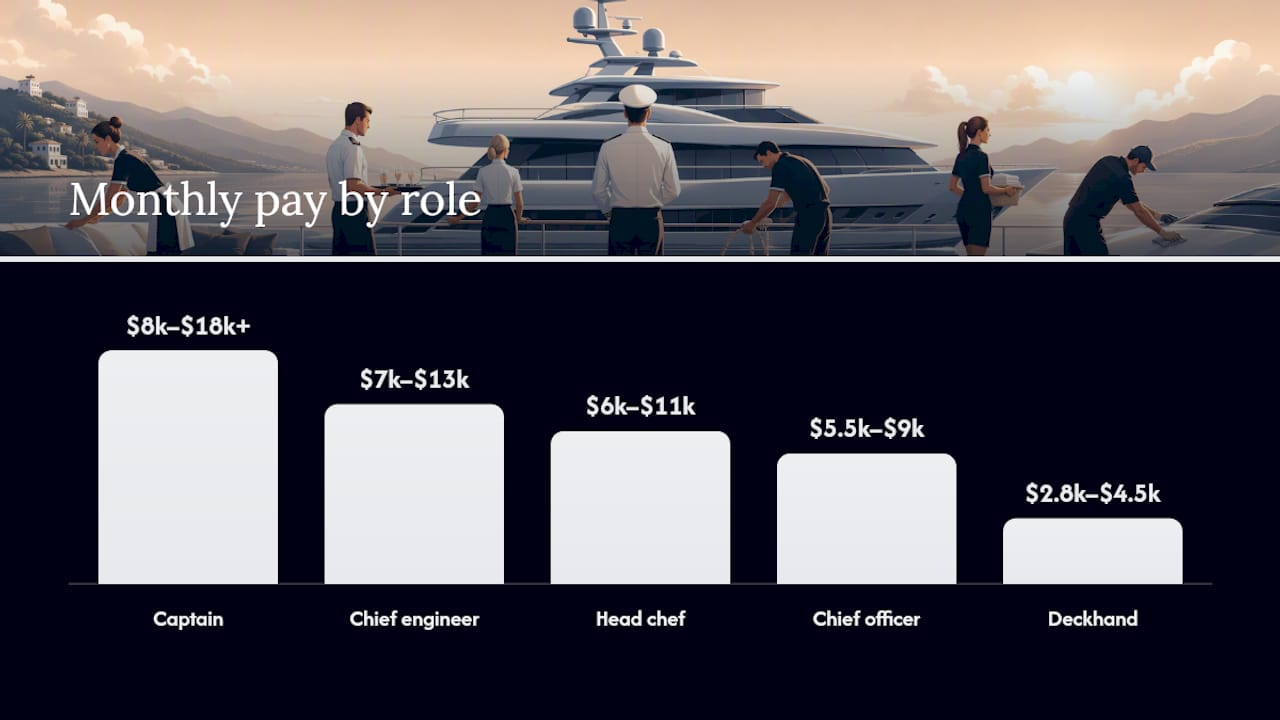
Once you know your headcount, the next question is what each seat actually costs. Salary bands vary by vessel size, certification level, and whether the role sits on a private or charter program, but here’s a realistic 2026 planning range by position:
- Captain: $8,000 to $18,000+ per month, scaling sharply with tonnage and license class
- Chief engineer: $7,000 to $13,000 per month
- Chief officer: $5,500 to $9,000 per month
- Head chef: $6,000 to $11,000 per month
- Chief stewardess: $4,500 to $7,500 per month
- Bosun: $4,000 to $6,500 per month
- Deckhand: $2,800 to $4,500 per month
- Stewardess: $3,000 to $5,000 per month
Pro Tip: Certification moves pay more than experience alone does. An engineer with a Y3 or Y4 ticket commands meaningfully more than one working toward it, and captains with an unlimited MCA license out-earn those capped at 3,000 gross tons by a wide margin.
Role-by-role figures like these scale materially with vessel size and the crew’s certification level, which is why two 45 meter yachts with identical layouts can carry very different payrolls depending on who’s aboard. Most contracts run in US dollars or euros depending on flag and management company, and charter gratuities, typically 5 to 10% of the charter fee, get distributed to crew separately from salary. That’s good for retention, but it means an owner running a busy charter calendar needs to budget gratuity float into cashflow, not just payroll.
Salary growth across the industry has leveled out after the sharp 2021 to 2022 surge, so current survey data is the safer reference point than pay figures from a few years back. If you’re building a captain’s offer today, lean on a fresh salary guide, not a number a broker quoted you in 2022.
The Hidden Costs That Turn Salary Into Real Yacht Crew Cost
Base salary is the visible number. It’s also only about 75 to 80% of the true cost of employing someone aboard. Here’s what fills the remaining gap:
- Employer social charges. Depending on flag state and payroll structure, expect roughly 15 to 20% on top of base salary for statutory contributions and related employer costs.
- Crew insurance and medical cover. Budget several hundred to a couple thousand dollars per head annually, layered alongside your P&I coverage rather than replacing it.
- Travel and repatriation. Flights home, crew changes, and contractual repatriation obligations can add tens of thousands per season on a busy rotation schedule.
- Certification renewals. STCW refreshers run on a five year cycle and ENG1 medicals need renewing annually, so calendar these across your whole crew to avoid a lump-sum year.
- Recruitment and turnover. Replacing a crew member typically costs about one month’s salary plus travel and a familiarization period, and repeated churn quietly erodes a budget faster than almost anything else.
- Uniforms, provisioning, and training. Smaller line items individually, but they add up to a meaningful slice once totaled across a full crew.
Rotational crewing, however appealing for retention, carries its own math problem: you’re often paying two qualified people to cover one role, which pushes senior payroll up 40 to 60% versus a single year-round contract for that position.
Compliance isn’t optional here. STCW and the Maritime Labour Convention set minimum requirements for employment agreements, medical fitness, and training that owners must document and fund, and 2025 STCW amendments added fatigue-management competency to the list. These aren’t costs you can budget around. They’re the floor.
What a Full Year of Crew Actually Costs by Yacht Size
The role and hidden-cost math rolls up into planning ranges that hold reasonably steady across most private and light-charter programs:
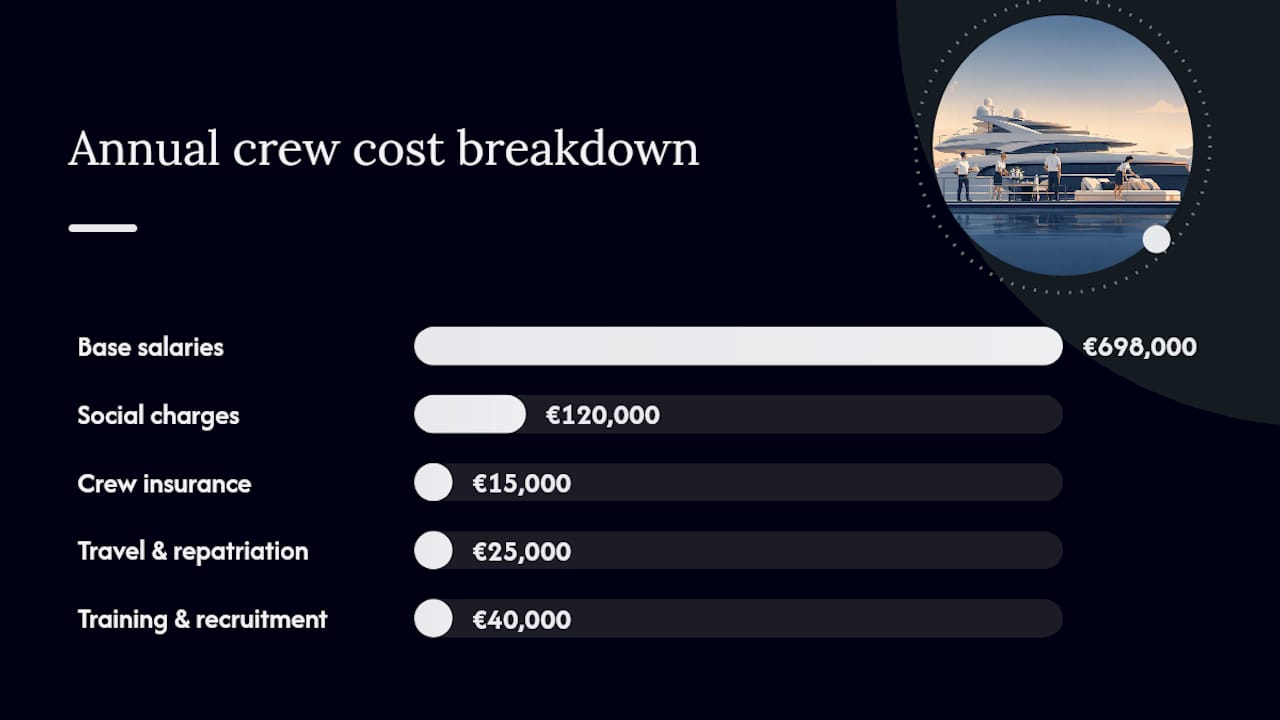
A worked example makes the arithmetic real. On a 50 meter charter yacht running a 10 person crew, base salaries alone typically total around €698,000 a year. Layer on employer social charges near €120,000, crew insurance around €15,000, travel and repatriation near €25,000, and training and recruitment contingency of roughly €40,000, and the total lands somewhere between €880,000 and €900,000.
Pro Tip: Flag state changes this math more than most owners expect. Certain flags carry lighter statutory employer obligations than others, so ask your management company to model the same crew under two flag options before you commit.
How to Budget for Crew and Where You Can Trim
Before you sign a management agreement, ask three direct questions: How is payroll structured, gross or net of employer charges? Are gratuities pooled or distributed by role? What’s the agency’s placement fee if a crew member leaves within the first year?
The honest cost-control levers that don’t compromise safety or service:
- Match crew size to your actual usage pattern, not the yacht’s maximum charter capacity
- Invest in retention bonuses and training. Losing a chief engineer twice in a season costs more than keeping one happy
- Consider local hiring for entry-level deck and interior roles where cruising grounds allow it
- Weigh rotation carefully. It solves a retention problem but adds real payroll cost, so it should be a deliberate choice, not a default
Watch for management contracts that quote a “crew budget” excluding social charges, repatriation, or recruitment fees. That’s not a lower cost. It’s a hidden one, and you’ll meet it again in month three of ownership. A gelcoat maintenance partner like Diamond Brite’s protection guidance is a useful reminder that crew aren’t the only budget line owners underestimate. Hull care carries its own recurring cost that deserves the same scrutiny.
Overview: Why Crew Cost Belongs in Your Purchase Decision
Overview: crew cost isn’t an afterthought you sort out after closing. It’s a number that should shape which yacht you buy in the first place, because a boat with the wrong layout for its intended crew size will always run over budget. Crew quality and size directly affect guest experience and eventual resale value, so getting it right from day one protects both your lifestyle and your investment.
Yachts by Steve builds crew-cost modeling into the buying conversation early, not after the survey:
- Sizing realistic headcount against your intended usage, private, light charter, or full charter program
- Vetting management companies on payroll transparency and rotation policy before you sign
- Checking contract compliance against MLC and STCW obligations so nothing surprises you in year one
- Walking new owners through onboarding so the first season runs smoothly, not reactively
The Editorial Take: Crew Cost Should Drive the Purchase, Not Follow It
The conventional advice treats crew cost as a line item to solve after you’ve fallen in love with a boat. That order is backward. If a 55 meter yacht demands a 14 person crew and your usage pattern only justifies eight, you haven’t found a bargain. You’ve found a boat that will bleed money every year you own it, regardless of what you paid for the hull.
What’s overrated in most crew-cost conversations is base salary. What’s underrated is rotation. It looks like a luxury add-on, but on the right size yacht it’s a retention tool that pays for itself by keeping a good captain for five years instead of losing one every eighteen months.
My honest recommendation: model crew cost against your actual usage pattern before you fall in love with a length. The yacht that fits your program, not your ego, is almost always the one that keeps your annual budget where you planned it.
— Jason
Sources
- Superyacht Crew Cost Per Year: Budgeting for a Full-Time Crew | OwlMar Blog
- Superyacht Crew Salary Guide 2026: What to Budget by Position and Yacht Size | Foreland Marine
- Dockwalk Salary Guide
Recommended
Featured Listings

2028 Columbus Yachts
$22,900,008
137
Ancona

2012 Benetti PATIENCE
$10,975,000
132
Fort Lauderdale Florida

2028 Kingship Kingship
$20,350,000
125

2024 Silver Yachts
$25,400,000
117

2009 Hargrave BRANDI WINE
$2,500,000
114
Fort Lauderdale Florida

2028 Extra Yachts
$20,350,000
100
Ancona

2028 Alpha
$12,100,000
100
Ft Lauderdale Florida

2028 Extra Yachts Extra 96
$9,495,000
96
Ancona

2021 Sanlorenzo GATSBY
$6,795,000
96
Fort Lauderdale Florida

2028 Kingship
$11,990,000
90

2028 Alpha
$9,894,500
90
Fano

2023 Azimut COMPASS
$7,950,000
88
Miami Beach Florida

1999 Northern Marine OFF LINE
$2,495,000
84
Ft Lauderdale Florida

2013 Pershing DOROTHY ANN
$1,375,000
82
Fort Lauderdale Florida

1997 Ferretti Yachts
$825,000
80
La Paz

2008 Princess Yachts OCARALIA
$1,095,000
75
Charleston South Carolina

2014 Sunseeker
$1,400,000
68
New York New York

2024 Fairline
$2,750,000
68
Ft. Lauderdale Florida

2019 Vanquish Yachts IMPULSIVE
$1,799,000
58
Miami Beach Florida

2021 Ferretti Yachts HAVEN
$1,595,000
57
Fort Lauderdale Florida

2025 Formula BREAKTHROUGH III
$1,895,000
53
Miami Beach Florida

2023 Fairline
$900,000
45
Fort Lauderdale Florida

2012 Zeelander Mississippi Queen
$575,000
44
West Palm Beach Florida
2028 Columbus Yachts 137'
$22,900,008
2012 Benetti 132'
$10,975,000
2028 Kingship 125'
$20,350,000
2024 Silver Yachts 117'
$25,400,000
2009 Hargrave 114'
$2,500,000
2028 Extra Yachts 100'
$20,350,000
2028 Alpha 100'
$12,100,000
2028 Extra Yachts 96'
$9,495,000
2021 Sanlorenzo 96'
$6,795,000
2028 Kingship 90'
$11,990,000
2028 Alpha 90'
$9,894,500
2023 Azimut 88'
$7,950,000
1999 Northern Marine 84'
$2,495,000
2013 Pershing 82'
$1,375,000
1997 Ferretti Yachts 80'
$825,000
2008 Princess Yachts 75'
$1,095,000
2014 Sunseeker 68'
$1,400,000
2024 Fairline 68'
$2,750,000
2019 Vanquish Yachts 58'
$1,799,000
2021 Ferretti Yachts 57'
$1,595,000
2025 Formula 53'
$1,895,000
2023 Fairline 45'
$900,000
2012 Zeelander 44'
$575,000