

Running a yacht typically costs somewhere between $200 and $2,400 per hour underway, depending entirely on the size of the vessel and its cruising speed. The formula behind every one of those numbers is the same: Cost = Hours Underway × Burn Rate × Fuel Price, with distance divided by speed substituted for hours when you’re planning a specific route.
TL;DR:
- Fuel costs significantly vary with yacht size, from around $60 to over $2,400 per hour, based on burn rate and regional fuel prices.
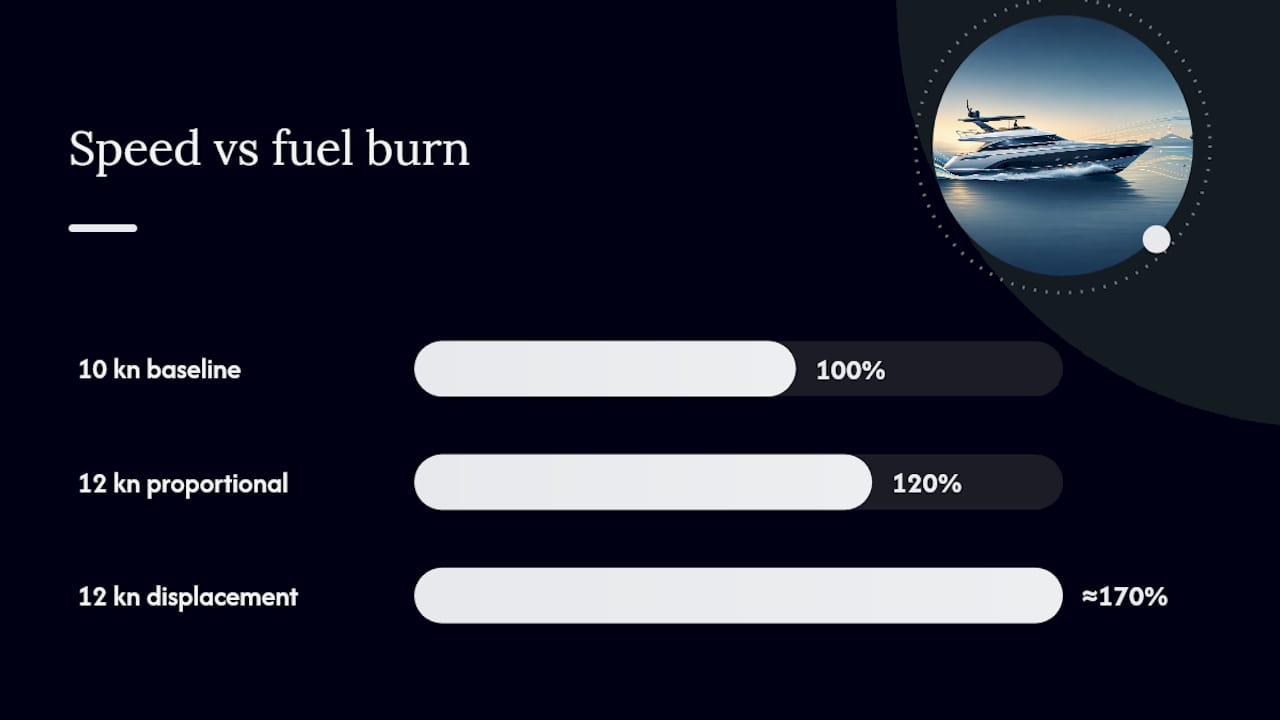
- Speed increases dramatically raise fuel burn because displacement hulls burn roughly three times more fuel when speed rises from 10 to 12 knots.
- Generator fuel can add about 15% to total yearly fuel expenses, especially on yachts with heavy air conditioning or extended anchoring hours.
- Regular maintenance, hull cleaning, propeller efficiency, and strategic fueling can help reduce overall fuel consumption and operating costs.
Table of Contents
- What Is the Formula Behind Yacht Fuel Cost?
- How Much Fuel Do Different Yacht Sizes Burn?
- Why Does Fuel Consumption Vary So Much Between Yachts?
- What About Generator and Tender Fuel?
- How Can You Lower Your Yacht’s Fuel Bill?
- How Yachts by Steve Uses Fuel Numbers to Guide Buyers
- Where to Verify These Numbers Yourself
- Sources
What Is the Formula Behind Yacht Fuel Cost?
The math is simpler than most owners expect, and once you have three numbers, you can price out any trip in about thirty seconds.
Method one, by time: Fuel Cost = Hours Running × Burn Rate (gallons or liters per hour) × Price per Gallon or Liter.
Method two, by distance: Fuel Cost = (Distance in Nautical Miles ÷ Speed in Knots) × Burn Rate × Fuel Price. This version matters more when you’re planning a passage rather than an afternoon cruise, since it forces you to commit to a cruising speed first.
You need four inputs to make either version work:
- Distance or planned running time. Nautical miles for a route, hours for a day trip.
- Cruising speed in knots. Not top speed. Cruise speed, which is usually 70 to 80% of maximum.
- Burn rate at that speed, in gallons per hour (GPH) or liters per hour (L/h). A widely used industry rule of thumb pegs this near 0.5 gallons per foot of boat length per hour at cruise, though it’s a starting estimate, not gospel.
- Current fuel price per gallon or liter at your likely fueling port.
Here’s how that plays out in practice:
- A 32-foot sailing motor cruiser at 8 GPH cruise burn, running 4 hours, at $5.50 per gallon: 4 × 8 × $5.50 = $176 for the trip.
- A 70-foot motor yacht burning roughly 60 GPH at cruise, 4 hours, at $6.00 per gallon: 4 × 60 × $6.00 = $1,440.
- A 100-foot yacht at 120 GPH, 4 hours, $6.25 per gallon: 4 × 120 × $6.25 = $3,000.
The second most common mistake is forgetting the generator entirely, which we’ll fix in a later section.
How Much Fuel Do Different Yacht Sizes Burn?
Burn rate scales with size, but not in a straight line, because hull design, engine count, and top speed all shift the curve. Market data for 2026 puts hourly running costs anywhere from $200 to $2,400, and the table below maps that range to specific size bands using a reference diesel price near $6.00 per gallon ($1.60 per liter).
| Yacht size | Cruise burn (L/h) | Cruise burn (GPH) | Approx. cost/hour |
|---|---|---|---|
| 30 ft | 40 to 80 ft | 10 to 20 | $60 to $120 |
| 50 to 60 ft | 100 to 180 | 26 to 48 | $150 to $290 |
| 70–80 ft | 200 to 350 | 53 to 92 | $320 to $550 |
| 90 to 120 ft | 350 to 700 | 92 to 185 | $555 to $1,100 |
| 150 ft+ (superyacht) | 900 to 1,500 | 238 to 396 | $1,430 to $2,400 |
A few things worth budgeting around:
- A moderate cruising week (35 hours underway) on a 70 to 80-foot yacht runs roughly $11,200 to $19,250 in main engine fuel alone at these rates.
- Scale that to 150 running hours a year, a fairly typical usage pattern for a privately owned yacht in this range, and you’re looking at $48,000 to $82,500 annually before generator and tender fuel.
- Prices swing hard by region. Mediterranean bunkering points offer both tax-paid and tax-free fuel depending on the vessel’s commercial flag status, and that differential alone can move a weekly fuel bill by thousands of dollars.
Treat the table as a planning reference, not a quote. Your actual number depends on the specific engines aboard and how the previous owner ran the boat.
Why Does Fuel Consumption Vary So Much Between Yachts?
Speed is the biggest lever, and it isn’t a small one. For displacement hulls, fuel burn scales roughly with the cube of speed, so pushing from 10 to 12 knots (a 20% speed increase) doesn’t cost 20% more fuel. It can cost closer to 70% more, because the relationship between speed and consumption is sharply non-linear rather than proportional.
Hull form changes the whole equation. Displacement hulls are efficient at low speed and punishing above their natural hull speed. Semi-displacement designs give you a wider comfortable speed range. Planing hulls burn heavily to get up on plane, then flatten out at higher cruise speeds, which is why some fast yachts are surprisingly efficient once they’re running.
Beyond speed and hull shape, a handful of maintenance factors quietly drain the fuel budget:
- Hull fouling and marine growth can add drag that raises burn rate well before it’s visible from the deck.
- Propeller pitch mismatched to the engine’s power curve wastes fuel at every speed.
- Engines overdue for tuning or injector service burn more to produce the same thrust.
- Trim tabs and running attitude, when out of adjustment, force the hull to fight its own wake.
Pro Tip: *Log your actual burn rate every trip against builder specifications.
What About Generator and Tender Fuel?
Main engines get all the attention, but the generator running at anchor is quietly one of the largest line items on a fuel budget, especially on yachts with heavy air conditioning loads or extended anchor time. A generator doesn’t stop consuming fuel just because the yacht isn’t moving.
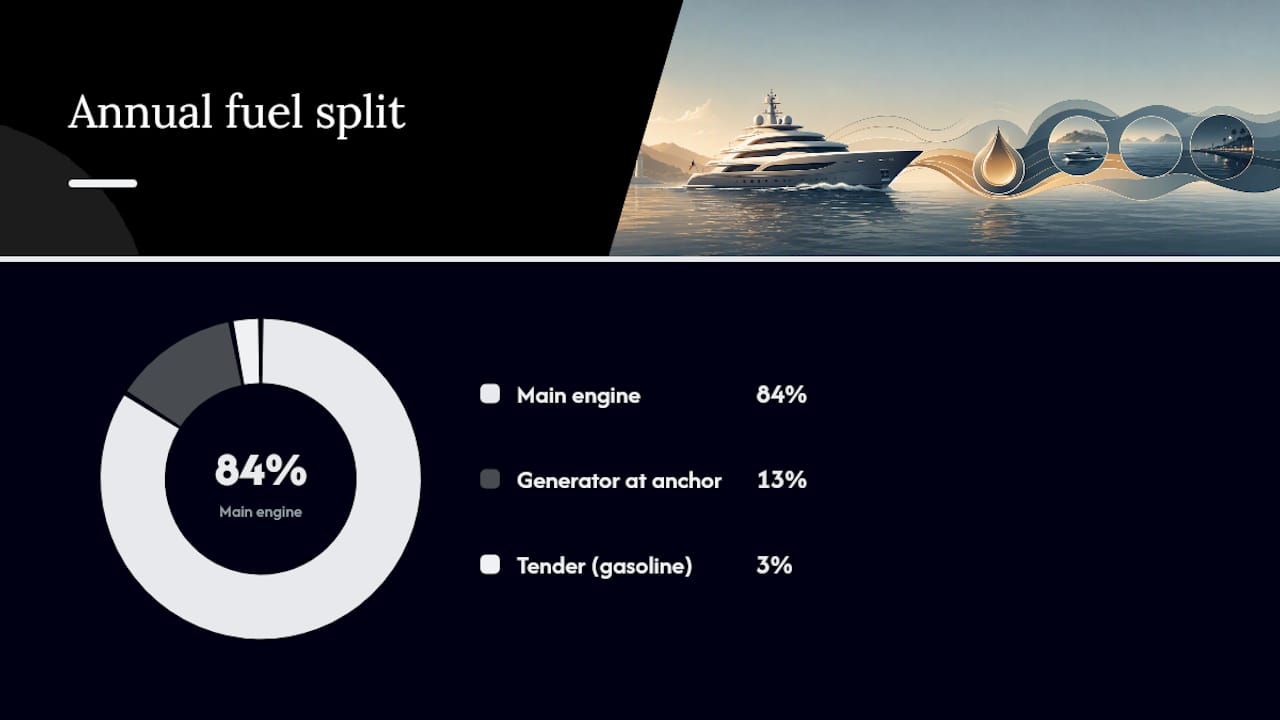
This adjustment reflects how meaningfully ancillary loads add to the total fuel bill, though it can understate reality on yachts with oversized gensets or near-constant AC use at anchor in hot climates.
Here’s how that stacks into an annual figure:
- Main engine fuel: 150 hours at $370/hour average (mid-size motor yacht) = $55,500.
- Generator fuel at anchor: applying the 15% multiplier = $8,325.
- Tender fuel (gasoline, separate line item): roughly $1,500 to $3,000 for a season of regular use.
- Annual total: approximately $65,000 to $67,000 in combined fuel expenses.
Keep diesel and gasoline as separate accounting lines. Mixing them muddies your per-hour numbers and makes it harder to spot when one system, rather than the other, is driving a cost spike.
How Can You Lower Your Yacht’s Fuel Bill?
Speed management delivers the fastest win with the least effort.
Hull and machinery condition matter almost as much:
- Regular hull cleaning and antifouling keep drag down between haul-outs.
- Propeller alignment and pitch checks recover efficiency lost to wear.
- Parametric hull optimization and CFD-informed design work can improve fuel efficiency by roughly 5 to 10% on refits or new builds.
- Hybrid and battery systems cut genset runtime for hotel loads and pay off most clearly on yachts that spend a lot of time at anchor. Our overview of hybrid yacht benefits goes deeper on where that investment makes sense.
- A marine ceramic coating on the hull can reduce drag between cleanings, which adds up over a season of running hours.
- Planning fueling stops around regional price differences, rather than topping off at the nearest marina, avoids paying premium rates out of convenience.
Pro Tip: *Before assuming your fuel bill is high because of the boat, consider other factors such as cruising habits first.
How Yachts by Steve Uses Fuel Numbers to Guide Buyers
Fuel cost is a key consideration in a brokerage conversation, as it shapes both the annual ownership budget and how a listing gets positioned against comparable vessels.
Before recommending a yacht to a client, our approach is to push past the builder’s stated consumption figures and verify what the boat has actually been doing. Three questions consistently surface the real picture:
- Can the seller or captain produce recent fuel logs, not just factory specifications?
- What are the generator run hours, and how do they compare to main engine hours?
- When was the hull last cleaned or the running gear serviced, and what does that maintenance history suggest about current efficiency?
A yacht with clean logs, moderate genset hours, and a documented maintenance record often justifies a stronger asking price, because it removes guesswork from the buyer’s operating budget. If you’re weighing a purchase and want those numbers run against a specific vessel, our guide on choosing a yacht broker walks through how that process works, or reach out directly for a personalized estimate.
Where to Verify These Numbers Yourself
For emissions and regulatory context, the IMO’s air pollution and environment work is the primary reference. For technical design and efficiency questions, DNV’s expert analysis on yacht design optimization is the stronger source. For quick market-rate calculations, the LuxCalculator trip planner lets you run your own scenario against current pricing.
Sources
- Yacht Fuel Costs: $200 to $2,400 Per Hour Underway in 2026
- Yacht Fuel Cost Calculator: Consumption Guide by Engine & Size
- Optimizing yacht designs for maximum efficiency — DNV expert story
- Yacht Fuel Cost Calculator — Cruising, Trip Planner & Annual Budget | LuxCalculator
- IMO — Air pollution and environment work
Recommended
Featured Listings

2028 Columbus Yachts
$22,900,008
137
Ancona

2012 Benetti PATIENCE
$10,975,000
132
Fort Lauderdale Florida

2028 Kingship Kingship
$20,350,000
125

2024 Silver Yachts
$25,400,000
117

2009 Hargrave BRANDI WINE
$2,500,000
114
Fort Lauderdale Florida

2028 Extra Yachts
$20,350,000
100
Ancona

2028 Alpha
$12,100,000
100
Ft Lauderdale Florida

2028 Extra Yachts Extra 96
$9,495,000
96
Ancona

2021 Sanlorenzo GATSBY
$6,795,000
96
Fort Lauderdale Florida

2028 Kingship
$11,990,000
90

2028 Alpha
$9,894,500
90
Fano

2023 Azimut COMPASS
$7,950,000
88
Miami Beach Florida

1999 Northern Marine OFF LINE
$2,495,000
84
Ft Lauderdale Florida

2013 Pershing DOROTHY ANN
$1,375,000
82
Fort Lauderdale Florida

1997 Ferretti Yachts
$825,000
80
La Paz

2008 Princess Yachts OCARALIA
$1,095,000
75
Charleston South Carolina

2014 Sunseeker
$1,400,000
68
New York New York

2024 Fairline
$2,750,000
68
Ft. Lauderdale Florida

2019 Vanquish Yachts IMPULSIVE
$1,799,000
58
Miami Beach Florida

2021 Ferretti Yachts HAVEN
$1,595,000
57
Fort Lauderdale Florida

2025 Formula BREAKTHROUGH III
$1,895,000
53
Miami Beach Florida

2023 Fairline
$900,000
45
Fort Lauderdale Florida

2012 Zeelander Mississippi Queen
$575,000
44
West Palm Beach Florida
2028 Columbus Yachts 137'
$22,900,008
2012 Benetti 132'
$10,975,000
2028 Kingship 125'
$20,350,000
2024 Silver Yachts 117'
$25,400,000
2009 Hargrave 114'
$2,500,000
2028 Extra Yachts 100'
$20,350,000
2028 Alpha 100'
$12,100,000
2028 Extra Yachts 96'
$9,495,000
2021 Sanlorenzo 96'
$6,795,000
2028 Kingship 90'
$11,990,000
2028 Alpha 90'
$9,894,500
2023 Azimut 88'
$7,950,000
1999 Northern Marine 84'
$2,495,000
2013 Pershing 82'
$1,375,000
1997 Ferretti Yachts 80'
$825,000
2008 Princess Yachts 75'
$1,095,000
2014 Sunseeker 68'
$1,400,000
2024 Fairline 68'
$2,750,000
2019 Vanquish Yachts 58'
$1,799,000
2021 Ferretti Yachts 57'
$1,595,000
2025 Formula 53'
$1,895,000
2023 Fairline 45'
$900,000
2012 Zeelander 44'
$575,000