

Yacht galley features are the specialized design and functional elements that determine whether a vessel’s kitchen works beautifully at sea or becomes a source of daily frustration. The galley, as the marine kitchen is properly called, must solve problems no land-based kitchen ever faces: a moving floor, limited square footage, and provisions that need to last weeks. Get these features right, and the galley becomes the warm, productive heart of life aboard. Get them wrong, and even a short passage feels like a test of endurance. Buyers who understand what separates a well-designed galley from a compromised one make far better purchasing decisions.
What are the core yacht galley features that matter most?
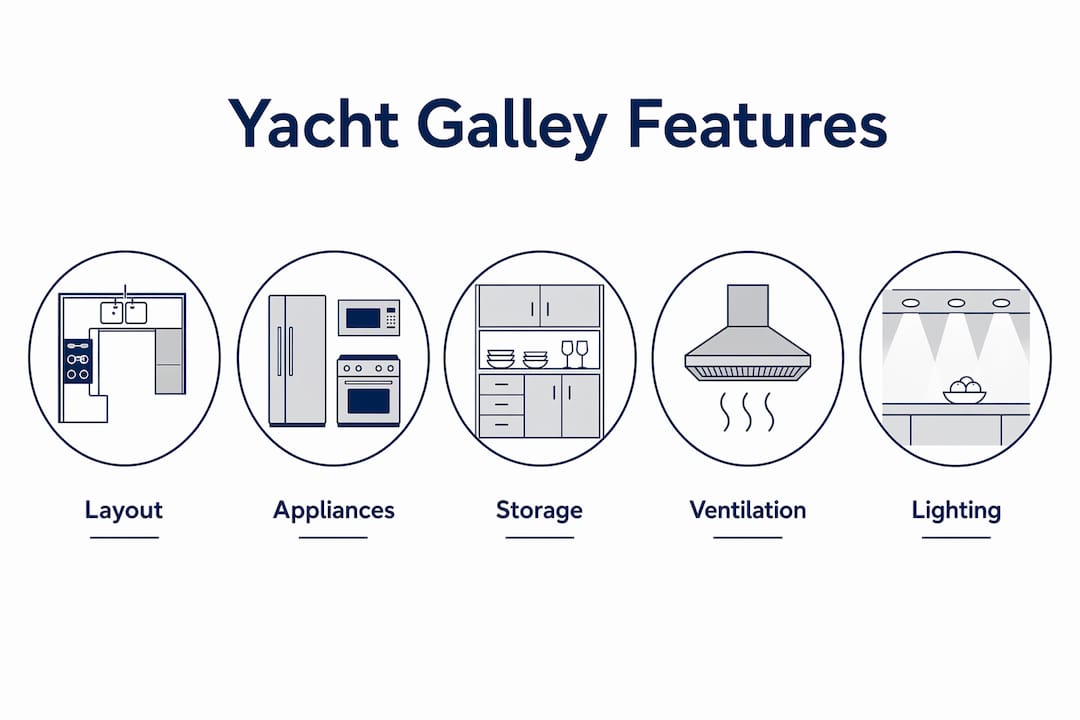
Yacht galley features fall into five categories: layout and ergonomics, appliances and safety equipment, storage systems, ventilation, and lighting. Each category addresses a distinct challenge of cooking in a marine environment. A galley that scores well across all five delivers the kind of luxury galley experience that transforms extended voyages into genuine pleasure.
The industry term for the onboard kitchen is the galley, and the distinction matters. A galley is not simply a kitchen installed on a boat. It is an engineered space where every dimension, fixture, and fitting accounts for vessel movement, weight distribution, and crew safety. Buyers evaluating listings should treat the galley with the same scrutiny they give to the engine room or navigation station.
How does layout design shape galley functionality?
The layout is the foundation of every other galley decision. Three configurations dominate yacht design: the U-shaped galley, the L-shaped galley, and the single-bench or corridor galley. U-shaped layouts offer the most counter space and the best bracing options, making them the preferred choice on larger vessels. L-shaped layouts suit mid-size yachts where the cook needs freedom of movement without sacrificing too much cabin space. Single-bench layouts appear most often on smaller cruisers where every inch counts.
The marine work triangle adapts the classic kitchen design principle to yacht conditions. On land, the work triangle connects the refrigerator, sink, and stove for efficiency. At sea, the same triangle must also provide secure bracing points at each station, so the cook can hold position when the vessel heels or pitches. This is not a comfort preference. It is a safety requirement.
Early chef involvement in galley predevelopment reduces costs, improves ergonomics, and produces a space aligned with real cooking workflows. Skipping this step is, as one industry expert put it, like building a race car without consulting the driver. The refit costs that follow poor initial planning are rarely small.
Key ergonomic features to evaluate in any galley layout:
- Shallow counters with non-skid surfaces that allow secure bracing without reaching
- Fiddle rails along counter edges to prevent pots and dishes from sliding
- Knee braces or hip supports at the stove and prep areas
- Counter heights adjusted for the primary cook’s stature
- Clear, unobstructed movement paths between each work station
Pro Tip: Ask the listing broker whether the galley was designed with chef input during the build or refit phase. A yes is a strong signal of thoughtful construction.
What appliances and safety equipment does a yacht galley need?
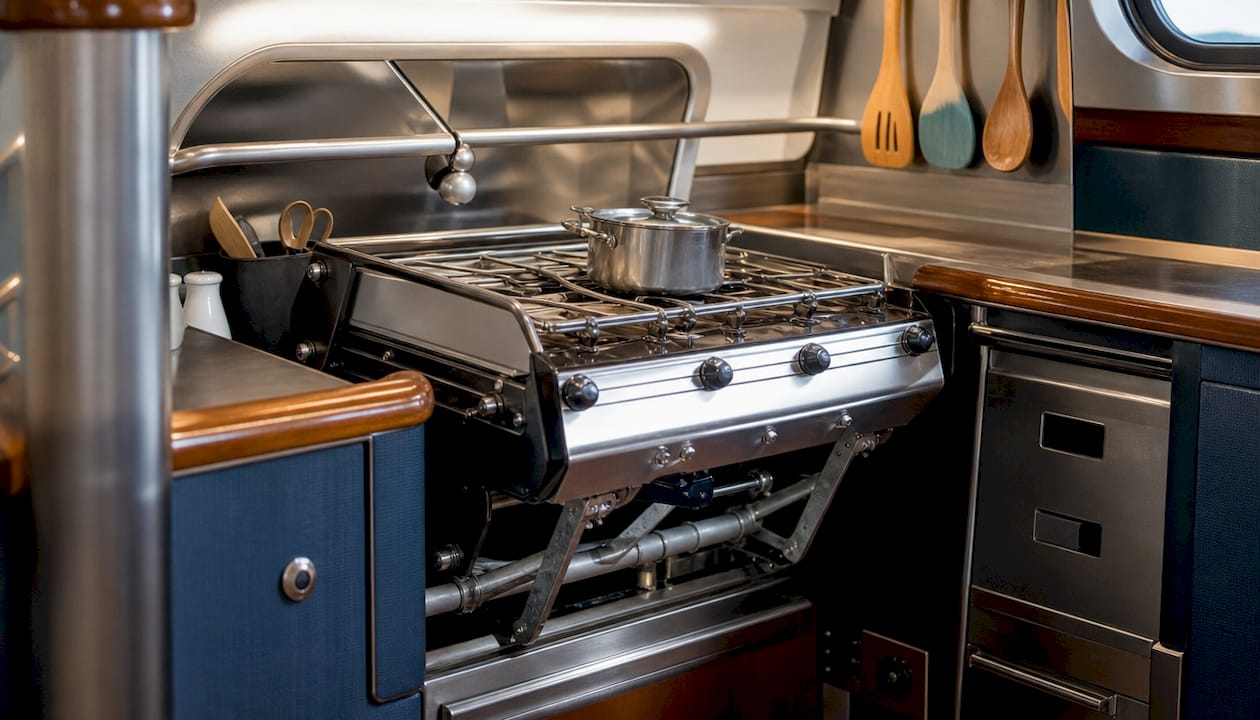
Appliances in a yacht galley must perform reliably in conditions that would destroy standard residential equipment. The stove is the most safety-critical item. Gimballed stoves should allow a tilt range of 20–30 degrees to accommodate typical sailing heel angles safely. A stove that cannot swing freely with the vessel becomes a burn hazard the moment the wind picks up.
Refrigeration deserves equal attention. Marine refrigerators must maintain consistent temperatures despite ambient heat, limited power budgets, and the vibration of a running engine. High-quality units use efficient compressors and thick insulation to minimize energy draw. On long passages, a dedicated freezer separate from the main refrigerator extends provisioning capacity significantly.
Safety equipment in the galley is non-negotiable. The following systems protect both crew and vessel:
- A fixed fire suppression system, ideally an automatic wet chemical unit, installed above the stove
- A portable dry chemical extinguisher mounted within arm’s reach of the cooking area
- A smoke detector positioned to trigger before flames reach critical size
- A carbon monoxide detector if the galley uses gas appliances
- A gas shut-off valve accessible from outside the galley space
Ventilation works alongside these systems. Hatches positioned directly above the galley provide more effective fume control than mechanical exhaust fans alone. Powered fans supplement natural airflow but should never be the primary ventilation strategy.
How do smart storage solutions keep a galley functional underway?
Storage is where most galley designs either earn their keep or reveal their shortcomings. The challenge is not simply finding space for provisions. It is securing every item so that nothing shifts, rattles, or becomes a projectile when the vessel rolls. Effective galley storage uses kickboard compartments, under-seat lockers, bulkhead-mounted racks, and specialized spice restraints to keep the galley organized at sea.
The table below shows how storage solutions differ by item type and the specific challenge each one addresses.
| Item type | Storage solution | Key benefit |
|---|---|---|
| Cookware | Padded, divided drawers with inserts | Prevents noise and surface damage underway |
| Spices and condiments | Bulkhead-mounted racks with lip rails | Keeps bottles accessible and upright |
| Dry goods | Sealed, stackable containers in deep lockers | Protects from moisture and shifting |
| Canned goods | Under-seat storage with non-slip liners | Uses dead space efficiently |
| Utensils | Magnetic strips or slotted drawer inserts | Eliminates rattle and keeps tools visible |
Collapsible and stackable kitchenware has become a practical standard on well-equipped yachts. Silicone colanders, nesting bowls, and flat-fold cutting boards reclaim significant locker space without sacrificing function. The best galleys treat every cubic inch as a resource.
- Fresh produce stores best in ventilated net bags hung in cool, shaded lockers
- Canned goods should be rotated regularly and stored label-out for quick identification
- Breakable items belong in padded, dedicated compartments, never loose in a drawer
Pro Tip: Before purchasing a vessel, open every locker and drawer in the galley while imagining the boat at a 20-degree heel. If anything would fall or shift, the storage design needs work.
How do lighting and ventilation affect galley performance?
Lighting in a yacht galley does more than illuminate a workspace. The color temperature of the light directly affects how accurately a cook reads the color of food. Artificial lighting between 4000K and 5000K best replicates natural daylight, which matters when checking whether fish is properly cooked or whether produce is still fresh. Warm, amber lighting that suits a dining saloon creates real problems in a working galley.
Ventilation is equally consequential, and its effects extend well beyond the galley itself. Odors that migrate into guest spaces significantly reduce onboard comfort, particularly on longer passages. Dorade vents and dedicated galley hatches allow cooking fumes and heat to escape without letting rain or spray enter. Positioning these openings directly above the cooking area is the most effective design choice.
Effective galley ventilation relies on these elements working together:
- A dedicated hatch above the stove, operable from inside the galley
- Dorade vents on the coachroof to draw fresh air through the space
- A powered exhaust fan as a secondary system for calm-weather or motoring passages
- Cross-ventilation paths that move air from the forward cabin through the galley and out
Poor ventilation also creates hygiene risks. Heat and humidity accelerate bacterial growth on food surfaces, making airflow a food safety issue, not just a comfort one.
How does galley design influence provisioning and menu planning?
The galley’s physical constraints shape every meal served aboard, often before the vessel leaves the dock. Approximately 80% of fine-dining yacht galley operations use pre-departure preparation methods such as sous-vide or partial cooking to work within onboard limitations. This means a well-designed galley must accommodate not just cooking but also the storage of partially prepared dishes.
Route-based menu planning synchronizes provisioning with the availability of fresh ingredients in regional ports. A yacht heading through the Mediterranean can plan menus around what is fresh in each port of call, reducing cold storage pressure and keeping meals vibrant. This approach requires a galley with clearly organized, accessible cold storage so the cook can rotate stock efficiently.
Practical provisioning steps that work with good galley design:
- Audit cold storage capacity before departure and assign zones for fresh, chilled, and frozen items
- Plan menus by passage leg, not by the full voyage, to match ingredient freshness windows
- Use digital inventory lists to track what is aboard and what needs replenishment at each port
- Pre-portion and vacuum-seal proteins before departure to extend refrigerator life and reduce prep time underway
- Designate a dedicated dry-goods locker with a running inventory, updated after each provisioning stop
A galley that supports this kind of organized provisioning workflow is not a luxury. On a passage of two weeks or more, it is the difference between a crew that eats well and one that survives on canned goods.
Key Takeaways
A yacht galley’s value lies in the integration of layout, appliances, storage, ventilation, and lighting into a single system that performs safely and efficiently at sea.
| Point | Details |
|---|---|
| Layout determines safety | U-shaped and L-shaped galleys with bracing points protect cooks during vessel movement. |
| Gimballed stoves are non-negotiable | A 20–30 degree tilt range keeps the cooking surface level and safe when the yacht heels. |
| Storage must secure, not just hold | Divided drawers, fiddle rails, and bulkhead racks prevent shifting and noise underway. |
| Lighting affects food quality | Color temperatures of 4000K–5000K replicate daylight for accurate food assessment. |
| Provisioning starts with galley design | Cold storage organization and pre-departure prep directly determine meal quality on long passages. |
What I’ve learned from watching buyers overlook the galley
Buyers consistently underestimate the galley. They walk through a vessel, admire the saloon, inspect the helm, and give the galley a cursory glance before moving on. I have watched this happen on vessels where the galley was the single biggest flaw, and the buyer only discovered it three weeks into their first passage.
The galley is not a supporting character in the story of yacht ownership. For anyone spending more than a weekend aboard, it is the space that sets the rhythm of daily life. A poorly ventilated galley makes every meal a chore. A galley without proper bracing turns a moderate swell into a genuine hazard. These are not abstract concerns.
The detail I find most telling is whether a yacht’s original builder involved the chef during the predevelopment phase. When that conversation happened early, the galley almost always works. When it did not, you can feel the compromises in every drawer that does not quite close and every counter that sits at the wrong height.
My honest advice: treat the galley tour as seriously as the sea trial. Bring someone who cooks. Open every locker. Run the stove. Check the ventilation. A galley that performs at sea is one of the most undervalued assets on any vessel, and one of the hardest things to fix after the fact.
— Jason
Finding a yacht with a galley worth living in
The galley is one of the most telling indicators of how thoughtfully a vessel was designed and maintained. At Yachts-bysteve, the team understands that buyers who live aboard or charter extensively need a galley that genuinely performs, not one that merely photographs well. Working with an experienced yacht broker means having someone who knows which questions to ask about galley construction, appliance specifications, and storage capacity before you ever step aboard. Yachts-bysteve connects buyers with vessels where the galley matches the standard of the rest of the yacht. Reach out to discuss your requirements and find a listing that fits your life at sea.
FAQ
What is a yacht galley?
A yacht galley is the onboard kitchen of a vessel, engineered specifically for marine conditions including vessel movement, limited space, and extended provisioning needs.
What layout works best for a yacht galley?
U-shaped layouts offer the most counter space and the best bracing options, making them the preferred choice on larger yachts where safety and efficiency are the priority.
Why do yacht stoves need to be gimballed?
Gimballed stoves pivot to stay level as the vessel heels, and a tilt range of 20–30 degrees covers the heel angles most sailing yachts experience in normal conditions.
How important is ventilation in a yacht galley?
Ventilation is critical. Hatches positioned directly above the galley outperform mechanical fans for controlling cooking fumes, and poor airflow allows odors to migrate into guest spaces.
What lighting color temperature suits a yacht galley?
Lighting between 4000K and 5000K replicates natural daylight, which allows accurate assessment of food color and doneness during meal preparation.
Recommended
Featured Listings

2028 Columbus Yachts
$22,900,008
137
Ancona

2012 Benetti PATIENCE
$10,975,000
132
Fort Lauderdale Florida

2028 Kingship Kingship
$20,350,000
125

2024 Silver Yachts
$25,400,000
117

2009 Hargrave BRANDI WINE
$2,500,000
114
Fort Lauderdale Florida

2028 Extra Yachts
$20,350,000
100
Ancona

2028 Alpha
$12,100,000
100
Ft Lauderdale Florida

2028 Extra Yachts Extra 96
$9,495,000
96
Ancona

2021 Sanlorenzo GATSBY
$6,795,000
96
Fort Lauderdale Florida

2028 Kingship
$11,990,000
90

2028 Alpha
$9,894,500
90
Fano

2023 Azimut COMPASS
$7,950,000
88
Miami Beach Florida

1999 Northern Marine OFF LINE
$2,495,000
84
Ft Lauderdale Florida

2013 Pershing DOROTHY ANN
$1,375,000
82
Fort Lauderdale Florida

1997 Ferretti Yachts
$825,000
80
La Paz

2008 Princess Yachts OCARALIA
$1,095,000
75
Charleston South Carolina

2014 Sunseeker
$1,400,000
68
New York New York

2024 Fairline
$2,750,000
68
Ft. Lauderdale Florida

2019 Vanquish Yachts IMPULSIVE
$1,799,000
58
Miami Beach Florida

2021 Ferretti Yachts HAVEN
$1,595,000
57
Fort Lauderdale Florida

2025 Formula BREAKTHROUGH III
$1,895,000
53
Miami Beach Florida

2023 Fairline
$900,000
45
Fort Lauderdale Florida

2012 Zeelander Mississippi Queen
$575,000
44
West Palm Beach Florida
2028 Columbus Yachts 137'
$22,900,008
2012 Benetti 132'
$10,975,000
2028 Kingship 125'
$20,350,000
2024 Silver Yachts 117'
$25,400,000
2009 Hargrave 114'
$2,500,000
2028 Extra Yachts 100'
$20,350,000
2028 Alpha 100'
$12,100,000
2028 Extra Yachts 96'
$9,495,000
2021 Sanlorenzo 96'
$6,795,000
2028 Kingship 90'
$11,990,000
2028 Alpha 90'
$9,894,500
2023 Azimut 88'
$7,950,000
1999 Northern Marine 84'
$2,495,000
2013 Pershing 82'
$1,375,000
1997 Ferretti Yachts 80'
$825,000
2008 Princess Yachts 75'
$1,095,000
2014 Sunseeker 68'
$1,400,000
2024 Fairline 68'
$2,750,000
2019 Vanquish Yachts 58'
$1,799,000
2021 Ferretti Yachts 57'
$1,595,000
2025 Formula 53'
$1,895,000
2023 Fairline 45'
$900,000
2012 Zeelander 44'
$575,000