

Overview: When a tropical watch appears on the National Hurricane Center advisory board, the clock starts immediately. The non-negotiable first moves are these: confirm your insurer’s specific plan requirements, decide on your safe location, begin the relocation or securing sequence, and activate your designated response team. Every hour of hesitation after that point costs you options.
Your immediate priority checklist:
- Confirm insurance requirements — call your broker today; some policies void coverage if a filed plan isn’t followed
- Choose your safe location — haul-out, inland marina, hurricane hole, or secured slip (decide before the storm names)
- Book haul-out or slip space — yards fill within hours of a named storm; call at the first watch
- Double and cross your dock lines — add spring lines, chafe protection, and fender boards now
- Charge batteries and test bilge pumps — float switches, primary and backup; confirm all are operational
- Document the vessel’s current condition — timestamped photos and video of every compartment, deck, and system
- Delegate authority — confirm your captain or agent has signed authorization and keys
- Remove canvas, biminis, and loose gear — windage reduction is one of the highest-impact actions you can take
Watch vs. warning: the timing trigger that changes everything. A hurricane watch means conditions are possible within 48 hours. A hurricane warning means they are expected within 36 hours. Your haul-out or relocation must be complete before a warning is issued, not started. Industry guidance is consistent on this point: owners who wait for certainty before booking haul-out space routinely find none available.
Key Takeaways
A solid yacht hurricane plan requires decisions made months before a storm forms: filed insurance plans, confirmed haul-out agreements, and a delegated response team are the three actions that most consistently protect both the vessel and the claim.
| Point | Details |
|---|---|
| Act on a watch, not a warning | Haul-out yards fill within hours of a named storm; book at the first watch, not when the track firms up. |
| File your plan before June 1 | Submit a written hurricane plan to your insurer before the season opens; late filing can complicate claims. |
| Documentation is the claim | Timestamped photos, maintenance logs, and receipts are what adjusters need; collect them before the storm, not after. |
| Delegate with signed authority | Your shore agent or captain needs written authorization, keys, and a full contact list to act effectively in your absence. |
| May is your preparation month | Confirm haul-out agreements, review insurance terms, and assign your response team before the season begins. |
Table of Contents
- What forecast sources should you trust for your yacht hurricane plan?
- How do you choose the safest location for your yacht in a storm?
- How to secure your yacht in a slip before a hurricane
- When does anchoring offshore make sense, and how do you rig it correctly?
- What hull and systems prep does your yacht need before a hurricane?
- How to plan the haul-out or relocation: a T-minus timeline
- What does your insurance policy actually require for hurricane coverage?
- Why you should not stay aboard and how to delegate authority properly
- Post-storm recovery: the right steps for safety and a clean claim
- What belongs in your yacht storm kit?
- What experienced captains know about timing that most owners don’t
- A broker’s perspective on why May is the most important month of hurricane season
- Sources
What forecast sources should you trust for your yacht hurricane plan?
The National Hurricane Center is the authoritative source for tropical cyclone tracks, watches, and warnings in U.S. waters. Check NHC advisories every six hours during an active storm season. The five-day forecast cone and the wind probability graphics are the two most tactically useful products for yacht owners making location decisions.
For short-range, local confirmation, NWS radar gives you real-time precipitation bands and coastal returns in the final 24 hours. Use it to verify timing when you’re making last-mile decisions about whether to move the vessel or button it up in place.
The watch-to-warning timeline, mapped to owner actions:
The U.S. Coast Guard publishes boat-prep guidance that marinas and captains use as a procedural baseline. Their materials reinforce the same timing logic: preparation must be complete before warning conditions arrive, not during them.
Commercial weather-routing services such as PredictWind or Passage Weather add value when you’re planning a transit to a safer port. For a vessel already at its home marina, NHC and NWS radar are sufficient. Escalate to a professional router only when you’re considering an offshore passage of more than a few hours during an active advisory period. America’s Boating Club also offers hurricane-preparation seminars and owner checklists worth bookmarking before the season opens.
Key monitoring habits for the season:
- Set NHC email or push alerts for your region from June 1 through November 30
- Check the Atlantic basin outlook every Monday during active periods
- Know your marina’s specific trigger points — some require boats secured 24 hours before a warning, not at the warning itself
- Keep a printed copy of your plan aboard and with your designated shore contact
How do you choose the safest location for your yacht in a storm?
The decision isn’t simply “haul out or stay.” It turns on storm category, marina construction, surge exposure, debris risk, and what your insurance policy actually requires. Getting this wrong doesn’t just risk the vessel; it can void your coverage.
Severe-weather preparedness templates consistently identify four primary options: haul-out and dry storage, a protected inland marina, a hurricane hole, and a secured in-water slip. Each has a distinct risk profile.
Location decision matrix:
| Option | Best For | Key Advantage | Key Risk | Insurance Note |
|---|---|---|---|---|
| Haul-out / dry storage | Cat 3+ storms; displacement yachts | Eliminates surge and wave action | Yard capacity fills fast; cradle failure risk | Most insurers prefer or require this for major storms |
| Protected inland marina | Cat 1–2; vessels too large to haul | Reduced fetch and surge | Debris from trees; fixed-piling surge limits | Confirm marina’s surge rating with insurer |
| Hurricane hole | Smaller vessels; known anchorages | Low cost; natural protection | Crowded; holding ground varies; swing room | Document location and anchoring setup for insurer |
| Secured in-water slip | Last resort or Cat 1 only | Convenient; no transit needed | Highest exposure to surge, wave, and debris | Requires documented line plan; some policies exclude |
Haul-out is the professional threshold for Category 3 and above for displacement yachts. Older fixed-piling marinas with lower surge tolerance may warrant hauling even for a Category 2 forecast. When evaluating a yard or hurricane hole, check these factors specifically:
- Elevation above mean high water and the yard’s published surge rating
- Cradle and blocking quality — ask whether the yard uses hurricane-rated blocking
- Proximity to trees, power lines, or structures that could become projectiles
- Confirmed availability and a written haul-out agreement, not a verbal promise
- Access road flooding risk — can crew reach the yard after the storm?
For owners choosing a home port with hurricane risk in mind, the yacht home port selection guide at Yachts-bysteve covers the infrastructure and geographic criteria worth weighing before you ever sign a slip agreement.
Insurance note: Location choices directly affect coverage. Some policies include navigation area clauses that restrict where the vessel may be during storm season. Confirm your policy’s geographic limits with your broker before committing to a hurricane hole outside your covered area.
How to secure your yacht in a slip before a hurricane
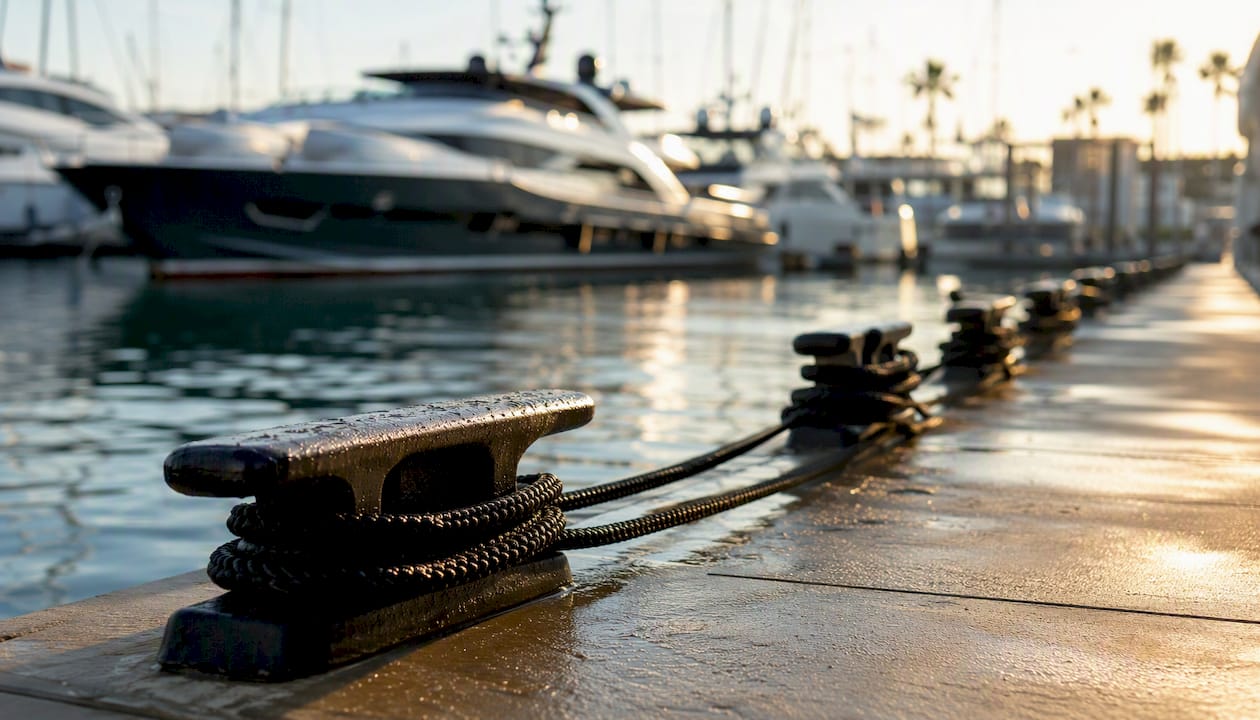
The goal is to make the vessel as immovable as possible while absorbing surge without chafing through a line. Neither goal is achievable with standard dock lines alone.
Materials you need by vessel length:
- Under 40 feet: 3/4-inch double-braid nylon lines (nylon’s stretch absorbs surge shock)
- 40–60 feet: 1-inch double-braid nylon; consider 3-strand for added elasticity
- Over 60 feet: 1-1/4-inch or larger; consult a rigger for displacement-specific sizing
- Fender boards (not just round fenders) to distribute load across pilings
- Chafe guards: leather, rubber hose sections, or commercial chafe sleeves at every contact point
- Snubbers for any chain rode used in conjunction with dock lines
Step-by-step line layout:
- Remove all standard lines and replace with your heavy storm lines — don’t add to existing lines, which may already be weakened.
- Set bow and stern lines to pilings (not dock cleats) at a 45-degree angle, long enough to allow for surge rise without going taut.
- Add forward and aft spring lines crossing from bow cleat to aft piling and stern cleat to forward piling — these prevent surge from driving the vessel forward or aft.
- Run crossing breast lines if the slip allows: port bow to starboard piling and starboard bow to port piling. This dramatically reduces lateral movement.
- Install fender boards between the hull and pilings — a round fender alone will roll and allow hull contact.
- Apply chafe protection at every point where a line crosses a rail, cleat, or piling edge. Inspect and re-tape after initial tensioning.
- Verify line tension is firm but not bar-tight — you need elasticity for surge, not a rigid connection that will snap a cleat.
- Final walk-around: check every attachment point, every chafe sleeve, and confirm no line is routed over a sharp edge.
USCG boat-prep guidance and marina-level hurricane plans both emphasize that vessels should be fully secured before a warning is posted — not during the warning window, when conditions are already deteriorating.
Pro Tip: Never rely on a single cleat or tie point for any one line. If that cleat fails, the line is gone. Route every critical line to a piling or a through-bolted fitting, and back up each attachment with a secondary line to a separate fixed structure.
Chubb’s owner-directed hurricane prep resources consistently list doubling dock lines and removing canvas as two of the highest-impact actions — both of which cost nothing but time.
When does anchoring offshore make sense, and how do you rig it correctly?
Anchoring in a hurricane hole or offshore is viable for smaller vessels in well-chosen locations with good holding ground and adequate swing room. For larger displacement yachts, it is rarely the preferred option and carries real risk if the anchorage becomes crowded.
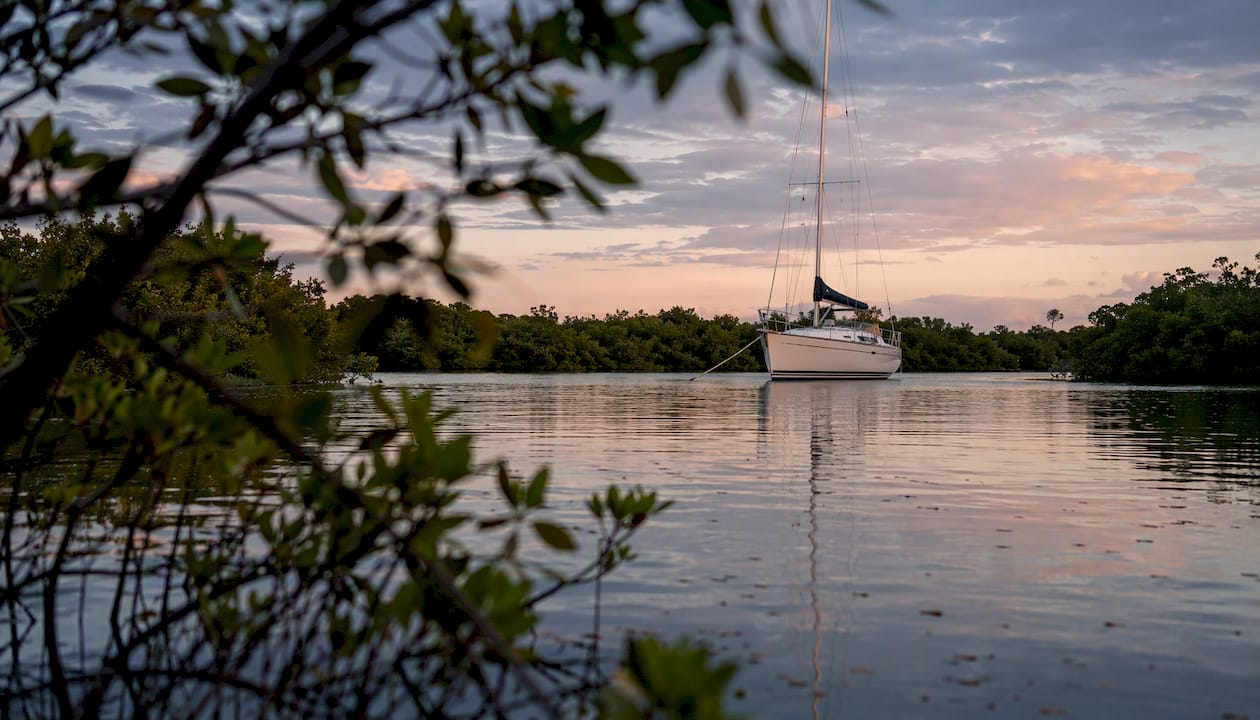
Storm anchoring differs from everyday anchoring in three ways: scope ratios are much higher, multiple anchors are typically deployed in a bridle or Bahamian moor configuration, and anchor sizing must account for the vessel’s displacement under extreme wind load, not just its length.
Gear sizing and setup guidance:
- Scope of 7:1 to 10:1 (chain rode to depth) is the minimum for storm conditions; 10:1 is preferred in surge-prone anchorages
- Use your heaviest anchor (plow or claw style for mixed bottoms; Danforth for sand) as the primary, with a secondary set at 30–45 degrees off the bow
- All-chain rode is strongly preferred over rope in storm conditions — it resists chafe on the bottom and adds catenary weight that absorbs surge shock
- A snubber or bridle on the chain reduces shock load on the windlass and deck hardware
Red flags that make anchoring unsafe:
- Crowded anchorage with limited swing room — a dragging neighbor becomes your problem
- Poor or unknown holding ground (rock, grass, or soft mud without adequate penetration)
- Proximity to shipping channels, tidal currents, or lee shores
- Forecast surge height that would put the vessel over shoal water at high tide
When any of these conditions apply, hauling out or transiting to a protected marina is the correct call. An anchorage that looks idyllic in calm conditions can become untenable within hours of a storm’s outer bands arriving. Yacht storage solutions covers the full range of dry-storage and inland options for owners who need an alternative to anchoring.
What hull and systems prep does your yacht need before a hurricane?
Systems failures during a storm are often more damaging than the storm itself. A bilge pump that trips its breaker at 2 AM, a seacock left open, or a hatch that leaks under surge pressure can sink a vessel that the wind alone would have spared.
Bilge pump strategy:
- Test the primary electric bilge pump and its float switch at least 48 hours before the storm
- Install or confirm a secondary electric pump on a separate circuit and float switch
- Keep a manual backup pump aboard — electric systems can fail when you need them most
- Carry spare impellers, hose clamps, and pump hoses; a pump that fails mid-storm with no spare is useless
- Confirm the bilge is clear of debris that could clog the strainer
Electrical prep:
- Charge all battery banks to full before disconnecting shore power
- Isolate battery banks so a single fault doesn’t drain the entire system
- Disconnect shore power at the pedestal before the storm arrives — surge and flooding can cause electrical fires
- Keep a dedicated battery bank for automatic bilge operation and VHF communications
Seacock and hatch management:
- Close all seacocks except those needed for automatic bilge discharge
- Inspect every hatch seal and portlight gasket; replace any that show cracking or compression failure
- Tape or seal hatches with waterproof tape as a secondary measure in extreme forecasts
- Confirm the companionway washboards are in place and secured
Spare parts to have on hand:
| Item | Purpose | Store Location |
|---|---|---|
| Spare bilge pump (submersible) | Backup if primary fails | Dry bag, aboard |
| Impellers (2+) | Pump maintenance | Tool kit, aboard |
| Hose clamps (assorted) | Hose repairs | Tool kit, aboard |
| Battery leads and terminals | Electrical continuity | Dry bag, aboard |
| Multimeter | Fault diagnosis | Tool kit, aboard |
| Waterproof flashlights | Inspection in darkness | Accessible locker |
| Dry bags for electronics | Protect nav gear | Ashore or sealed below |
The yacht inspection checklist at Yachts-bysteve provides a systems-level framework that translates directly into pre-storm verification.
How to plan the haul-out or relocation: a T-minus timeline
The single most common mistake owners make is waiting for a definite forecast before booking. By the time a storm is named and tracking toward your region, haul-out yards are full. The timeline below assumes you are acting on a watch, not a warning.
T-minus timeline:
- T-minus 7 days (or at first watch): Confirm haul-out booking with a written agreement; contact your insurance broker to notify of the approaching storm and confirm plan requirements; assign crew roles and confirm availability; begin fuel planning.
- T-minus 72 hours: Fuel the vessel to capacity; confirm haul-out yard has cleared the area of loose scaffolding and debris; brief the delivery captain if you’re using one; pull canvas, biminis, and dodgers; remove electronics and valuables ashore.
- T-minus 48 hours: Transit to haul-out yard or protected marina; complete all dock-securing steps if staying in-water; photograph the vessel’s full condition (timestamped); confirm bilge pumps, batteries, and seacocks are set.
- T-minus 24 hours: All securing complete; crew evacuated; final check of lines, chafe gear, and bilge; leave contact information with the marina manager; confirm your shore agent has keys and authority.
NWS radar is the right tool for last-mile timing in the T-minus 24-hour window — use it to confirm whether outer bands are arriving earlier than forecast.
Logistics checklist:
- Written haul-out agreement with the yard (not a verbal reservation)
- Trailer or travel permits if the vessel is moving by road
- Crew assignments confirmed in writing with contact numbers
- Fuel plan: top off at least 72 hours out; fuel docks close early
- Tow or delivery captain arranged and briefed on the route
- Marina permissions and any required haul-out waivers signed
Captains consistently report that yachts undergoing yard work face the highest risk — refit schedules don’t pause for storms, and moving a vessel north at least a week before a potential event is often the only safe option. Waiting for certainty eliminates options. For owners considering moving a vessel across regions or internationally to avoid a storm corridor, the international travel preparation guide at Yachts-bysteve covers the transit logistics in detail.
Legal and administrative requirements:
- Confirm your insurance policy’s navigation area clause before transiting outside your covered zone
- Obtain written confirmation from the marina of any storm-protocol exceptions
- Keep signed haul-out waivers and marina agreements in your documentation file
- Confirm local port authority requirements for vessels transiting during an advisory
What does your insurance policy actually require for hurricane coverage?
This is where many owners discover, too late, that their policy had conditions they never read. Named-storm deductibles are the most common surprise: rather than a flat dollar amount, they are often calculated as a percentage of the vessel’s insured value, which on a luxury yacht can represent a substantial figure.
Industry guidance is consistent: many insurers require a filed and followed hurricane plan, and failure to comply with that plan can affect claim outcomes. The plan must be submitted before the season opens, not after a storm is named.
Common insurance features to review:
- Named-storm deductible: confirm whether it’s a flat amount or a percentage of insured value
- Navigation area clause: geographic limits on where the vessel may be during storm season
- Coverage limits for surge, total loss, and salvage operations
- Salvage clause: understand what rights the insurer retains over a damaged vessel
- Wreck removal requirements: some policies require the owner to fund removal even after a total-loss settlement
What to file with your broker before June 1:
- Written hurricane plan specifying your chosen safe location and securing procedures
- Haul-out yard agreement or marina storm-protocol confirmation
- Contact list for your response team (captain, agent, marina manager)
- Confirmation that the vessel’s navigation area clause permits your planned storm location
Pre-storm documentation is the difference-maker in recovery. Timestamped photos, maintenance logs, and receipts for haul-out and repairs limit disputes with adjusters and accelerate settlement.
Claim documentation checklist:
- Timestamped photos and video of every compartment, deck fitting, and system before the storm
- Maintenance logs showing the vessel was in good condition prior to the event
- Receipts for haul-out, securing materials, and any pre-storm repairs
- Log entries documenting compliance with each step of your filed plan
- Written communication with your broker confirming notification before the storm
For a thorough overview of policy structures and coverage considerations for high-value vessels, the luxury yacht insurance guide at Yachts-bysteve covers the essential terms owners need to understand before a storm season begins.
Why you should not stay aboard and how to delegate authority properly
The U.S. Coast Guard is unambiguous on this point: remaining aboard a vessel during a hurricane is dangerous and, in most cases, unnecessary. The vessel can be secured and monitored remotely. No yacht is worth a life.
There are narrow scenarios where a professional captain with full crew, a large vessel, and a protected berth might maintain a managed presence in the very early stages of a storm. These are exceptions, not templates, and they require USCG coordination and explicit insurer approval. For the vast majority of owners, the correct answer is: leave early, leave with a plan, and leave someone empowered to act.
Your evacuation and delegation checklist:
- Designate a shore agent or captain with signed written authority to make decisions about the vessel in your absence
- Provide that person with keys, access codes, and a copy of the hurricane plan
- Confirm the agent’s contact information with the marina manager and haul-out yard
- Stage spare fuel and critical spares at a location the agent can access after the storm
- Record who is responsible for each task in writing — verbal agreements dissolve under pressure
Contact sheet template (keep one aboard and one ashore):
- Primary owner: name, cell, alternate number
- On-call captain or agent: name, cell, authority scope
- Marina manager: name, direct line, storm-protocol contact
- Haul-out yard: name, address, contact, confirmation number
- Insurance broker: name, direct line, policy number, claims hotline
- Local emergency services: USCG sector, county emergency management
Legal delegation documents — including signed authority forms for captains and managers — are worth preparing before the season opens, not during a 48-hour warning window.
Crew safety actions before leaving:
- Confirm each crew member’s personal evacuation plan and destination
- Record who will perform each key task and when
- Obtain confirmation from the marina that your vessel is secured to their satisfaction
- Do not return to the vessel until authorities have cleared the area
Post-storm recovery: the right steps for safety and a clean claim
The storm has passed. The instinct is to get to the vessel immediately. Resist it. Downed power lines, fuel leaks, unstable structures, and compromised docks make early access genuinely dangerous. Wait for official clearance from local authorities or the marina before boarding.
Safe inspection sequence:
- Wait for clearance from local authorities, the marina, or the USCG before approaching the vessel.
- Approach on foot first — check for downed lines, fuel sheens on the water, and structural damage to the dock or yard.
- Board with PPE — non-sparking boots, gloves, and a flashlight; assume electrical systems are compromised until tested.
- Check for flooding — confirm bilge levels before starting any engine or electrical system.
- Document everything before touching anything — photograph all damage in its post-storm state before any mitigation work begins.
- Notify your broker — call before undertaking any repairs beyond emergency mitigation.
Immediate mitigation steps (document as you go):
- Pump bilges and confirm the source of any ingress before sealing
- Apply temporary tarps over damaged deck areas to prevent further water intrusion
- Secure loose rigging or hardware that poses a safety risk
- Photograph each mitigation action before and after
Do/don’t list for early recovery:
- Do photograph all damage before and after any mitigation work
- Do save all receipts for emergency materials and labor
- Do keep a written log of every action taken and when
- Don’t cut into fuel tanks or fuel lines without professional supervision
- Don’t dispose of damaged components before the adjuster has inspected them
- Don’t authorize permanent repairs before the insurer approves the scope
Documentation templates and evidence guidance from Yachts-bysteve can be adapted for post-storm claim filing.
What belongs in your yacht storm kit?
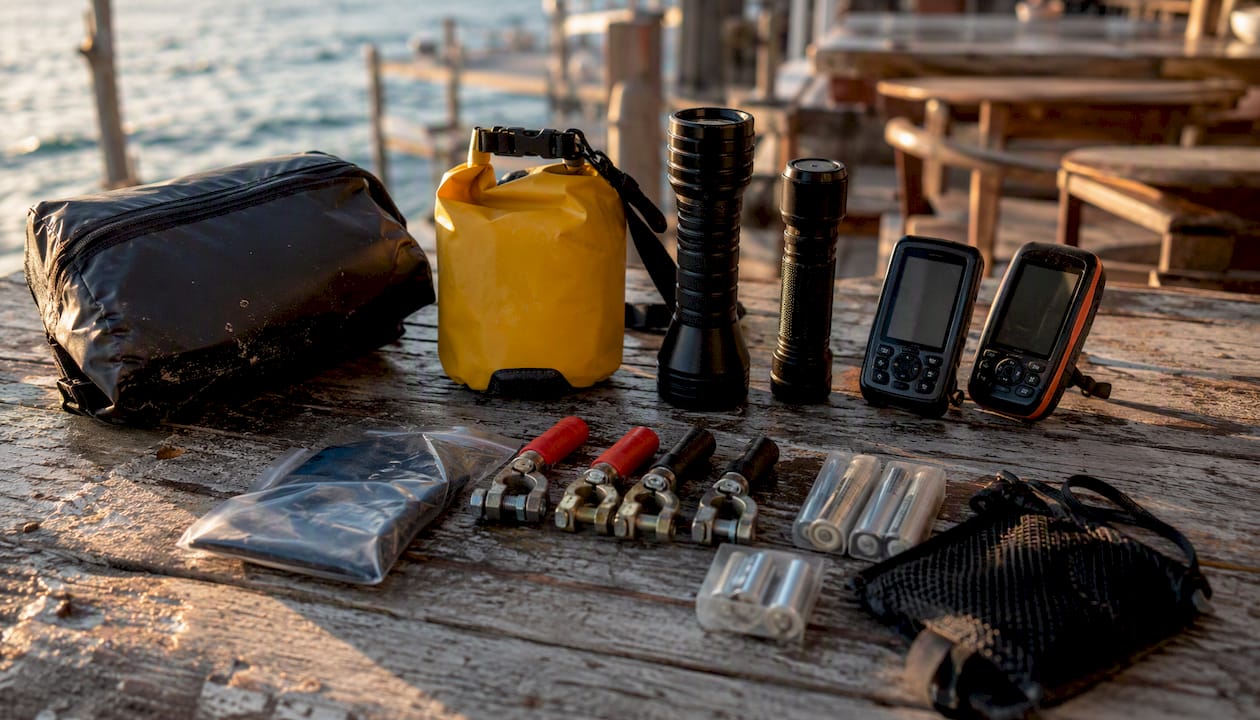
A storm kit is not a grab bag. It’s a pre-staged, organized set of materials that your captain or agent can deploy without hunting through lockers under pressure. Half of it lives aboard; the other half lives ashore in a waterproof container at a location that won’t flood.
Aboard (secured in a dedicated locker or dry bag):
- Heavy dock lines (at least four extra, sized for your vessel)
- Long snubbers for chain rode
- Large fenders and fender boards
- Chafe gear: leather strips, rubber hose sections, commercial chafe sleeves
- Spare submersible bilge pump with hose and fittings
- Manual bilge pump
- Spare impellers, hose clamps, and pump hoses
- Battery leads and terminals
- Multimeter and basic hand tools
- Waterproof flashlights with spare batteries
- Handheld VHF radio (charged)
- Personal flotation devices for any crew remaining near the vessel
Ashore (waterproof container, accessible post-storm):
| Item | Why It’s Ashore |
|---|---|
| Navigation electronics (chartplotter, handheld GPS) | Surge and flooding risk aboard |
| Winch handles and deck tools | Theft and loss risk during storm chaos |
| Spare keys and access codes | Agent needs them if you’re not present |
| Critical documents (insurance, registration) | Waterproof copies for claims |
| Satellite communicator (if available) | Reliable comms when cell networks fail |
Pro Tip: Label every item in your storm kit with its purpose and the vessel’s name. When a yard crew or agent is working under stress, a clearly labeled kit gets deployed correctly. An unlabeled bag gets opened, rummaged through, and partially used.
America’s Boating Club offers printable checklists owners can adapt and laminate for the kit. Run through the full list at T-minus 72 hours, not T-minus 24.
What experienced captains know about timing that most owners don’t
The gap between a good hurricane plan and a great one is almost always timing. Owners who’ve never lost a vessel to a storm tend to underestimate how fast options disappear once a storm is named. Captains who’ve worked through multiple seasons know that the decision to move is almost always made too late.
Consider three common scenarios. A vessel in active refit at a yard: the yard may not be able to launch the boat quickly, scaffolding may be in place, and systems may be partially disassembled. Captains advise moving such a vessel north at least a week before a potential event — not when the storm is named, but when the season’s first active disturbance appears in the Gulf or Atlantic. A seasonal owner who visits the boat monthly: that owner needs a designated local captain or agent with full authority, because they will not be able to reach the vessel in time once a watch is issued. A large displacement yacht at a fixed-piling marina: even a Category 1 forecast warrants a serious conversation about hauling, because older fixed-piling infrastructure has lower surge tolerance than floating-dock systems.
Common mistakes captains see every season:
- Relying entirely on yard staff to secure the vessel — yards are managing dozens of boats simultaneously; your boat is your responsibility
- Leaving fuel tanks low — fuel docks close 48–72 hours before landfall; a vessel that can’t move is a vessel that stays
- Underestimating haul-out yard demand — a single named storm can fill every yard within 200 miles within 24 hours of the watch
- Waiting for the forecast to “firm up” before booking — by then, it’s too late
Pro Tip: If your vessel is stuck at a fixed dock and cannot be moved, use thrusters and keep minimal propulsion available with crew standing by. Maintaining slight forward or lateral pressure against surge can prevent lines from going bar-tight and snapping cleats. This is a last-resort tactic, not a substitute for hauling — but it can make the difference when options are gone. Captains cite this as one of the most underused tools in a marina storm scenario.
For owners planning Caribbean passages during hurricane season, the Caribbean hurricane season overview is worth reading before committing to a routing plan.
A broker’s perspective on why May is the most important month of hurricane season
There’s a season that happens before the season, and most owners miss it entirely. June 1 is the official start of Atlantic hurricane season, but the decisions that determine whether a yacht survives a major storm are almost always made in May — or they aren’t made at all.
The pattern repeats itself with quiet regularity. An owner files a hurricane plan in September, after a storm has already formed. The insurer notes that the plan wasn’t submitted before the season opened. The haul-out yard is full. The captain is unavailable. The vessel sustains damage that a few weeks of preparation would have prevented. The claim is complicated by the absence of pre-storm documentation.
The habit worth building is simple: treat May as your hurricane month. Submit your written plan to your insurer before June 1. Confirm your haul-out agreement in writing. Walk the vessel with your captain and run through every item on the systems checklist. Assign your shore agent and confirm they have everything they need to act without you.
Delegate a response team and confirm haul-out contracts annually — not reactively, but as a ritual as reliable as the season itself. The owners who sleep well during storm season are the ones who made their decisions in May.
Sources
The sources below are the ones worth bookmarking before June 1. Each serves a distinct purpose in your hurricane preparedness workflow.
- Nhc
- Your Boat and Hurricanes – US Coast Guard Atlantic Area
- Yacht Hurricane Plan: A Complete Guide for Safety and Protection | W3 Marine Insurance
Confirm your local marina’s specific hurricane protocols in writing each spring. Marina plans vary significantly — some require boats secured 36 hours before a warning; others specify owner responsibilities that differ from what your insurer expects. The gap between those two sets of requirements is where claims get complicated.
Recommended
Featured Listings

2028 Columbus Yachts
$22,900,008
137
Ancona

2012 Benetti PATIENCE
$10,975,000
132
Fort Lauderdale Florida

2028 Kingship Kingship
$20,350,000
125

2024 Silver Yachts
$25,400,000
117

2009 Hargrave BRANDI WINE
$2,500,000
114
Fort Lauderdale Florida

2028 Extra Yachts
$20,350,000
100
Ancona

2028 Alpha
$12,100,000
100
Ft Lauderdale Florida

2028 Extra Yachts Extra 96
$9,495,000
96
Ancona

2021 Sanlorenzo GATSBY
$6,795,000
96
Fort Lauderdale Florida

2028 Kingship
$11,990,000
90

2028 Alpha
$9,894,500
90
Fano

2023 Azimut COMPASS
$7,950,000
88
Miami Beach Florida

1999 Northern Marine OFF LINE
$2,495,000
84
Ft Lauderdale Florida

2013 Pershing DOROTHY ANN
$1,375,000
82
Fort Lauderdale Florida

1997 Ferretti Yachts
$825,000
80
La Paz

2008 Princess Yachts OCARALIA
$1,095,000
75
Charleston South Carolina

2014 Sunseeker
$1,400,000
68
New York New York

2024 Fairline
$2,750,000
68
Ft. Lauderdale Florida

2019 Vanquish Yachts IMPULSIVE
$1,799,000
58
Miami Beach Florida

2021 Ferretti Yachts HAVEN
$1,595,000
57
Fort Lauderdale Florida

2025 Formula BREAKTHROUGH III
$1,895,000
53
Miami Beach Florida

2023 Fairline
$900,000
45
Fort Lauderdale Florida

2012 Zeelander Mississippi Queen
$575,000
44
West Palm Beach Florida
2028 Columbus Yachts 137'
$22,900,008
2012 Benetti 132'
$10,975,000
2028 Kingship 125'
$20,350,000
2024 Silver Yachts 117'
$25,400,000
2009 Hargrave 114'
$2,500,000
2028 Extra Yachts 100'
$20,350,000
2028 Alpha 100'
$12,100,000
2028 Extra Yachts 96'
$9,495,000
2021 Sanlorenzo 96'
$6,795,000
2028 Kingship 90'
$11,990,000
2028 Alpha 90'
$9,894,500
2023 Azimut 88'
$7,950,000
1999 Northern Marine 84'
$2,495,000
2013 Pershing 82'
$1,375,000
1997 Ferretti Yachts 80'
$825,000
2008 Princess Yachts 75'
$1,095,000
2014 Sunseeker 68'
$1,400,000
2024 Fairline 68'
$2,750,000
2019 Vanquish Yachts 58'
$1,799,000
2021 Ferretti Yachts 57'
$1,595,000
2025 Formula 53'
$1,895,000
2023 Fairline 45'
$900,000
2012 Zeelander 44'
$575,000