

Budget for four federal line items when you bring a yacht into American waters: duty calculated under HTS 8903, the merchandise processing fee, the harbor maintenance fee, and small entry or user fees. Most pleasure yachts land near a moderate duty reference point, but origin-based tariffs can push that higher, and state sales or use tax arrives as a completely separate bill once you clear federal customs.
TL;DR:
- Duty rates depend heavily on the yacht’s origin, with tariffs changing frequently due to trade measures under Section 301, 232, or IEEPA.
- The Merchandise Processing Fee is roughly 0.3464% of declared value, with minimum and maximum limits, adding modestly to total costs.
- Additional costs include a small harbor maintenance fee, a $25 annual user fee for yachts over 30 feet, and potential state sales taxes that vary widely by jurisdiction.
- Accurate documentation, including the bill of sale, EPA engine compliance forms, and USCG registration, is crucial to avoiding delays during customs clearance.
- Working with a licensed marine customs broker helps reduce risks of misclassification or missing forms, potentially saving weeks and thousands in avoidable expenses.
Table of Contents
- What Does It Cost to Import a Yacht Into the USA?
- How Are Duty and Additional Tariffs Determined?
- What Documents Do You Need to Clear CBP, EPA, and NHTSA?
- Do State Sales Tax and Registration Cost More Than Federal Fees?
- Can You Legally Reduce What You Pay to Import a Yacht?
- What’s a Realistic Timeline for Clearing a Yacht at a U.S. Port?
- What Additional Costs Come Beyond Duty and Federal Fees?
- How Do You Actually Pay Customs Duties and Fees?
- Does Vessel Age or Condition Change What You Owe?
- What Pitfalls Most Often Blow Up an Import Budget?
- Do Import Costs Vary by U.S. Port of Entry?
- A Broker’s View on Managing Import Risk
- How Yachts-bysteve Simplifies Your Import Coordination
- Sources
- FAQ
What Does It Cost to Import a Yacht Into the USA?
Federal import cost for a yacht breaks into a handful of predictable pieces, and once you understand how they stack, the math stops feeling mysterious. The base layer is duty, assessed under Harmonized Tariff Schedule (HTS) code 8903, which covers yachts and other pleasure vessels. Many buyers see an effective rate near a moderate percentage of declared value, though that figure shifts depending on where the yacht was built and what additional tariff measures apply that year.
On top of duty sits the Merchandise Processing Fee. U.S. Customs and Border Protection calculates MPF at roughly 0.3464% of value, with a floor and ceiling that keep it from running away on very large purchases. Then there’s the Harbor Maintenance Fee, a smaller ad valorem charge tied to using improved U.S. harbors, and a set of flat entry and user fees, including the private vessel user fee.
| Fee type | Basis | Typical figure |
|---|---|---|
| Duty (HTS 8903) | Declared value | varies depending on origin |
| Merchandise Processing Fee (MPF) | Ad valorem | approximately 0.3464%, subject to statutory min/max |
| Harbor Maintenance Fee (HMF) | Ad valorem, applicable ports | Small percentage of value |
| Annual private vessel user fee | Flat annual charge | $25 per year |
That $25 figure isn’t a typo or a rounding error. Federal statute sets it as an annual processing fee for documented or registered pleasure vessels 30 feet and longer, due at first arrival each calendar year unless a cruising license applies.
Here’s how it plays out on paper. Say you’re importing a yacht valued at $2,000,000:
- Duty at roughly 1.5%: approximately $30,000
- MPF at roughly 0.3464% (within statutory caps): a few thousand dollars
- HMF: a modest additional percentage
- Annual user fee: $25
Pro Tip: Run your own numbers through a live tariff calculator before you sign a purchase agreement. Duty rates and add-on measures shift with policy changes, and the number you saw last quarter may not be the number that clears customs this quarter.
How Are Duty and Additional Tariffs Determined?
The starting point is always HTS 8903, and it’s worth pulling up the actual tariff schedule entry rather than trusting a broker’s memory or a broker’s estimate from a prior deal. That listing shows the base duty rate and flags where additional origin-based measures might apply.
Origin matters more in 2026 than it did five years ago. Trade actions under Section 301, Section 232, or the International Emergency Economic Powers Act (IEEPA) can layer extra duty onto yachts built in specific countries, and these measures change with little warning.
Valuation is the other lever that moves your number. CBP generally uses declared purchase price as the starting basis, but reserves the right to substitute appraised fair market value if something looks off.
- Confirm the current HTS 8903 rate and check for active origin-based add-ons before closing the purchase.
- Get the purchase agreement’s stated price aligned with realistic fair market value to avoid a valuation dispute.
- Ask specifically whether non-U.S. content adjustments apply if the yacht was partially built or refit outside the United States.
- Recheck tariff measures close to your actual import date, not just at the time you signed the contract.
What Documents Do You Need to Clear CBP, EPA, and NHTSA?
Paperwork gaps are the single most common reason a yacht sits at the dock longer than planned. Four checkpoints matter most:
- CBP entry documents. You’ll need the bill of sale, proof of ownership, and standard entry forms; CBP’s own guidance on importing a boat for personal use spells out exactly what officers expect to see.
- EPA Form 3520-21. This engine declaration confirms emissions compliance for the vessel’s engines and is required before EPA will sign off.
- NHTSA HS-7. If your yacht arrives on a trailer, that trailer can be treated as a motor vehicle for import purposes, triggering HS-7 declaration requirements.
- USCG documentation. Vessel documentation or state registration needs to be in order, particularly if you plan to operate under a specific hailing port.
The trailer rule catches people off guard almost every season. A trailer with its own VIN crosses into “motor vehicle” territory under NHTSA rules, which means a second layer of paperwork most buyers never anticipated. Gather everything, including your essential ownership and sale documentation, well before the yacht physically arrives.
Do State Sales Tax and Registration Cost More Than Federal Fees?
Federal import fees stop at the customs line. What happens next, state sales or use tax and registration, is a completely separate financial event, and it often costs more than everything CBP collects combined.
- States generally tax the transaction where the yacht is delivered, used, or domiciled, not where it first touched U.S. soil.
- Rates vary widely by state, and buyers moving a yacht to a high-tax jurisdiction can face a materially larger bill than someone registering in a lower-tax state.
- Some states offer partial exemptions or caps for large vessel purchases; others do not.
- Timing matters too. Tax can attach at purchase, at first use, or at registration, depending on the state’s specific rules.
Because these rules vary so much by jurisdiction, talk to your state’s department of revenue, or better, your customs broker, before you finalize the import. Guessing here is how a straightforward purchase turns into an unpleasant surprise months later.
Can You Legally Reduce What You Pay to Import a Yacht?
Several compliant strategies can trim your landed cost, though each comes with real trade-offs worth weighing against your specific situation.
- Buying U.S.-built or high U.S.-content vessels. Increasing domestic content can reduce exposure to origin-based tariffs, though it obviously narrows your shopping pool if you have a specific foreign builder in mind.
- Temporary importation or a cruising permit. If you don’t intend to keep the yacht permanently in U.S. waters, a temporary import bond or cruising license may let you defer or avoid full duty, but it requires precise documentation and strict adherence to the permitted use.
- Free Trade Zones and customs bonds. Larger transactions sometimes benefit from FTZ handling, which can defer duty payment timing, though it adds administrative complexity that only makes sense for certain deal structures.
- Working with a licensed customs broker. CBP’s own guidance on brokers notes that professionals with marine-specific experience are the biggest single factor in avoiding misclassification and the delays that come with it.
Pro Tip: Never rely on a cruising license as a permanent workaround. It’s designed for foreign-flagged vessels used temporarily, and CBP treats attempts to stretch it into a long-term duty dodge as a serious compliance problem, not a clever loophole.
What’s a Realistic Timeline for Clearing a Yacht at a U.S. Port?
Clearance timing depends heavily on paperwork readiness, not on the size of the yacht.
- Pre-arrival (weeks before). Confirm HTS classification, gather the bill of sale, EPA Form 3520-21, HS-7 if trailered, and USCG documentation.
- Arrival and entry filing. Your broker files entry paperwork with CBP; incomplete forms are the top cause of delay here.
- Duty and fee assessment. CBP calculates duty, MPF, HMF, and confirms the annual user fee is current.
- Release. Once fees are paid and forms verified, the yacht is released for use or transport.
Build a sample budget checklist before you arrive: duty, MPF, HMF, broker fee, a pre-purchase survey, marina or haul-out charges, and a state tax placeholder. Our step-by-step importation guide walks through each stage in more detail.
What Additional Costs Come Beyond Duty and Federal Fees?
Federal duty and processing fees are just the floor. Layered on top, several ancillary costs routinely add real money to a landed-cost budget, and buyers who skip this math are usually the ones who feel blindsided later.
Brokerage fees for handling the customs entry itself typically run as a flat fee or a small percentage of transaction value, and they’re worth every dollar when they prevent a misclassification. Inspection fees, often tied to a marine surveyor confirming the vessel’s condition matches its declared value, add another line item, particularly important on older or previously damaged vessels.
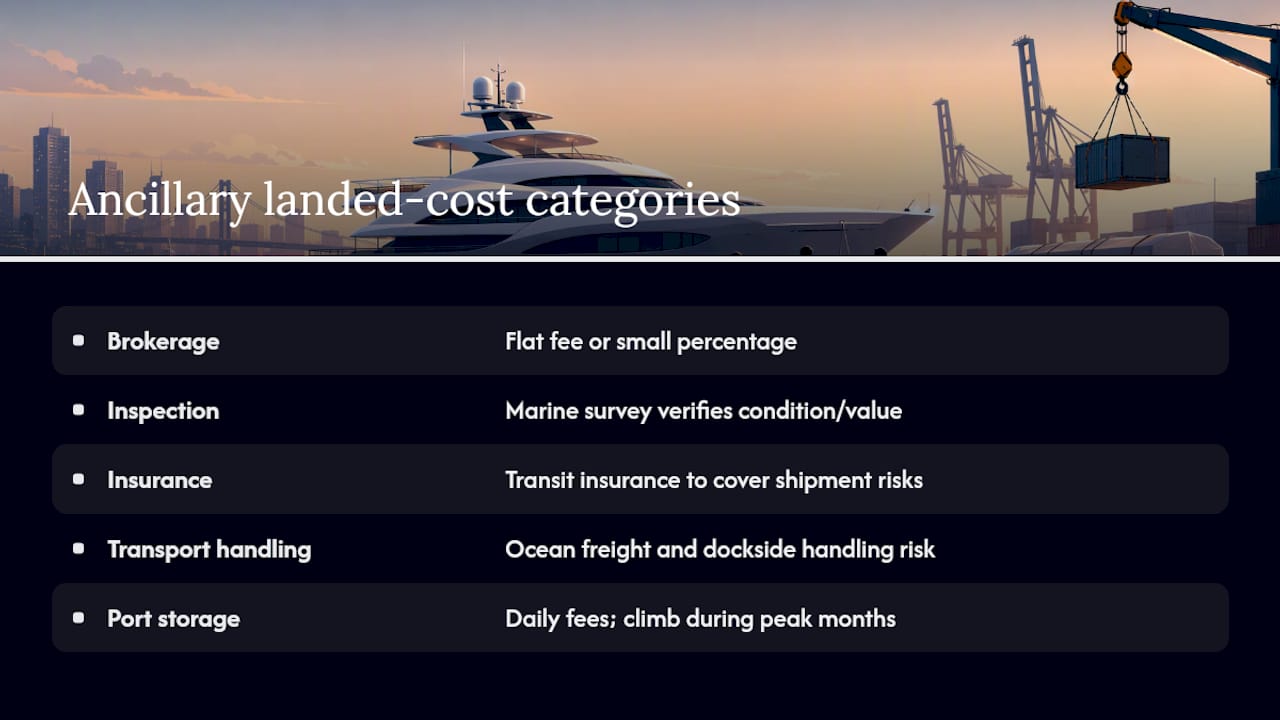
Insurance during transit is easy to overlook until something goes wrong mid-shipment, so applying proper gelcoat protection is an essential step to guard your boat’s finish throughout transport. Ocean transport and dockside handling carry real risk, and a lapse in coverage during that window can turn a minor incident into a financial disaster. Storage fees at the port of entry accumulate daily once a yacht clears customs but hasn’t been moved to its next destination, and ports with heavy seasonal traffic can see those daily rates climb fast during peak months.
Industry guidance on landed import costs suggests building in a buffer beyond duty alone to cover these ancillary categories, often a moderate additional percentage, according to Yachttrading’s import guide. That range depends heavily on vessel size, port, and how quickly you can arrange onward transport. Our shipping cost overview breaks these ancillary categories down further for buyers building a full budget.
How Do You Actually Pay Customs Duties and Fees?
Payment timing follows the entry process, and it’s less flexible than most first-time importers expect. CBP generally requires duty, MPF, and HMF to be paid at or near the time of formal entry, before the yacht is released for use.
Licensed customs brokers typically handle payment on the importer’s behalf, using an established bond or account with CBP, then invoice the client directly. This is one of the practical advantages of working through a broker rather than attempting a self-filed entry: brokers already have payment infrastructure in place, which avoids the delay of setting up a first-time payment method mid-transaction.
Accepted payment methods generally include wire transfer and, for brokers with established accounts, ACH debit through CBP’s electronic systems. Personal checks and cash are not standard practice for formal entries at this value level. The annual $25 private vessel user fee is typically paid separately at first arrival each calendar year, often directly to the port rather than folded into the broader entry payment.
Timing discipline matters here. Fees assessed at entry are due promptly, and delays in payment can hold up release of the vessel, adding storage costs on top of whatever you already owe. If you’re coordinating a purchase closing alongside the import, build a few days of buffer between your closing date and your planned entry date, so payment logistics don’t collide with an already tight timeline.
Does Vessel Age or Condition Change What You Owe?
Age and condition affect your import bill in ways that aren’t always obvious from the sticker price alone. Duty is assessed on declared value, and CBP has latitude to question a suspiciously low declared price against the vessel’s actual fair market value, particularly for older vessels where “value” gets more subjective.
Older yachts can also trigger more scrutiny on EPA emissions compliance. Engines that predate certain emissions standards may need additional documentation, or in rare cases, may face restrictions depending on how the engine was originally certified. This is exactly the kind of detail that a marine-specific customs broker catches early, before it becomes a hold-up at the port.
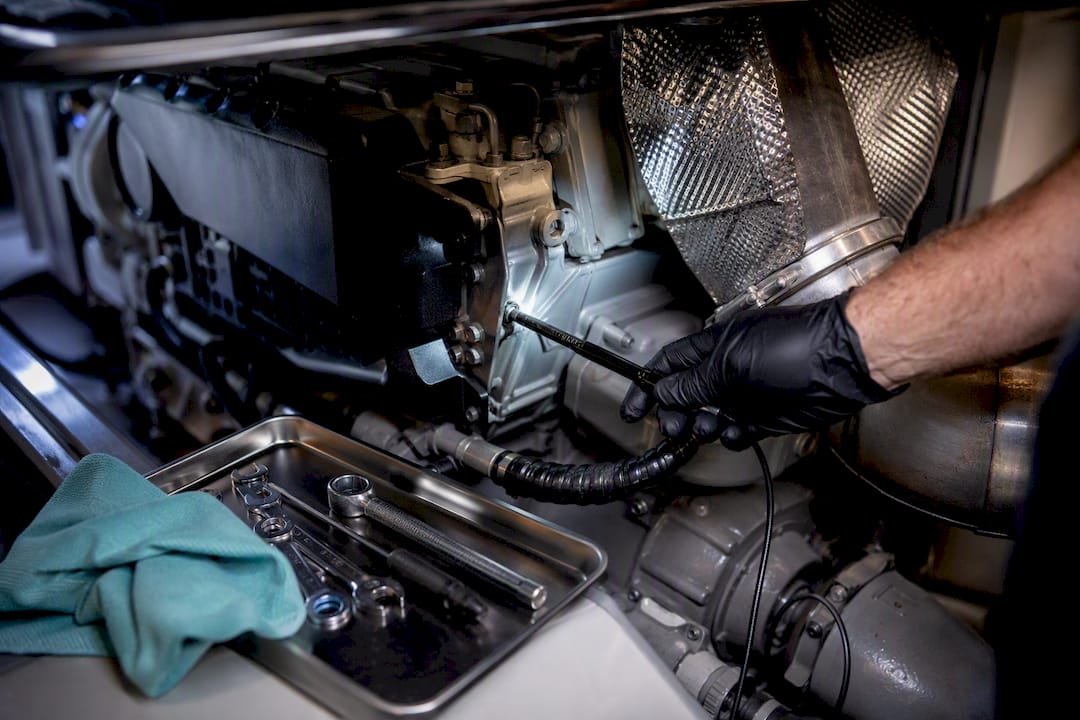
Condition matters for a second reason: a pre-purchase survey often becomes part of the valuation conversation. If a survey documents damage or deferred maintenance that materially affects value, that documentation can support a lower declared value, but it needs to be handled correctly and transparently, not used as a shortcut to underdeclare. CBP has seen every version of that trick, and getting caught costs far more than the duty saved.
Refit history matters too. A yacht substantially rebuilt or re-engined outside the United States can trigger a fresh look at non-U.S. content and origin rules, even if the hull itself was originally built domestically.
What Pitfalls Most Often Blow Up an Import Budget?
The buyers who end up paying more than expected almost always trace it back to one of a handful of repeatable mistakes.
Misclassification under the wrong HTS code sits at the top of the list. A vessel filed under the wrong subheading can trigger a completely different duty rate, and correcting it after the fact means reassessment, penalties, and delay. This is precisely the kind of error a broker prepares against by confirming classification and collecting valuation evidence before filing, according to guidance from licensed marine import specialists.
A few other repeat offenders worth flagging:
- Assuming last year’s tariff rate still applies. Origin-based measures under Section 301, 232, or IEEPA shift with little notice, and a rate that was accurate six months ago may not hold today.
- Underdeclaring value to save on duty. This is not a gray area; it’s a documented compliance violation that CBP actively investigates.
- Forgetting the trailer VIN rule and arriving without HS-7 paperwork for a trailered vessel.
- Assuming a cruising license covers a vessel intended for permanent U.S. use.
- Skipping a pre-purchase survey, then discovering an EPA or structural compliance issue only after the yacht has already crossed into U.S. waters.
Do Import Costs Vary by U.S. Port of Entry?
Federal duty, MPF, and HMF rates don’t change based on which port processes your yacht. HTS 8903 duty is a national rate, not a regional one. What varies by port is everything around that fixed federal number.
High-traffic yachting ports like Miami and Fort Lauderdale handle enormous volume, which cuts both ways. On one hand, brokers and CBP officers there see marine-specific paperwork constantly, and that familiarity often means faster processing for correctly filed entries. On the other hand, peak season congestion at those same ports can mean longer waits simply due to volume, along with higher storage costs if your yacht sits waiting for a slot.
Smaller or less-trafficked ports may move faster on any given day, but staff there may see fewer yacht-specific entries, which can translate to more questions and slower resolution if something in your paperwork looks unusual. Regional CBP pleasure-boat pages, like the one covering Alabama, Louisiana, and Mississippi, confirm the same $25 annual user fee applies regardless of location, reinforcing that the federal fee structure itself is uniform nationwide.
The real cost variable between ports is logistics: marina availability, haul-out capacity, local surveyor availability, and how quickly a broker local to that port can turn around your entry filing.
A Broker’s View on Managing Import Risk
The paperwork is not the hard part. The hard part is catching a misclassification or a missing EPA form before it costs you weeks and thousands in avoidable fees. Coordinating customs, state registration, and documentation is exactly where an experienced broker earns their fee. Start by gathering your bill of sale and engine records, then talk to a qualified customs broker before you close.
— Jason
How Yachts-bysteve Simplifies Your Import Coordination
Importing a yacht into the United States means juggling CBP entries, EPA declarations, state tax questions, and a purchase closing all at once, and most buyers only want to do that math once. Our team brings extensive hands-on experience in global yachting and manufacturing to that exact coordination challenge, with direct, personal guidance through each step rather than handing you off to a call center. Whether you’re considering a catamaran, a flybridge cruiser, or a new build for Florida waters, this service helps you line up documentation, understand your duty exposure, and avoid the classification errors that turn a straightforward import into an expensive delay. Ready to see what’s currently available or get a read on your specific import situation? Visit Yachts-bysteve to start the conversation, or explore how to choose the right yacht broker for your purchase.
Sources
- Importing a Boat for Personal Use into the United States
- 19 USC 58c: Fees for certain customs services
- HTS 8903: Yachts and other vessels for pleasure o… US import duty (2026) | Tariffs API
- Search
FAQ
What Is the 24-Meter Rule for Yachts?
Vessel length thresholds typically relate to international commercial and safety classification standards, not U.S. federal import duty, which is instead determined by HTS 8903 classification and declared value regardless of vessel length.
What Is the 12-Person Rule for Yachts?
This generally refers to passenger limits under maritime safety and commercial charter regulations rather than import cost, so it doesn’t affect the duty, MPF, or HMF calculations covered here.
Can a 50-Foot Yacht Cross the Atlantic?
Many larger yachts are capable of an Atlantic crossing with the right hull design, fuel range, and experienced crew, though that’s a seaworthiness and routing question separate from import duty, which applies once the vessel arrives in U.S. waters regardless of how it got there.
Who Should Handle My Yacht’s Customs Entry?
A licensed customs broker with marine-specific experience is strongly advisable, since correct HTS classification and complete EPA and NHTSA paperwork are what prevent costly delays and reassessments at the port.
Recommended
Featured Listings

2028 Columbus Yachts
$22,900,008
137
Ancona

2012 Benetti PATIENCE
$10,975,000
132
Fort Lauderdale Florida

2028 Kingship Kingship
$20,350,000
125

2024 Silver Yachts
$25,400,000
117

2009 Hargrave BRANDI WINE
$2,500,000
114
Fort Lauderdale Florida

2028 Extra Yachts
$20,350,000
100
Ancona

2028 Alpha
$12,100,000
100
Ft Lauderdale Florida

2028 Extra Yachts Extra 96
$9,495,000
96
Ancona

2021 Sanlorenzo GATSBY
$6,795,000
96
Fort Lauderdale Florida

2028 Kingship
$11,990,000
90

2028 Alpha
$9,894,500
90
Fano

2023 Azimut COMPASS
$7,950,000
88
Miami Beach Florida

1999 Northern Marine OFF LINE
$2,495,000
84
Ft Lauderdale Florida

2013 Pershing DOROTHY ANN
$1,375,000
82
Fort Lauderdale Florida

1997 Ferretti Yachts
$825,000
80
La Paz

2008 Princess Yachts OCARALIA
$1,095,000
75
Charleston South Carolina

2014 Sunseeker
$1,400,000
68
New York New York

2024 Fairline
$2,750,000
68
Ft. Lauderdale Florida

2019 Vanquish Yachts IMPULSIVE
$1,799,000
58
Miami Beach Florida

2021 Ferretti Yachts HAVEN
$1,595,000
57
Fort Lauderdale Florida

2025 Formula BREAKTHROUGH III
$1,895,000
53
Miami Beach Florida

2023 Fairline
$900,000
45
Fort Lauderdale Florida

2012 Zeelander Mississippi Queen
$575,000
44
West Palm Beach Florida
2028 Columbus Yachts 137'
$22,900,008
2012 Benetti 132'
$10,975,000
2028 Kingship 125'
$20,350,000
2024 Silver Yachts 117'
$25,400,000
2009 Hargrave 114'
$2,500,000
2028 Extra Yachts 100'
$20,350,000
2028 Alpha 100'
$12,100,000
2028 Extra Yachts 96'
$9,495,000
2021 Sanlorenzo 96'
$6,795,000
2028 Kingship 90'
$11,990,000
2028 Alpha 90'
$9,894,500
2023 Azimut 88'
$7,950,000
1999 Northern Marine 84'
$2,495,000
2013 Pershing 82'
$1,375,000
1997 Ferretti Yachts 80'
$825,000
2008 Princess Yachts 75'
$1,095,000
2014 Sunseeker 68'
$1,400,000
2024 Fairline 68'
$2,750,000
2019 Vanquish Yachts 58'
$1,799,000
2021 Ferretti Yachts 57'
$1,595,000
2025 Formula 53'
$1,895,000
2023 Fairline 45'
$900,000
2012 Zeelander 44'
$575,000