

That means a moderate annual amount scaling with the yacht’s value, with larger and more complex yachts typically incurring higher yearly costs. Those numbers assume a normal year. Add a refit or a season of heavy cruising, and the total climbs fast, which is exactly why disciplined management matters as much as the purchase price itself.
TL;DR:
- Routine annual costs for a yacht scale with size, with larger yachts often exceeding one million dollars, especially when fully crewed and used year-round.
- Major refits occur approximately every five to ten years and can cost between $2 million and $5 million for larger vessels, significantly impacting long-term budgets.
- A real operating budget should include dockage, insurance, crew wages, fuel, scheduled maintenance, and a reserve for unexpected repairs, with the 10% rule being only a rough estimate.
- Owners must account for upfront costs like surveys, initial deferred maintenance, and emergency reserves, which vary widely based on vessel age and usage profile.
- Proper management and annual budget reviews help prevent surprises, with professional yacht management often reducing costs for yachts exceeding 60 feet or with paid crew.
Table of Contents
- Quick Annual Yacht Maintenance Cost Summary By Size
- What Are The Main Recurring Yacht Maintenance Costs?
- Does The 10% Rule Actually Hold Up?
- Why Refit Years Blow Up A Normal Budget
- How Yacht Management Changes The Math
- Sample Annual Budgets You Can Adapt
- What Upfront Costs Belong In A Maintenance Budget?
- How Should You Budget For Emergency Repairs?
- What I’ve Learned Watching Buyers Underestimate The True Cost
- Get A Budget-Aligned Yacht Search With Yachts-bysteve
- Sources
Quick Annual Yacht Maintenance Cost Summary By Size
Before you fall in love with a specific listing, run the size and price through a rough annual filter. The ranges below reflect what owners across the industry typically budget for routine operating costs, not a one time renovation or a market downturn in resale value.
Part-time crew, regional cruising |
| 80 ft (~$4 million) | a typical annual cost in the mid six figures to over one million dollars | Full-time crew, extended seasons |
| — | annual costs generally exceeding one million dollars | Professional crew, year-round operation |
These figures come from size-based industry budget guides and represent recurring costs only. Multi-year refits, major engine overhauls, and depreciation sit outside these ranges entirely, and that distinction trips up more first-time buyers than any other line item on the budget.
Pro Tip: Ask any seller or broker for the last two years of actual operating invoices, not just an estimate. A real invoice history tells you more about a boat’s true upkeep than any size chart ever will.
What Are The Main Recurring Yacht Maintenance Costs?
Six categories eat up nearly all of a typical annual budget, and each one behaves differently depending on where and how you use the boat.
- Dockage and marina fees run from $10 to $30+ per foot per month, with waterfront cities and hurricane-prone regions charging a premium for covered or hurricane-rated slips.
- Insurance typically lands between 1% and 1.5% of insured value annually, though hull age, cruising territory, and crew credentials all swing that rate.
- Crew and payroll become the dominant line item once you cross roughly 60 feet, where crew costs often represent a significant portion of operating budgets on crewed yachts on a professionally crewed yacht.
- Fuel and consumables scale with engine hours and cruising speed, not distance. A displacement hull idling at anchor for a month costs almost nothing; the same boat running at planing speed for a week can burn through thousands.
- Engine servicing, haul-outs, and hull care include annual bottom painting, running gear inspections, and generator service, each typically running a few thousand dollars per event depending on size.
- Electronics, interior upkeep, and safety servicing cover chartplotter and satellite subscriptions, upholstery and teak deck maintenance, and mandatory recertification of life rafts, flares, and fire suppression systems.
A detailed 2026 maintenance cost guide confirms that dockage, insurance, and scheduled servicing are consistently the largest fixed expenses, well ahead of the smaller variable costs owners tend to fixate on.
Does The 10% Rule Actually Hold Up?
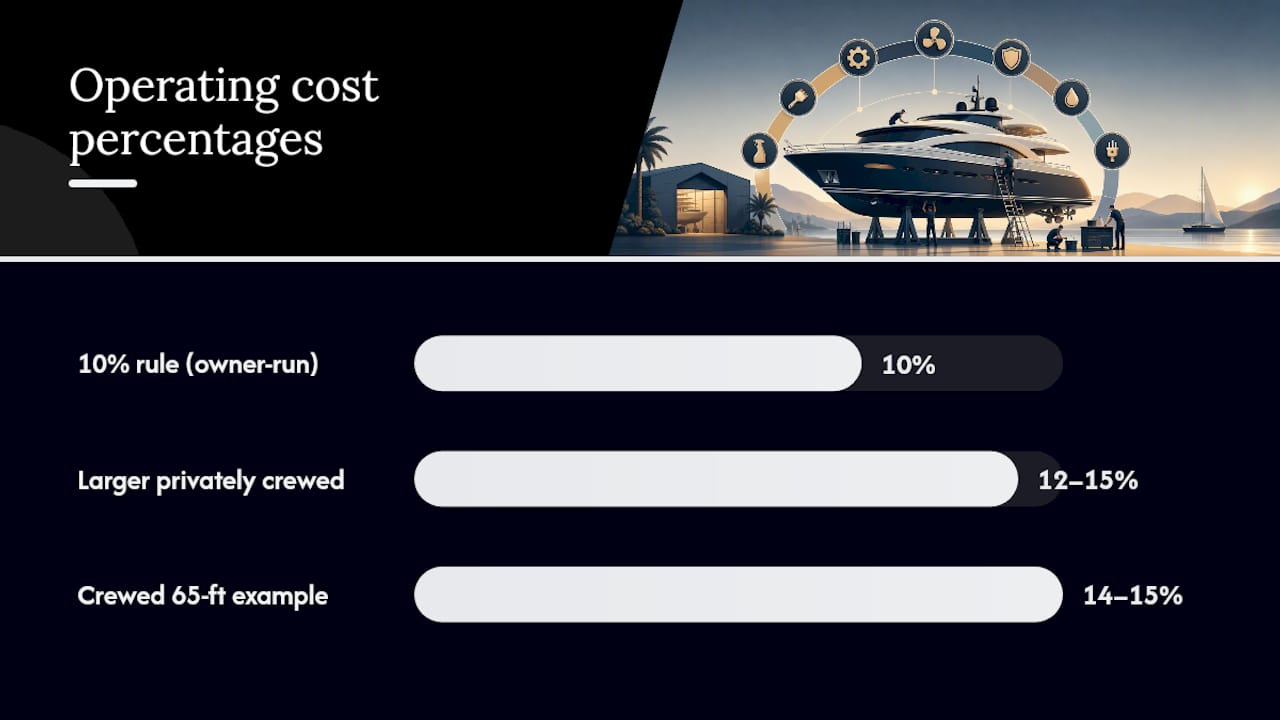
The 10% rule is a starting heuristic, not a guarantee. It works reasonably well for smaller, owner-operated boats where the owner handles most maintenance decisions directly. It breaks down fast once you add a paid crew, extended cruising seasons, or an older hull with deferred maintenance.
Several factors push a budget above or below that baseline: annual usage hours, vessel age, whether you hire full-time or part-time crew, your home berth’s cost of living, and how much electronics and mechanical equipment the yacht carries. A 2026 market analysis on superyacht operating costs found that 12% to 15% is often a more realistic band for larger, privately crewed motor yachts.
Consider two owners side by side. A crewed 65-footer with a full-time captain and mate routinely runs closer to 14% or 15%, purely because payroll adds a cost category the smaller boat never had.
Why Refit Years Blow Up A Normal Budget
Every yacht faces a major overhaul cycle roughly every five to ten years, and that single year can cost as much as the previous four combined. Planning around this reality separates realistic owners from ones caught flat-footed.
- Paint and hull work: full topside and bottom repaints on a mid-size yacht can range in the tens of thousands to a couple hundred thousand dollars.
- Engine and mechanical overhauls: rebuilding or replacing main engines and generators can run into the hundreds of thousands on larger vessels.
- Electronics and systems upgrades: replacing navigation suites, stabilizers, or air conditioning systems adds another significant chunk.
- Interior refresh: new upholstery, teak deck replacement, and cabinetry work round out a full refit.
On a large yacht, a comprehensive refit every ten years can reach $2 million to $5 million. Spread that $2 million over ten years and you get a $200,000 annual sinking-fund contribution, a number smart owners fold into every year’s budget rather than treating as a surprise.
How Yacht Management Changes The Math
A yacht management company handles maintenance scheduling, vendor negotiation, insurance renewals, and crew oversight so small issues get caught before they become five-figure repairs. That shift from reactive to scheduled maintenance is where the real savings live.
Preventive maintenance programs consistently cost less than emergency repairs and help preserve resale value, since a documented service history reassures future buyers and surveyors alike. A dedicated yacht management resource explains how a good manager also negotiates better rates with vendors than an individual owner typically can.
Pro Tip: Before hiring a manager, ask exactly how they bill: flat monthly fee, percentage of operating spend, or commission on vendor work. Each model changes the incentive to control costs.
Management tends to pay for itself once a yacht exceeds roughly 60 feet or carries any paid crew at all. Below that threshold, many owners handle scheduling themselves and rely on routine maintenance checklists instead.
Sample Annual Budgets You Can Adapt
A usable budget template lists dockage, insurance, crew, fuel, routine maintenance, and a refit reserve as separate line items, each assigned a dollar figure rather than a vague percentage.
Review the budget every year, not just when something breaks. Costs for insurance, dockage, and crew wages all drift upward annually, and a stale budget from three years ago will consistently understate what you’re actually spending.
What Upfront Costs Belong In A Maintenance Budget?
Before a single dollar goes toward routine upkeep, most buyers need to account for a set of one-time costs tied to the purchase itself. A pre-purchase survey is the biggest of these, typically covering hull integrity, mechanical systems, and safety equipment condition. A survey on a mid-size yacht commonly runs a few thousand dollars but can save you from inheriting a hidden five-figure repair.
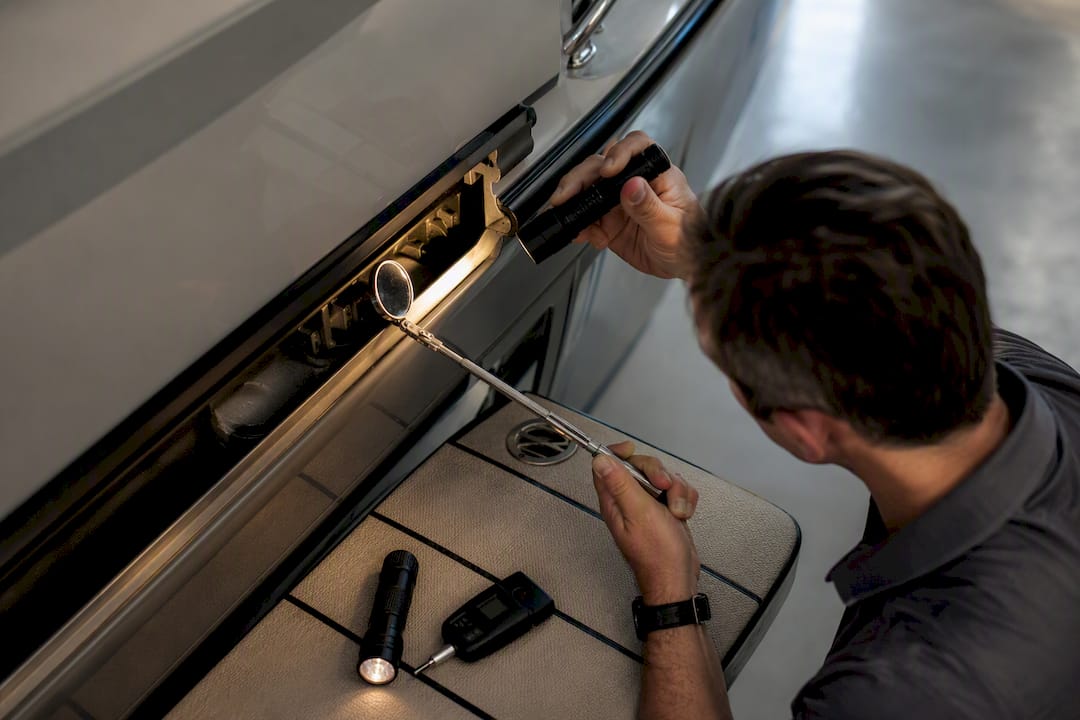
Sea trials, haul-out fees for the survey itself, and a baseline oil and fluid analysis often ride along with the survey process. Some buyers also commission a specialized rigging inspection on sailing yachts or an underwater hull inspection using a diver, both of which add modest but real costs on top of the main survey fee.
Once the purchase closes, budget for an initial round of deferred maintenance almost every used yacht carries. Even a well-kept boat usually needs fresh zincs, updated safety certifications, and a first detailing pass before it matches the condition described in the listing. Treat this initial catch-up spend as separate from your ongoing annual budget. Folding it into year one’s operating number distorts what a normal year actually costs, and that distortion tends to make owners either underestimate future years or panic unnecessarily when year two looks cheaper by comparison.
How Should You Budget For Emergency Repairs?
Every experienced owner eventually faces a repair nobody scheduled: a failed alternator mid-season, storm damage to a hardtop, or a transmission that needs replacing years ahead of expectation. The question isn’t whether this happens. It’s whether your budget already has room for it.
That separation matters: refit money is earmarked for known, cyclical work, while the emergency reserve exists for the unknown and immediate.
Vessel age heavily influences how large that reserve should be. A yacht under five years old, still largely under warranty, can lean toward the lower end of that range. A yacht approaching its second or third refit cycle, with systems well past their original service life, deserves the higher end and possibly more. Cruising profile matters too. A yacht that spends months offshore or in remote anchorages faces higher odds of an expensive tow, salvage, or emergency haul-out than one that stays close to a home marina with familiar service contacts on call.
The owners who handle emergencies best rarely have the least expensive boats. They simply never let the reserve fund sit at zero.
What I’ve Learned Watching Buyers Underestimate The True Cost
I’ve seen buyers budget carefully for insurance and dockage, then get blindsided by a teak deck replacement quote that came in at $80,000 on a boat they assumed was in “great shape.” The survey never flagged it as urgent. It just wasn’t due yet, until it suddenly was.
That’s the pattern worth remembering: the sticker price is the easy number. The real cost of ownership lives in the years you didn’t plan for. Fund a sinking account from day one, review your actual spending against budget every twelve months, and don’t let a quiet year lull you into thinking the quiet is permanent. If you’re still narrowing down what size or class of yacht actually fits your budget, a broker who understands operating costs, not just sale prices, is worth the conversation.
— Jason
Get A Budget-Aligned Yacht Search With Yachts-bysteve
A specialized yacht brokerage exists to address the common issue of buyers focusing on purchase price before realizing the ongoing operating costs. Expert brokers can guide buyers toward yachts matching their realistic annual budget, considering size, crew needs, and vessel age.
That alignment is the difference between an owner who enjoys the boat and one who resents the bills. If you want a search built around your realistic annual budget from the start, learn how to choose a yacht broker who will ask the right questions before you ever look at a listing, then reach out to a trusted yacht brokerage service to start that conversation.
Sources
- Yacht Maintenance Costs by Size: Budget Guide
- Preventive yacht maintenance: the annual plan to avoid emergency refitting – Orazzini Refit & Repair
- The Real Annual Cost of Running a Superyacht in 2026: A Complete Breakdown by Size – Hype Luxury Blog
- Yacht maintenance costs in 2026: the complete guide for yacht owners & captains – Swift Marine
Recommended
Featured Listings

2028 Columbus Yachts
$22,900,008
137
Ancona

2012 Benetti PATIENCE
$10,975,000
132
Fort Lauderdale Florida

2028 Kingship Kingship
$20,350,000
125

2024 Silver Yachts
$25,400,000
117

2009 Hargrave BRANDI WINE
$2,500,000
114
Fort Lauderdale Florida

2028 Extra Yachts
$20,350,000
100
Ancona

2028 Alpha
$12,100,000
100
Ft Lauderdale Florida

2028 Extra Yachts Extra 96
$9,495,000
96
Ancona

2021 Sanlorenzo GATSBY
$6,795,000
96
Fort Lauderdale Florida

2028 Kingship
$11,990,000
90

2028 Alpha
$9,894,500
90
Fano

2023 Azimut COMPASS
$7,950,000
88
Miami Beach Florida

1999 Northern Marine OFF LINE
$2,495,000
84
Ft Lauderdale Florida

2013 Pershing DOROTHY ANN
$1,375,000
82
Fort Lauderdale Florida

1997 Ferretti Yachts
$825,000
80
La Paz

2008 Princess Yachts OCARALIA
$1,095,000
75
Charleston South Carolina

2014 Sunseeker
$1,400,000
68
New York New York

2024 Fairline
$2,750,000
68
Ft. Lauderdale Florida

2019 Vanquish Yachts IMPULSIVE
$1,799,000
58
Miami Beach Florida

2021 Ferretti Yachts HAVEN
$1,595,000
57
Fort Lauderdale Florida

2025 Formula BREAKTHROUGH III
$1,895,000
53
Miami Beach Florida

2023 Fairline
$900,000
45
Fort Lauderdale Florida

2012 Zeelander Mississippi Queen
$575,000
44
West Palm Beach Florida
2028 Columbus Yachts 137'
$22,900,008
2012 Benetti 132'
$10,975,000
2028 Kingship 125'
$20,350,000
2024 Silver Yachts 117'
$25,400,000
2009 Hargrave 114'
$2,500,000
2028 Extra Yachts 100'
$20,350,000
2028 Alpha 100'
$12,100,000
2028 Extra Yachts 96'
$9,495,000
2021 Sanlorenzo 96'
$6,795,000
2028 Kingship 90'
$11,990,000
2028 Alpha 90'
$9,894,500
2023 Azimut 88'
$7,950,000
1999 Northern Marine 84'
$2,495,000
2013 Pershing 82'
$1,375,000
1997 Ferretti Yachts 80'
$825,000
2008 Princess Yachts 75'
$1,095,000
2014 Sunseeker 68'
$1,400,000
2024 Fairline 68'
$2,750,000
2019 Vanquish Yachts 58'
$1,799,000
2021 Ferretti Yachts 57'
$1,595,000
2025 Formula 53'
$1,895,000
2023 Fairline 45'
$900,000
2012 Zeelander 44'
$575,000