

Overview — In the U.S. market right now, yacht price per foot runs roughly $3,200 at the entry end and climbs past $600,000 per foot for bespoke superyacht builds. The formula is straightforward: purchase price ÷ length overall (LOA) = price per foot. A 40-foot production cruiser listed at $400,000 works out to about ten thousand dollars per foot. A 100-foot custom motor yacht at $20 million lands at about two hundred thousand dollars per foot. Same arithmetic, radically different worlds.
What that single number captures is the raw purchase price spread across the vessel’s length. Think of price per foot as a compass bearing, not a destination. It orients you quickly across listings and length bands, but it will mislead you the moment you treat it as the whole picture.
A practical rule of thumb: budget roughly 10% of the purchase price annually for ownership costs, though that figure can range from 8% to 20% depending on size, crew requirements, and how hard you use the vessel.
- Price per foot = purchase price ÷ LOA (length overall in feet)
- The metric reflects purchase price only; refit, commission, berthing, and running costs sit outside it
- Annual ownership costs commonly run between around eight and twenty percent of purchase price, with ten percent as a widely cited midpoint
Pro Tip: Never negotiate against the asking price per foot in isolation. Sellers price on total value, not length. A boat with a recent $200,000 refit may look expensive per foot but represent genuine value; one sitting at a low per-foot figure with 3,000 engine hours and no service records may cost you far more in the first year.
Key Takeaways
Yacht price per foot is a reliable budgeting compass for the U.S. market, but effective buyers pair it with survey data, refit history, and broker-level listing analysis before any offer is made.
| Point | Details |
|---|---|
| Price-per-foot formula | Purchase price ÷ LOA (in feet); always verify LOA from builder documentation, not the listing headline. |
| Per-foot ranges by size | Entry boats run roughly $3,200–$8,000/ft; mid-size 40–70 ft vessels range $9,000–$70,000/ft; 100 ft+ custom builds reach $120,000–$600,000/ft. |
| Annual ownership cost rule | Budget 8–20% of purchase price annually for running costs, with 10% as the widely cited midpoint for owner-operated vessels. |
| Negotiation cushion | Most superyachts sell 5–15% below asking; older or poorly maintained vessels often transact 15–25% below asking price. |
| Yachts-bysteve listing analysis | Yachts-bysteve applies per-foot analysis to individual listings to move buyers from published averages to offer-ready numbers. |
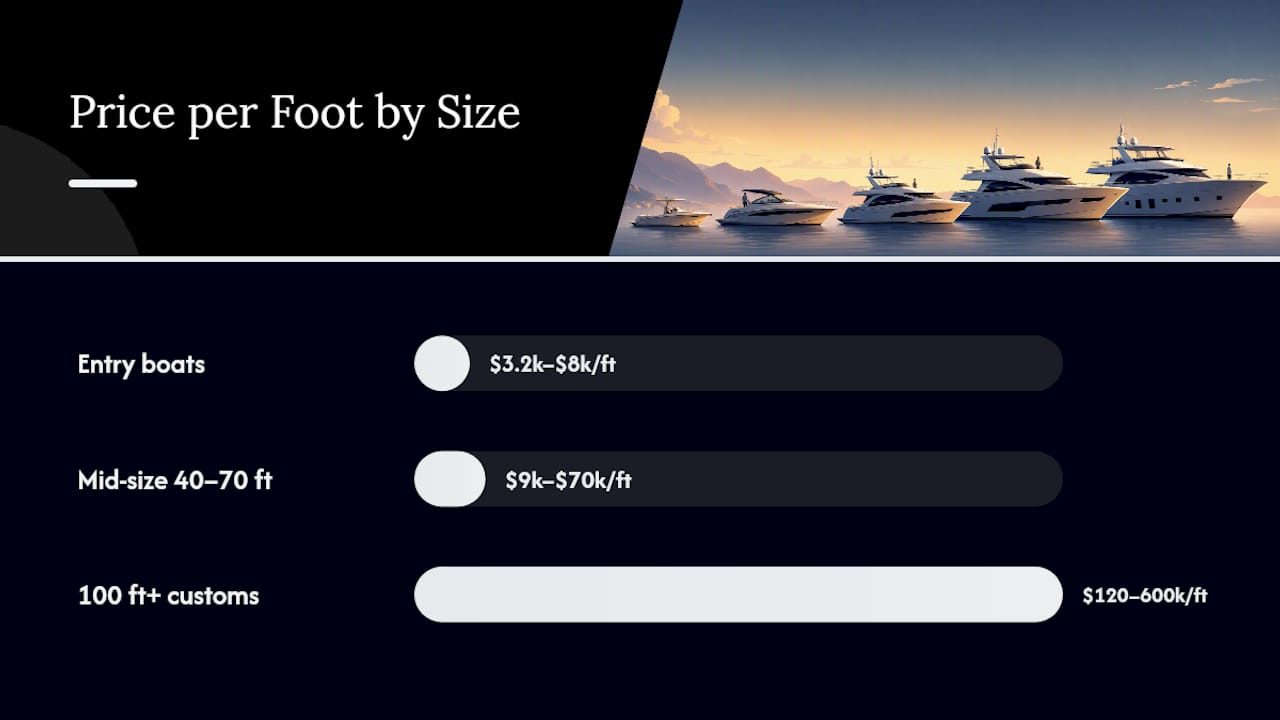
Table of Contents
- What does yacht price per foot look like across different lengths?
- How do you calculate price per foot correctly?
- New vs. pre-owned: how does price per foot really differ?
- What actually drives the price per foot on any given listing?
- What will it actually cost you to own a yacht each year?
- What should every buyer check before making an offer?
- Yachts-bysteve 2026 U.S. market snapshot: what the listings actually show
- Why price per foot is a tool, not a verdict
- Ready to apply these numbers to a real listing?
- Sources
What does yacht price per foot look like across different lengths?
The numbers below reflect the U.S. market in 2026, drawing on broker listing analysis, industry asking-price samples, and published per-foot benchmarks. New-build figures assume production or semi-custom builds; used figures assume reasonable condition with no major deferred maintenance.
Industry blog data puts new yachts under 30 feet at roughly $3,200 per foot, mid-range 50–60 foot vessels near $14,800 per foot, and new 80–100 foot yachts approaching $78,000 per foot. These are illustrative averages; actual listings vary considerably based on builder, specification, and condition.
Three worked examples:
- 30 ft production sailboat, used, $150,000: $150,000 ÷ 30 = $5,000/ft
- 70 ft motor yacht, new semi-custom, $7M: $7,000,000 ÷ 70 = $100,000/ft
- 200 ft superyacht, custom build, $80M: $80,000,000 ÷ 200 = $400,000/ft
For the 100-foot tier specifically, Cost Insider’s buyer guide documents a range of $120,000–$600,000 per foot depending on hull material and customization level, with basic steel-hull scenarios at the lower end and premium composite custom builds at the top.
A 50-foot cruiser listed in Fort Lauderdale will often carry a meaningfully higher asking price than the same vessel listed in the Gulf Coast or Pacific Northwest. Location’s effect on yacht valuation is a real and quantifiable factor in any per-foot comparison.
How do you calculate price per foot correctly?
The arithmetic is simple. Getting it right requires a few extra steps that most buyers skip.
The formula: Purchase price ÷ LOA (in feet) = price per foot
Step-by-step process:
- Locate the vessel’s LOA (length overall) on the specification sheet. LOA measures from the tip of the bow to the stern’s furthest point, including any fixed bowsprit or swim platform.
- Confirm you are using LOA, not LWL (load waterline length), registered length, or deck length. LWL is typically 10–15% shorter than LOA on a displacement hull, which inflates your per-foot figure if used by mistake.
- Take the asking price as listed. Do not adjust it yet.
- Divide: asking price ÷ LOA.
- Now adjust: add estimated immediate refit costs and subtract any realistic negotiation discount to get your effective per-foot entry price.
Worked example 1: A 30-foot sloop listed at $150,000. $150,000 ÷ 30 = $5,000/ft. A pre-purchase survey reveals $20,000 in deferred maintenance. Adjusted effective price: $170,000 ÷ 30 = $5,667/ft.
Worked example 2: A 70-foot motor yacht listed at $4,000,000. $4,000,000 ÷ 70 = $57,143/ft. $3,720,000 ÷ 70 = $53,143/ft.
The measurement caveat deserves real attention. Builders measure length differently. Some include fixed platforms in LOA; others do not. On a listing where the spec sheet shows 52 feet but the deck length is 48 feet, using 52 feet produces a lower per-foot figure that flatters the asking price. Always verify LOA against the builder’s original specification document or the vessel’s documentation papers, not just the listing headline. Understanding why yacht length matters beyond the price calculation is worth the extra reading before you make an offer.
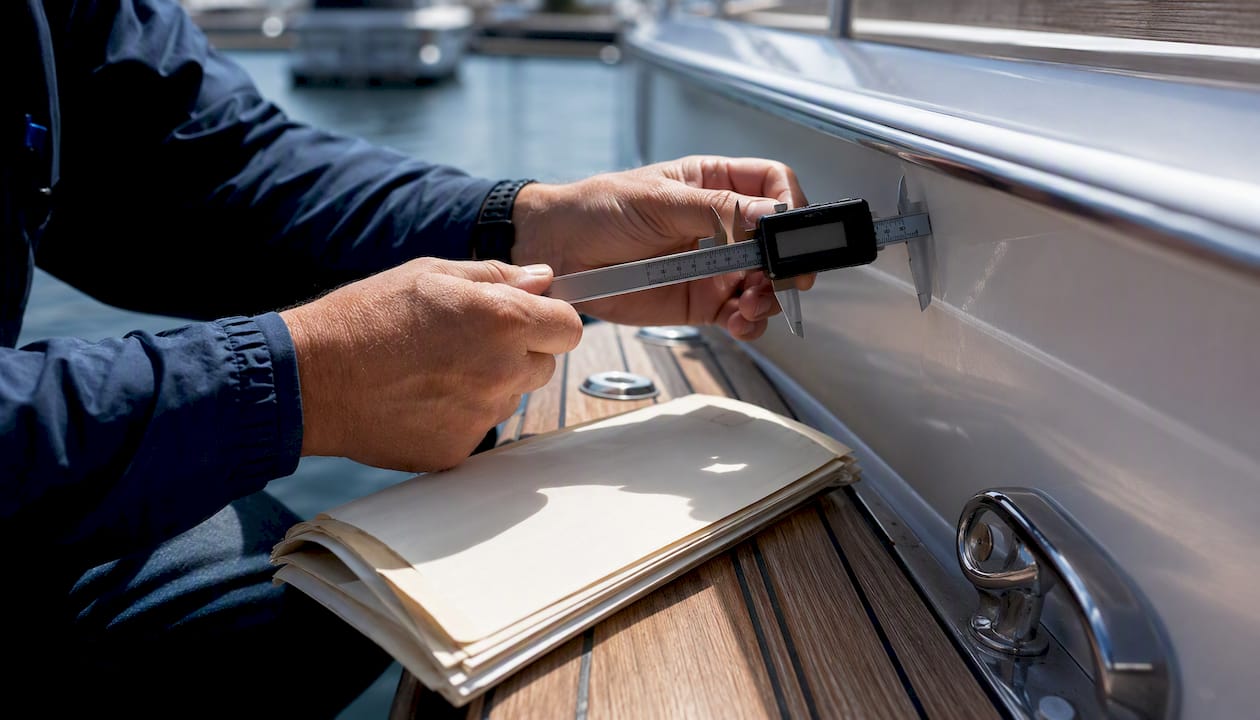
Pro Tip: Before comparing two listings on a per-foot basis, request the refit invoice history for both. A vessel with $150,000 in recent mechanical and cosmetic work may show a higher per-foot asking price but a lower effective cost once you factor in what you won’t spend in year one. That’s the comparison that actually matters.
New vs. pre-owned: how does price per foot really differ?
A new 50-foot production cruiser from a recognized builder typically lists at $1.2M–$1.8M, putting it at roughly $24,000–$36,000 per foot. A comparable 50-footer that is ten years old and well-maintained might list at $450,000–$750,000, or $9,000–$15,000 per foot.
The pre-owned discount can evaporate quickly. A ten-year-old 50-foot motor yacht at $600,000 ($12,000/ft) looks compelling until the survey surfaces $80,000 in engine work, $30,000 in electronics, and $25,000 in upholstery. Suddenly the effective entry price is $735,000, or $14,700/ft, and you are still buying a ten-year-old boat.
New builds carry a genuine premium for reasons beyond the obvious. Warranty coverage, factory-fresh systems, the ability to specify interior finishes and layout, and a delivery timeline that suits your schedule all add real value.
High-end custom builds depreciate more slowly, partly because their replacement cost is so high and partly because the secondary market for them is thinner and more relationship-driven.
Engine hours matter as much as calendar age for motor yachts. A five-year-old vessel with 2,500 hours on twin diesels may be closer to a major service interval than a ten-year-old boat with 400 hours. Per-foot comparisons between two used motor yachts should always be accompanied by an engine-hours check and a service log review. Sailboats are somewhat more forgiving on this front, but rigging age, sail inventory condition, and winch service history carry equivalent weight.
What actually drives the price per foot on any given listing?
Length is the starting point, not the explanation. Two 60-foot yachts can sit $2 million apart in asking price, and both figures can be entirely rational. The factors that influence yacht pricing are numerous, but a handful of them account for most of the variance you will encounter in real listings.
- Hull material and construction method: Fiberglass production hulls sit at the low end of the cost spectrum. Aluminum semi-custom builds add 20–30% to per-foot costs. Carbon fiber or advanced composite construction on a performance yacht can more than double the per-foot figure compared to a comparable fiberglass vessel of the same length.
- Builder and brand pedigree: A Feadship, Lürssen, or Benetti carries a brand premium that is as real as any specification upgrade. Branded collaborations push this further still — the Tecnomar for Lamborghini 63 is a documented example of how automotive-luxury partnerships create per-foot outliers that sit in a category of their own, well above the standard band for their length.
- Propulsion system: Twin diesel inboards are the baseline. Hybrid or full-electric propulsion adds cost. High-performance waterjet or pod-drive systems on a motor yacht can add $500,000–$1M+ to the total price, which translates directly into a higher per-foot figure.
- Interior finishes and customization: Production interiors are priced into the base cost. Custom joinery, rare stone, bespoke upholstery, and designer-specified lighting packages are pure additions. On a 70-foot yacht, a full custom interior refit can add $500,000–$2M to the vessel’s value.
- Onboard systems: Stabilizers (both underway and at-anchor), satellite communications, advanced A/V systems, watermakers, and generator capacity all add to the build cost and therefore to the per-foot figure. A well-equipped 60-footer with full stabilization and satellite connectivity will price meaningfully higher per foot than a stripped-down vessel of the same length.
- Refit history and certification: A vessel with documented recent refit work, current class certification, and a clean survey history commands a premium. The inverse is equally true.
- Intended use (private vs. charter): Charter-ready specification, including USCG or MCA compliance, commercial-grade safety equipment, and charter management history, affects both the asking price and the buyer pool.
Pro Tip: Once you pass roughly 50 feet, specification choices tend to outpace length as the primary driver of per-foot cost. Two 65-foot yachts from the same builder can differ by $3M in price based on systems and finishes alone. Budget for the spec, not just the length.
What will it actually cost you to own a yacht each year?
The purchase price is the headline. The annual running cost is the reality check. Yachtpedia’s 2026 ownership cost guide documents annual running costs that commonly fall in the range of 8–15% of purchase price, with the figure trending toward the higher end for larger, crewed vessels and toward the lower end for smaller, owner-operated boats.
A $500,000 40-footer might cost $40,000–$75,000 per year to run. A $5M 60-footer can easily reach $500,000–$750,000 annually once crew, fuel, insurance, and marina fees are accounted for. At the superyacht end, the math becomes its own discipline.
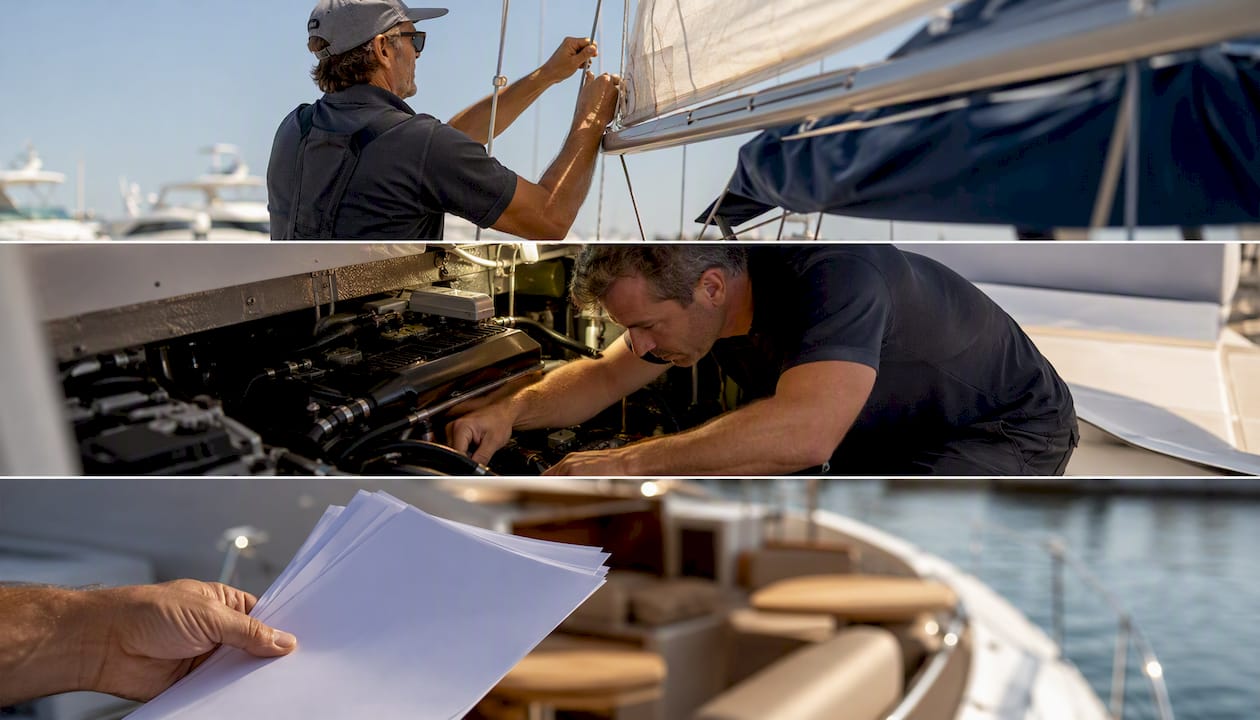
To convert annual ownership costs into an annualized per-foot figure, divide the annual total by LOA. A 60-foot yacht costing $300,000 per year to run adds $5,000 per foot per year to your effective ownership cost. Over five years, that is $25,000 per foot in running costs alone, on top of whatever you paid at purchase. Charter revenue through a managed program, such as those offered through Virgin Charter Yachts, can offset a meaningful portion of these costs, and charter-ready specification often supports a higher per-foot resale value as well.
What should every buyer check before making an offer?
Price per foot is a starting point for negotiation, not a closing argument. The buyers who use it most effectively treat it as a filter to identify listings worth investigating, then do the deeper work before any offer goes in.
Pre-offer checklist:
- Confirm LOA from original builder documentation, not just the listing
- Request the full survey history, including the most recent pre-purchase survey report
- Review engine logs and confirm current hours on all propulsion and generator units
- Obtain refit invoices for any work completed in the past five years
- Clarify berth terms: is a marina contract transferable, and at what cost?
- Confirm sales tax liability in the state of purchase and registration (this varies significantly by state)
- Understand delivery costs if the vessel is not in your target home port
- Ask about any outstanding warranties on systems or recent work
- Verify that the asking price is inclusive or exclusive of brokerage commission
Red flags to watch for:
- Inconsistent LOA figures across the listing, spec sheet, and documentation papers
- High days-on-market with no price reduction and no explanation
- Missing or incomplete refit records on a vessel over ten years old
- An unusually low per-foot asking price on a large yacht with vague condition notes
- Engine hours that don’t align with the vessel’s stated usage history
On negotiation: Superyacht Review’s pricing signals analysis documents that most superyachts sell 5–15% below asking price, while older or poorly maintained vessels often transact 15–25% below asking. Those ranges are useful anchors, but they are not guarantees. A well-maintained, recently refitted yacht in a high-demand market may attract multiple offers and sell at or above asking.
Pro Tip: Days-on-market is one of the most reliable signals of seller motivation. A listing that has been active for 180+ days without a price adjustment, in a market where comparable vessels moved in 60–90 days, tells you the seller has not yet accepted market reality. That gap is your negotiation leverage.
Yachts-bysteve 2026 U.S. market snapshot: what the listings actually show
Yachts-bysteve tracks active U.S. listings across the primary coastal markets, with a focus on the 40–120 foot range where the majority of serious private-buyer transactions occur. The 2026 snapshot draws on broker listing analysis across Florida, California, and the Northeast, cross-referenced against NMMA industry data for broader market-direction signals.
What the current market shows: Mid-size used yachts in the 40–60 foot range are transacting at effective per-foot prices roughly 15–25% below their 2022 peak levels, creating genuine value opportunities for prepared buyers. The 70–100 foot segment remains more resilient, with quality vessels holding per-foot values more firmly due to constrained new-build supply and longer lead times.
Two anonymized sample listings from the current Yachts-bysteve analysis illustrate how per-foot math plays out in practice:
Sample A: 52-foot motor yacht, 2016 build, listed at $895,000. LOA confirmed at 52 feet. Calculated per-foot: $17,212. Broker notes: engines at 1,100 hours with recent service, $45,000 in cosmetic work completed in 2024. Adjusted effective per-foot after refit credit: approximately $16,346 (adjusting for the refit value already absorbed into the asking price). Clean survey history. This vessel sits at the lower end of the 50–70 foot used range and represents a well-documented entry point.
Sample B: 78-foot sailing yacht, 2009 build, listed at $3,200,000. LOA confirmed at 78 feet. Calculated per-foot: $41,026. Broker notes: rigging replaced in 2023, two-cabin crew quarters, charter-compliant. Immediate refit estimate from surveyor: $120,000 for engine and electronics updates. Adjusted effective per-foot: $3,320,000 ÷ 78 = $42,564. Still within the used 70–100 foot band, but the refit requirement narrows the negotiation cushion.
Yachts-bysteve uses this kind of listing-level per-foot analysis to help buyers move beyond published averages and into the specific arithmetic of each vessel they are considering. Published ranges give you a map; listing analysis gives you the actual terrain.
Why price per foot is a tool, not a verdict
There is a version of the price-per-foot conversation that goes wrong in a very specific way. A buyer finds a 65-foot yacht at $8,000 per foot, compares it to a market average of $40,000 per foot for that length, and concludes they have found a bargain. Sometimes that is true. More often, the gap exists for a reason the listing does not volunteer.
Price per foot is most useful as a screening tool and least useful as a closing tool. At the screening stage, it helps you identify which length bands fit your budget and flag listings that are priced well above or below comparable vessels. At the closing stage, the per-foot figure becomes almost irrelevant compared to the survey, the engine logs, the refit history, and the specific terms of the transaction.
The other trap is using per-foot comparisons across different yacht types as though they were equivalent. A 50-foot sailing yacht and a 50-foot motor yacht are not the same asset. Motor yachts typically carry higher per-foot prices due to propulsion complexity, fuel capacity, and systems load. Catamarans price differently from monohulls of the same LOA because beam and interior volume differ substantially. Comparing them on a per-foot basis without accounting for type is like comparing a two-bedroom apartment to a studio by price per square foot and ignoring the room count.
The buyers who navigate this well are the ones who use per-foot data to build a shortlist, then bring a broker and a surveyor into the process before any number becomes an offer.
Ready to apply these numbers to a real listing?
Yachts-bysteve works with private buyers across the U.S. who are past the research stage and ready to move on a specific vessel or length band. The service covers buyer representation, listing-level per-foot analysis, negotiation support, and full delivery coordination, so you are not doing the arithmetic alone when it matters most.
The buyers who benefit most are those acquiring in the $500,000–$30M range, whether it is a first serious yacht purchase or a step up from a vessel they already own. Confidentiality is standard; custom searches for off-market vessels are available on request.
If you are ready to translate per-foot ranges into a real offer strategy, choosing the right yacht broker is the most consequential decision you will make in this process. Reach out to Yachts-bysteve for a personalized market snapshot and a conversation about what the current listings actually look like at your target length and budget.
Sources
The 2026 price-per-foot ranges in this article were compiled from a blend of public broker listing data, published market guides, and Yachts-bysteve’s own listing analysis across U.S. coastal markets. Where specific figures are cited, the source is linked inline.
- Yacht Prices & Ownership Costs: What You’ll Really Pay in 2026 — Yachtpedia
- 100-Foot Yacht Cost: Price Guide for Buyers – Cost Insider
- How Much Does a Yacht Really Cost per Foot?
This article is general information, not a substitute for advice from a qualified financial advisor. Consult a qualified financial professional about your own circumstances before acting on anything here.
Recommended
Featured Listings

2028 Columbus Yachts
$22,900,008
137
Ancona

2012 Benetti PATIENCE
$10,975,000
132
Fort Lauderdale Florida

2028 Kingship Kingship
$20,350,000
125

2024 Silver Yachts
$25,400,000
117

2009 Hargrave BRANDI WINE
$2,500,000
114
Fort Lauderdale Florida

2028 Extra Yachts
$20,350,000
100
Ancona

2028 Alpha
$12,100,000
100
Ft Lauderdale Florida

2028 Extra Yachts Extra 96
$9,495,000
96
Ancona

2021 Sanlorenzo GATSBY
$6,795,000
96
Fort Lauderdale Florida

2028 Kingship
$11,990,000
90

2028 Alpha
$9,894,500
90
Fano

2023 Azimut COMPASS
$7,950,000
88
Miami Beach Florida

1999 Northern Marine OFF LINE
$2,495,000
84
Ft Lauderdale Florida

2013 Pershing DOROTHY ANN
$1,375,000
82
Fort Lauderdale Florida

1997 Ferretti Yachts
$825,000
80
La Paz

2008 Princess Yachts OCARALIA
$1,095,000
75
Charleston South Carolina

2014 Sunseeker
$1,400,000
68
New York New York

2024 Fairline
$2,750,000
68
Ft. Lauderdale Florida

2019 Vanquish Yachts IMPULSIVE
$1,799,000
58
Miami Beach Florida

2021 Ferretti Yachts HAVEN
$1,595,000
57
Fort Lauderdale Florida

2025 Formula BREAKTHROUGH III
$1,895,000
53
Miami Beach Florida

2023 Fairline
$900,000
45
Fort Lauderdale Florida

2012 Zeelander Mississippi Queen
$575,000
44
West Palm Beach Florida
2028 Columbus Yachts 137'
$22,900,008
2012 Benetti 132'
$10,975,000
2028 Kingship 125'
$20,350,000
2024 Silver Yachts 117'
$25,400,000
2009 Hargrave 114'
$2,500,000
2028 Extra Yachts 100'
$20,350,000
2028 Alpha 100'
$12,100,000
2028 Extra Yachts 96'
$9,495,000
2021 Sanlorenzo 96'
$6,795,000
2028 Kingship 90'
$11,990,000
2028 Alpha 90'
$9,894,500
2023 Azimut 88'
$7,950,000
1999 Northern Marine 84'
$2,495,000
2013 Pershing 82'
$1,375,000
1997 Ferretti Yachts 80'
$825,000
2008 Princess Yachts 75'
$1,095,000
2014 Sunseeker 68'
$1,400,000
2024 Fairline 68'
$2,750,000
2019 Vanquish Yachts 58'
$1,799,000
2021 Ferretti Yachts 57'
$1,595,000
2025 Formula 53'
$1,895,000
2023 Fairline 45'
$900,000
2012 Zeelander 44'
$575,000