

Regional yacht price medians vary widely, but the gap is mostly a reflection of inventory mix, not a straightforward markup on the same boat. A 45-foot flybridge cruiser priced in Fort Lauderdale and a similar model listed in Palma may differ by hundreds of thousands of dollars simply because the Mediterranean listing pool skews newer and larger. Yachts by Steve has watched buyers chase a “cheap region” only to discover the savings evaporate once delivery, tax, and survey costs land. Use regional medians to screen your search, then ask a broker for like-for-like comparables, and budget ownership costs at roughly 10 to 15% of the vessel’s value every year.
TL;DR:
- Regional yacht medians largely reflect inventory mix, with newer and larger yachts in the Mediterranean pushing prices higher, not necessarily higher asking prices for identical boats.
- Charter demand and tax structures significantly influence regional price differences, often making a cheaper-looking boat in one region more expensive after additional costs are considered.
- For yachts around 40 to 60 feet, prices range from $250,000 to $2 million depending on the region, with the Mediterranean and Florida generally having higher medians.
- Buying in a distant region based solely on a lower median can incur extra costs for delivery, support, and taxes, often offsetting the initial savings.
- Owner costs are roughly 10 to 15% of the vessel’s value annually, and the breakeven point between chartering and owning is about 16 weeks of usage per year.
Table of Contents
- Yacht Prices by Region: A Snapshot Across Markets
- What Actually Drives Regional Price Differences?
- How Do Price Bands Compare Across Regions By Size?
- Is It Cheaper to Charter Than to Buy?
- How to Use Regional Price Data When Buying
- How Have Regional Yacht Prices Shifted Historically?
- Do Currency Swings Actually Affect Yacht Prices?
- Why Do Regional Supply and Demand Differ So Much?
- A Broker’s View: Common Mistakes First-Time Buyers Make
- Sources
- FAQ
Yacht Prices by Region: A Snapshot Across Markets
Ask “how much are yachts” and the honest answer is: it depends entirely on where you’re looking and what’s actually for sale there. Regional yacht pricing isn’t a single number. It’s a cluster of medians shaped by whichever boats happen to be listed in that market at that moment.
Country-level data from GetBoat’s median price-per-foot index shows wide spreads across listing markets, and the site is candid about why: medians describe the mix of what’s currently for sale, not a fixed price tag on a given hull. A market flooded with ten-year-old sailing yachts will post a lower median than one dominated by three-year-old motor yachts, even if the individual boats are comparably built.
Here’s roughly how the size bands stack up across major cruising regions, based on current listing data and regional market reporting:
- 30 to 40 feet: Typically $250,000 to $600,000, with the Caribbean and U.S. Gulf Coast often on the lower end and Mediterranean listings running higher due to newer inventory.
- 40 to 60 feet: Roughly $600,000 to $2 million, the band where regional spread starts widening noticeably.
- 60 to 80 feet: Commonly $2 million to $6 million, with Monaco and the French Riviera consistently near the top of this range.
- 80 feet and up: $6 million and climbing fast, often into eight figures, concentrated in the Mediterranean, the Middle East, and select U.S. East Coast markets.
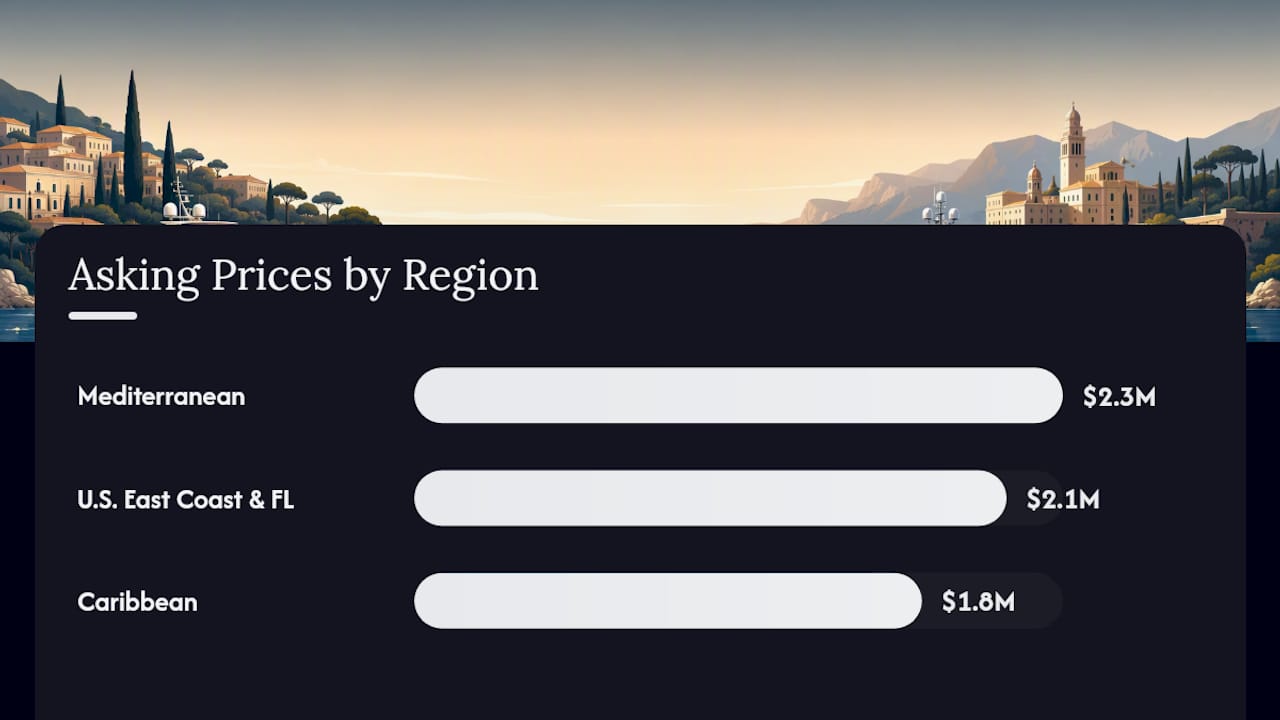
Statistic Callout: Regional index data from Get Top Lists puts average asking prices for 50 to 100 foot yachts around $2.3 million in the Mediterranean, $2.1 million on the U.S. East Coast and Florida, and $1.8 million in the Caribbean. Asia-Pacific and Middle East markets sit in comparable territory but with thinner inventory, which makes their medians more volatile month to month.
Monaco and the wider Mediterranean consistently post the highest per-foot medians of any region, largely because the fleet there trends newer, larger, and more heavily optioned. That’s not proof the region is overpriced. It’s proof the region is where a lot of the newest tonnage lives.
What Actually Drives Regional Price Differences?
The same yacht, hull for hull, rarely costs the same in two regions, and inventory mix is the biggest reason why. Markets with a higher concentration of newer, larger builds will always show a higher median than markets where the fleet skews older, even when individual comparable boats are priced similarly.
Charter demand adds another layer. The Caribbean and Mediterranean both function as major charter hubs, and that seasonal demand pulls certain size and price bands upward because charter operators compete with private buyers for the same inventory.
Then there’s the tax question, which trips up more first-time buyers than almost anything else. VAT, import duties, and registration requirements vary by jurisdiction and can add a meaningful percentage to the landed cost of a yacht, even when the asking price looked identical to a boat sold elsewhere. Yachts-bysteve’s guide on how location influences yacht buying breaks down how these regional tax and market differences change the real number you’ll pay.
- Larger, newer fleets concentrate in the Mediterranean and parts of the U.S. East Coast, lifting medians.
- Charter demand in the Caribbean and Mediterranean keeps certain size bands persistently firm.
- VAT, duties, and registration rules shift the effective price well beyond the sticker figure.
- Local service networks and haul-out access affect both resale value and day-to-day ownership cost.
Pro Tip: Before comparing two listings in different regions, ask what the effective landed cost is after tax and delivery. A “cheaper” boat two time zones away can end up costing more once you account for both.
How Do Price Bands Compare Across Regions By Size?
Breaking yacht prices down by size band makes regional pricing much easier to interpret than staring at a single national average.
At the 40 to 60 foot mark, a well-kept flybridge motor yacht in Florida often lists lower than a comparable model in the South of France, largely because builder presence and newer stock concentrate more heavily in the Mediterranean. Move into the 60 to 80 foot range and the gap widens further. Get Top Lists’ regional index shows Mediterranean averages for 50 to 100 foot yachts running roughly 20 to 25% above Caribbean figures for comparable size, driven largely by charter-ready inventory age and builder concentration.
Statistic Callout: For identical hull lengths, motor yachts often cost significantly more than sailing yachts, varying by size (https://www.yachttrading.com/yacht-encyclopedia/motor-yacht-vs-sailing-yacht-which-one-should-you-choose-in-2026-1198/), and that spread often widens further with size. A region with a motor-heavy fleet, like South Florida, will naturally post a higher median than a sail-heavy market of the same average length.
Regional notes worth remembering:
- Mediterranean: Premium builder presence and newer fleets keep medians elevated across nearly every size band.
- Caribbean: Strong charter demand supports firm pricing at 40 to 80 feet, though older tonnage pulls the overall median down.
- U.S./Florida and East Coast: A deep, liquid market with strong motor yacht representation and competitive pricing at the entry and mid-size bands.
- Asia-Pacific and Middle East: Smaller listing pools mean prices can swing sharply based on just a handful of transactions.
Every one of these figures reflects asking prices, not closed sale prices, and none of them include delivery or tax. Add both before you compare a listing across borders.
Is It Cheaper to Charter Than to Buy?
For most people, the honest math favors chartering, at least until usage crosses a specific threshold. Vital Charters’ cost comparison puts that threshold at roughly 16 weeks of use per year. Below that, chartering tends to come out ahead financially. Above it, ownership starts to make more sense.
Three numbers matter more than any others when you’re running this comparison:
- Annual operating cost: Commonly estimated at 10 to 15% of the yacht’s value every year, covering crew, dockage, insurance, and maintenance.
- Weekly charter equivalent: A high-end charter week often costs a fraction of what one week of ownership actually costs once fixed annual expenses are averaged across usage.
- Repositioning costs: Moving a yacht between cruising grounds, say the Caribbean to the Mediterranean for the season, can run tens of thousands of dollars and changes the regional economics considerably.
Statistic Callout: A $3 million yacht carrying a 12% annual operating cost runs roughly $360,000 a year in upkeep alone, before financing. That’s the number that changes minds faster than any brochure. Our guide on charter versus purchase tradeoffs walks through how lifestyle and investment goals should shape that decision.
How to Use Regional Price Data When Buying
Regional medians are a starting filter, never a final answer. Treat every published range as the first pass in a much more specific comparison.
- Match length, year, and builder. A 2016 55-footer isn’t comparable to a 2023 model of the same length, even in the same marina.
- Check refit history and engine hours. Two boats priced identically can carry very different mechanical futures.
- Ask for recent comparable sales, not just listings. Asking prices and closed prices often diverge by a meaningful margin.
- Confirm survey access before you commit. A seller who resists a full survey is a signal worth taking seriously.
- Budget delivery, tax, and registration separately. These rarely show up in the headline price but always show up on the closing statement.
Pro Tip: Ask your broker directly: “What did the last three comparable boats in this size and region actually sell for, not list for?” That single question filters out more bad deals than any spreadsheet.
Proximity matters more than most first-time buyers expect. Yachting World’s buying guide notes that a price-equal boat in a distant region doesn’t guarantee a comparable ownership experience, since local support and service access shape day-to-day satisfaction as much as the purchase price does. Our breakdown of yacht pricing dynamics covers the value factors worth weighing before you sign.
How Have Regional Yacht Prices Shifted Historically?
Regional pricing has never moved in lockstep. The Mediterranean’s status as a premium market has held for decades, anchored by builder concentration in Italy and France and reinforced by a charter economy that keeps demand steady even through soft years elsewhere. The Caribbean’s pricing has historically tracked hurricane season risk and insurance costs more than any other single factor, with medians softening in years following major storm damage to regional fleets.
The U.S. market, particularly Florida and the broader East Coast, has trended toward deeper liquidity over the past decade as more builders opened direct sales channels and brokers digitized listings. That liquidity tends to smooth out price swings compared to thinner markets. Asia-Pacific pricing has been the most volatile of the major regions historically, since a smaller pool of transactions means a handful of high-value sales can swing the regional median noticeably in a single year.
None of these regional patterns are permanent. Builder capacity shifts, new charter destinations open, and tax regimes change, all of which can move a region’s median over a two or three year window. That’s exactly why a snapshot median should never be treated as a long-term price guarantee. It’s a picture of the market at a moment, not a forecast.
Do Currency Swings Actually Affect Yacht Prices?
Currency matters more in yacht pricing than most buyers assume, especially for anyone shopping across the dollar and euro markets. A yacht priced in euros in the Mediterranean can become meaningfully more or less expensive for a dollar-based buyer purely because of exchange rate movement, with no change to the boat’s actual asking price in its home currency.
This cuts both ways. A strengthening dollar can make Mediterranean inventory look like a relative bargain to American buyers even when local prices haven’t moved at all. A weakening dollar does the opposite, quietly inflating the effective cost of a European purchase during the months between an accepted offer and closing.
Buyers negotiating across currencies should lock in exchange rate assumptions early and build in a buffer for movement between offer and closing, particularly on larger transactions where even a few percentage points of currency swing translates into real money. This is one more reason a raw regional median, quoted in whatever currency the listing market uses, needs translation into your own numbers before it means anything practical.
Why Do Regional Supply and Demand Differ So Much?
Every region’s pricing ultimately traces back to a straightforward supply and demand story, just with different players. The Mediterranean’s tight pricing reflects genuine builder concentration. Many premium yards are based in Italy, France, and the surrounding region, which means new inventory naturally lands there first before it filters elsewhere.
The Caribbean’s demand runs on charter economics more than local ownership. Winter charter season pulls buyers and operators toward the same limited pool of desirable yachts, which keeps prices firm in that specific window even when broader market conditions soften. The U.S. market benefits from sheer scale. A larger population of buyers and a mature dealer network create liquidity that smaller regions simply can’t match, which tends to produce more stable, predictable pricing.
Thinner markets like parts of Asia-Pacific and the Middle East face the opposite dynamic. Fewer transactions mean supply and demand can swing sharply based on just a few high-value deals, and a single large yacht entering or leaving the market can shift the regional median noticeably. Understanding which dynamic is driving a given region’s number is often more useful than the number itself.
A Broker’s View: Common Mistakes First-Time Buyers Make
Every season, Some buyers chase a lower regional median without weighing what sits behind it. One recurring pattern: someone buys a boat two regions away because the sticker price looked better, then spends the first year of ownership fighting warranty logistics and a service network that doesn’t know the vessel.
Proximity and support matter more than most first-timers expect going in. A boat priced 15% lower in a distant market can easily cost that difference back in delivery, unfamiliar service networks, and lost time during the first year. Specialist brokerage guidance exists precisely to catch that mismatch before a deposit changes hands, not after.
— Jason
Sources
Regional medians tell you where the market is, but they don’t tell you what a specific boat is actually worth to you. This gap can be closed with direct market intelligence, like-for-like comparables pulled from recent sales rather than stale listings, and guidance through every stage of a cross-region transaction. That combination is what separates a confident purchase from an expensive guess.
If you’re weighing a boat in one region against a comparable listing somewhere else, request a set of true comparables before you negotiate anything. Steve Doyle and the team can pull recent sales data specific to your size range and region, flag the tax and delivery variables that change the real cost, and walk you through next steps whether you’re buying or selling. Start at Yachts by Steve to request a private consult or join the VIP list for early access to new listings as they come to market.
- Yacht Charter vs. Ownership: Real Cost Comparison (2026)
- How to buy your first yacht (Yachting World, 2026)
- Yacht Prices by Country: Median €/ft | GetBoat
- 2025 Global Yacht Price Index: Regional Breakdown & Trends – Get Top Lists
FAQ
Why Do Yacht Prices Vary So Much By Region?
Regional prices differ mainly because of inventory mix, not identical boats carrying different price tags. Markets like the Mediterranean concentrate newer, larger yachts, which pulls the median up, while regions with older fleets post lower medians even when comparable individual boats are priced similarly.
What’s a Reasonable Annual Operating Cost Estimate?
Most estimates put annual operating costs at 10 to 15% of the yacht’s value, covering crew, dockage, insurance, and routine maintenance. Larger yachts and motor yachts generally sit toward the higher end of that range.
Is Buying Cheaper Than Chartering?
It depends entirely on usage. Chartering tends to be more economical below roughly 16 weeks of annual use, while ownership starts to make more financial sense above that threshold.
How much do yacht brokers typically charge for brokerage services?
Yachts by Steve doesn’t publish flat brokerage fees online. Current terms and services are available directly through Yachts by Steve after a private consult with the team.
Should I Trust a Low Regional Median as a Bargain Signal?
Not on its own. A low median usually reflects an older or smaller fleet mix in that market, and once you add delivery, tax, and survey costs, the apparent savings can shrink or disappear entirely.
Recommended
Featured Listings

2028 Columbus Yachts
$22,900,008
137
Ancona

2012 Benetti PATIENCE
$10,975,000
132
Fort Lauderdale Florida

2028 Kingship Kingship
$20,350,000
125

2024 Silver Yachts
$25,400,000
117

2009 Hargrave BRANDI WINE
$2,500,000
114
Fort Lauderdale Florida

2028 Extra Yachts
$20,350,000
100
Ancona

2028 Alpha
$12,100,000
100
Ft Lauderdale Florida

2028 Extra Yachts Extra 96
$9,495,000
96
Ancona

2021 Sanlorenzo GATSBY
$6,795,000
96
Fort Lauderdale Florida

2028 Kingship
$11,990,000
90

2028 Alpha
$9,894,500
90
Fano

2023 Azimut COMPASS
$7,950,000
88
Miami Beach Florida

1999 Northern Marine OFF LINE
$2,495,000
84
Ft Lauderdale Florida

2013 Pershing DOROTHY ANN
$1,375,000
82
Fort Lauderdale Florida

1997 Ferretti Yachts
$825,000
80
La Paz

2008 Princess Yachts OCARALIA
$1,095,000
75
Charleston South Carolina

2014 Sunseeker
$1,400,000
68
New York New York

2024 Fairline
$2,750,000
68
Ft. Lauderdale Florida

2019 Vanquish Yachts IMPULSIVE
$1,799,000
58
Miami Beach Florida

2021 Ferretti Yachts HAVEN
$1,595,000
57
Fort Lauderdale Florida

2025 Formula BREAKTHROUGH III
$1,895,000
53
Miami Beach Florida

2023 Fairline
$900,000
45
Fort Lauderdale Florida

2012 Zeelander Mississippi Queen
$575,000
44
West Palm Beach Florida
2028 Columbus Yachts 137'
$22,900,008
2012 Benetti 132'
$10,975,000
2028 Kingship 125'
$20,350,000
2024 Silver Yachts 117'
$25,400,000
2009 Hargrave 114'
$2,500,000
2028 Extra Yachts 100'
$20,350,000
2028 Alpha 100'
$12,100,000
2028 Extra Yachts 96'
$9,495,000
2021 Sanlorenzo 96'
$6,795,000
2028 Kingship 90'
$11,990,000
2028 Alpha 90'
$9,894,500
2023 Azimut 88'
$7,950,000
1999 Northern Marine 84'
$2,495,000
2013 Pershing 82'
$1,375,000
1997 Ferretti Yachts 80'
$825,000
2008 Princess Yachts 75'
$1,095,000
2014 Sunseeker 68'
$1,400,000
2024 Fairline 68'
$2,750,000
2019 Vanquish Yachts 58'
$1,799,000
2021 Ferretti Yachts 57'
$1,595,000
2025 Formula 53'
$1,895,000
2023 Fairline 45'
$900,000
2012 Zeelander 44'
$575,000