

Never act on emailed wiring instructions for a yacht purchase, no matter how official they look, without an independent phone call to a number you sourced yourself, not one pulled from the email. Yacht sale wire fraud thrives on exactly that moment of trust, the closing table, when a buyer wants to be done and stops asking questions.
Three things matter more than anything else in this article:
- Verify any wiring instructions by phone, using a number you find independently, before you send a cent.
- Fund the deal through an independent escrow service or a licensed marine title company, never a seller’s personal account.
- If you suspect fraud, stop all communication immediately and call your bank and law enforcement the same hour, not the same day.
Everything else in this guide builds on those three moves. Get them right, and you’ll close far more safely than most buyers ever realize is necessary.
Key Takeaways
Preventing yacht sale wire fraud comes down to independently verifying wiring instructions by phone and routing every dollar through licensed escrow rather than direct transfers.
| Point | Details |
|---|---|
| Verify before you wire | Call the escrow agent or attorney using a number you sourced yourself, never one from the email. |
| Use licensed escrow only | Route all funds through an independent escrow or marine title company, never a seller’s personal account. |
| Understand the legal limits | Under UCC Article 4A, banks can shift loss to you if they followed commercially reasonable procedures. |
| Lock instructions early | Confirm wiring details in writing well before closing and refuse same-day changes by email. |
| Act fast if fraud occurs | Call your bank, file with IC3 and the FTC, and preserve all communications immediately. |
Table of Contents
- How Yacht Sale Wire Fraud Actually Happens
- Why It’s So Hard to Get Wired Money Back
- The Prevention Checklist Every Yacht Buyer Should Follow
- The Secure Closing Workflow That Keeps Funds Safe
- What to Do the Moment You Suspect Fraud
- How Yachts-bysteve Builds Fraud Protection Into Every Closing
- Why the Standard Fraud Advice Falls Short
- Sources
How Yacht Sale Wire Fraud Actually Happens
Yacht sale wire fraud rarely looks like a crude scam. It looks like your closing, right down to the letterhead. Here’s the pattern that shows up again and again in brokerage circles:
- Email compromise near closing. Fraudsters monitor or spoof a broker’s, attorney’s, or seller’s email account, then send “updated” wiring instructions days or hours before the transfer, often citing a bank change or audit. These messages commonly provide fraudulent bank account details right before closing, and funds sent to them tend to vanish within minutes.
- Mirrored listings. Scammers copy photos, specs, and hull descriptions from a real yacht listing and repost them at a suspiciously attractive price, then vanish once a deposit lands.
- Bait-and-switch demands. Some listings for vessels that don’t exist ask for “expense allowances” or early deposits before any inspection takes place, a tactic outlined in recent analysis of consumer wire fraud liability.
- Payment method pressure. A request to use Zelle, Venmo, gift cards, or a wire straight to a personal account instead of escrow is one of the clearest signals something is wrong.
Fraudsters have even circulated forged identity documents, fake passports scanned as PDFs, to make a stolen listing feel more credible during negotiation.
Why It’s So Hard to Get Wired Money Back
Once a wire clears, the law is not on your side the way most buyers assume. Federal commercial law treats an authorized wire transfer as, well, authorized, even if a criminal tricked you into sending it.
Under UCC Article 4A, a bank that follows commercially reasonable security procedures can treat the transfer as authorized, which shifts the loss to the customer rather than the bank, even when the instructions came from a spoofed email.
That single legal fact explains why banks are often unable, not just unwilling, to reverse a fraudulent wire once it clears. Article 4A’s commercially reasonable standard means your bank’s obligation is procedural, not a guarantee it caught the fraud. Recovery odds drop sharply once funds cross state or international banking lines, sometimes within hours of the transfer clearing.
The practical takeaway: prevention beats recovery every time. Speed matters if fraud happens, but it’s a distant second to never sending the wire in the first place.
The Prevention Checklist Every Yacht Buyer Should Follow
This is the “check twice, send once” discipline that maritime attorneys and brokers keep repeating for good reason, because independent verification consistently outperforms trust-based transfers. Run through this before you authorize a single dollar:
- Verify the vessel’s paperwork. Confirm the original title, U.S. Coast Guard documentation, and the Hull Identification Number match the listing and the seller’s name, not a stand-in or “representative.”
- Insist on independent escrow. Use a licensed escrow arrangement or marine title company, never a seller-provided personal bank account, regardless of how reasonable the excuse sounds.
- Source the phone number yourself. Look up the escrow agent, broker, or attorney’s number independently, through a state bar directory or the brokerage’s official site, and call to confirm every detail before wiring.
- Lock instructions in writing early. Wiring details should be confirmed and documented well ahead of the transfer date. A change that arrives by email the morning of closing is a red flag, not a formality.
- Skip Zelle, Venmo, and ACH for deposits. These platforms were built for splitting dinner bills, not six-figure marine transactions, and they offer almost no fraud recourse once funds move.
- Bring in a surveyor and a maritime attorney. A certified surveyor’s inspection and an attorney’s title search catch liens, forged ownership claims, and phantom vessels before money ever moves.
Pro Tip: Ask the escrow agent to confirm your wiring instructions verbally, on a recorded or witnessed call, and require a 24 hour hold on any last-minute changes. That single buffer defeats most closing-day spoofing attempts before they can work.
Buyers who skip due diligence on the paper trail are the ones who end up explaining to their bank why they wired $400,000 to an account nobody can identify.
The Secure Closing Workflow That Keeps Funds Safe
A yacht closing has a natural order, and every deviation from it is where fraud sneaks in. Here’s the sequence worth requiring contractually, not just hoping happens:
- Offer and earnest money. Deposit funds go into a neutral escrow account, never a seller’s or broker’s operating account, the moment the purchase agreement is signed.
- Phone verification checkpoint one. Before the deposit moves, call the escrow company using a number you found independently to confirm account details match what’s in the contract.
- Inspection and survey. A certified surveyor examines the hull, engines, and systems, and confirms the vessel matches its documentation, before any additional funds are released.
- Title search. A maritime attorney clears the chain of title and checks for liens, confirming the seller actually owns what they’re selling.
- Phone verification checkpoint two. Immediately before the final wire, call the escrow agent again to reconfirm instructions, especially if anything in the deal changed since checkpoint one.
- Escrow funding and closing. Funds release only after signed closing documents, clear title, and survey sign-off are all in hand, coordinated by the broker as the point of contact for every party.
Each role has a distinct job: the broker keeps the timeline moving, the attorney clears title, the surveyor confirms condition, and the escrow agent holds the money until every box is checked. No single party should ever hold both the funds and the authority to release them.
What to Do the Moment You Suspect Fraud
Speed is everything once money has moved, even though recovery is far from guaranteed. Move through this sequence immediately:
- Call your bank first. Ask them to attempt a wire recall and to contact the receiving bank directly, since some funds can be frozen if caught within hours of clearing.
- File with IC3 and the FTC. Report to the FBI’s Internet Crime Complaint Center, then at reportfraud.ftc.gov, and file a report with local police the same day.
- Notify the listing platform and broker. They may have seen the same scheme target other buyers and can flag the account or listing.
- Preserve every scrap of evidence. Save emails with full headers, screenshots, wire confirmations, and call logs before anything gets deleted or overwritten.
- Call a maritime attorney fast. They can advise on realistic recovery paths and whether your bank’s security procedures were actually commercially reasonable.
Federal prosecutors do pursue these cases, and sentences can be severe, one wire fraud conviction resulted in a five-year prison term and asset forfeiture. That’s real accountability, but it rarely translates into your money coming back. Justice and reimbursement are two different outcomes, and only one of them is likely.
How Yachts-bysteve Builds Fraud Protection Into Every Closing
Yachts-bysteve treats fraud prevention as part of the brokerage service itself, not an afterthought bolted onto closing paperwork. That means:
- Coordinating escrow arrangements with licensed title companies instead of leaving buyers to sort out payment logistics alone is supported by resources like the Custom Power of Attorney Sample for Shipping that help manage secure documentation.
- Verifying seller documents, vessel registration, and Hull Identification Numbers before a listing ever reaches a client.
- Bringing in certified surveyors and maritime attorneys as standard practice, not optional extras, on every high-value transaction.
- Establishing phone verification checkpoints for wiring instructions at every stage of the deal, so no last-minute email change gets a pass.
If you want a clearer picture of what that kind of oversight actually involves, yacht brokerage services exist precisely to put a trained set of eyes on every document and every dollar before it moves.
Why the Standard Fraud Advice Falls Short
Most fraud prevention advice tells you to “trust your gut” or “watch for red flags,” which sounds reasonable until you’re staring at an email that looks exactly like every legitimate one you’ve received all week. Gut instinct doesn’t catch a spoofed domain that differs by one character. Independent verification does.
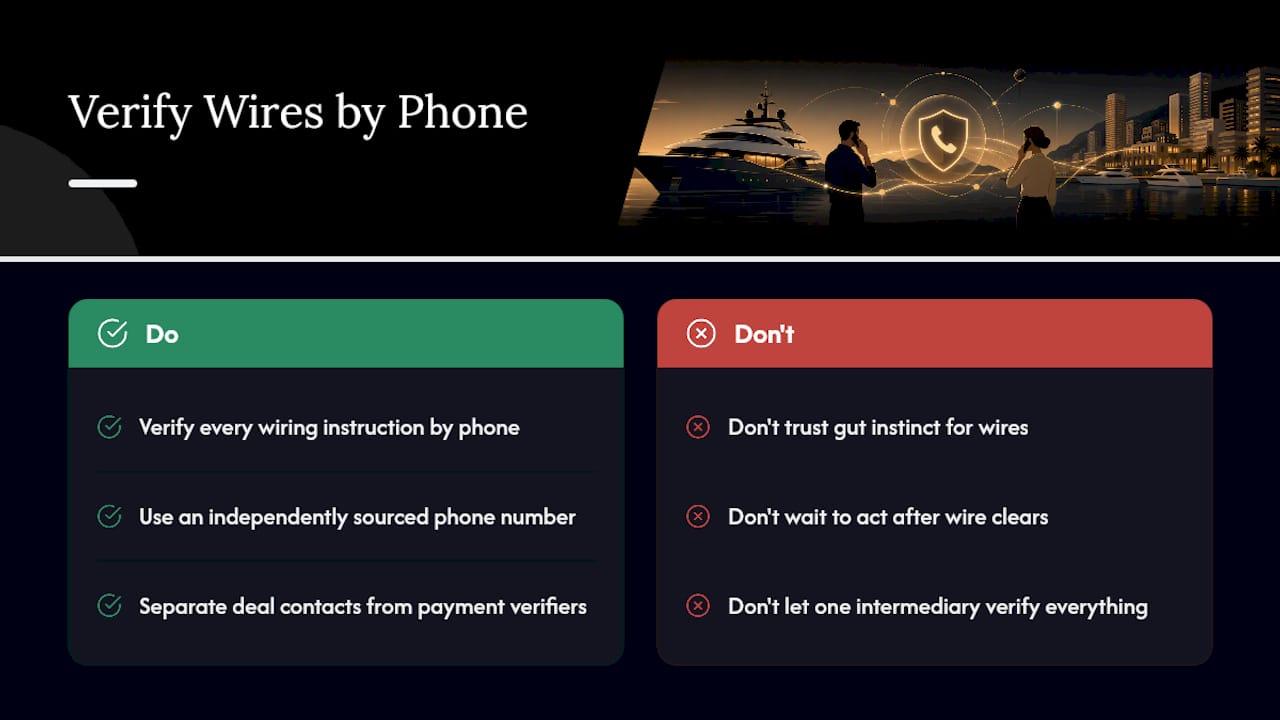
The bigger blind spot in conventional advice is the assumption that speed after the fact matters as much as prevention before it. It doesn’t. Once a wire clears under Article 4A’s authorized-transfer standard, you’re arguing procedure with a bank’s legal team, not requesting a simple reversal. Buyers should treat every wiring instruction, no matter who it’s from, as unverified until confirmed by an independently sourced phone call.
If there’s one habit worth building before your next yacht purchase, it’s this: separate the people who talk to you about the deal from the people who verify how the money moves. A broker, attorney, and escrow agent who each know their lane make a far tighter net than any single trusted intermediary ever could.
— Jason
Sources
- Fraudulent wire transfer instructions and other scams | IYBA
- Second Circuit poised to rule on what law applies to consumer wire fraud | Mayer Brown
- Buyers: How to Spot Scam Boats | Boat Alert Blog
- Fuel executive gets five-year prison sentence after defrauding U.S. military in contract bid scam | DOJ
Recommended
Featured Listings

2028 Columbus Yachts
$22,900,008
137
Ancona

2012 Benetti PATIENCE
$10,975,000
132
Fort Lauderdale Florida

2028 Kingship Kingship
$20,350,000
125

2024 Silver Yachts
$25,400,000
117

2009 Hargrave BRANDI WINE
$2,500,000
114
Fort Lauderdale Florida

2028 Extra Yachts
$20,350,000
100
Ancona

2028 Alpha
$12,100,000
100
Ft Lauderdale Florida

2028 Extra Yachts Extra 96
$9,495,000
96
Ancona

2021 Sanlorenzo GATSBY
$6,795,000
96
Fort Lauderdale Florida

2028 Kingship
$11,990,000
90

2028 Alpha
$9,894,500
90
Fano

2023 Azimut COMPASS
$7,950,000
88
Miami Beach Florida

1999 Northern Marine OFF LINE
$2,495,000
84
Ft Lauderdale Florida

2013 Pershing DOROTHY ANN
$1,375,000
82
Fort Lauderdale Florida

1997 Ferretti Yachts
$825,000
80
La Paz

2008 Princess Yachts OCARALIA
$1,095,000
75
Charleston South Carolina

2014 Sunseeker
$1,400,000
68
New York New York

2024 Fairline
$2,750,000
68
Ft. Lauderdale Florida

2019 Vanquish Yachts IMPULSIVE
$1,799,000
58
Miami Beach Florida

2021 Ferretti Yachts HAVEN
$1,595,000
57
Fort Lauderdale Florida

2025 Formula BREAKTHROUGH III
$1,895,000
53
Miami Beach Florida

2023 Fairline
$900,000
45
Fort Lauderdale Florida

2012 Zeelander Mississippi Queen
$575,000
44
West Palm Beach Florida
2028 Columbus Yachts 137'
$22,900,008
2012 Benetti 132'
$10,975,000
2028 Kingship 125'
$20,350,000
2024 Silver Yachts 117'
$25,400,000
2009 Hargrave 114'
$2,500,000
2028 Extra Yachts 100'
$20,350,000
2028 Alpha 100'
$12,100,000
2028 Extra Yachts 96'
$9,495,000
2021 Sanlorenzo 96'
$6,795,000
2028 Kingship 90'
$11,990,000
2028 Alpha 90'
$9,894,500
2023 Azimut 88'
$7,950,000
1999 Northern Marine 84'
$2,495,000
2013 Pershing 82'
$1,375,000
1997 Ferretti Yachts 80'
$825,000
2008 Princess Yachts 75'
$1,095,000
2014 Sunseeker 68'
$1,400,000
2024 Fairline 68'
$2,750,000
2019 Vanquish Yachts 58'
$1,799,000
2021 Ferretti Yachts 57'
$1,595,000
2025 Formula 53'
$1,895,000
2023 Fairline 45'
$900,000
2012 Zeelander 44'
$575,000