

Most recreational yacht sea trials last about 1.5 to 3 hours, and that window typically covers everything from a cold engine start to a full-throttle run. Builder acceptance trials on new construction or larger commercial vessels are a different animal entirely, often stretching across multiple days of formal testing. If you’re booking a trial with a survey attached, reserve at least a morning, and block off a full day when the yacht is large or complex enough to warrant it.
TL;DR:
- Sea trial duration varies from 1.5 to 3 hours for small recreational yachts and can extend to multiple days for large or complex vessels; planning accordingly is essential.
- Larger boats with advanced systems, stabilization, or multiple engines require more extensive testing time, often half a day or more, to thoroughly evaluate performance and systems under load.
- Critical steps like a cold engine start and post-run engine room inspection are vital to identify hidden issues and should never be skipped, even if time constraints tempt otherwise.
- A well-structured checklist guides an efficient trial from dock checks to handling and emergency maneuvers, ensuring no crucial test is rushed or overlooked.
- Buyer and surveyor fees are typically paid by the buyer, with survey costs based on vessel size, while seller often covers fuel costs, emphasizing clear documentation for negotiations.
Table of Contents
- What Determines Yacht Sea Trial Duration?
- Who Should Be on Board During a Sea Trial?
- What Should a Sea Trial Checklist Cover?
- How Does Trial Length Vary by Yacht Size?
- What Do Real Sea Trial Itineraries Look Like?
- What Does a Sea Trial Cost, and Who Pays?
- How Yachts-bysteve Helps You Plan the Right Trial
- A Broker’s View on the Mistakes Buyers Make
- Ready to Arrange Your Own Sea Trial?
- Sources
- FAQ
What Determines Yacht Sea Trial Duration?
A 32-foot express cruiser with a single diesel and straight shaft doesn’t need the same runway as a 65-foot flybridge motoryacht with pod drives, stabilizers, and three generators. Size sets the baseline, but propulsion complexity does the heavy lifting. A sailboat trial has to account for raising and trimming sail, tacking, and testing the auxiliary engine separately, which adds real time a powerboat trial skips entirely.
There’s also a meaningful split between what a private buyer needs and what a builder’s acceptance protocol demands. A buyer wants to know the boat runs true and the systems hold up under load. A shipyard running acceptance trials on a new build is verifying design specifications against measured performance, often referencing seakeeping standards like ISO 22834:2022 to assess comfort and motion characteristics in real sea states. Those are two different jobs, and they take two very different amounts of time.
Weather and logistics matter more than most first-time buyers expect. A marina with a long, no-wake transit zone can eat 30 minutes each way before you even reach open water to test anything. Short winter daylight windows compress your options. Sea state on the test day can force a captain to skip the high-speed run entirely, which means you may need a second trial date just to finish the job.
The factors that most reliably extend or shrink your time on the water:
- Hull length and displacement: bigger boats need longer warmup and more distance to reach cruise and top speed cleanly.
- Propulsion type: pod drives, waterjets, and sail rigging each add distinct test steps a simple single inboard doesn’t require.
- Onboard systems: stabilizers, bow thrusters, and advanced electronics all need separate functional checks.
- Trial purpose: a private buyer’s confirmation run is shorter than a formal builder acceptance test.
- Conditions on the day: wind, chop, and daylight can shorten the usable test window regardless of what’s scheduled.
Who Should Be on Board During a Sea Trial?
A sea trial works best as a small, purposeful crew, not a crowd. Each person on board has a distinct job, and skipping one usually means missing something important.
- The buyer rides along to feel the boat firsthand, taking notes on handling, noise, and comfort, and photographing anything that looks off.
- The broker manages logistics, timing, and the conversation between buyer and seller, and keeps negotiations moving if issues surface.
- A certified marine surveyor, ideally credentialed through a body like NAMS/CMS, SAMS-AMS, or IIMS, runs the technical evaluation and produces the written report the buyer will actually rely on.
- The seller or the seller’s captain operates the vessel and answers questions about maintenance history and quirks, though it’s worth remembering they have a financial stake in the boat performing well that day.
A sea trial functions as the performance verification that confirms mechanical systems and seaworthiness before money changes hands, and having a surveyor who answers to no one but the buyer is what keeps that verification honest.
What Should a Sea Trial Checklist Cover?
A good trial follows a sequence, not a random tour around the harbor. Skipping steps to save time is exactly how expensive problems get discovered after closing instead of before.
- Dock checks first. Review documentation, confirm fuel and oil levels, inspect batteries, and verify safety gear is aboard and current before the lines even come off; following UK hull cleaning steps can help avoid unexpected cleaning costs that impact trial readiness.
- Cold start. Insist the engines start from fully cold, not pre-warmed by the seller an hour earlier. A cold start reveals starting battery weakness, glow plug problems, and smoke patterns that a warm engine will hide completely.
- Idle and low-speed handling. Check steering response, thruster function, and any unusual vibration while still in protected water.
- Cruise speed run. Hold a steady mid-range RPM long enough to check temperature stability and fuel burn.
- High-speed run. Push toward top end briefly to confirm the boat reaches its rated performance without alarms or overheating.
- Handling and emergency maneuvers. Test hard turns, quick stops, and reverse response.
- Systems under load. Run air conditioning, generators, and electronics simultaneously to see if the electrical system holds up under real demand.
- Post-run inspection. Open the engine room immediately after shutdown to check for fresh leaks, unusual heat, or smells that only appear after a real workload.
Pro Tip: If your trial time gets cut short by weather or scheduling, don’t sacrifice the cold start or the post-run engine room check to fit in a longer high-speed run. Those two steps expose more hidden problems than an extra ten minutes at cruise speed ever will.
How Does Trial Length Vary by Yacht Size?
The right amount of time to book depends heavily on what class of boat you’re testing, and asking for too little time is the most common planning mistake buyers make.
- Trailerable boats and dayboats: a tight 1 to 1.5 hour loop is usually enough to cover the full checklist on a simple single engine setup.
- Recreational yachts, 30 to 50 feet: plan for 1.5 to 3 hours, which lines up with the industry-standard duration most surveyors expect for this range and matches what forum discussions among private buyers commonly report for typical outings.
- Large motoryachts, 50 to 100 feet: half a day to a full day, since multiple engines, stabilizers, and generator systems each need their own test window.
- New builds, refits, and commercial vessels: multi-day acceptance trials are standard, following formal testing protocols that can include endurance runs, classification society sign-off, and seakeeping assessments spread across several outings.
If a broker offers you a 45 minute slot on a 60 foot motoryacht with pod drives and full stabilization, that’s not enough time to do the job right, and it’s worth pushing back on before you agree to the date.
What Do Real Sea Trial Itineraries Look Like?
Having a template to hand your broker or the seller’s captain saves you from awkward back and forth about scheduling once you’re already at the dock.
- The 1 to 1.5 hour quick check: skip the scenic cruising and go straight to cold start, a 10 minute idle check, a 15 minute cruise run, a brief top-speed push, and 15 minutes of post-run inspection. This works when you already trust the seller or you’re doing a preliminary look before committing to a full survey.
- The standard 2 to 4 hour buyer and survey trial: 20 minutes dockside and cold start, 30 minutes at idle and low speed, 45 minutes at cruise and top speed with handling tests woven in, 30 minutes of systems under load, and a full 30 to 45 minute post-run inspection with the surveyor writing notes throughout.
- The multi-day builder acceptance trial: day one covers dockside commissioning and short local runs, day two covers extended endurance and speed trials plus seakeeping assessment in varied conditions, and a final session covers punch-list verification once the yard addresses anything flagged.
What Does a Sea Trial Cost, and Who Pays?
The trial itself is often free when a broker or dealer is showing a boat they represent, since fuel is the seller’s cost of doing business. What you’ll actually pay for is the surveyor, and that bill belongs to the buyer.
- Surveyor fees commonly follow a per-foot pricing scale, and buyer-paid surveys are the accepted norm across the industry rather than the exception.
- Fuel burned during the trial is typically covered by the seller, since the boat isn’t sold yet and the seller has an interest in demonstrating it well.
- Captain or crew time, if a professional delivery captain is required to run the boat, is usually negotiated case by case and should be settled before the trial date, not after.
- Documentation matters: get who pays for what in writing as part of the purchase agreement, since survey findings, most of which turn out to be routine maintenance items rather than deal-breakers, become your primary leverage in price negotiations regardless of who covered the bill.
How Yachts-bysteve Helps You Plan the Right Trial
Booking the right amount of time starts with knowing exactly what to ask for, and that’s where a step-by-step booking checklist pays off. It walks you through who to call, what information to hand the surveyor ahead of time, and how much time to actually reserve based on the boat you’re looking at.
- Log the numbers as you go: RPM at each speed stage, actual boat speed versus rated speed, fuel burn rate, and any vibration or noise that wasn’t in the listing description.
- Use a debrief form immediately after the trial while details are still fresh, not days later from memory.
- Turn anomalies into negotiating language: a documented vibration at 3,200 RPM is worth far more at the closing table than a vague memory of “it felt a little off.”
Pro Tip: Bring a phone with a voice recorder running in your pocket during the trial. Narrating observations in real time captures details a written note taken later almost always misses. The sea trial checklist built for exactly this purpose gives you a structured place to put all of it.
A Broker’s View on the Mistakes Buyers Make
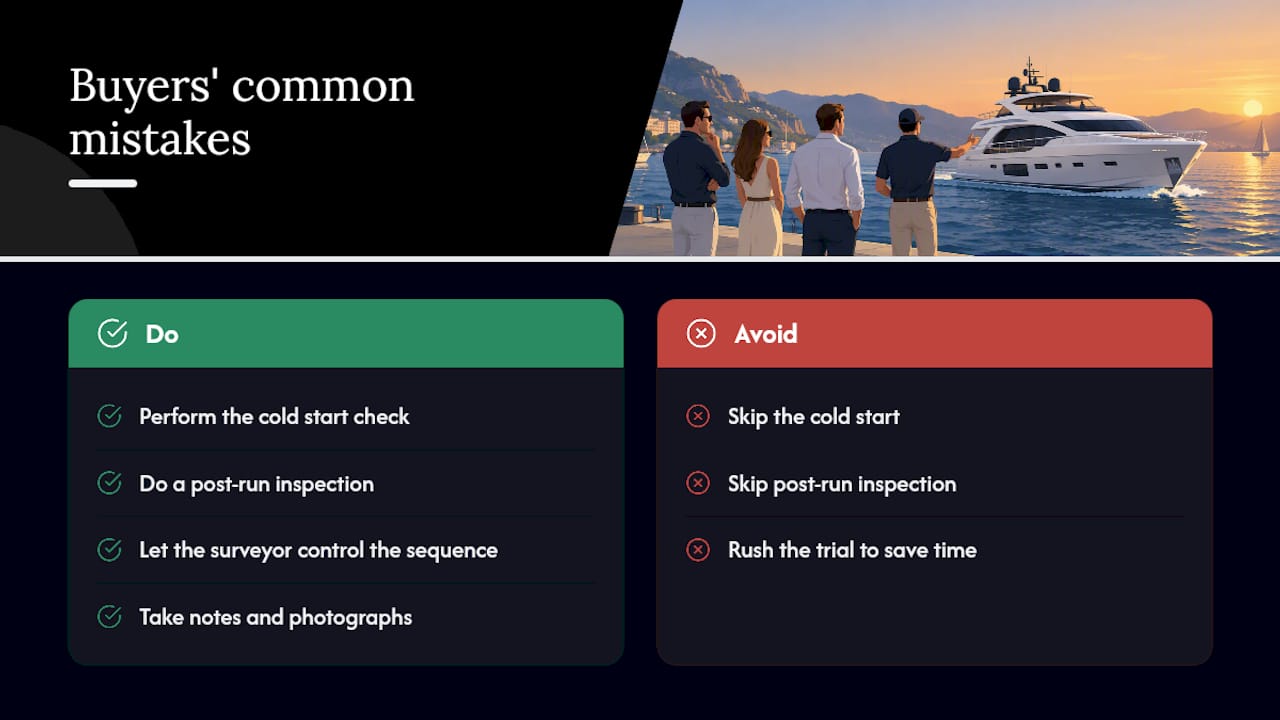
Buyers under time pressure tend to cut the two steps that matter most: the cold start and the post-run inspection. Both happen at moments when nothing exciting is visible on deck, which is exactly why sellers are sometimes happy to let them slide. A warm engine hides starting problems. A skipped engine room check after shutdown hides fresh leaks that only appear once the boat has been under load.
Stay hands-on without stepping on the surveyor’s process. Take your own notes, ask questions between test phases, and photograph anything that catches your eye, but let the surveyor control the sequence. A trial rushed to fit a tight schedule rarely reveals what it’s supposed to.
— Jason
Ready to Arrange Your Own Sea Trial?
Comparing sea trial time slots and surveyor availability across multiple listings is exactly the kind of coordination that eats up a buyer’s weekend, and it’s the piece Yachts-bysteve handles directly. Through Premier Yacht Broker Services, Steve Doyle and his team schedule the trial, line up a certified surveyor and captain, and hand you the same checklist and data logging templates covered above, so you walk into the trial knowing exactly what to test and in what order. Whether you’re evaluating a Sunreef catamaran, a flybridge cruiser, or a new build, the goal is the same: a trial that actually tells you something before you sign anything. If you’re ready to schedule a trial or want guidance on which questions to ask your surveyor, reach out to arrange your next steps today.
Sources
- Yacht Survey & Sea Trial: Costs & Checklist (2026) | Boat Tomorrow
- Yacht Survey and Sea Trial Checklist Before You Buy | The Luxury Playbook
FAQ
How Long Should a Sea Trial Last?
Most recreational sea trials last 1.5 to 3 hours, covering a cold start, cruise and top speed runs, handling tests, and a post-run inspection. Larger yachts or new builds can require half a day to several days depending on system complexity.
What Is the 12 Person Rule on a Yacht?
The passenger limits under maritime commercial vessel regulations typically trigger stricter safety and crewing requirements when exceeded. This doesn’t apply to a private pre-purchase sea trial, which usually involves a small group of buyer, broker, surveyor, and captain.
What Is the 10 Rule for Yachts?
There isn’t a single, universally recognized “10 rule” specific to yacht sea trials; this phrase varies by context and sometimes gets confused with unrelated boating guidelines. If you’ve seen it referenced for a specific regulation, it’s worth confirming the source directly with a surveyor or maritime authority rather than relying on a general definition.
How Long Do Sea Trials Last in the Navy?
Naval and other commercial or military sea trials are multi-day affairs, running for several days up to multiple weeks depending on the vessel class and testing scope. These trials evaluate endurance, speed, maneuvering, and seakeeping under a much more rigorous protocol than a private buyer’s trial ever needs.
Who Pays for the Sea Trial on a Yacht?
The surveyor’s fee is almost always the buyer’s responsibility, commonly billed on a per-foot scale. Fuel burned during the trial is typically covered by the seller, and captain or crew fees, when needed, are negotiated separately before the trial date.
Recommended
Featured Listings

2028 Columbus Yachts
$22,900,008
137
Ancona

2012 Benetti PATIENCE
$10,975,000
132
Fort Lauderdale Florida

2028 Kingship Kingship
$20,350,000
125

2024 Silver Yachts
$25,400,000
117

2009 Hargrave BRANDI WINE
$2,500,000
114
Fort Lauderdale Florida

2028 Extra Yachts
$20,350,000
100
Ancona

2028 Alpha
$12,100,000
100
Ft Lauderdale Florida

2028 Extra Yachts Extra 96
$9,495,000
96
Ancona

2021 Sanlorenzo GATSBY
$6,795,000
96
Fort Lauderdale Florida

2028 Kingship
$11,990,000
90

2028 Alpha
$9,894,500
90
Fano

2023 Azimut COMPASS
$7,950,000
88
Miami Beach Florida

1999 Northern Marine OFF LINE
$2,495,000
84
Ft Lauderdale Florida

2013 Pershing DOROTHY ANN
$1,375,000
82
Fort Lauderdale Florida

1997 Ferretti Yachts
$825,000
80
La Paz

2008 Princess Yachts OCARALIA
$1,095,000
75
Charleston South Carolina

2014 Sunseeker
$1,400,000
68
New York New York

2024 Fairline
$2,750,000
68
Ft. Lauderdale Florida

2019 Vanquish Yachts IMPULSIVE
$1,799,000
58
Miami Beach Florida

2021 Ferretti Yachts HAVEN
$1,595,000
57
Fort Lauderdale Florida

2025 Formula BREAKTHROUGH III
$1,895,000
53
Miami Beach Florida

2023 Fairline
$900,000
45
Fort Lauderdale Florida

2012 Zeelander Mississippi Queen
$575,000
44
West Palm Beach Florida
2028 Columbus Yachts 137'
$22,900,008
2012 Benetti 132'
$10,975,000
2028 Kingship 125'
$20,350,000
2024 Silver Yachts 117'
$25,400,000
2009 Hargrave 114'
$2,500,000
2028 Extra Yachts 100'
$20,350,000
2028 Alpha 100'
$12,100,000
2028 Extra Yachts 96'
$9,495,000
2021 Sanlorenzo 96'
$6,795,000
2028 Kingship 90'
$11,990,000
2028 Alpha 90'
$9,894,500
2023 Azimut 88'
$7,950,000
1999 Northern Marine 84'
$2,495,000
2013 Pershing 82'
$1,375,000
1997 Ferretti Yachts 80'
$825,000
2008 Princess Yachts 75'
$1,095,000
2014 Sunseeker 68'
$1,400,000
2024 Fairline 68'
$2,750,000
2019 Vanquish Yachts 58'
$1,799,000
2021 Ferretti Yachts 57'
$1,595,000
2025 Formula 53'
$1,895,000
2023 Fairline 45'
$900,000
2012 Zeelander 44'
$575,000