

Most yacht listings stall for the same handful of reasons: sellers price from emotion instead of the market, skip the pre-listing inspection, present a boat that looks tired in photos, and go quiet when a buyer asks a real question. The single highest-impact fix is pricing to market and getting the boat inspection-ready before it ever goes live. Everything else in this guide, from paperwork to sea trials, matters, but those two moves decide whether your listing moves in weeks or limps along for a year.
TL;DR:
- Pricing based on recent closed sales and preparing the boat inspection-ready significantly reduces time on the market, especially beyond the 90-day mark.
- Organizing all ownership documents, service records, and warranties before listing speeds up due diligence and avoids closing delays.
- Ensuring the boat looks clean, smells fresh, and is photogenic, along with strategic staging and location for photos, can substantially increase inquiries and sales speed.
- Responding promptly to buyer questions and setting clear negotiation terms, including deposit size and inspection windows, maintains listing momentum.
- Timing the listing for peak regional and seasonal demand and choosing an experienced broker can shorten the selling cycle and improve sale outcomes.
Table of Contents
- The Yacht Seller Mistakes That Cost the Most Time and Money
- Getting the Asking Price and Launch Window Right
- The Documents You Need Ready Before You List
- What to Fix Before the Camera Ever Comes Out
- Interviewing a Broker and Protecting Your Terms
- What Closing Actually Costs and How Long It Takes
- Why Brokerage Experience Changes the Outcome
- Neglecting Boat Maintenance Leading Up to Sale
- Failing to Understand Tax Implications of the Sale
- Ignoring Proper Marketing Channels and Target Audience
- Not Preparing for Sea Trial or Demonstration for Buyers
- Overlooking Timing and Seasonality of Yacht Sales
- What Actually Moves the Needle for Sellers
- How Yachts By Steve Helps Sellers Avoid Every Mistake on This List
- Sources
- FAQ
The Yacht Seller Mistakes That Cost the Most Time and Money
Every one of these yacht seller mistakes shows up in brokerage files again and again. Some cost a sale outright. Others just cost months.
- Overpricing based on attachment, not comparables. Sellers who remember what they paid, plus every dollar of maintenance since, almost always price above what the market will bear. Pull three to five closed comparable sales from the last six to nine months, not active listings, since active listings only tell you what other sellers hope to get.
- Presenting a boat that looks neglected. A dirty bilge, corroded battery terminals, or a lingering fuel smell tells a buyer the engine room has been ignored, even when the mechanicals are sound. Buyers equate visible cleanliness with maintenance, and they abandon interest fast when that signal is missing.
- Skipping the pre-listing survey. Sellers who wait for the buyer’s surveyor to find problems lose leverage and time. A pre-listing survey lets you fix or disclose issues on your own terms, before a buyer’s inspector finds them and starts renegotiating.
- Hiding known problems. A soft spot in the deck or a history of engine overheating will surface eventually. Disclosing it upfront, with a repair estimate attached, builds more trust than a buyer discovering it during survey week.
- Missing or disorganized paperwork. Incomplete title records, missing lien releases, or absent service history can delay closing by weeks even after a buyer commits.
- Choosing a broker who lists and waits. An ineffective broker uploads photos to a few sites and hopes. Ask any candidate broker how many active buyer inquiries they generated on comparable boats in the last 90 days.
- Slow responses to buyer questions. Failing to answer quickly or supply requested photos and records stalls momentum and buyers move to the next listing. Aim to respond within a few hours during business days, not a few days.
- Confusing price negotiation with terms negotiation. A seller who fixates only on the number often gives away the inspection window or deposit terms without noticing. Deposit size, inspection deadlines, and closing timeline deserve as much attention as the sale price itself.
Pro Tip: Keep a single answer sheet ready before you list, covering engine hours, last haul-out date, known issues, and asking price rationale. It turns a slow email exchange into a five-minute reply and signals to buyers that you’re organized and not hiding anything.
Getting the Asking Price and Launch Window Right
Build your comp set from actual closed sales, adjusted for engine hours, equipment, and condition, not the purchase price you paid years ago. Overpricing based on emotional attachment is the single most common reason listings stagnate, particularly once a boat sits past the 90-day mark and buyers start wondering what’s wrong with it.
- Set the initial asking price at the top of a realistic range, not above it, so the first wave of serious buyers actually sees the listing.
- Plan a modest reprice at day 45 to 60 if showings are light, rather than waiting until day 120.
- Keep a defined negotiation range separate from the asking price, and require proof of funds before scheduling a sea trial.
- Treat the deposit as a signal of seriousness, typically 10% held in escrow, not a formality to skip.
The Documents You Need Ready Before You List
Incomplete documentation and missing lien or title records create delays that can scuttle a deal even after both sides agree on price. Assemble this folder before you list, not after an offer arrives.
- Title or documentation certificate, current registration, and any lien release paperwork.
- Bill of sale template, engine serial numbers, and manuals for every major system.
- Complete service records, including oil analysis and any prior survey reports.
- Warranty documents still in effect for engines, generators, or electronics.
Buyers increasingly request this packet during early due diligence, and having it organized in a shared folder speeds up their due diligence process considerably. For a full breakdown of what documentation actually covers, see this owner’s guide to yacht paperwork.
What to Fix Before the Camera Ever Comes Out
Presentation problems are the fastest, cheapest fixes on this whole list, and they’re also the ones sellers skip most often.
- Clean the bilge completely and replace any corroded battery terminals before anyone photographs the engine room.
- Eliminate fuel, mildew, or head odors, since smell is one of the fastest ways buyers lose interest.
- Declutter cabins and lockers so photos show storage capacity, not personal belongings.
- Sequence photography deliberately: exterior profile, helm and electronics, engine room, cabins, then systems and storage.
- Move the boat to a premium berth for photo day if the current slip has poor light or a cluttered background.
A thorough post charter cleaning process is a useful reference even for a private sale, since the same detailing standards charter operators use for turnovers apply directly to pre-sale staging. Professional photography and a dedicated photo-day berth move often pay for themselves several times over by increasing inquiry volume and shortening time on market.
Pro Tip: Skip the expensive refit and spend that budget on photography and detailing instead. A photo-day berth move and a few hours of cleaning typically move the needle more than a $10,000 cosmetic upgrade nobody notices in listing photos.
Interviewing a Broker and Protecting Your Terms
Picking the wrong broker is one of the costliest yacht selling pitfalls, because it compounds every other mistake on this list. A passive broker won’t catch a pricing error, won’t push back on a bad offer, and won’t respond fast enough to hold a buyer’s attention.
- Ask how many qualified buyer inquiries they generated on comparable boats in recent months, and request references from recent sellers.
- Ask about co-brokerage relationships and which marketing channels they actually use beyond a single listing site.
- Watch for red flags: no references offered, vague answers about marketing reach, or unrealistic promises about closing timelines.
- Before signing anything, confirm the deposit amount, inspection window length, financing contingencies, and who carries liability during sea trial and delivery.
- Keep the purchase agreement focused on the yacht transaction itself. Standard templates can expand into broad corporate or tax audits that expose sellers to liability well beyond the boat sale, so resist redlines that widen scope without a clear reason.
What Closing Actually Costs and How Long It Takes
Most yacht sales run 60 to 120 days from listing to closing, and the delays that eat that timeline are predictable: survey findings that require negotiation, paperwork that wasn’t ready, or a lienholder who takes two weeks to respond to a payoff request.
- Budget for brokerage commission, typically a percentage of sale price agreed upfront with your broker.
- Set aside funds for haul-out and survey access, since most buyers require both.
- Factor in delivery costs if the closing location differs from the boat’s current location.
- Budget for legal or document preparation fees, especially on higher-value transactions.
Brokers are essential for keeping a deal moving toward close, but their incentive to complete the transaction can occasionally push sellers toward accepting broader warranties than necessary. A quick legal review of the closing documents before signing is worth the modest cost.
Why Brokerage Experience Changes the Outcome
Yachts by Steve built this checklist from real transaction files, not theory. Jason’s specific credentials in yachting or brokerage inform every recommendation here, from pricing corrections to documentation timing.
Case studies or client testimonials authored or attributed to Jason show what happens when sellers apply these fixes early instead of after a listing has already gone stale. Any proprietary data or metrics demonstrating Jason’s expertise or the site’s success back up the pricing and timeline guidance throughout this guide. The workflow is simple: price correctly, document completely, present cleanly, then let an experienced broker manage buyer traffic.
Neglecting Boat Maintenance Leading Up to Sale
A yacht that hasn’t been serviced in the months before listing tells buyers a story the seller never meant to write. Deferred maintenance rarely stays invisible. It shows up as a slow-starting engine at sea trial, a surveyor’s note about corrosion, or a generator that won’t hold a load during demonstration.
The fix isn’t a full refit. It’s targeted attention to the systems buyers and surveyors actually test: engine oil and filter changes current within the service interval, batteries tested and terminals cleaned, bilge pumps confirmed operational, and any known leaks addressed rather than papered over. Buyers read visible care as a proxy for mechanical condition, so a boat that starts on the first try and runs clean during a demonstration earns trust that spreadsheets of service records can’t fully replace on their own.

Sellers who neglect this step often find survey day becomes a negotiation minefield instead of a formality. A surveyor who finds corrosion nobody mentioned will flag it prominently, and buyers use survey findings as leverage to renegotiate price, sometimes for repairs that would have cost a fraction as much if handled before listing. Fixing a fuel filter or servicing a generator before the boat ever goes on the market costs far less than a price reduction demanded after a buyer’s surveyor finds the same issue three weeks into a deal.
Maintenance timing matters too. Servicing should happen close enough to listing that records look current to a buyer reviewing them, not eighteen months stale. A boat with a service entry from last month reads very differently than one with a gap.
Failing to Understand Tax Implications of the Sale
Yacht sales carry tax consequences that catch sellers off guard, and the details vary significantly depending on how the yacht is titled, where it’s registered, and whether the sale crosses state or international lines. A vessel owned personally, held in an LLC, or documented under a foreign flag can each trigger different reporting requirements at the federal and state level.
Sales tax exposure is one of the most common surprises. Depending on the state where the transaction closes or where the buyer takes delivery, sales or use tax obligations can apply to either party, and the rules differ enough between states that assuming your home state’s treatment applies elsewhere is a costly guess. Capital gains treatment on the sale itself depends on how long the yacht was held, how it was used, and whether depreciation was claimed if the vessel was used commercially or chartered.
None of this is guidance a broker or a general listing article can responsibly give in place of a tax professional. What sellers can control is timing: consulting a CPA or maritime tax attorney before listing, not after an offer arrives, gives you room to structure the sale correctly instead of scrambling to fix a tax problem during closing week. Sellers who skip this step sometimes find a state tax bill or a reporting obligation they never budgeted for landing well after the deal has closed, when there’s far less room to negotiate a solution.
Ignoring Proper Marketing Channels and Target Audience
Listing a yacht in the wrong places is one of the quieter yacht listing mistakes, because it doesn’t look like a mistake. The listing exists. It has photos. It just never reaches the buyers who would actually want that specific boat.
A 45-foot sport fisherman and a 65-foot flybridge motor yacht don’t share a buyer pool, and marketing both the same way wastes exposure on people who were never going to buy either one. Sport fishing buyers search specialized tournament and fishing community channels. Cruising couples researching a flybridge yacht are more likely to respond to lifestyle-driven content, destination guides, and detailed specification sheets than a bare listing with a price tag.
Effective marketing also means matching the channel to where serious buyers actually look, which increasingly includes broker networks with co-brokerage reach, not just a single listing site. A broker who understands how marketing shapes yacht sales will position a boat differently depending on whether the target buyer is a first-time owner, an experienced cruiser upgrading, or an investor eyeing charter potential. Sellers who rely on one generic listing site and call it marketing usually see the same result: a trickle of low-quality inquiries instead of a pool of genuinely qualified buyers.
Geography matters too. A yacht based in Florida during winter season reaches a different, larger buyer pool than the same boat marketed only through local channels in a slower region.
Not Preparing for Sea Trial or Demonstration for Buyers
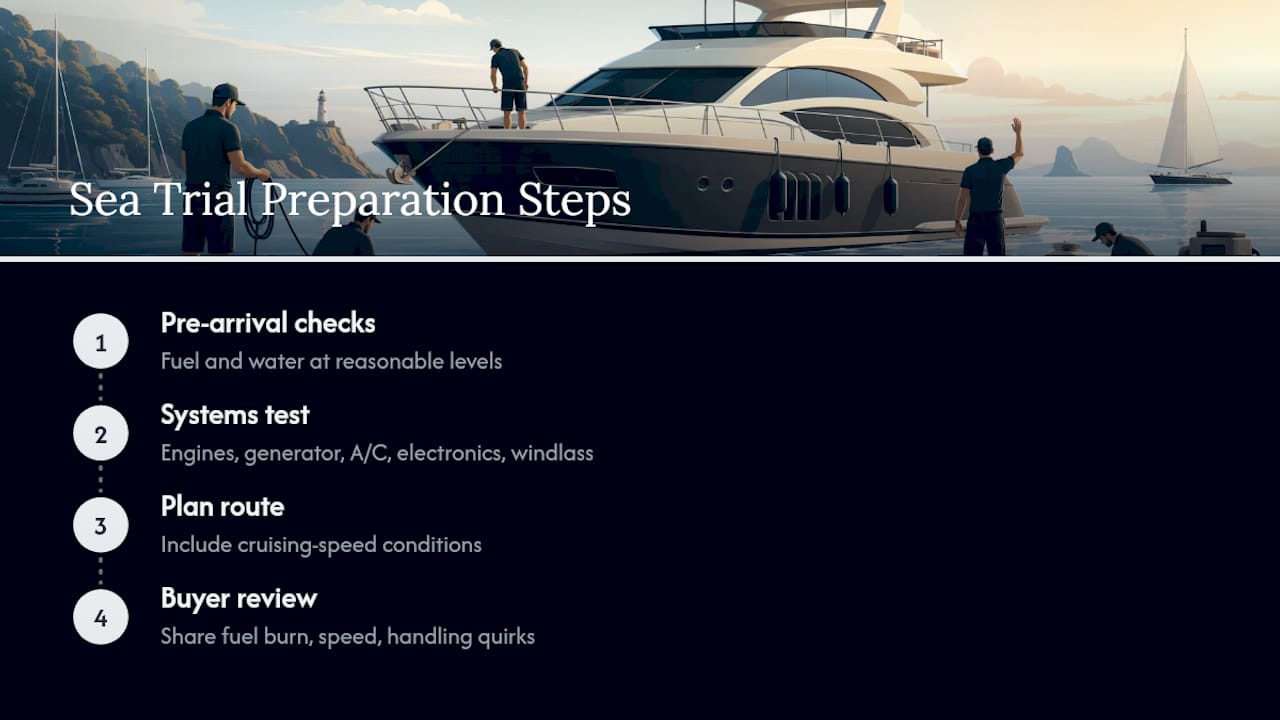
The sea trial is where deals are won or lost in real time, and sellers who treat it as an afterthought often watch a serious buyer’s enthusiasm cool within twenty minutes on the water. This is the moment a buyer confirms everything the listing promised, and any gap between the photos and the actual boat shows up immediately.
Preparation starts before the buyer arrives. Fuel and water tanks should be at a reasonable level, all systems, generators, air conditioning, electronics, and windlass should be tested and working, and the boat should be as clean underway as it was for photos. A cold engine that struggles to start, a generator that won’t hold a load, or electronics that haven’t been updated all read as red flags to a buyer who’s already primed to look for reasons to walk away or renegotiate.
Sellers should also plan the route and duration in advance, ideally including conditions that let the buyer feel how the boat handles at cruising speed, not just idling out of the marina. A structured approach to test runs helps sellers anticipate what buyers will want to see and reduces the chance of an awkward, unplanned demonstration. Having a checklist ready, covering fuel burn figures, cruising speed, and known quirks of the boat’s handling, turns the sea trial from a nervous formality into a confidence-building conversation. Buyers remember boats that performed exactly as described far more than boats with the fanciest photos.
Overlooking Timing and Seasonality of Yacht Sales
Listing a yacht at the wrong time of year is one of the most avoidable yacht selling pitfalls, yet sellers do it constantly, usually because they’re ready to sell and don’t stop to consider whether buyers are ready to look.
Yacht buying activity follows predictable seasonal patterns tied to boating season and regional climate. In much of the United States, interest peaks in late winter and spring as buyers prepare for the season ahead, then tapers through late summer and fall as the window for immediate use narrows. A yacht listed for the first time in October, right as the season winds down in many regions, often sits through winter with minimal traffic, not because the boat or the price is wrong, but because the buyer pool simply isn’t actively shopping.
Regional differences matter as much as the calendar. A yacht in Florida sees steadier year-round interest because of the winter boating season, while a boat in the Northeast faces a much tighter window before serious inquiries drop off. Sellers relocating a listing, or timing it around a boat show or regional event, can meaningfully shift how much traffic a listing gets in its first critical weeks. Waiting for the right seasonal window, rather than listing the moment you’re personally ready, often shortens the total time to sale rather than lengthening it, because the listing launches into an active buyer pool instead of a quiet one.
What Actually Moves the Needle for Sellers
Most yacht selling advice treats every mistake as equally urgent, and that’s where conventional wisdom goes wrong. Pricing and presentation aren’t just two items on a checklist. They’re the two variables that determine whether a buyer ever seriously considers the boat at all.
What’s overrated in most seller guidance is the emphasis on marketing spend and channel selection before the fundamentals are fixed. Throwing more advertising budget at an overpriced, poorly staged listing just shows more buyers a boat they’ll pass on. Fix the price and the presentation first, then let marketing do its job on a listing that’s actually ready to convert interest into offers.
If there’s one habit worth building, it’s treating the first 30 days after listing as the highest-leverage window you’ll get. Buyers pay attention to new listings disproportionately, and a boat that launches priced right, documented completely, and photographed well captures that attention before the listing goes stale. Everything after that is damage control.
— Jason
How Yachts By Steve Helps Sellers Avoid Every Mistake on This List
Selling without a broker means owning every task on this checklist alone: pricing research, buyer qualification, paperwork chasing, and negotiation, all while trying to sell a multi-hundred-thousand-dollar asset in your spare time. Yachts-bysteve exists to take that entire workload off a seller’s plate.
Through the Sell With Confidence service, professional brokers handle market-based pricing, marketing across qualified buyer channels, buyer qualification before a sea trial is ever scheduled, and deal management through closing. Experienced professionals bring extensive years in global yachting and manufacturing to that process, which means the pricing, staging, and negotiation guidance in this article comes from practical experience rather than theory. If you’re ready to see what your yacht is actually worth in today’s market, start a conversation through Yachts-bysteve and get a straight answer instead of a guess.
Sources
- Selling Boats: 7 Costly Mistakes to Avoid
- The template trap
- Sellyourboat
- How to sell your yacht faster: pricing strategy, staging and broker marketing – Nicholson Yachts
FAQ
What Is the 10% Rule for Yachts?
Sellers should keep this in mind when pricing, since well-documented maintenance history reassures buyers that this ongoing cost hasn’t been deferred.
What Are the Downsides of Owning a Yacht?
The main downsides are ongoing costs for maintenance, insurance, dockage, and crew if applicable, along with depreciation and the time commitment of upkeep. These same factors are exactly why buyers scrutinize service records and maintenance history so closely during a sale.
What Is the Commission on a Yacht Sale?
Brokerage commission is typically a percentage of the sale price, agreed upfront between the seller and the broker before the listing agreement is signed. Yachts-bysteve outlines how commission structures affect negotiation and net proceeds in its guide to yacht sales commission.
Why Don’t You Wear Shoes on a Yacht?
Shoes, especially those with hard soles or dark rubber, can scuff or scratch a yacht’s deck and interior flooring, which is why most boats have a no-shoes policy on board. For sellers, this matters at showings and sea trials: a deck free of scuff marks photographs better and signals a well-maintained boat to prospective buyers.
How Long Does It Typically Take to Sell a Yacht?
Most yacht sales run 60 to 120 days from listing to closing, though a correctly priced, well-presented boat launched in an active seasonal window can move faster. Delays usually trace back to survey findings, missing paperwork, or a listing that was overpriced from the start.
Recommended
Featured Listings

2028 Columbus Yachts
$22,900,008
137
Ancona

2012 Benetti PATIENCE
$10,975,000
132
Fort Lauderdale Florida

2028 Kingship Kingship
$20,350,000
125

2024 Silver Yachts
$25,400,000
117

2009 Hargrave BRANDI WINE
$2,500,000
114
Fort Lauderdale Florida

2028 Extra Yachts
$20,350,000
100
Ancona

2028 Alpha
$12,100,000
100
Ft Lauderdale Florida

2028 Extra Yachts Extra 96
$9,495,000
96
Ancona

2021 Sanlorenzo GATSBY
$6,795,000
96
Fort Lauderdale Florida

2028 Kingship
$11,990,000
90

2028 Alpha
$9,894,500
90
Fano

2023 Azimut COMPASS
$7,950,000
88
Miami Beach Florida

1999 Northern Marine OFF LINE
$2,495,000
84
Ft Lauderdale Florida

2013 Pershing DOROTHY ANN
$1,375,000
82
Fort Lauderdale Florida

1997 Ferretti Yachts
$825,000
80
La Paz

2008 Princess Yachts OCARALIA
$1,095,000
75
Charleston South Carolina

2014 Sunseeker
$1,400,000
68
New York New York

2024 Fairline
$2,750,000
68
Ft. Lauderdale Florida

2019 Vanquish Yachts IMPULSIVE
$1,799,000
58
Miami Beach Florida

2021 Ferretti Yachts HAVEN
$1,595,000
57
Fort Lauderdale Florida

2025 Formula BREAKTHROUGH III
$1,895,000
53
Miami Beach Florida

2023 Fairline
$900,000
45
Fort Lauderdale Florida

2012 Zeelander Mississippi Queen
$575,000
44
West Palm Beach Florida
2028 Columbus Yachts 137'
$22,900,008
2012 Benetti 132'
$10,975,000
2028 Kingship 125'
$20,350,000
2024 Silver Yachts 117'
$25,400,000
2009 Hargrave 114'
$2,500,000
2028 Extra Yachts 100'
$20,350,000
2028 Alpha 100'
$12,100,000
2028 Extra Yachts 96'
$9,495,000
2021 Sanlorenzo 96'
$6,795,000
2028 Kingship 90'
$11,990,000
2028 Alpha 90'
$9,894,500
2023 Azimut 88'
$7,950,000
1999 Northern Marine 84'
$2,495,000
2013 Pershing 82'
$1,375,000
1997 Ferretti Yachts 80'
$825,000
2008 Princess Yachts 75'
$1,095,000
2014 Sunseeker 68'
$1,400,000
2024 Fairline 68'
$2,750,000
2019 Vanquish Yachts 58'
$1,799,000
2021 Ferretti Yachts 57'
$1,595,000
2025 Formula 53'
$1,895,000
2023 Fairline 45'
$900,000
2012 Zeelander 44'
$575,000