

Budget 10% to 15% of the sale price for total seller closing costs, with broker commission as the largest single line item. Buyers should set aside a separate pool for surveys, insurance, and commissioning, plus an import duty near 1.5% of vessel value when the yacht crosses a border into the US. Those three numbers, seller closing costs, buyer delivery costs, and import duty, are the backbone of any yacht shipping cost worksheet, and everything else in this guide fills in the details around them.
Before you get on the phone with your broker, put these five items on paper:
- Brokerage commission (largest single cost, almost always seller-paid)
- Escrow and legal/title fees
- Import duty and customs-broker fees, if applicable
- Insurance and commissioning costs (survey, sea trial, haul-out)
- Carrying costs (slip fees, maintenance) for every month the yacht sits on the market
Pro Tip: Ask for every one of these as a dollar figure, not a percentage, before you sign anything. Percentages hide the real number until it’s too late to negotiate.
Key Takeaways
| Point | Details |
|---|---|
| Seller closing cost range | Budget 10% to 15% of sale price, including commission, escrow, legal, and documentation. |
| Commission model matters | IYBA’s flat 10% and MYBA’s sliding scale can produce very different net proceeds on large sales. |
| Import duty is a fixed rate | Expect roughly 1.5% of vessel value under HTS, plus $400 to $1,200 in customs-broker fees. |
| Escrow and legal fees | Typically $1,500 to $5,000 each, scaling with deal complexity. |
| Get it in writing | Request an itemized closing worksheet naming the payer for every single fee before you sign. |
Table of Contents
- What Does Yacht Shipping Cost Actually Include?
- How Do IYBA and MYBA Commission Structures Compare?
- What Closing Costs Should Sellers Expect at the Table?
- What Do the Numbers Look Like on a Real Sale?
- What Should You Ask Your Broker Before Closing?
- How Yachts-Bysteve Helps You Budget These Costs
- What Most Buyers and Sellers Get Wrong About This Budget
- Sources
What Does Yacht Shipping Cost Actually Include?
The phrase gets used loosely, but for a buyer or seller working through a brokerage, yacht shipping cost really means the full bundle of transaction and delivery-related expenses tied to closing a deal, not a freight invoice. That includes commission, escrow, legal work, import duty, insurance, and pre-delivery prep. Understanding each piece separately is the only way to avoid a surprise at the closing table.
Broker commission typically runs 10% of the sale price in the US market, though the exact figure moves with yacht age, value, and how competitive the listing is. It’s almost always paid by the seller out of sale proceeds, deducted at closing rather than billed separately.
Escrow, attorney, and title fees are the next biggest chunk. Escrow services commonly run $1,500 to $5,000, and legal or title-search work lands in roughly the same range. Bigger, more complex deals push toward the top of both bands.
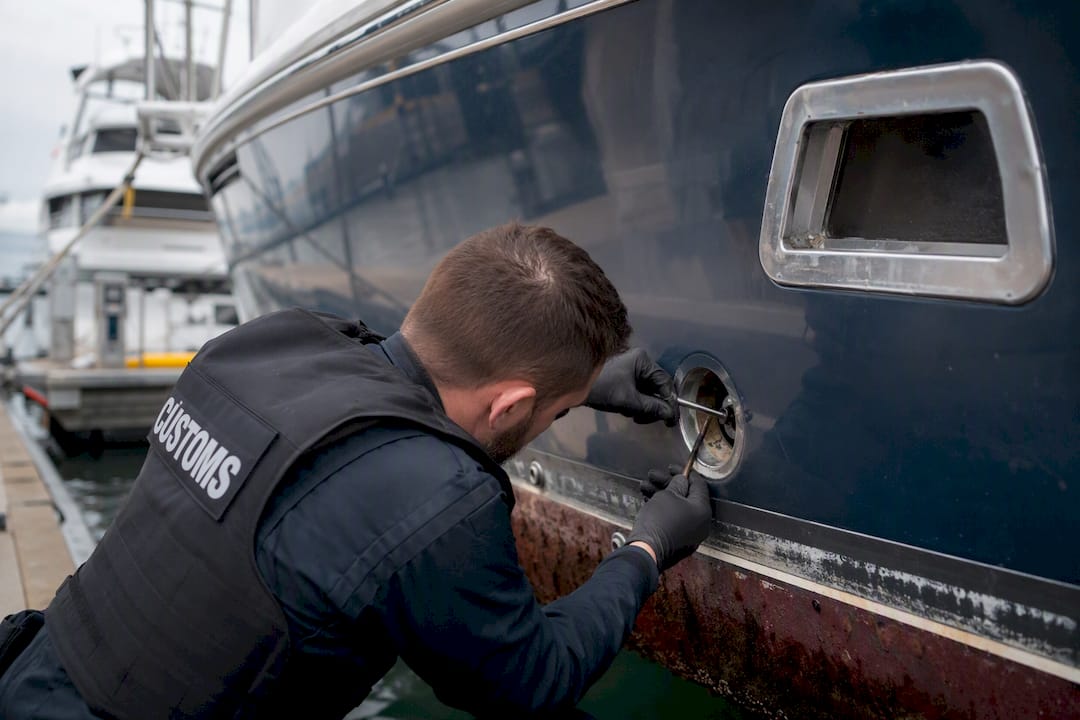
Import duty and customs fees enter the picture whenever a yacht crosses into US waters from a foreign flag. The Harmonized Tariff Schedule rate for pleasure yachts commonly sits at 1.5% of vessel value, with US Customs and Border Protection making the final call on classification. Customs-broker fees for routine entries run roughly $400 to $1,200, climbing higher for complicated ownership structures.
Insurance and commissioning cover the survey, sea trial, haul-out, and any yard work needed before handover. These vary widely by yacht condition, but skipping them to save money almost always costs more later.
Carrying costs while the yacht sits unsold, slip fees, routine maintenance, insurance premiums, add up month by month and quietly erode a seller’s expected net.
How Do IYBA and MYBA Commission Structures Compare?
Two commission models dominate the yacht brokerage world, and which one applies to your deal changes the math meaningfully on anything above a few million dollars.
- IYBA/US flat model: a flat 10% of gross sale price, regardless of value. A $2 million sale generates a $200,000 commission pool.
- MYBA sliding scale: 10% on the first €10 million, 5% on the next €10 million, and 2.5% above that. A €25 million sale nets roughly €1.75 million in commission under this structure, well below what a flat 10% would produce.
- Buyer-broker share: typically 4% to 5% of the sale price, paid out of the same seller-funded commission pool through co-brokerage.
Pro Tip: *Before you list or make an offer, ask which model applies and get it in writing.
Cutting commission to save money has a real cost of its own. Reduced listing rates give co-brokers less incentive to show a yacht, which can stretch time on market and quietly increase the carrying costs discussed above. Our yacht sales commission breakdown covers how this trade-off plays out in real negotiations.
What Closing Costs Should Sellers Expect at the Table?
Sellers routinely underestimate everything that isn’t commission, and that’s where the unpleasant surprises happen at closing. A realistic worksheet includes:
- Escrow fees: generally $1,500 to $5,000, scaling with transaction complexity
- Attorney and title/search fees: typically $1,500 to $5,000 as well
- Documentation and transfer fees: Coast Guard documentation and state registration costs vary by jurisdiction and yacht size
- Applicable state or local taxes: these depend heavily on where the transaction closes and where the yacht will be documented
Add commission to this list and you land in that 10% to 15% total range that governs most seller transactions. Building this worksheet before you list, rather than after an offer arrives, is what keeps net proceeds predictable instead of guessed. Our guide to yacht closing cost examples walks through sample worksheets buyers and sellers can adapt.
What Do the Numbers Look Like on a Real Sale?
Percentages only mean something once they’re attached to dollars. Here’s how three different price points shake out.
-
Under $500,000: A $400,000 sale under a flat 10% commission produces a $40,000 broker fee. Add roughly $3,000 in escrow and legal fees and $2,000 in documentation, and total seller closing costs land near $45,000, about 11% of sale price, leaving the seller with approximately $355,000 net.
-
$1 million to $5 million: A $3 million sale at 10% generates $300,000 in commission. Escrow and legal fees trend toward the higher end of the $1,500 to $5,000 bands given added complexity, pushing total closing costs to roughly $315,000, or about 10.5%.
-
Multi-million sale under a sliding scale: A €25 million sale under MYBA’s tiered structure produces about €1.75 million in commission, versus €2.5 million under a flat 10%. That’s a €750,000 difference driven entirely by which commission model the contract specifies, even before escrow and legal costs enter the picture.
Every one of these examples assumes the seller pays commission and most closing fees, which is standard practice, while the buyer typically covers survey, insurance, and any import duty on their own side of the ledger.
What Should You Ask Your Broker Before Closing?
A short list of direct questions saves you from discovering costs after they’ve already been deducted from your check.
- Which commission structure applies to this deal, flat or sliding scale, and can I see it in writing?
- Can you provide an itemized closing-cost estimate, not just a percentage range?
- Are there any retrocessions or referral fees tied to the escrow company, surveyor, or customs broker?
- If import applies, what’s your experience with CBP filings, and what HTS classification do you expect?
- What’s your estimated customs-broker fee for this specific transaction?
Pro Tip: Insist on a written closing worksheet that names a payer for every single line item. If your broker can’t produce one before you sign, that’s a red flag worth pausing over.
How Yachts-Bysteve Helps You Budget These Costs
Yachts-bysteve builds tailored cost worksheets for every client, matched to real market pricing rather than generic percentage ranges, and coordinates directly with escrow companies and customs brokers so nothing falls through the cracks between contract and closing.
- Commission structure and any retrocessions are disclosed upfront, before a listing agreement or offer is signed
- Import scenarios get routed to experienced customs brokers with documented CBP filing experience
- Closing worksheets specify a payer for every fee, escrow through documentation
- Review our guide on how to choose a yacht broker if you’re still selecting representation
- Request a tailored cost estimate for your specific transaction size and route
- Bring your worksheet to your accountant or financial planner before finalizing an offer
Jason, editorial lead at Yachts-bysteve, oversees the brokerage’s client guidance content, drawing on transaction patterns across the firm’s completed sales.
What Most Buyers and Sellers Get Wrong About This Budget
The conventional advice treats commission as the whole story, and that’s the biggest miscalculation I see repeated across yacht forums and even some broker pitch decks. Commission is the largest single number, but it’s rarely the number that catches people off guard. It’s the accumulation of escrow, legal, documentation, and carrying costs, each individually modest, that turns a seller’s mental math upside down at closing.
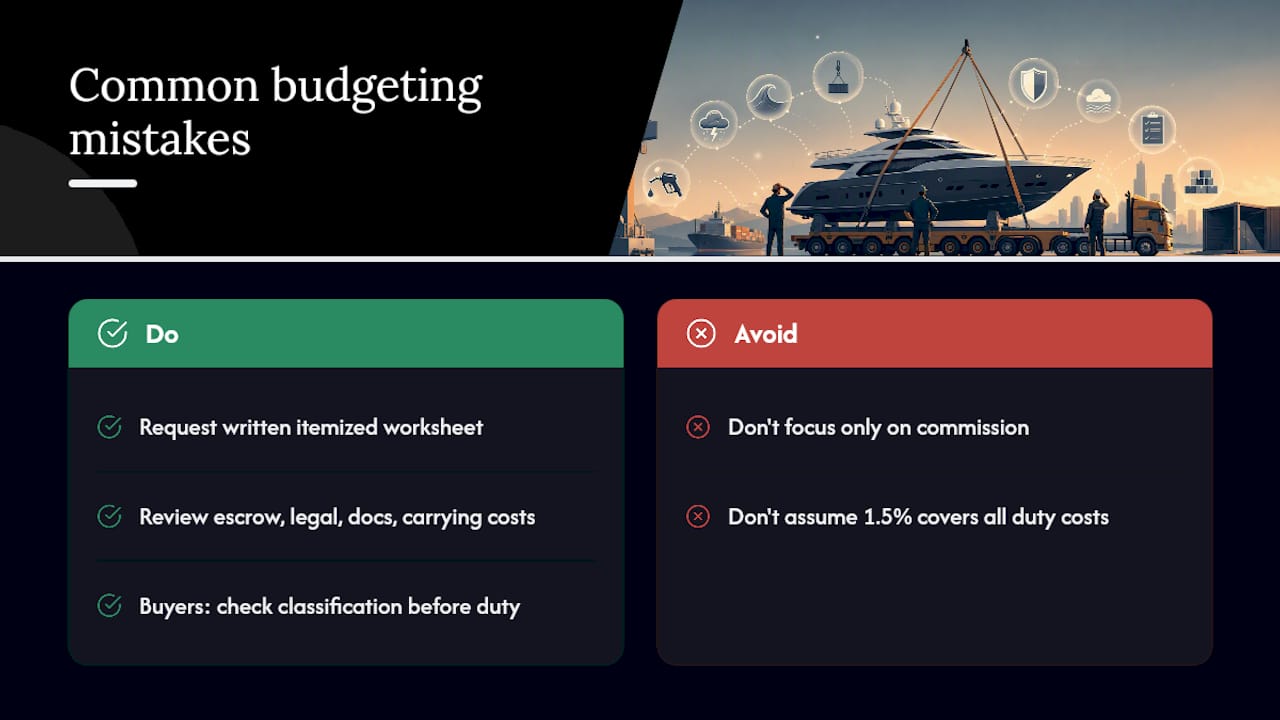
My honest read: sellers should worry less about shaving a point off commission and more about getting a written, itemized worksheet before they list. Buyers face a parallel trap with import duty. The 1.5% rate is simple math, but classification and documentation complexity is where costs actually balloon, not the headline percentage. Ask for the worksheet before you ask for the discount.
Sources
- Understanding Your Yacht Import Duties – Howard S Reeder Inc
- Closing Costs for Yacht Sellers: Commission, Taxes, and Escrow Fees | YachtWay Knowledge Center
- Yacht broker commissions, retrocessions, and conflicts of interest | The First Owner’s Reference
- Yacht Brokerage Fees: What You Should Know – Windward Yachts
Recommended
Featured Listings

2028 Columbus Yachts
$22,900,008
137
Ancona

2012 Benetti PATIENCE
$10,975,000
132
Fort Lauderdale Florida

2028 Kingship Kingship
$20,350,000
125

2024 Silver Yachts
$25,400,000
117

2009 Hargrave BRANDI WINE
$2,500,000
114
Fort Lauderdale Florida

2028 Extra Yachts
$20,350,000
100
Ancona

2028 Alpha
$12,100,000
100
Ft Lauderdale Florida

2028 Extra Yachts Extra 96
$9,495,000
96
Ancona

2021 Sanlorenzo GATSBY
$6,795,000
96
Fort Lauderdale Florida

2028 Kingship
$11,990,000
90

2028 Alpha
$9,894,500
90
Fano

2023 Azimut COMPASS
$7,950,000
88
Miami Beach Florida

1999 Northern Marine OFF LINE
$2,495,000
84
Ft Lauderdale Florida

2013 Pershing DOROTHY ANN
$1,375,000
82
Fort Lauderdale Florida

1997 Ferretti Yachts
$825,000
80
La Paz

2008 Princess Yachts OCARALIA
$1,095,000
75
Charleston South Carolina

2014 Sunseeker
$1,400,000
68
New York New York

2024 Fairline
$2,750,000
68
Ft. Lauderdale Florida

2019 Vanquish Yachts IMPULSIVE
$1,799,000
58
Miami Beach Florida

2021 Ferretti Yachts HAVEN
$1,595,000
57
Fort Lauderdale Florida

2025 Formula BREAKTHROUGH III
$1,895,000
53
Miami Beach Florida

2023 Fairline
$900,000
45
Fort Lauderdale Florida

2012 Zeelander Mississippi Queen
$575,000
44
West Palm Beach Florida
2028 Columbus Yachts 137'
$22,900,008
2012 Benetti 132'
$10,975,000
2028 Kingship 125'
$20,350,000
2024 Silver Yachts 117'
$25,400,000
2009 Hargrave 114'
$2,500,000
2028 Extra Yachts 100'
$20,350,000
2028 Alpha 100'
$12,100,000
2028 Extra Yachts 96'
$9,495,000
2021 Sanlorenzo 96'
$6,795,000
2028 Kingship 90'
$11,990,000
2028 Alpha 90'
$9,894,500
2023 Azimut 88'
$7,950,000
1999 Northern Marine 84'
$2,495,000
2013 Pershing 82'
$1,375,000
1997 Ferretti Yachts 80'
$825,000
2008 Princess Yachts 75'
$1,095,000
2014 Sunseeker 68'
$1,400,000
2024 Fairline 68'
$2,750,000
2019 Vanquish Yachts 58'
$1,799,000
2021 Ferretti Yachts 57'
$1,595,000
2025 Formula 53'
$1,895,000
2023 Fairline 45'
$900,000
2012 Zeelander 44'
$575,000