

A shore power converter takes whatever electricity a marina hands you, whether that is 50 Hz European current or 60 Hz American current, and reshapes it into clean, isolated power your yacht’s systems can trust. Any owner who cruises between regions, docks at marinas with inconsistent supply, or runs sensitive electronics onboard needs one. The technology draws on the IEC 80005 shore connection standard and pairs with proper grounding protection, and Yachts-bysteve treats it as a baseline consideration for any serious refit or purchase.
TL;DR:
- Advanced converter units can handle a wide input voltage and frequency range from 110 to 520V and 45 to 75 Hz, ensuring compatibility worldwide.
- Proper sizing requires a detailed load inventory, including continuous and peak loads, to prevent overloads, nuisance trips, or inefficient operation.
- Correct installation with adequate ventilation, protection devices, and seamless power source switching is crucial for reliability and safety at sea.
- Monitoring and diagnostics features in modular systems help detect faults early and reduce downtime, especially in complex or large setups.
- Using high-quality, true galvanic isolation transformers minimizes galvanic corrosion and ensures clean power delivery to sensitive electronics.
Table of Contents
- What Yacht Shore Power Conversion Actually Does
- Why Marina Power Is Not as Reliable as You Think
- Sizing a Converter: The Load Calculation Owners Skip
- Getting the Installation Right
- What to Demand in an RFQ or Quote
- Budgeting Time and Money for the Project
- How Conversion Affects Your Battery Charging and Power Management
- Troubleshooting Shore Power Converter Problems
- The Environmental Case for Doing This Right
- Yachts-bysteve’s Take: When to Call for a Survey
- Sources
What Yacht Shore Power Conversion Actually Does
Picture the shore cord as the front door and the converter as the security desk just inside it. Dock power comes aboard, and before it touches a single outlet or nav system, the converter’s rectifier turns that incoming AC into DC, holds it on a DC bus, then an inverter rebuilds it into clean AC at exactly the voltage and frequency your onboard systems expect. That rectify-then-invert sequence, often called dual conversion, allows a 50 Hz dock feed to run 60 Hz equipment without missing a beat, according to BDF Digital’s technical rundown of its Calipso converter.
Simpler autotransformer setups skip that DC step and just adjust voltage ratios. They are lighter and cheaper, but they cannot fix a frequency mismatch. If your yacht’s systems are built around 60 Hz and the marina is feeding 50 Hz, an autotransformer will not save you. Only a true frequency converter or combi unit does that job.
Worldwide compatibility comes down to the input window a converter can accept. Advanced units on the market now take in anywhere from roughly 110 to 520 volts and 45 to 75 Hz, according to ANG Converters’ marine converter specifications, which covers essentially every shore supply you would encounter from the Mediterranean to the Caribbean to Southeast Asia.
That range matters because it determines whether you plug in with confidence or spend an afternoon on the phone with dockmasters trying to figure out why your microwave is buzzing.
Some specifics worth knowing before you spec a system:
- Pure sine wave output protects sensitive electronics (navigation systems, medical equipment, entertainment electronics) from the waveform distortion cheap converters introduce.
- Active front-end technology, found in Magnus Marine’s modular converter line, cleans up harmonics before they ever reach your panel.
- A moderate-capacity unit generally covers a mid-size motor yacht’s hotel loads (HVAC, galley, lighting, entertainment) without straining.
Quick stat: Efficiency in mid-size converter models runs around 87 to 91 percent, per Aseapower’s AC Series specifications, meaning that a minor portion of the power you draw dockside gets lost to heat during conversion rather than reaching your systems.
Why Marina Power Is Not as Reliable as You Think
Dockside electricity is not a guarantee. It is a shared resource running through pedestals that see decades of salt air, tourist traffic, and inconsistent maintenance, and that combination produces real problems.
- Voltage swings. Marinas overloaded during peak season can sag well under nominal voltage, or spike when neighboring boats disconnect suddenly. Both scenarios stress transformers, chargers, and compressors.
- Frequency mismatches. Cross an ocean and the standard shifts from 60 Hz to 50 Hz or back. Equipment rated for one frequency run on the other risks overheating motors or throwing off timing-sensitive electronics.
- Transients and harmonics. Dock wiring shared across dozens of boats picks up noise. That noise shows up as flickering lights, buzzing audio systems, or, worse, corrupted data on navigation displays.
- Galvanic corrosion. When your yacht’s grounding ties directly into a shared shore ground, tiny currents can flow between your underwater metals and a neighboring boat’s, slowly eating away at props, shafts, and fittings. An isolation transformer breaks that electrical connection magnetically, according to ANG Converters’ analysis of galvanic corrosion prevention, so current simply cannot travel hull to hull.
- Nuisance tripping and RFI. Radio frequency interference from poorly shielded dock wiring can crash chartplotters or VSAT connections at the worst possible moment.
Know the line between “call the dockmaster” and “handle it yourself.” A pedestal that will not energize or a breaker that keeps tripping on the shore side is the marina’s problem. Anything past your shore cord inlet, meaning your isolation transformer, panel, and wiring, is yours, and unless you are a certified marine electrician, that is not a DIY afternoon, according to PlanM8’s overview of yacht electrical systems.
Sizing a Converter: The Load Calculation Owners Skip
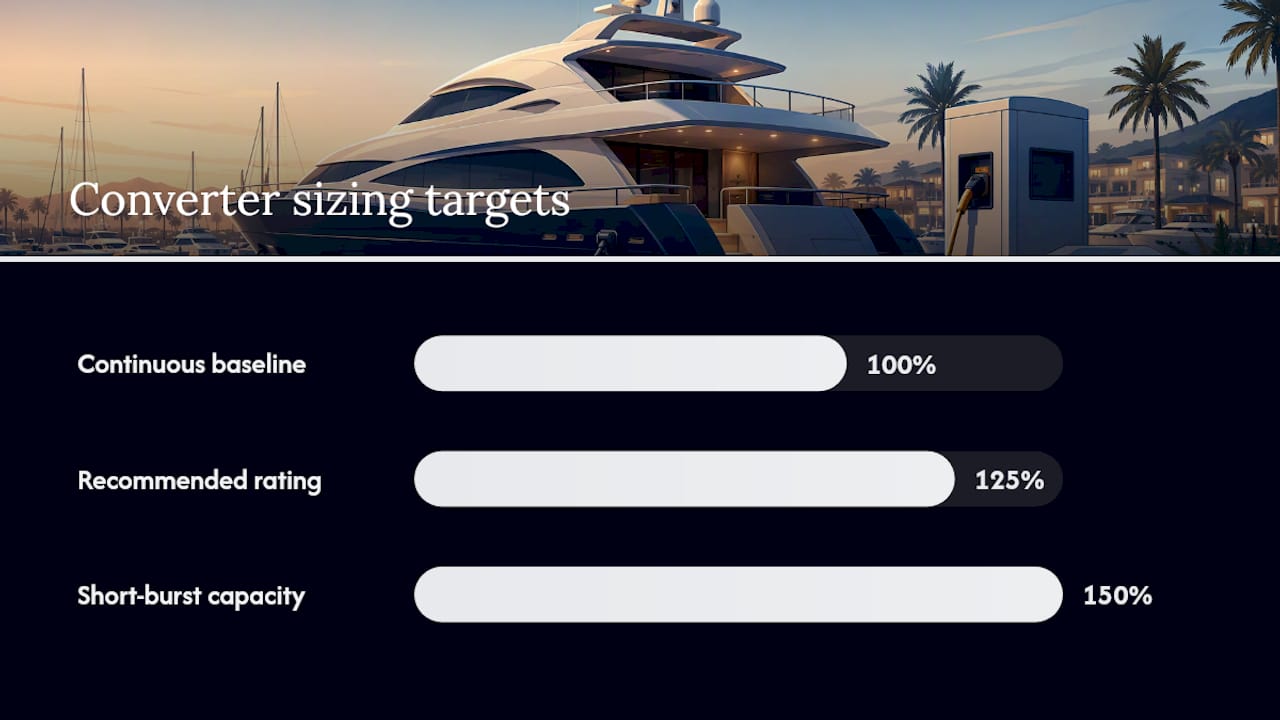
Here is the mistake almost every first-time buyer makes: they guess at converter size based on boat length instead of actual load. A 60-footer with a modest galley and no washer/dryer draws far less than a 60-footer with three AC zones and a wine cooler running around the clock.
Start with an honest inventory. List every AC appliance and system, then separate continuous loads (HVAC, refrigeration, battery chargers) from intermittent peak loads (microwave, hair dryers, washer/dryer cycles). Add up continuous wattage first; that is your baseline.
Then convert watts to amps using your voltage:
- Single-phase 230V system: amps = watts ÷ 230
- Single-phase 120V system: amps = watts ÷ 120
- Three-phase systems: divide total watts by (voltage × 1.732), since three-phase math accounts for the phase offset
Peak loads rarely hit all at once, but they do happen, and a well-specified converter should handle short overload bursts at 125 to 150 percent of rated capacity without shutting down. That headroom is what separates a system that survives a Tuesday morning with everyone running hair dryers from one that trips the moment the espresso machine kicks on.
Undersizing causes more than nuisance trips. Running a generator or converter well below its rated capacity for extended periods, a problem often called wet stacking in diesel gensets, leads to incomplete combustion and fouled injectors. Oversizing wastes money and, in some architectures, actually hurts efficiency at partial load. The Aseapower AC Series data on real-world installs points to inaccurate load calculation as the single most common owner error, cutting both ways.
Modular sizing solves a lot of this. Instead of buying one large fixed-capacity unit, several smaller modules working in parallel let you add capacity as needs grow and keep running (at reduced capacity) if one module needs service.
Pro Tip: Before you request quotes, run your generator or current shore setup for a normal week and log amp draw at different times of day. That real data will validate or correct your paper calculation faster than any spec sheet, and integrators take you more seriously when you show up with actual numbers.
Getting the Installation Right
A converter is only as good as the install around it. Larger units, especially anything above 30 kVA, generate real heat and need proper ventilation or water cooling, plus enough clearance for service access. Cramming a converter into a tight lazarette without airflow planning is a common and expensive oversight.
- Plan the footprint early. Enclosure ratings, ventilation paths, and cooling method (air versus water) should be locked in during design, not discovered during installation.
- Place the switchboard thoughtfully. Shore input breakers and labeled test points need to be accessible for troubleshooting, not buried behind a bilge pump.
- Synchronize power sources. The converter should hand off seamlessly between shore power, generator, and battery/inverter systems without a blackout moment that reboots your electronics. This is where pairing the converter’s design with your inverter-charger and battery bank as one system, rather than as separate purchases, prevents the transient interruptions that plague poorly integrated setups.
- Install protection devices. RCD or GFCI protection and surge arrestors are non-negotiable, not optional add-ons.
- Commission properly. A real commissioning sequence includes polarity and insulation testing, a dry run of the synchronization logic, step-load testing to confirm the unit handles its rated overload, harmonics measurement, and a check of the event log, according to BDF Digital’s commissioning guidance.
Quick stat: Step-load testing typically verifies overload handling at a headroom above rated capacity, the same principle that should drive your sizing decisions above.
Hire a certified marine electrician for this work, and insist on documentation: test results, wiring diagrams, and a commissioning report you can hand to a surveyor or future buyer.
What to Demand in an RFQ or Quote
When you send out requests for quotes, vague specs get you vague answers. Be specific about what you require, and make vendors prove it in writing.
- Input voltage and frequency range. Look for converters covering roughly 110 to 520V and 45 to 75 Hz for genuine worldwide flexibility, the range ANG Converters documents on its higher-end marine units.
- True galvanic isolation, not just a galvanic isolator diode. Isolators are a lower-cost partial fix; full isolation transformers offer stronger protection, especially critical for aluminum hulls and heavily bonded systems where corrosion risk runs higher.
- Overload rating and module redundancy. Ask what happens if one module fails: does the system degrade gracefully or drop completely?
- Remote monitoring and diagnostics. Modular systems with built-in monitoring let you (or your captain) catch a fault before it becomes a failure, and pairing that data with a broader smart yacht tech setup makes troubleshooting far less guesswork.
- Warranty and service network. A converter is useless if the nearest certified technician is three time zones away.
- Standards compliance. Confirm alignment with the IEC/IEEE 80005 family for shore connections, NEC guidance (particularly Article 555) for marina wiring, and proper RCD or earth-fault protection.
Budgeting Time and Money for the Project
Costs scale steeply with capacity and complexity. Small units in the 8 to 20 kVA range, suitable for modest hotel loads on a mid-size yacht, sit at the lower end of the market. Large modular shore-park systems at 50 kVA and above, the kind built for superyachts running full HVAC, spa systems, and heavy galley equipment, cost substantially more and typically require custom engineering.
- Off-the-shelf converters in common sizes often ship within weeks.
- Custom modular systems, especially anything requiring naval architecture sign-off, commonly run several months from order to commissioning.
- Routine maintenance should include visual inspections, ventilation and filter checks, firmware updates, and periodic load testing, ideally on a schedule your installer writes into the commissioning documentation.
- Plan for a spare-module strategy on larger systems. Keeping one module in reserve means a failure becomes a quick swap instead of a haul-out delay.
How Conversion Affects Your Battery Charging and Power Management
The converter is not just a gatekeeper for outlets and air conditioning. It is the front door for your entire power management architecture, and how it hands off to your battery bank matters as much as how it handles the dock feed.
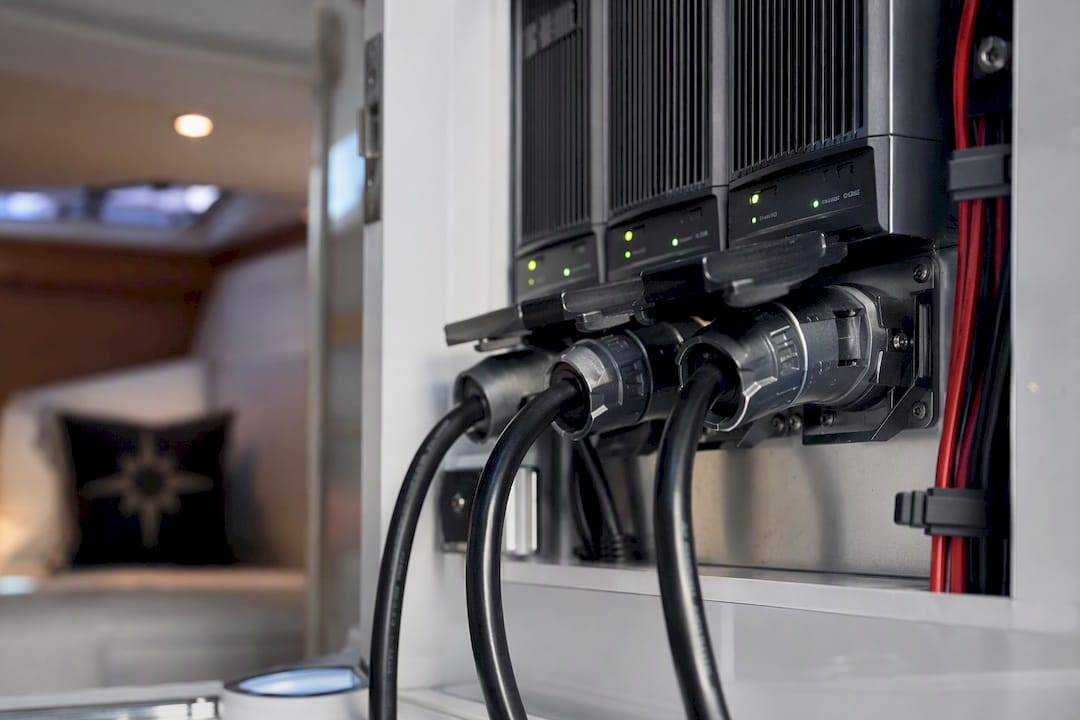
Clean, stable AC output means your battery chargers and inverter-chargers see consistent input instead of the sags and spikes raw dock power might deliver. That consistency extends charger life and keeps charge profiles (bulk, absorption, float) executing correctly rather than restarting every time voltage dips. A charger that keeps resetting its charge cycle because of unstable input never actually reaches a full, healthy charge, which quietly shortens battery life over years of ownership.
The bigger opportunity is treating shore power, generator power, and battery/inverter capacity as one coordinated system rather than three separate purchases. When the converter, charger, and inverter share communication (a setup increasingly common on yachts also running solar arrays), the system can prioritize shore power when available, draw down batteries intelligently overnight, and hand off to inverter power during brief shore interruptions without anyone aboard noticing. That seamless handoff is the entire point of a well-integrated hybrid power setup, and it is where a lot of otherwise well-specified converters fall short, simply because nobody designed the charging and inverter side to match.
Get this pairing wrong and you will notice it in subtle ways: chargers that never seem to top off the bank, inverters that hunt for a stable reference during transfer, or batteries that degrade faster than their rated cycle life suggests they should.
Troubleshooting Shore Power Converter Problems
Most converter issues trace back to a handful of repeat offenders, and knowing the pattern saves hours of guessing.
Unit won’t power up or energize the panel. Check the shore cord connection first, then confirm the pedestal itself is live (a neighboring boat’s breaker can trip and take out a shared circuit). If the pedestal is fine, check your input breaker and any ground fault protection that may have tripped silently.
Nuisance tripping on RCD or GFCI protection. This usually points to a wiring fault, moisture intrusion at a connection point, or a genuine ground fault somewhere downstream. Do not simply reset it repeatedly; that is masking a real problem.
Flickering lights or buzzing electronics. Often a sign of poor frequency regulation or harmonics passing through an aging or undersized unit. If it happens consistently at one marina but not others, the dock supply itself may be the culprit rather than your converter.
Overload shutdowns during normal use. This is almost always a sizing issue: either your load calculation was optimistic, or your usage pattern changed (added AC units, new appliances) since the system was specified.
Slow or incomplete battery charging despite shore connection. Check for a communication fault between the converter and charger, or confirm the charger’s voltage set points still match the converter’s output profile.
When a problem persists after basic checks, event logs from a monitored system are invaluable. They show exactly when a fault occurred and what preceded it, turning a guessing game into a five-minute diagnosis for a qualified technician.
The Environmental Case for Doing This Right
Shore power conversion is not purely a comfort and equipment-protection story. It carries a genuine environmental upside that gets overlooked in most buying decisions.
When a yacht plugs into properly converted shore power instead of running a generator at anchor or dockside, it can shut its auxiliary engines down entirely, a practice the shipping industry calls cold ironing, according to Wärtsilä’s overview of shore power systems. That means less fuel burned, less noise disturbing the marina at 2 a.m., and lower emissions right at the dock where air quality matters most to everyone nearby.
Efficiency numbers matter here too. A converter running at 87 to 91 percent efficiency, the range Aseapower documents for its mid-size units, still loses roughly a tenth of incoming power to heat. Choosing a well-engineered unit over a bargain option is not just about reliability; it is a real difference in wasted energy over a season of regular dockside use. Larger port infrastructure investments, the kind ABB builds for commercial shore connection systems, point toward where the whole industry is heading: standardized, efficient shore power as the default rather than the exception.
For owners weighing a retrofit, the environmental case pairs naturally with the practical one. A yacht that can cut its generator hours dockside burns less fuel, requires less generator maintenance, and runs quieter for everyone aboard and nearby.
Yachts-bysteve’s Take: When to Call for a Survey
If you are buying a yacht that has cruised internationally, request the electrical survey before you close, not after. A mismatched or aging converter is expensive to discover post-purchase.
Hand your integrator this short list: input voltage and frequency range, isolation type, overload rating, monitoring capability, and commissioning documentation. If they cannot answer all five without checking, keep looking.
Yachts-bysteve recommends a full electrical survey any time you are buying, selling, or planning a retrofit involving international cruising plans. It is one of the clearer signals of a well-maintained vessel, and our team factors it into how we guide clients through choosing a yacht broker who understands the technical side of a deal, not just the paperwork.
— Jason
Sources
- Marine converters | ANG CONVERTERS
- Shore Power Converter – CALIPSO | BDF Digital
- Shore power | Wärtsilä
Recommended
Featured Listings

2028 Columbus Yachts
$22,900,008
137
Ancona

2012 Benetti PATIENCE
$10,975,000
132
Fort Lauderdale Florida

2028 Kingship Kingship
$20,350,000
125

2024 Silver Yachts
$25,400,000
117

2009 Hargrave BRANDI WINE
$2,500,000
114
Fort Lauderdale Florida

2028 Extra Yachts
$20,350,000
100
Ancona

2028 Alpha
$12,100,000
100
Ft Lauderdale Florida

2028 Extra Yachts Extra 96
$9,495,000
96
Ancona

2021 Sanlorenzo GATSBY
$6,795,000
96
Fort Lauderdale Florida

2028 Kingship
$11,990,000
90

2028 Alpha
$9,894,500
90
Fano

2023 Azimut COMPASS
$7,950,000
88
Miami Beach Florida

1999 Northern Marine OFF LINE
$2,495,000
84
Ft Lauderdale Florida

2013 Pershing DOROTHY ANN
$1,375,000
82
Fort Lauderdale Florida

1997 Ferretti Yachts
$825,000
80
La Paz

2008 Princess Yachts OCARALIA
$1,095,000
75
Charleston South Carolina

2014 Sunseeker
$1,400,000
68
New York New York

2024 Fairline
$2,750,000
68
Ft. Lauderdale Florida

2019 Vanquish Yachts IMPULSIVE
$1,799,000
58
Miami Beach Florida

2021 Ferretti Yachts HAVEN
$1,595,000
57
Fort Lauderdale Florida

2025 Formula BREAKTHROUGH III
$1,895,000
53
Miami Beach Florida

2023 Fairline
$900,000
45
Fort Lauderdale Florida

2012 Zeelander Mississippi Queen
$575,000
44
West Palm Beach Florida
2028 Columbus Yachts 137'
$22,900,008
2012 Benetti 132'
$10,975,000
2028 Kingship 125'
$20,350,000
2024 Silver Yachts 117'
$25,400,000
2009 Hargrave 114'
$2,500,000
2028 Extra Yachts 100'
$20,350,000
2028 Alpha 100'
$12,100,000
2028 Extra Yachts 96'
$9,495,000
2021 Sanlorenzo 96'
$6,795,000
2028 Kingship 90'
$11,990,000
2028 Alpha 90'
$9,894,500
2023 Azimut 88'
$7,950,000
1999 Northern Marine 84'
$2,495,000
2013 Pershing 82'
$1,375,000
1997 Ferretti Yachts 80'
$825,000
2008 Princess Yachts 75'
$1,095,000
2014 Sunseeker 68'
$1,400,000
2024 Fairline 68'
$2,750,000
2019 Vanquish Yachts 58'
$1,799,000
2021 Ferretti Yachts 57'
$1,595,000
2025 Formula 53'
$1,895,000
2023 Fairline 45'
$900,000
2012 Zeelander 44'
$575,000