

Expect roughly $18 to $25 per foot for a typical pre-purchase survey on a mid-size cruising yacht, though industry guidance often widens that range to $20 to $35 per foot depending on location and scope. A 45-foot sailboat might land near a low-thousands figure for the surveyor’s fee alone. A 100-foot motor yacht, once you add haul-out, sea trial, and specialist inspections, can climb into a substantial sum quickly. The headline number is rarely the final number.
- Entry-level cruisers (30 to 45 feet): typically a few hundred to low thousands for the base survey
- Larger motor yachts and sailing yachts (60 to 90 feet): often several thousand once specialists get involved
- Superyachts (40 to 60 meters): full pre-purchase surveys commonly run $25,000 to $80,000 all-in
Pro Tip: Match the survey scope to the vessel’s complexity, not just its length. A 50-foot sailboat with old rigging and a single diesel is a simpler job than a 50-foot motor yacht with twin engines, generators, and stabilizers, and the price should reflect that difference.
Key Takeaways
Yacht survey pricing scales with vessel size and complexity, and the base per-foot fee is only the starting point once haul-out, specialists, and sea trials enter the budget.
| Point | Details |
|---|---|
| Base pricing range | Expect $18 to $35 per foot for most pre-purchase surveys, with wide variance by location and scope. |
| Superyacht totals differ | Full 40 to 60 meter surveys often run $25,000 to $80,000 all-in, priced by specialist day rates, not per foot. |
| Surveyor works for the buyer | Hire and pay the surveyor yourself to keep the report objective and useful in negotiation. |
| Credentials matter | Verify membership with a body like NAMS Global and request a sample report before booking. |
| Yachts-bysteve coordinates the process | The brokerage sources specialists, attends sea trials, and helps translate findings into a real negotiating position. |
Table of Contents
- What Does Yacht Survey Cost Actually Cover?
- Who Pays for the Survey, and Whose Interests Does It Protect?
- How Do You Verify a Surveyor’s Credentials?
- What Gets Inspected During a Pre-Purchase Survey?
- What Does It Cost to Survey a 30-Foot, 60-Foot, or 120-Foot Yacht?
- What Extra Fees Show Up After the Base Survey Quote?
- How Do You Pick the Right Surveyor and Scope of Work?
- How Should You Use the Survey Report to Negotiate?
- How Should Sellers Prepare Before the Surveyor Arrives?
- Where Can You Reasonably Trim Survey Costs?
- What Happens in the Days After the Survey?
- When Is a Specialist Survey Team Worth the Extra Cost?
- Is the Extra Cost of a Thorough Survey Worth It?
- How Yachts-bysteve Helps You Manage Survey Costs and Results
- Frequently Asked Questions
- Sources
What Does Yacht Survey Cost Actually Cover?
A marine survey is a formal, documented inspection performed by a credentialed professional, not the walk-through a broker or friend might do before you make an offer. The distinction matters because insurers, lenders, and courts treat a certified surveyor’s written report as evidence. An informal look at a boat tells you whether you like it. A survey tells you whether it is structurally sound, safely wired, and worth the asking price.
Three survey types dominate the market, and each carries different pricing and depth:
- Pre-purchase (condition and value) survey: the most thorough option, covering structure, systems, and market value, and the type buyers rely on before closing
- Insurance survey: narrower in scope, focused on safety and liability items insurers care about, and typically cheaper than a full condition and value survey
- Damage or appraisal survey: conducted after an incident or for estate, tax, or divorce valuation purposes, priced around the specific task rather than the whole vessel
Most lenders financing a yacht purchase and most insurers writing a new policy will require a survey completed within the past 12 months. If you already have a recent insurance survey, ask whether it satisfies your lender, because paying for two overlapping inspections wastes money you could put toward the boat itself.
Who Pays for the Survey, and Whose Interests Does It Protect?
The surveyor works for whoever hires them, and in a purchase transaction that should be you, the buyer, never the seller or the listing broker. This is the single most important rule in the entire process. A surveyor who reports to the seller has every incentive, intentional or not, to soften findings that could kill a sale.
- The buyer typically pays for and hires the surveyor directly
- Sellers occasionally cover the cost as a goodwill gesture, especially in a slow market, but the surveyor’s loyalty still belongs to whoever signs the contract
- Costs are rarely split evenly, though some buyers negotiate a shared fee for specialist add-ons like an oil analysis or rigging inspection
Pro Tip: If a seller or their broker recommends a specific surveyor, treat that as useful information, not a directive. Call two or three independent surveyors yourself and compare their questions before you commit, because the surveyor’s independence is worth more than any convenience the referral offers.
How Do You Verify a Surveyor’s Credentials?
Not every surveyor is equally qualified, and vessel type matters as much as general experience. A surveyor who has spent 20 years on sailing sloops may not be the right choice for a 70-foot motor yacht with twin turbo diesels and complex hydraulics.
- Check membership with a recognized credentialing body such as NAMS Global, which maintains standards and a searchable directory of accredited surveyors
- Ask for a sample report from a similar vessel type and size before you hire anyone
- Confirm the surveyor carries professional liability insurance, since a bad report with no accountability behind it protects nobody
- A qualified surveyor documents findings with photos, categorizes issues by urgency (safety critical versus cosmetic versus recommended), and delivers a written report, not a verbal summary over the phone
Federal boating safety standards from the U.S. Coast Guard also inform what a competent surveyor checks for, particularly around fuel systems, ventilation, and fire suppression.
What Gets Inspected During a Pre-Purchase Survey?
A comprehensive pre-purchase survey moves through the vessel systematically, and understanding the checklist helps you judge whether a quoted fee reflects real depth or a rushed once-over.
- Hull and structure: moisture readings for osmosis, core sampling in suspect areas, deck and hull integrity, keel and rudder condition
- Propulsion and mechanical systems: engine hours, compression tests, transmission, shafts, struts, and cutless bearings
- Electrical systems: wiring condition, battery banks, shore power connections, and grounding, all areas where surveyors commonly turn up faults that owners never noticed
- Plumbing and fuel systems: tanks, hoses, fittings, and signs of corrosion or leaks
- Rigging and sails (for sailing yachts): standing and running rigging, mast step, chainplates, and sail condition
- Electronics and navigation: chartplotters, radar, autopilot, and communication systems
- HVAC and freshwater systems: air conditioning, watermakers, and holding tanks
- Sea trial: engine performance under load, steering response, and handling in real conditions
- Photo documentation and final report: issues sorted into safety-critical, recommended, and cosmetic categories
That structural-damage and electrical-fault category is where surveys earn their keep, especially when planning a boat charter for cruising to ensure seaworthiness and safety. Finding a moisture-saturated core or a corroded battery terminal before you close can save far more than the survey fee itself, sometimes many times over. For a deeper walk-through of what gets checked and why, the complete yacht inspection checklist breaks down each system in more detail.
What Does It Cost to Survey a 30-Foot, 60-Foot, or 120-Foot Yacht?
Per-foot pricing works reasonably well for smaller, simpler vessels, but it starts to mislead once you cross into larger or more mechanically dense yachts. A 60-foot sailboat and a 60-foot motor yacht with generators, stabilizers, and hydraulic systems are not the same job, even though the per-foot math suggests otherwise.
Here is how the math tends to play out in practice:
- 30-foot sailboat: at $20 to $25 per foot, expect roughly $600 to $750 for the base survey, plus haul-out
- 60-foot motor yacht: at $25 to $35 per foot given the added systems, expect $1,500 to $2,100 for the base fee, with specialist add-ons pushing the real total higher
- 120-foot superyacht: per-foot pricing breaks down almost entirely here; instead, surveys are quoted as day rates across a specialist team, covering hull and structure, machinery, electro-technical systems, and HVAC separately
On vessels in the superyacht range, expect the total survey investment to represent a small fraction of the purchase price, not a fixed per-foot rate. That $25,000 to $80,000 figure for 40 to 60 meter yachts typically includes multiple surveyor days, haul-out, and a team of specialists working in parallel rather than one generalist working alone. The specialist-day-rate model exists precisely because a single surveyor cannot credibly evaluate a Fireboy suppression system, a stabilizer array, and a generator bank with the same depth in one afternoon.
What Extra Fees Show Up After the Base Survey Quote?
The base survey fee is rarely the whole bill. Budgeting for these predictable add-ons up front prevents an unpleasant surprise at invoice time.
| Add-on | Typical range | What drives the cost |
|---|---|---|
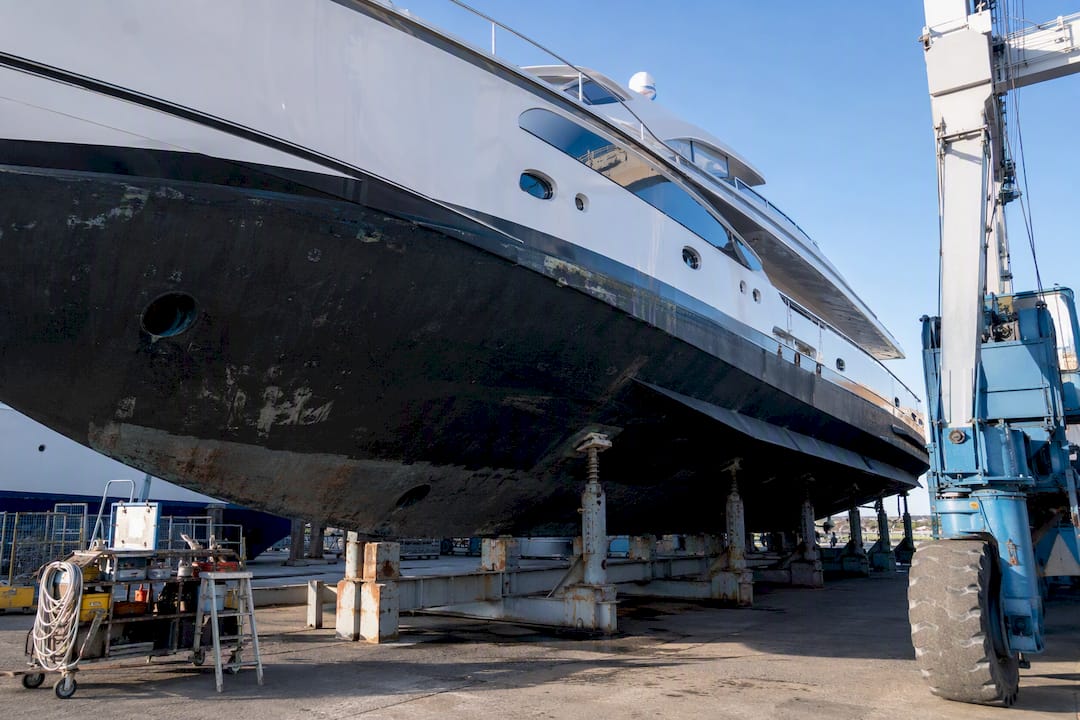
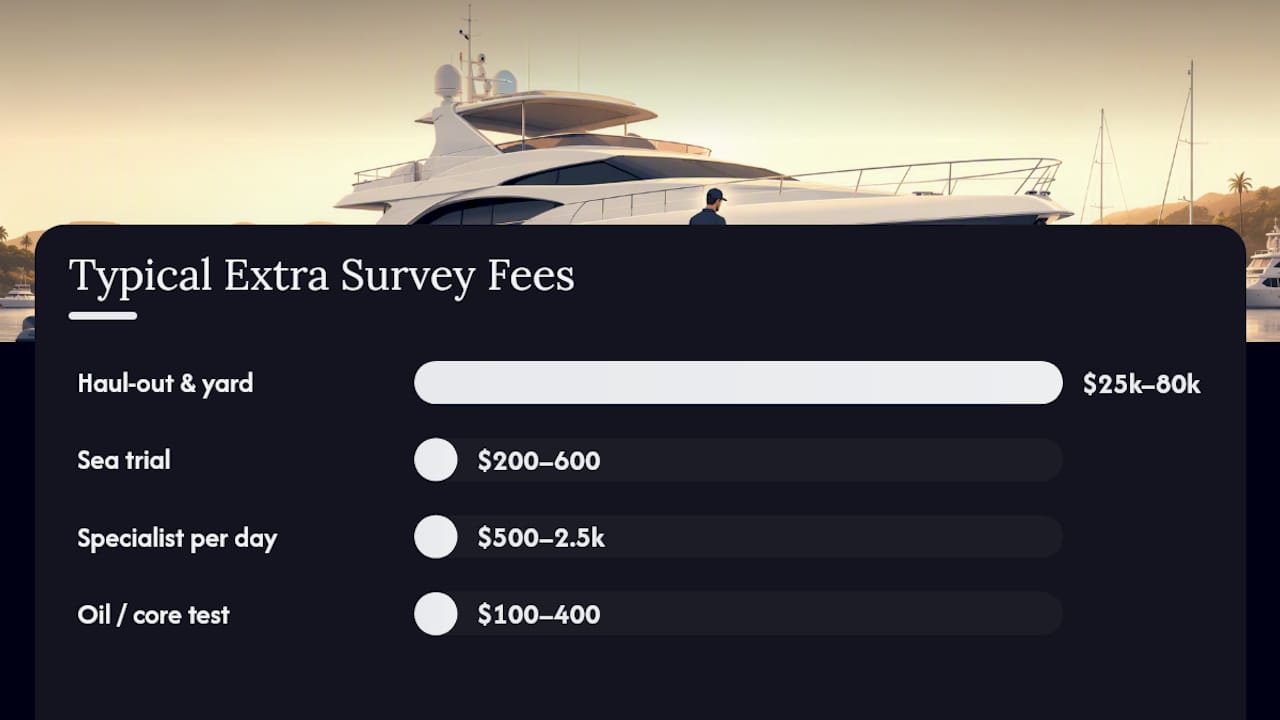
| Haul-out and yard fees | $25,000 to $80,000 for large yachts (region dependent) | Vessel size, yard location, and travel lift availability |
| Sea trial | Often bundled, sometimes $200 to $600 separately | Fuel, captain time, and duration on the water |
| Specialist consultants (machinery, electro-technical, HVAC) | $500 to $2,500 per specialist per day | Vessel complexity and number of systems needing separate expertise |
| Oil analysis and core sampling | $100 to $400 per test | Number of samples and lab turnaround |
| Surveyor travel and attendance | Varies widely | Distance to vessel location and number of days on-site |
Smaller boats rarely need more than the base fee and a modest haul-out charge. Superyachts almost always need the full lineup, and treating each specialist day rate as its own line item rather than folding everything into one number will keep your budget realistic.
How Do You Pick the Right Surveyor and Scope of Work?
Choosing well up front saves money and headaches later. Run through this before you sign anything:
- Confirm credentials with a recognized body and ask for two references from recent clients with similar vessels
- Request a sample report so you know what the deliverable actually looks like
- Ask directly: what specialists will you bring in, will you attend the haul-out and sea trial, and what is the turnaround time for the written report?
- Get an itemized quote, not a lump sum, so you know exactly what haul-out, specialists, and travel will add
Red flags include a surveyor who cannot produce a sample report, a quote with no breakdown, or a surveyor recommended exclusively by the seller’s side who seems reluctant to discuss independence.
Pro Tip: Ask every candidate surveyor one direct question: “What did your last three reports on similar boats find?” A surveyor with real experience answers specifically. One who gives vague reassurance is telling you something too.
How Should You Use the Survey Report to Negotiate?
The report is a negotiating document, not just a file for your records. Buyers who attend the survey and gather local repair quotes quickly tend to convert findings into realistic asks faster than those who wait.
- Turn each significant finding into a repair estimate from a local yard or technician, then present it as a credit request or a price reduction
- Insurers and lenders want the same report; a clean, itemized document with clear categorization speeds up underwriting on both sides
- Typical outcomes fall into a few buckets: seller completes repairs before closing, funds go into escrow, the price gets adjusted, or, if findings are severe enough, the buyer walks away entirely
The complete guide to yacht surveys covers how to read a report line by line before you sit down at the negotiating table.
How Should Sellers Prepare Before the Surveyor Arrives?
A little prep work on the seller’s side shortens the survey and avoids ugly surprises for everyone.
- Gather maintenance records, engine logs, and prior survey reports for easy access
- Handle small, obvious fixes (corroded terminals, minor leaks) before the surveyor steps aboard
- Grant full access to engine rooms, bilges, and lazarettes without last-minute scrambling
Transparency here speeds up closing and heads off disputes before they start.
Where Can You Reasonably Trim Survey Costs?
You can control cost without cutting corners on the checks that actually protect you.
- Do a basic pre-inspection yourself (check the bilge, run the engine, look for obvious neglect) before hiring a surveyor, since a boat with visible problems may not be worth surveying at all
- Prioritize structural and propulsion checks over cosmetic items if budget forces a tradeoff, since those systems carry the highest repair costs
- Negotiate the haul-out fee directly with the yard, or ask whether specialist fees can be split with the seller in a soft market
- Never skip the sea trial or a structural moisture check to save a few hundred dollars. Those are exactly the areas where problems hide.
What Happens in the Days After the Survey?
Most surveyors deliver a written report within three to seven days. Once it lands, move quickly:
- Read the report in full and separate safety-critical items from cosmetic notes
- Request quotes from local yards for any significant repair items before you go back to the seller
- Share the report with your lender or insurer promptly, since delays here can hold up closing
- Decide among your four real options: repair before close, escrow funds, negotiate a credit, or walk away
The yacht closing checklist walks through what needs to happen between the report landing and the papers getting signed.
When Is a Specialist Survey Team Worth the Extra Cost?
On a 25-foot center console, one generalist surveyor covers everything that matters. On a 100-foot motor yacht with stabilizers, twin generators, and a hydraulic swim platform, that same generalist is out of their depth on at least half the vessel.
A specialist team costs more up front, but on a complex yacht it is the only way to actually understand what you are buying. A naval architect’s read on hull stress is not something a generalist surveyor can substitute, and a broker who has coordinated dozens of these inspections knows which specialist to call before a problem becomes a closing delay.
Coordinating that team, and translating dense technical findings into a negotiating position, is where an experienced broker earns their role in the transaction.
Is the Extra Cost of a Thorough Survey Worth It?
Buyers consistently underestimate how much a survey report is worth as leverage, not just as protection. The real value shows up at the negotiating table, not in the inspection itself.
The instinct to save $500 by hiring the cheapest available surveyor is understandable and usually wrong. A generalist surveyor working a boat that needed a specialist can miss the one finding that would have justified a $15,000 price reduction. Spend proportionally: modest boats warrant a modest survey, but any yacht over roughly 50 feet or with meaningful mechanical complexity deserves the specialist attention, even at a premium. The leverage a detailed report gives you at the table almost always outweighs the extra few hundred or few thousand dollars it cost to get it.
How Yachts-bysteve Helps You Manage Survey Costs and Results
Coordinating a survey on a complex yacht means juggling a generalist surveyor, two or three specialists, a yard for haul-out, and a timeline that has to satisfy a lender, all while you are still working your day job. Yachts-bysteve handles that coordination directly, sourcing the right specialists for your specific vessel type, sitting in on the sea trial, and translating a dense technical report into a clear negotiating position instead of a stack of jargon. That is the practical difference between managing five vendors yourself and having one broker who already knows which surveyor to call for a 65-foot flybridge with twin diesels. If you are still shopping for representation, the guide on how to choose a yacht broker walks through exactly what to ask before you sign with anyone.
Frequently Asked Questions
How much does a yacht survey cost on average?
Most pre-purchase surveys run $18 to $35 per foot depending on location and vessel complexity, with larger or mechanically dense yachts requiring specialist add-ons that push the total well beyond the base fee.
Who pays for a yacht survey, the buyer or the seller?
The buyer typically hires and pays the surveyor directly, which keeps the surveyor’s report objective and loyal to the buyer’s interests rather than the seller’s.
Does a yacht survey cost more for insurance than for a purchase?
No, generally the reverse. Insurance surveys are narrower in scope and usually cost less than a full pre-purchase condition and value survey.
What is included in a typical pre-purchase survey?
Hull and structural checks, propulsion and mechanical systems, electrical wiring, plumbing and fuel systems, rigging (for sailboats), electronics, and a sea trial, all documented with photos and a written report.
Can you negotiate the price after a yacht survey finds problems?
Yes. Buyers commonly use survey findings, paired with local repair quotes, to request a price credit, ask for repairs before closing, or in serious cases, walk away from the deal entirely.
Sources
- Yacht Survey: What a $40K Pre-Purchase Inspection Actually
- NAMS Global
- The Ultimate Guide to Marine Surveys and Surveyors
Recommended
Featured Listings

2028 Columbus Yachts
$22,900,008
137
Ancona

2012 Benetti PATIENCE
$10,975,000
132
Fort Lauderdale Florida

2028 Kingship Kingship
$20,350,000
125

2024 Silver Yachts
$25,400,000
117

2009 Hargrave BRANDI WINE
$2,500,000
114
Fort Lauderdale Florida

2028 Extra Yachts
$20,350,000
100
Ancona

2028 Alpha
$12,100,000
100
Ft Lauderdale Florida

2028 Extra Yachts Extra 96
$9,495,000
96
Ancona

2021 Sanlorenzo GATSBY
$6,795,000
96
Fort Lauderdale Florida

2028 Kingship
$11,990,000
90

2028 Alpha
$9,894,500
90
Fano

2023 Azimut COMPASS
$7,950,000
88
Miami Beach Florida

1999 Northern Marine OFF LINE
$2,495,000
84
Ft Lauderdale Florida

2013 Pershing DOROTHY ANN
$1,375,000
82
Fort Lauderdale Florida

1997 Ferretti Yachts
$825,000
80
La Paz

2008 Princess Yachts OCARALIA
$1,095,000
75
Charleston South Carolina

2014 Sunseeker
$1,400,000
68
New York New York

2024 Fairline
$2,750,000
68
Ft. Lauderdale Florida

2019 Vanquish Yachts IMPULSIVE
$1,799,000
58
Miami Beach Florida

2021 Ferretti Yachts HAVEN
$1,595,000
57
Fort Lauderdale Florida

2025 Formula BREAKTHROUGH III
$1,895,000
53
Miami Beach Florida

2023 Fairline
$900,000
45
Fort Lauderdale Florida

2012 Zeelander Mississippi Queen
$575,000
44
West Palm Beach Florida
2028 Columbus Yachts 137'
$22,900,008
2012 Benetti 132'
$10,975,000
2028 Kingship 125'
$20,350,000
2024 Silver Yachts 117'
$25,400,000
2009 Hargrave 114'
$2,500,000
2028 Extra Yachts 100'
$20,350,000
2028 Alpha 100'
$12,100,000
2028 Extra Yachts 96'
$9,495,000
2021 Sanlorenzo 96'
$6,795,000
2028 Kingship 90'
$11,990,000
2028 Alpha 90'
$9,894,500
2023 Azimut 88'
$7,950,000
1999 Northern Marine 84'
$2,495,000
2013 Pershing 82'
$1,375,000
1997 Ferretti Yachts 80'
$825,000
2008 Princess Yachts 75'
$1,095,000
2014 Sunseeker 68'
$1,400,000
2024 Fairline 68'
$2,750,000
2019 Vanquish Yachts 58'
$1,799,000
2021 Ferretti Yachts 57'
$1,595,000
2025 Formula 53'
$1,895,000
2023 Fairline 45'
$900,000
2012 Zeelander 44'
$575,000