

Yacht warranty transfer is possible on most new and near-new boats, but only for the unused portion of the original term, and only if the paperwork lands with the manufacturer inside a tight window. Skip the deadline, and the coverage that made your used yacht attractive simply evaporates. The process itself is straightforward: a transfer form, a notarized bill of sale, a fee, and a fast follow-up call to make sure it actually went through.
TL;DR:
- Transfer deadlines typically range from 14 to 60 days, and missing them usually results in losing warranty transfer rights entirely.
- Structural hull warranties are the most transferable, with Monterey offering five years and Scout providing ten years, while component and gelcoat warranties are shorter or often nontransferable.
- Engine warranties from manufacturers like Mercury or Volvo run separately and require additional registration and maintenance proof to transfer properly.
- The transfer process demands notarized bills of sale, completed forms, and timely submission of comprehensive documentation, often with fees up to several hundred dollars.
- Having all paperwork prepared before closing and verifying current manufacturer policies prevents transfer denials and preserves warranty coverage.
Table of Contents
- Understanding Yacht Warranty Transfer and What Coverage Survives a Sale
- How to Transfer Your Yacht Warranty Step by Step
- Warranty Transfer Deadlines and What They Cost
- Engine Warranties Rarely Move With the Boat Automatically
- Documents to Collect Before You Submit a Transfer
- What a Broker Actually Does at the Closing Table
- Legal Considerations and Consumer Protections in Warranty Transfers
- An Editorial Take on Getting This Right the First Time
- Let Yachts by Steve Handle the Paperwork While You Handle the Closing
- Where to Verify the Details Yourself
- Sources
- FAQ
Understanding Yacht Warranty Transfer and What Coverage Survives a Sale
A hull warranty rarely means the whole boat is protected. Builders separate coverage into categories, and each one has its own rules about what happens when the title changes hands.
Structural or hull warranties tend to be the most transferable piece of the package. Monterey Boats backs its structural coverage with a five-year transferable limited warranty, while Scout Boats offers a ten-year structural warranty that follows the same transfer logic. Component warranties, covering electronics, upholstery, and hardware, often carry shorter terms and stricter documentation requirements. Gelcoat and finish warranties are usually the thinnest of the three, frequently excluded from transfer altogether or capped at a fraction of the original term.
Watch for language that says a warranty is transferable only once. According to YachtBuyer’s warranty guide, some manufacturers cap transfers at a single resale, which matters enormously if you’re buying a boat that already changed hands once under warranty. Common exclusions apply across nearly every brand:
- Damage from abuse, grounding, or collision
- Aftermarket modifications that alter the hull or rigging
- Maintenance performed by unauthorized technicians
- Cosmetic issues like gelcoat fading beyond the stated cosmetic term
If the boat you’re eyeing has a gelcoat finish that’s already showing wear, a protective product like Diamond Brite’s gelcoat protection can extend the look of the surface, though it won’t reinstate coverage a warranty has already excluded.
How to Transfer Your Yacht Warranty Step by Step
Here’s the sequence that keeps a transfer from falling apart, in the order you should actually do it.
- Confirm eligibility first. Pull the original warranty document or call the manufacturer’s warranty department to verify how much term is left and whether the coverage has already been transferred once.
- Get the bill of sale notarized. It needs the sale date and the exact Hull Identification Number. A mismatched HIN is one of the most common reasons manufacturers reject a submission, according to Scout’s own warranty documentation.
- Download the manufacturer’s transfer form. Most builders post this directly on their warranty page; dealers can also supply it and often know the current mailing or upload address.
- Submit everything inside the window. Attach the notarized bill of sale, the completed form, and the transfer fee, then send it by whatever method the manufacturer specifies.
- Get written confirmation. Don’t assume silence means approval. Call or email until you have a transfer certificate or a dated confirmation in hand.
Pro Tip: Have the notarized bill of sale and transfer form ready before you sit down at closing, not after. Manufacturers frequently deny late submissions outright, and a broker handling the sale can often file the paperwork the same day, according to guidance in Yachts by Steve’s ownership transfer walkthrough.
Warranty Transfer Deadlines and What They Cost
Most builders give you 14 to 30 days from the sale date to file, though a few stretch that to 60. Missing it doesn’t just delay the paperwork; it typically kills your transfer rights outright, since Regal’s dealer support documentation confirms manufacturers frequently deny transfers submitted after the deadline.
Transfer windows across the industry commonly run a short window, sometimes up to two months according to documented policy, per Supra Boats’ warranty transfer guide.
Fees vary by brand and, in some cases, by hull length:
- Monterey Boats: $300 under 27 feet, $500 for 27 to 33 feet, $700 for boats over 33 feet, filed within 30 days
- Scout Boats: flat $100 fee, notarized bill of sale required, 30-day window
- Regal Boats: $250 processing fee through a dealer-assisted process, with up to 60 days to submit
Processing typically takes a few weeks once the manufacturer has a complete file. If confirmation stalls past that, call the warranty department directly rather than waiting on an email reply that may never come.
Engine Warranties Rarely Move With the Boat Automatically
This is where most private sales go wrong. Transferring the builder’s structural warranty does nothing for the engine. Engine makers like Mercury Marine, Volvo Penta, and Indmar run their own warranty programs entirely separate from the hull builder, and Mercury’s own warranty terms state the coverage transfers only for whatever portion of the term remains unused, on Mercury’s terms, not the boat builder’s.
Before closing, buyers should get:
- The engine’s current warranty registration status directly from the manufacturer
- Complete service records proving maintenance was done on schedule
- Contact information for the dealer who performed prior service work
Skip this step and you may discover, six months into ownership, that the “warranty” you thought you inherited never covered the powerplant at all.
Documents to Collect Before You Submit a Transfer
Print this out and check items off as you gather them, because a missing signature is the single most common reason a filing gets bounced back.
Required for nearly every manufacturer:
- Notarized bill of sale with the sale date and correct HIN
- Completed manufacturer transfer form
- Names, mailing addresses, and emails for both buyer and seller
- Payment for the transfer fee
Worth having on hand even when not strictly required:
- Maintenance and service records
- Dealer invoice copies from prior work
- Proof of the original warranty registration
Pro Tip: Scan and keep digital copies of everything before you mail or upload the original documents. If a manufacturer claims they never received a filing, a dated confirmation email or certified mail receipt is your only leverage. For a deeper walkthrough of what belongs in the file, Yachts by Steve’s bill of sale guide covers the notarization piece in more depth.
What a Broker Actually Does at the Closing Table
A broker isn’t a substitute for the manufacturer’s process, but a good one catches the mistakes that sink transfers: the notarization that got skipped, the HIN that was typed wrong on the bill of sale, the filing that sat in a drawer past day 29. Some brokers walk clients through the paperwork before it becomes a problem, not after.

If you’re comfortable tracking deadlines and calling warranty departments yourself, DIY works fine. If you’d rather someone else chase the confirmation, resources like the ownership transfer guide and yacht deed explainer outline exactly what a broker or a diligent buyer needs in hand.
Legal Considerations and Consumer Protections in Warranty Transfers
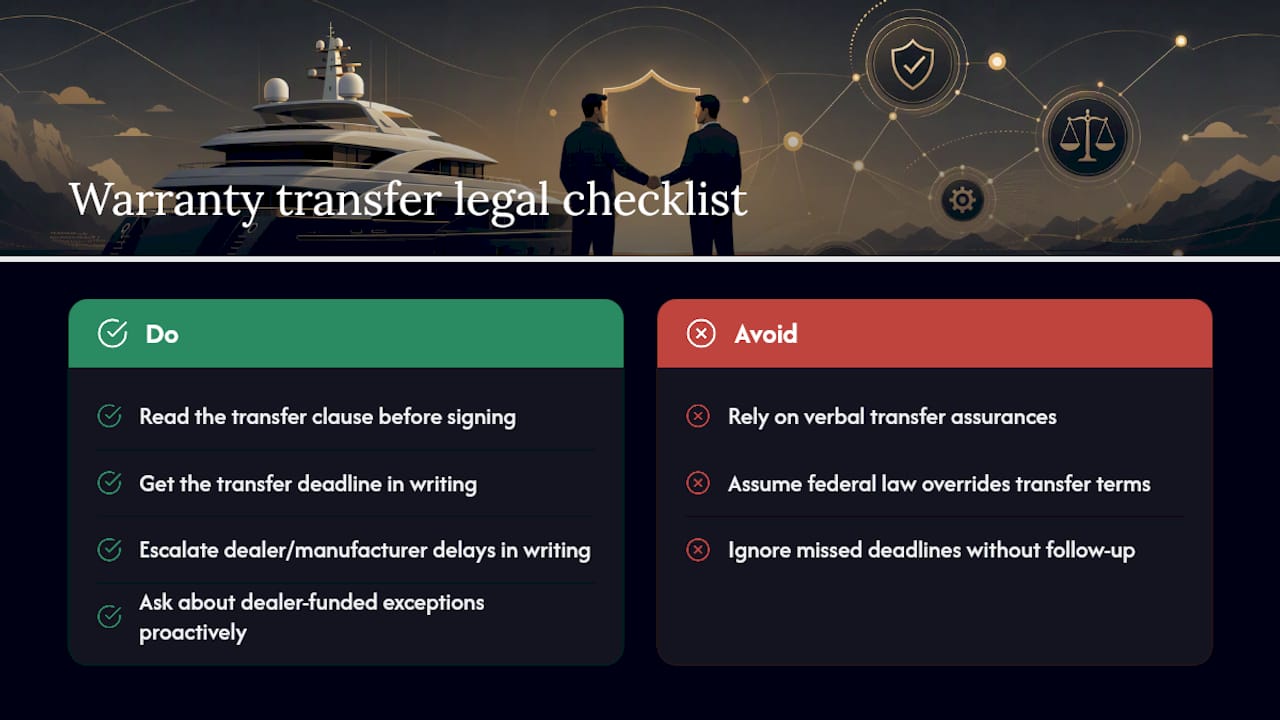
Manufacturer warranties are contracts, and the transfer clause inside them is enforceable exactly as written, not as a buyer might wish it read. If a warranty document says transfer requires notice within 30 days, a verbal agreement between buyer and seller at closing carries no legal weight against that clause. The manufacturer’s written policy controls the outcome.
This creates real exposure for buyers who rely on a seller’s assurance that “the warranty transfers automatically.” It usually doesn’t. Federal consumer protection law, including the Magnuson Moss Warranty Act, governs how written warranties must be disclosed and honored, but it doesn’t override a manufacturer’s own transferability terms. If the warranty document states the coverage is nontransferable or caps transfers at one resale, that term generally stands.
Buyers do have leverage in a few situations. If a transfer window passes because a dealer or manufacturer delayed processing on their end, that’s a different problem than a buyer simply missing a deadline, and it’s worth escalating in writing. Some manufacturers, as Regal’s dealer support page notes, will consider dealer-funded exceptions when a window is missed, though these are handled case by case rather than guaranteed.
The practical takeaway: read the actual transfer clause before you sign a purchase agreement, not after. A warranty that sounds valuable during a sales pitch is only worth what its transfer terms allow.
An Editorial Take on Getting This Right the First Time
Most advice on this topic treats warranty transfer as an afterthought, something to handle “sometime after closing.” That’s backwards, and it’s the single biggest reason transfers fail. The paperwork needs to exist before the ink dries on the sale, not after the new owner has already taken the boat out twice.
The conventional wisdom also oversells how uniform this process is. Scout’s $100 fee and Monterey’s tiered $300 to $700 structure aren’t interchangeable, and neither is a 30-day window versus Regal’s 60. Treating every warranty transfer like a form letter you fill out later is how sellers lose leverage and buyers lose coverage they thought they were getting.
What actually matters: know the deadline before you list the boat or sign an offer, have the notarized bill of sale ready at the table, and never assume engine coverage rides along with the hull warranty automatically. Everything else, the fee tiers, the confirmation emails, the follow-up calls, is administrative detail that a diligent buyer or a broker who’s done this before can handle without drama.
— Jason
Let Yachts by Steve Handle the Paperwork While You Handle the Closing
Chasing down a notarized bill of sale, a manufacturer’s transfer form, and a confirmation email while also negotiating a sale price is exactly the kind of overlap that causes missed deadlines. Some brokers coordinate paperwork directly with the selling dealer or manufacturer’s warranty department, so the filing goes out inside the window instead of sitting in someone’s inbox. That coordination doesn’t change a manufacturer’s policy or fee schedule; it just makes sure the right documents reach the right desk on time, with confirmation tracked instead of assumed.
If you’re weighing whether to handle a warranty transfer yourself or hand it to someone who does this at every closing, start with how to choose a yacht broker to see what a brokerage relationship actually covers, then reach out about your specific sale.
Where to Verify the Details Yourself
Manufacturer warranty pages change, so confirm current fees and windows directly before you file. Monterey Boats publishes its structural warranty terms and tiered transfer fees. Scout Boats lists its transfer form requirements and $100 fee. Regal’s dealer support page outlines its 60 day, dealer-assisted process. Mercury Marine covers engine-specific transfer rules on its warranty and product protection page. Cobalt Boats warranty details are best confirmed directly through an authorized Cobalt dealer.
Sources
- Warranty Info | Monterey Boats
- Warranty – Scout Boats
- Hull & Deck Structural Warranty Transfer Process – Regal Dealer Support
- Mercury Limited Warranty and Product Protection Transfer
FAQ
Do boat warranties transfer to new owners?
Yes, most manufacturer structural and component warranties transfer to a second owner for the unused portion of the term, but only after the required form and fee are submitted inside the deadline.
Can I transfer my warranty to another person?
Generally yes, as long as you file within the manufacturer’s transfer window, typically 14 to 30 days and up to 60 days with some brands, with a notarized bill of sale and the transfer fee.
How do I transfer a warranty to a new owner?
Confirm remaining coverage with the manufacturer, complete the official transfer form, attach a notarized bill of sale showing the HIN and sale date, and submit everything with payment before the deadline closes.
How do I transfer my Mercury Marine warranty to a new owner?
Mercury transfers its limited warranty for the remaining unused term only, and the new owner must complete Mercury’s own registration and transfer process listed on its warranty transfer page, separate from any hull builder transfer.
Recommended
Featured Listings

2028 Columbus Yachts
$22,900,008
137
Ancona

2012 Benetti PATIENCE
$10,975,000
132
Fort Lauderdale Florida

2028 Kingship Kingship
$20,350,000
125

2024 Silver Yachts
$25,400,000
117

2009 Hargrave BRANDI WINE
$2,500,000
114
Fort Lauderdale Florida

2028 Extra Yachts
$20,350,000
100
Ancona

2028 Alpha
$12,100,000
100
Ft Lauderdale Florida

2028 Extra Yachts Extra 96
$9,495,000
96
Ancona

2021 Sanlorenzo GATSBY
$6,795,000
96
Fort Lauderdale Florida

2028 Kingship
$11,990,000
90

2028 Alpha
$9,894,500
90
Fano

2023 Azimut COMPASS
$7,950,000
88
Miami Beach Florida

1999 Northern Marine OFF LINE
$2,495,000
84
Ft Lauderdale Florida

2013 Pershing DOROTHY ANN
$1,375,000
82
Fort Lauderdale Florida

1997 Ferretti Yachts
$825,000
80
La Paz

2008 Princess Yachts OCARALIA
$1,095,000
75
Charleston South Carolina

2014 Sunseeker
$1,400,000
68
New York New York

2024 Fairline
$2,750,000
68
Ft. Lauderdale Florida

2019 Vanquish Yachts IMPULSIVE
$1,799,000
58
Miami Beach Florida

2021 Ferretti Yachts HAVEN
$1,595,000
57
Fort Lauderdale Florida

2025 Formula BREAKTHROUGH III
$1,895,000
53
Miami Beach Florida

2023 Fairline
$900,000
45
Fort Lauderdale Florida

2012 Zeelander Mississippi Queen
$575,000
44
West Palm Beach Florida
2028 Columbus Yachts 137'
$22,900,008
2012 Benetti 132'
$10,975,000
2028 Kingship 125'
$20,350,000
2024 Silver Yachts 117'
$25,400,000
2009 Hargrave 114'
$2,500,000
2028 Extra Yachts 100'
$20,350,000
2028 Alpha 100'
$12,100,000
2028 Extra Yachts 96'
$9,495,000
2021 Sanlorenzo 96'
$6,795,000
2028 Kingship 90'
$11,990,000
2028 Alpha 90'
$9,894,500
2023 Azimut 88'
$7,950,000
1999 Northern Marine 84'
$2,495,000
2013 Pershing 82'
$1,375,000
1997 Ferretti Yachts 80'
$825,000
2008 Princess Yachts 75'
$1,095,000
2014 Sunseeker 68'
$1,400,000
2024 Fairline 68'
$2,750,000
2019 Vanquish Yachts 58'
$1,799,000
2021 Ferretti Yachts 57'
$1,595,000
2025 Formula 53'
$1,895,000
2023 Fairline 45'
$900,000
2012 Zeelander 44'
$575,000