

Zero speed stabilizers are onboard systems, active fins, gyros, or rotors, that cancel out roll while a yacht sits still at anchor, not just underway. They matter because that’s precisely when older stabilizer technology went quiet and let the boat rock. If you entertain, sleep, or work aboard while anchored, this single feature can decide whether your yacht feels like a sanctuary or a cradle rocking in the wrong rhythm.
TL;DR:
- Gyroscopic stabilizers offer up to 95% roll reduction at anchor, but real-world results typically average around 64 to 70 percent depending on conditions.
- Fin-based systems generally improve with vessel speed, while gyros provide consistent stabilization regardless of speed, affecting their suitability for different anchor conditions.
- Installation costs include unit price, hull modifications, labor, commissioning, and ongoing electrical power, with gyros consuming significant generator capacity during extended anchoring.
- System performance depends heavily on proper sizing, anchoring environment, electrical capacity, and documented sea trial data, rather than marketing claims alone.
- Maintenance involves regular inspections of bearings, seals, actuators, and energy management practices, with documented service history adding value during resale assessments.
Table of Contents
- What Are Zero Speed Stabilizers and How Do They Work?
- How Much Roll Reduction Can You Actually Expect?
- What Does It Cost to Install a Stabilizer System?
- How to Choose the Right Zero Speed Stabilizer for Your Yacht
- What Maintenance Do Zero Speed Stabilizers Require?
- A Broker’s View on Stability and Buyer Decisions
- Let Yachts-bysteve Help You Evaluate the Right System
- Sources
What Are Zero Speed Stabilizers and How Do They Work?
Traditional fin stabilizers relied on water flowing past the hull to generate lift, the same principle as an airplane wing. Drop the speed to zero and that lift disappears, which is why older systems went dormant the moment the anchor hit the seabed. Zero-speed engineering solved that gap through three distinct mechanical approaches, each with its own physics.
- Active fins in zero-speed mode stop relying on lift and instead flap or oscillate, generating drag-based reaction force. Engineering research on at-anchor systems found that trapezoidal flapping with a small half-cycle ratio produces stronger stabilizing force than simple sinusoidal motion, which is why fin geometry and control software matter as much as fin size.
- Gyroscopic stabilizers spin a flywheel at high RPM inside a sealed enclosure. When the boat rolls, gyroscopic precession converts that motion into a counteracting torque transmitted straight into the hull structure, no appendages, no hull penetrations.
- MAG or Magnus rotors spin a cylinder in moving water, and the pressure differential this creates, the Magnus effect, generates lift even when the vessel itself isn’t moving forward.
Retractable fin designs, often labeled XT or e-FIN in manufacturer literature, fold flush against the hull to eliminate drag underway and clear docking obstructions. Retrofitting any fin or rotor system means cutting into the hull; gyros install internally but demand serious structural mounting to handle the torque loads they generate.
How Much Roll Reduction Can You Actually Expect?
The headline number: Seakeeper’s own literature claims up to a 95% reduction in roll at anchor for appropriately sized gyro models, drift and low speed included. That’s the ceiling manufacturers advertise, and it’s achievable under the right conditions with the right unit size for your displacement.
Independent engineering tests tell a more nuanced story. A peer-reviewed study on at-anchor stabilization for large yachts recorded roughly 70% roll reduction at model scale and about 64% at full scale using optimized zero-speed fin control strategies. Full-scale results almost always trail model tests, and that gap is worth remembering every time a spec sheet quotes a single clean percentage.
A few things shift those numbers in practice:
- Fin-based systems improve as speed increases, since they were originally built around waterflow-generated lift, while gyros deliver consistent torque regardless of vessel speed.
- Wave period and angle relative to the hull change effectiveness more than any single spec on a brochure.
- Gyros correct roll only; fins and rotors can be tuned to influence pitch as well, which matters if your discomfort at anchor comes from bow motion rather than side-to-side roll.
What Does It Cost to Install a Stabilizer System?
Budgeting for a zero-speed system means pricing four separate line items, not one: the unit itself, structural or hull modification, installation labor, and commissioning with sea trials. Skip the sea trial line at your peril, since a system that isn’t tuned to your specific hull form underperforms no matter how good the spec sheet looks.
Power draw is where owners get surprised. Gyros pull a continuous electrical load measured in kilowatts around the clock while spinning, which means serious generator planning for extended anchoring. Active fin systems draw hydraulic or electric power in peaks rather than a steady hum, but sustained use during long anchor stays can still strain house battery banks unless the system includes energy buffering.
- Gyros consume real interior volume, a factor that matters on tighter hull layouts.
- Fin pockets and actuators eat into hull space and require garage clearance for retractable designs.
- Warranty terms, classification society certification, and insurance underwriting requirements should all be confirmed in writing before signing anything.
Pro Tip: Ask your broker or installer for the generator run-hours estimate at anchor with the stabilizer active. That single number tells you more about real-world livability than any percentage on a brochure.
How to Choose the Right Zero Speed Stabilizer for Your Yacht
Matching a system to your yacht starts with math, not marketing. Here’s the sequence worth following before you sign a purchase order:
- Confirm displacement and hull form first. Every manufacturer sizes units around specific weight and hull characteristics, and an undersized gyro or fin set underperforms no matter how good the control software is.
- Map your typical anchoring conditions. A yacht that spends weekends in protected coves has different needs than one that anchors in open roadsteads exposed to swell.
- Audit your electrical capacity. Confirm generator output and battery reserve can support continuous gyro draw or sustained fin operation without compromising other systems.
- Request documented sea trial data, not just brochure percentages. Full-scale test reports, like the kind referenced in peer-reviewed engineering studies, materially reduce guesswork.
- Ask about integration and downtime. Retrofitting into an existing hull is invasive; get a written timeline before committing a haul-out window.
- Watch for vague performance claims with no test data behind them, and treat that as a red flag worth walking away from.
- Consider hybrid or fully-electric options like e-FIN or F45 systems if energy efficiency and reduced generator dependence matter to your cruising pattern.
What Maintenance Do Zero Speed Stabilizers Require?
Gyros and fin systems age differently, and neither is maintenance-free. Gyro units need regular bearing inspections and drive checks since the flywheel spins continuously under load whenever the system is active. Fin and rotor systems need seal inspections, actuator servicing, and hydraulic fluid checks on a schedule, since hull penetrations are only as reliable as the seals protecting them.
- Conservative use during genuinely heavy seas extends component life on every system type.
- Scheduled sea trials, not just haul-out inspections, catch performance drift before it becomes a failure.
- Energy management habits, avoiding deep battery discharge cycles during extended anchoring, protect both the stabilizer and the rest of the electrical system.
Documented service history carries real weight at resale. Buyers and surveyors alike treat verified maintenance records and sea trial reports as a confidence signal, and their absence tends to surface as a survey flag during negotiation. Push your installer for a written service contract with clear response times before you close on any system.
A Broker’s View on Stability and Buyer Decisions
I’ve watched stabilization quietly become one of the first questions serious buyers ask, right after layout and range. It’s rarely about bragging rights. It’s about whether grandkids get seasick at anchor, or whether a work call held from the salon stays professional instead of visibly rocking.
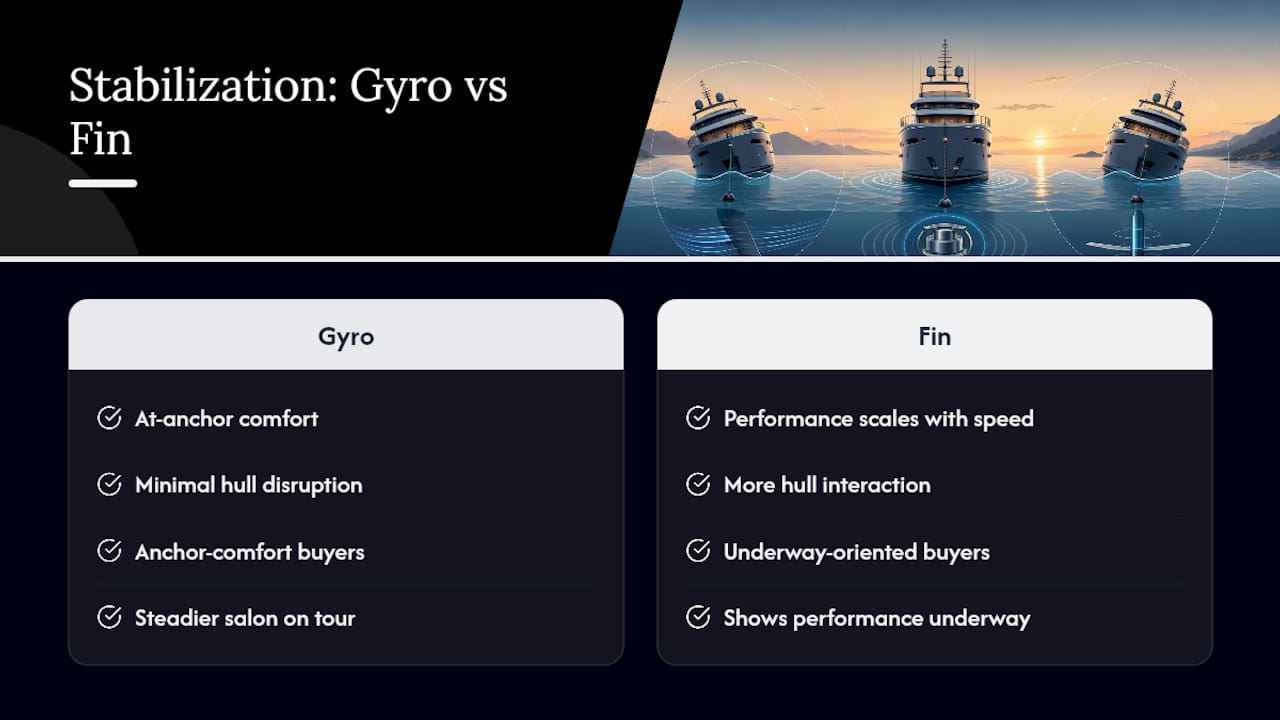
Buyers chasing pure at-anchor comfort with minimal hull disruption tend to gravitate toward gyros. Owners who spend meaningful time underway, and want performance that scales with speed, often prefer fin-based systems. Either choice affects how a yacht shows during a private tour and how confidently it lists. If you’re weighing a purchase around this feature, our guide to yacht specifications and our breakdown of hybrid yacht benefits are worth reading alongside this one.
— Jason
Let Yachts-bysteve Help You Evaluate the Right System
Choosing between a gyro, a fin system, or a Magnus rotor isn’t a decision to make from a spec sheet alone. Yachts-bysteve reviews stabilization specs as part of every serious buyer consultation, comparing manufacturer claims against real installation constraints on the specific hull you’re considering, before you commit to a retrofit or a new build. We also vet installers and request sea trial documentation on your behalf, so you’re negotiating from data instead of a brochure. Before your next hull walkthrough, request a stability-focused specification review through our guide on how to choose a yacht broker and let us handle the technical vetting while you focus on the yacht itself.
Sources
- Best-in-Class Boat Gyro Stabilizer | Seakeeper
- PLOS ONE: The Design of at-Anchor Stabilization Systems for Mega Yachts Based on Calculations and Model Tests
Recommended
Featured Listings

2028 Columbus Yachts
$22,900,008
137
Ancona

2012 Benetti PATIENCE
$10,975,000
132
Fort Lauderdale Florida

2028 Kingship Kingship
$20,350,000
125

2024 Silver Yachts
$25,400,000
117

2009 Hargrave BRANDI WINE
$2,500,000
114
Fort Lauderdale Florida

2028 Extra Yachts
$20,350,000
100
Ancona

2028 Alpha
$12,100,000
100
Ft Lauderdale Florida

2028 Extra Yachts Extra 96
$9,495,000
96
Ancona

2021 Sanlorenzo GATSBY
$6,795,000
96
Fort Lauderdale Florida

2028 Kingship
$11,990,000
90

2028 Alpha
$9,894,500
90
Fano

2023 Azimut COMPASS
$7,950,000
88
Miami Beach Florida

1999 Northern Marine OFF LINE
$2,495,000
84
Ft Lauderdale Florida

2013 Pershing DOROTHY ANN
$1,375,000
82
Fort Lauderdale Florida

1997 Ferretti Yachts
$825,000
80
La Paz

2008 Princess Yachts OCARALIA
$1,095,000
75
Charleston South Carolina

2014 Sunseeker
$1,400,000
68
New York New York

2024 Fairline
$2,750,000
68
Ft. Lauderdale Florida

2019 Vanquish Yachts IMPULSIVE
$1,799,000
58
Miami Beach Florida

2021 Ferretti Yachts HAVEN
$1,595,000
57
Fort Lauderdale Florida

2025 Formula BREAKTHROUGH III
$1,895,000
53
Miami Beach Florida

2023 Fairline
$900,000
45
Fort Lauderdale Florida

2012 Zeelander Mississippi Queen
$575,000
44
West Palm Beach Florida
2028 Columbus Yachts 137'
$22,900,008
2012 Benetti 132'
$10,975,000
2028 Kingship 125'
$20,350,000
2024 Silver Yachts 117'
$25,400,000
2009 Hargrave 114'
$2,500,000
2028 Extra Yachts 100'
$20,350,000
2028 Alpha 100'
$12,100,000
2028 Extra Yachts 96'
$9,495,000
2021 Sanlorenzo 96'
$6,795,000
2028 Kingship 90'
$11,990,000
2028 Alpha 90'
$9,894,500
2023 Azimut 88'
$7,950,000
1999 Northern Marine 84'
$2,495,000
2013 Pershing 82'
$1,375,000
1997 Ferretti Yachts 80'
$825,000
2008 Princess Yachts 75'
$1,095,000
2014 Sunseeker 68'
$1,400,000
2024 Fairline 68'
$2,750,000
2019 Vanquish Yachts 58'
$1,799,000
2021 Ferretti Yachts 57'
$1,595,000
2025 Formula 53'
$1,895,000
2023 Fairline 45'
$900,000
2012 Zeelander 44'
$575,000